When Trying Isn’t Enough

You may not control all the events that happen to you, but you can decide not to be reduced by them.” – Maya Angelou

There was a moment when I knew my marriage was over. It was about ten months after my business partner told me about my husband’s infidelities. We had been trying to put our marriage back together. And then one day I walked into the kitchen. My ex had cooked an egg, broken the yolk, dribbled it all across the stove and counter on the way to the plate (I assume), eaten breakfast (again, I assume – didn’t see that part), and then left the house without cleaning it up.

I took a picture of it with the remark, “Really?” and texted it to him while he was golfing. [Granted that might not have been the best way to deal with it on my part.]

He texted back a rant which I can’t remember verbatim. But it ended, “because I’m married to a bitch who can’t communicate.

I sat on the living room couch with my elbows leaning on my knees and looked at that message for a long time. I felt so tired. I knew I was done trying.

I’m a little slow to realize when it’s time to stop trying. But every time I accept that whatever I’m trying to do is not going to work, I get the same feeling. Maybe you know what I mean – it’s a sensation that lands the moment I know that I’m not going to succeed. It’s a cross between a gut punch and a groan.

And I have a visual that usually comes to mind at the same time. It’s from a climb I did on Mt. Whitney in 2005 – I’m lying on my back in the snow balanced on a giant pack, tired, and hungry, knowing I’m not going to make the summit. The marriage is a very dramatic example, but I flash to that even at smaller moments like when I’ve accepted that I overreached on the menu for a dinner party plan and need to stop.

In this episode of The Life of Try podcast, I tell the story about that winter climb on Whitney and the three things I’ve learned about working through that gut punch.

  • Pause before reacting to disappointment. Urgency is often just fear trying to get us to move before we’re ready.
  • Take the learning and leave the shame.
  • Widen the definition of success. A try can still matter even when the original outcome changes. Courage, honesty, effort, and accepting help all count.

If you are navigating disappointment, burnout, uncertainty, or a dream that feels too heavy to carry, this episode offers encouragement to pause, learn, accept help, and keep becoming the kind of person who tries.

Here are more ways to listen and subscribe:

Links for this episode:

When You Know You Aren’t Going to Make It transcript

📘 Amazon: ⁠Enough: Climbing Toward a True Self on Mount Everest ⁠by Melissa Arnot Reid

📘 Amazon: The Book of Awakening by Mark Nepo

🔗 Connect with Dr. Kristin Neff

Other Episodes You Might Enjoy

➡️ ⁠Letting Go Of Outcomes: The Mindset That Keeps You Moving⁠

➡️ ⁠Why Second Place Isn’t Failure | The Hidden Power of Persistence & Resilience⁠

➡️ ⁠When Your Plans Fall Apart | How to Stay Resilient, Adapt & Keep Moving Forward⁠

Success isn’t always about finishing first. Sometimes the greatest victories belong to those who stay prepared, keep growing, and never stop trying.

How Badly Do You Want It?

A child can teach an adult three things:
To be happy for no reason,
To always be busy with something, and
To know how to demand with all his might that which he desires.” – Paulo Coehlo

I think we are born with a great capacity for persistence. It’s not just the quote that makes me think so.

The other day I was out beach combing with my kids. After we spent about 45 minutes tickling the clams so they’d squirt, picking up the jagged sea glass (that sounds so much better than broken bottles) so it wouldn’t cut any paws, and hunting for moon snail shells, my seven-year-old son, Mr. D discovered a wide tide pool.

There were tiny fish in the pool. He declared he wanted to catch one. I wandered nearby looking at the rocks and shells and watching his efforts out of the corner of my eye. All the while thinking, “He’s never going to catch a fish with his hands.

So I emptied out our little beach bucket that I’d collected the broken glass and shells in and handed it to him.  The sand was too wet to sit so I kept circling as I daydreamed about sitting down with another cup of tea.

Finally, I took off my shoes and socks and waded in to the tide pool with him. It was warm and about the size a swimming pool with plenty of seaweed for the fish to hide under. I thought I could scare the fish towards him and hopefully speed up the process.

We spotted a flat fish that was almost an inch wide and the color of the sand. He was bigger than the other fish Mr. D had been chasing so he named him, “The King.” Every time Mr. D would get close, the fish would embed himself in the sand. The King’s camouflage was so good that he was nearly impossible to spot.

But Mr. D stayed at it and within minutes, we’d spot him again. As much as I wanted Mr. D to have success, I also was tiring of what seemed like a fruitless process. Isn’t this where we give up and call it a lesson in resilience?

I stepped out of the tide pool and started walking towards my shoes. I called over to Mr. D that we were heading back in five minutes. He responded with a verbal groan but kept working at catching The King.

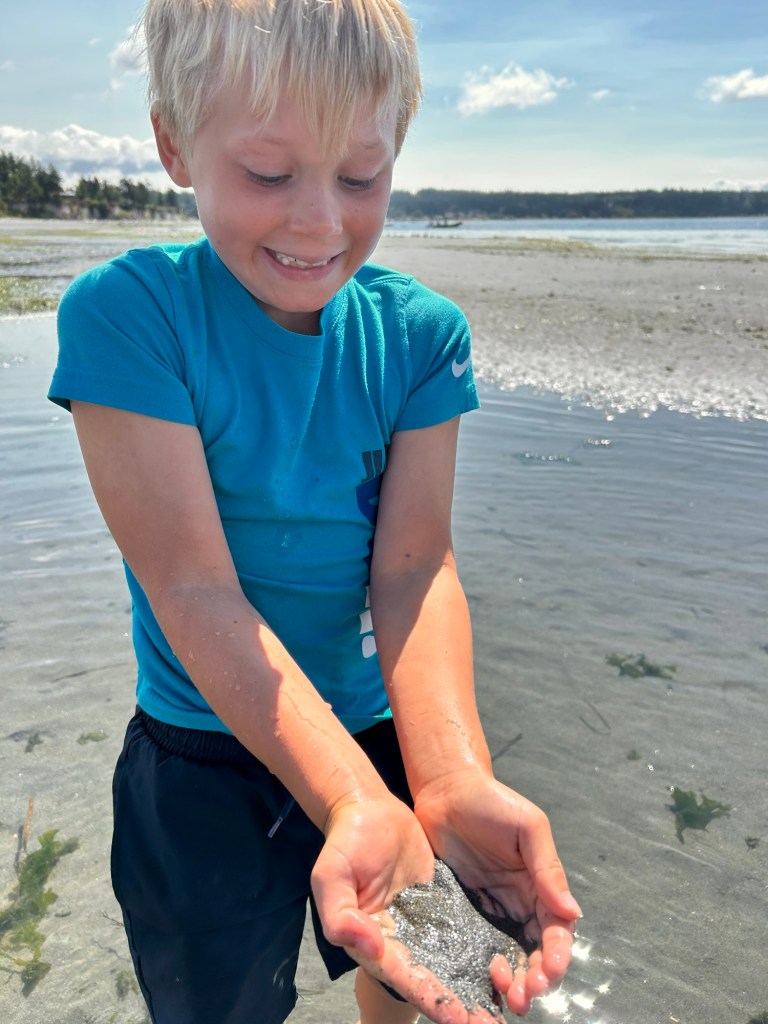
And about five minutes later, he bent down with his hands together and scooped up some sand. He shouted, “I caught The King!!”

Indeed he did – with his bare hands. I took in his glowing grin as I brought him the bucket to put The King in. Then we happily headed back to where we were staying so Mr. D could show his sister the fish.

Then, after taking a couple of photos and telling the story, he walked The King down to the water and returned him to the bay.

That’s when I realized that persistence was something purer than I often see it these days: it’s keeping with our goals, finding the people that will wade in and help, ignoring anyone that tells us we can’t do it. And that staying with it doesn’t have to preclude being kind and accepting – because we can still tell the story and then let the fish swim away.

So… how badly do you want it?

(featured photo is mine of Mr. D returning The King to the water, second picture is of Mr. D with The King)

If my work has encouraged, inspired, or helped you try something new, consider supporting it with a small “cup of coffee” donation. Your support helps me keep creating conversations, stories, and resources that cheer people on as they do brave, meaningful work.

You can find me on LinkedIn: https://www.linkedin.com/in/wynneleon/ and Instagram wynneleon

Please check out the The Life of Try podcast Where trying becomes the spark for personal growth, discovery, and re-invention!

Self-Limiting Beliefs

Man often becomes what he believes himself to be. If I keep on saying to myself that I cannot do a certain thing, it is possible that I may end by really becoming incapable of doing it. On the contrary, if I have the belief that I can do it, I shall surely acquire the capacity to do it even if I may not have it at the beginning.” – Mahatma Gandhi

When I was 22-years-old, a cute boy that I had just started dating invited me on a backpacking trip on the Olympic Peninsula to visit some natural hot springs. The group that was going included another couple that I liked hanging out with because they their conversational patter was a perfect mix of smart, fun, and cool.

I hesitated because I didn’t think I was outdoorsy. Outside of organized groups, I hadn’t really camped or hiked much in my life so far. But the prospect of spending time with my date and other interesting people outweighed my reluctance. And I was rewarded with a great weekend fording streams, soaking in hot springs, and having interesting conversations by the campfire. It was enough to plant a seed that maybe I was outdoorsy. It was an important identity shift that made way for my thought seven years later when I saw Mt. Rainier in the morning sun, “I should climb that.”

And… that opened the door for me to climb not only the Pacific NW volcanoes, but also peaks in Mexico, Russia, Nepal, Italy and Peru. Thank goodness for that cute guy! Even though the relationship wasn’t a significant one in my life, the change in mentality was.

So in this episode of The Life of Try, I talk with Kevin Yoder, creator of Infinite U, about identity-first transformation and why lasting personal growth begins with who we believe we are becoming. What if the reason you feel stuck isn’t a lack of discipline, strategy, or ambition—but an outdated identity you’ve outgrown?

Kevin brings more than two decades of experience in real estate, leadership, coaching, and personal development to a powerful conversation about self-image, paradigms, confidence ceilings, income ceilings, and the invisible patterns that keep capable people from reaching their next level.

Together, Kevin and I explore the question he learned from Bob Proctor—“How are your results?”—and how honest awareness can open the door to meaningful change.

Key Takeaways

  • Lasting change begins with identity: the way we see ourselves often shapes what we believe is possible, more than strategy alone.
  • Invisible ceilings—around confidence, income, consistency, or growth—can point to outdated self-image patterns that are ready to be examined.
  • The question “How are your results?” offers a simple but powerful way to practice honesty, awareness, and intentional transformation.
  • Attitude becomes the bridge between belief and behavior when our thoughts, words, feelings, and actions become more aligned with who we are trying to become.

If you’ve ever started strong and stalled out, felt like you had “weights around your ankles,” or wondered why the next version of your life still feels just out of reach, this episode offers a hopeful, practical look at how to begin again from the inside out. Listen for insights on identity transformation, personal growth, self-concept, mindset, attitude, and building a life that reflects who you are ready to become.

Here are some other ways you can listen and watch this episode:

Links for this episode:

Identity Before Strategy: How To Break Through Invisible Glass Ceilings With Kevin Yoder transcript

Infinite U

Infinite U Self-Assessment: https://infiniteuassessment.com

 Other episodes you might enjoy

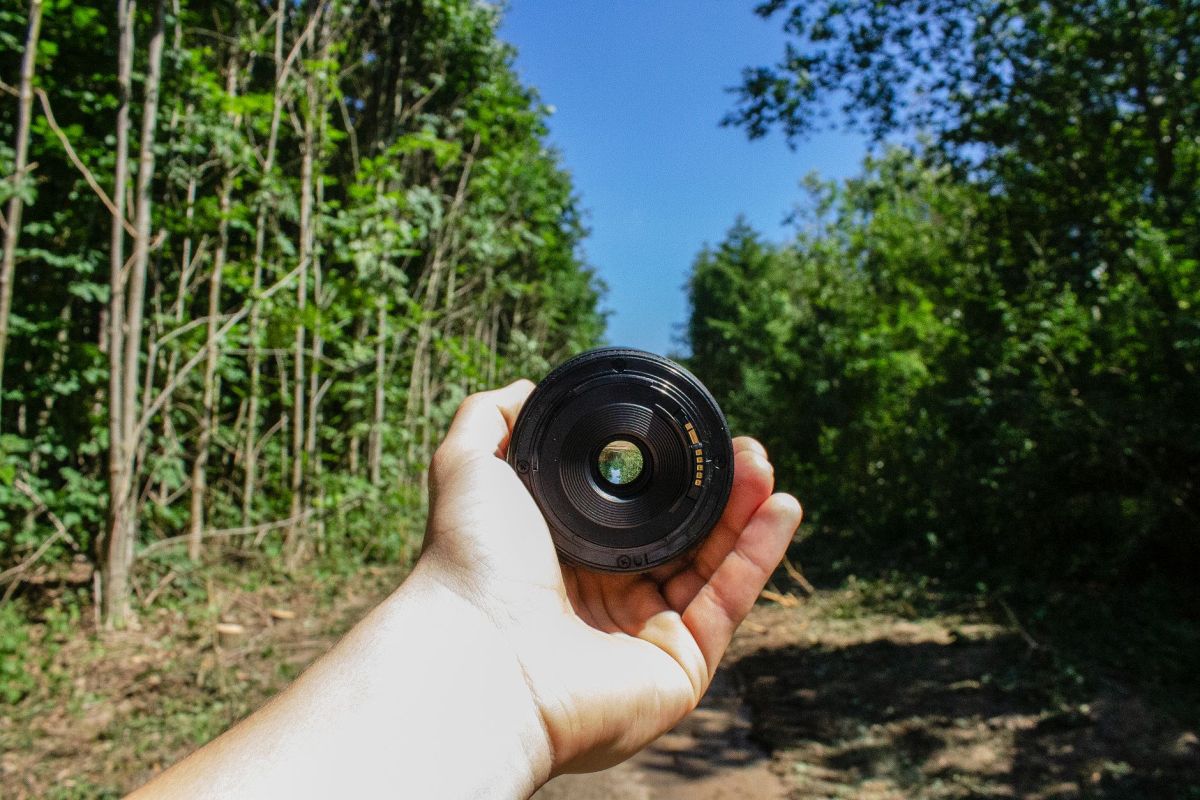
⁠The Power of Looking At Your Life Through a New Lens⁠

⁠How to Create Opportunities In Life | Motive + Means = Success Mindset⁠

⁠How to Tell Relatable Stories⁠

(featured photo from Pexels)

If my work has encouraged, inspired, or helped you try something new, consider supporting it with a small “cup of coffee” donation. Your support helps me keep creating conversations, stories, and resources that cheer people on as they do brave, meaningful work.

You can find me on LinkedIn: https://www.linkedin.com/in/wynneleon/ and Instagram wynneleon
The Tides of Life

The heart of man is very much like the sea, it has its storms, it has its tides and in its depths it has its pearls too.” – Vincent van Gogh

Previously, my favorite metaphor for the ups and downs of life was the carousel. You could see the rhythm, it was predictable, which appeals to my engineering brain, and it went full circle.

But my new favorite is the tide. I think it’s more apt. At the beach where we are staying, right now the tide is extremely low in the morning, followed by a very high tide in the afternoon, a barely noticeable low tide and then another high. Like this:

  • Low tide: -1.54 ft at 8:19am
  • High tide: 9.68 ft at 4:26pm
  • Low tide: 7.58 ft at 8:52 pm
  • High tide: 9.55 ft at 1:23am

And then as it moves through the month, it changes to be not so drastic. The low tide/high tide mark only shifts by about 5-6 feet. Like this:

  • Low tide: 1.48 ft at 3.35am
  • High tide: 7.45 ft at 10:08am
  • Low tide: 4.92 ft at 3.05pm
  • High tide: 9.61 ft at 9:04pm

There are several things that I like about the tide metaphor for life.

When it’s really low, it uncovers a lot of things that you can choose to comb through if you’re willing to get your feet wet.

At the times when the swing is drastic, the highs feel almost overwhelming like they’ll flood you. Also, there’s very little room to walk on the beach.

Life feels calmer when it evens out and the highs and lows aren’t very noticeable. But there isn’t a big impetus to get out onto the beach at any specific moment because they’re roughly the same. If you want to find treasures, it’s going to take a deep dive to get to them.

When the tide is very low, it’s going to be hard to float. You’ll have to work pretty hard to just get out there.

And maybe that’s the point: whenever possible, don’t fight the tides. It will change. Let the water come to you.

(featured photo is mine of the bay at a -1.54ft low tide)

If my work has encouraged, inspired, or helped you try something new, consider supporting it with a small “cup of coffee” donation. Your support helps me keep creating conversations, stories, and resources that cheer people on as they do brave, meaningful work.

You can find me on LinkedIn: https://www.linkedin.com/in/wynneleon/ and Instagram wynneleon
Please check out the The Life of Try podcast Where trying becomes the spark for personal growth, discovery, and re-invention!

The Stories We Inherit

No legacy is as rich as honesty.” – William Shakespeare

My ex-husband used to describe me as independent, especially when we were arguing. But he’d say it in a way that would fill out all four syllables with disdain…in-de-PEN-dent! The first time he said it that way, I was shocked that something I thought was a core value could be interpreted so negatively.

So when my mom came to stay with us for four nights recently, I asked her why being independent was so important to her, especially growing up. She told me that it came from her father. He was the oldest of eight kids. They were farmers in north eastern Washington and had very little money.

By the time my grandfather was seven years old, he was responsible for many things on the farm including spending days and nights in the wild chasing down their high-spirited mare when she’d get loose and run with the wild horses.

As she told the story, I felt like I’d gotten a new piece to the puzzle of what shaped my upbringing and legacy. It was a fascinating conversation to have with my mom on the heels of the podcast I recorded with author, Jennifer Griffith. She inspires the question: How do the stories we inherit from our families shape who we become—and how can we rewrite those stories with more compassion, courage, and purpose?

In this episode of The Life of Try, I talk with Jennifer Griffith, author of Both Sides of Then and host of the podcast About Your Mother, about inherited family stories, hidden shame, resilience, motherhood, memoir writing, and the healing power of bringing secrets into the light.

Jennifer shares how learning her mother’s story changed the way she understood her own identity, why family history can influence the way we parent and see ourselves, and how her LENS framework helps people revisit old narratives, look at them from a new perspective, and use those stories for good.

Here are some key takeaways from our conversation:

  • We all inherit stories—and they shape how we see ourselves.
    Jennifer reminds us that family history, secrets, wounds, and even everyday phrases from our parents can quietly influence our identity, choices, and relationships.
  • Seeing our parents as people can create compassion and clarity.
    When we understand the experiences, pain, and resilience that shaped our parents, we can better understand ourselves—and begin to loosen the grip of old assumptions.
  • Shame loses power when it is brought into the light.
    Family secrets can create distance, but honest storytelling—shared with care and appropriate boundaries—can create healing, connection, and freedom.
  • A new lens can help us rewrite old narratives.
    Jennifer’s LENS framework encourages us to listen to the stories we repeat, engage with them, narrate them from multiple perspectives, and step out of them so we can use them for good.
  • Trying again often means slowing down and letting the work become ready.
    Jennifer’s story about being told “you’re not ready” became a powerful lesson in patience, humility, and the creative courage required to keep going.

This eye-opening conversation explores family secrets, legacy, forgiveness, generational stories, personal growth, writing a memoir, and what it means to keep trying when a story is still unfolding.

Here are some other ways you can listen and watch this episode:

Links for this episode:

The Power of Looking at Your Life Through a New Lens transcript

Both Sides of Then: Finding Love After Abandonment by Jennifer Griffith on Amazon

Jennifer Griffith’s website: Jennifer Griffith – Author of Both Sides of Then – Podcast Host and Author

About Your Mother on Apple podcasts

 Other episodes you might enjoy

How to Tell Relatable Stories

The Quiet Mindset Shifts that Changes Everything | Mindfulness & Personal Growth with Joseph Schmidt

How to Embrace What Makes You Different | Finding Your Purpose with Kym Gordon Moore

(featured photo from Pexels)

If my work has encouraged, inspired, or helped you try something new, consider supporting it with a small “cup of coffee” donation. Your support helps me keep creating conversations, stories, and resources that cheer people on as they do brave, meaningful work.

You can find me on LinkedIn: https://www.linkedin.com/in/wynneleon/ and Instagram wynneleon

Effort Keeps You Eligible for Opportunity

Start where you are. Use what you have. Do what you can.” – Arthur Ashe

Golf is the sport that proves that I love my family. That is to say, it’s not my favorite sport but I’ll play if my people want to. So the other day I was playing with my almost seven-year-old son.

We were at a local city-run pitch and putt course where we can play nine par three holes for $12. I stepped up to the tee on the eighth hole, swung hard, and…completely and embarrassingly missed the ball. After a moment to regain my balance and composure, I swung again. It was my best hit of the round. The ball landed two feet from the hole and I got a birdie.

It made me laugh, and it also brought me back to a question I’ve been sitting with. What if coming in second, or a getting a second chance, is not failure but preparation?

In this episode of The Life of Try, I explore the hidden power of effort, persistence, and staying ready when life does not put you out front.

Through a business lesson about losing a big opportunity, Nathan Martin’s dramatic 2026 LA Marathon finish (thanks to Brian from Writing From the Heart with Brian), and the long-build success story of Dutch Bros Coffee, this episode is a reminder that effort keeps you eligible for the opening when it appears.

Key Takeaways:

  • Second place is not always failure; sometimes it is the place where patience, preparation, and readiness are built.
  • Effort keeps you eligible for opportunity, even when you are not out front or visible to everyone else.
  • Staying in the race matters because the opening often appears after most people have already slowed down or stopped trying.
  • A disappointing loss can still position you for a future win if you keep showing up with humility and persistence.
  • Nathan Martin’s dramatic LA Marathon finish is a reminder that you do not have to be in the picture early to have a meaningful finish.
  • Long-term success, like the Dutch Bros story, is often built through years of unseen work, reinvention, and consistent effort.

If you are learning how to keep going, build resilience, try again after disappointment, or trust the unseen work behind personal growth, this episode will encourage you to stay in position, keep showing up, and keep trying.

Here are some other ways you can listen and watch this episode:

Links for this episode:

Why Second Place Might be Preparation, Not Failure transcript

➡️Brian Hannon’s post ⁠It’s a Sprint to the Finish and the Winner Is… ⁠

🎥  Other episodes you might enjoy

➡️ ⁠Encourage Effort, Not Results | How to Build Resilience and Confidence⁠

➡️ ⁠The Courage to Try Something New with Lindsey Goldstein⁠

➡️ ⁠How to Write the Book You’ve Been Dreaming About with Dr. Vicki Atkinson

(featured photo from Pexels)

Fun Is a Practice, Not a Reward

“If you’re not having fun, you’re not learning. There’s a pleasure in finding things out.” – Richard Feynman

What if fun isn’t a reward for getting everything done—but a skill that helps us live better right now?

Recently as I was driving ten-year-old Miss O to a rehearsal for a musical, she said, “I always have fun at rehearsals.” Six-year-old Mr. D had a similar answer as I was bringing him home from baseball practice the other night. I asked what he liked best – the base running practice, the scrimmage, the throwing contest? His answer was, “I like all of it.

What kids know and grown-ups seem to forget (speaking for myself) is that fun is a day-to-day practice, not a reward only to be savored when we get everything else done. Fortunately, my guest for The Life of Try podcast this week, Mike Rucker, PhD, reminded me that parents have some agency in this too. We aren’t just Uber drivers getting our kids to the places they need to go. And that prompted me to put on my mitt and take part of the scrimmage at Mr. D’s baseball practice. The ball didn’t come to me but I enjoyed standing in the field and being part of the fun immensely for a couple of innings.

In this episode of Life of Try, I talk with Mike Rucker, PhD author of The Fun Habit, about the science-backed value of fun and why it matters for stress relief, resilience, creativity, relationships, and well-being. We discuss positive psychology, the “sandwich generation,” burnout, parenting, savoring joyful moments, and how to create simple systems that bring more play, rest, and connection into daily life.

Here are some of my favorite takeaways from this great book and fantastic, science-backed conversation about fun:

  • Fun is not frivolous — it’s restorative.
    Being intentional about fun can help reduce burnout, restore energy, and bring more meaning into everyday life.
  • Happiness and fun are not the same thing.
    As Mike says, “Happiness is a state of mind, but fun is something we can do.”
  • Agency matters.
    When we feel like we have a say in how we spend our time and energy, life becomes more enjoyable and sustainable.
  • Small “pattern interrupts” can change everything.
    Breaking our routines in creative ways can open up more space for joy, connection, and better habits.
  • Fun looks different for everyone.
    It doesn’t have to be loud, social, or high-energy. Fun can be calm, quiet, and personal.
  • Burnout narrows our thinking.
    When we’re depleted, we tend to rely on autopilot. Renewal helps us think more creatively, flexibly, and expansively.
  • Enjoyment is a powerful predictor of sticking with a habit.
    If you want to build sustainable habits, choose approaches you genuinely like—not just ones you think you “should” do.
  • You don’t need a total life overhaul.
    Reclaiming fun can start with just a few intentional hours, a simple list, or one activity that brings you back to yourself.
  • The “Fun File” is a practical tool.
    Keeping a running list of activities that genuinely light you up can make it easier to choose joy on purpose.
  • Making life better doesn’t always mean adding more.
    Sometimes it means removing, reframing, outsourcing, or rethinking routines that quietly drain you.

Here is a clip of one of Mike’s eye-opening points – that having fun is an upward spiral that creates more capacity for challenge and growth:

This conversation is for anyone looking for better work-life balance, more joy, and practical strategies for living with greater intention.

Here are some other ways you can listen and watch this great episode:

Growth Takes Energy| How Rest Helps Habits Stick The Life of Try: Personal growth, one try at a time.

Why does growth feel so exhausting—and could rest be themissing ingredient that helps new habits stick? In this episode of The Life of Try, Wynne Leon connects Carol Dweck’s growth mindset research, Adam Grant’s ideas about habits and identity, and the restorative power of sleep,fewer decisions, intentional breaks, and creativity. Through stories from the first day of school, middle-school drop-off, mountain climbing, and her daughter’s crochet project, Wynne shares three practical ways to protect yourenergy while building sustainable change. If you’re navigating a transition, working on personal growth, or trying to avoid burnout, this episode is a reminder that rest is not stepping away from the try—it is what helps you return.Listen next: Identity Before Strategy withKevin Yoder, a conversation about why lasting change begins with who we believe we are—not simply with a better plan.ABOUT MEHi, I’m Wynne Leon — host of The Life of Try, a personal growth and self-improvement podcast exploring resilience, reinvention, uncertainty, and the courage to keep trying.Through thoughtful interviews, reflective conversations, and real-life stories, I share insights to help you navigate change, get unstuck, and move forward with more intention.🌍 Website: https://wynneleon.com
  1. Growth Takes Energy| How Rest Helps Habits Stick
  2. When You Know You're Not Going to Make It
  3. Creating Lift: Leadership, Mentorship and the Courage to Keep Growing
  4. Brand Strategy for Humans with Nancy Martira
  5. Identity Before Strategy: How To Break Through Invisible Ceilings with Kevin Yoder

Links for this episode:

How to Reclaim Fun in Adult Life | Mike Rucker, PhD on Joy, Burnout and the Fun Habit transcript

The Fun Habit on Amazon and Barnes & Noble

Mike Rucker, PhD’s website

Michael Rucker, Ph.D. on LinkedIn

(featured photo from Pexels)

It’s Never Too Late to Begin Again | Personal Growth and Courage with Lindsey Goldstein

Things falling apart is a kind of testing and also a kind of healing. We think that the point is to pass the test or to overcome the problem, but the truth is that things don’t really get solved. They come together and they fall apart. Then they come together again and fall apart again. It’s just like that. The healing comes from letting there be room for all of this to happen: room for grief, for relief, for misery, for joy.” – Pema Chodron

The troubleshooting method that I’ve taught to new technology consultants is to change one thing at a time. But what happens when life goes sideways and you get a chance to change all the things keeping you rooted? Do you scramble trying to rebuild life as it was? Or lean in to the chance to rethink about where you want to be?

That’s the premise behind Lindsey Goldstein’s delightful novel, Gap Year. When in the span of a few days, Jane’s daughter leaves for a gap year, her husband informs her that he’s in love with someone else, and she’s forced to choose between a promotion or to quit at work, she decides to take her own gap year. She goes to Ecuador to climb the mountain she’s always wanted to, Cotopaxi.

There are many reasons I love this book. Climbing and Ecuador – two of my favorite topics. But also because walking alongside Jane in her adult gap year helps to put in perspective the choices that we’ve made that handcuff our ability to try.

I was lucky enough to sit down with Lindsey Goldstein, the author of Gap Year on The Life of Try podcast, for a conversation about personal growth, self-improvement, and finding the courage to try—even when the path ahead feels uncertain. From writing and running to parenting, failure, and fresh starts, we explore how confidence is built one brave step at a time. If you’ve ever wondered whether it’s too late to try something new, this uplifting episode is a reminder that growth often begins the moment we say “yes” to the challenge.

Key takeaways

  • When life falls apart, it can also become an opening.
  • Courage often starts before confidence.
  • Trying, failing, and learning are all part of growth.
  • Small steps lead to bigger transformations.
  • You do not always end up where you expected—but you still grow.
  • Practice changes what feels possible.
  • It is never too late to begin again.

Here’s the YouTube video of our conversation:

Here are some other ways you can listen and watch this episode:

Growth Takes Energy| How Rest Helps Habits Stick The Life of Try: Personal growth, one try at a time.

Why does growth feel so exhausting—and could rest be themissing ingredient that helps new habits stick? In this episode of The Life of Try, Wynne Leon connects Carol Dweck’s growth mindset research, Adam Grant’s ideas about habits and identity, and the restorative power of sleep,fewer decisions, intentional breaks, and creativity. Through stories from the first day of school, middle-school drop-off, mountain climbing, and her daughter’s crochet project, Wynne shares three practical ways to protect yourenergy while building sustainable change. If you’re navigating a transition, working on personal growth, or trying to avoid burnout, this episode is a reminder that rest is not stepping away from the try—it is what helps you return.Listen next: Identity Before Strategy withKevin Yoder, a conversation about why lasting change begins with who we believe we are—not simply with a better plan.ABOUT MEHi, I’m Wynne Leon — host of The Life of Try, a personal growth and self-improvement podcast exploring resilience, reinvention, uncertainty, and the courage to keep trying.Through thoughtful interviews, reflective conversations, and real-life stories, I share insights to help you navigate change, get unstuck, and move forward with more intention.🌍 Website: https://wynneleon.com
  1. Growth Takes Energy| How Rest Helps Habits Stick
  2. When You Know You're Not Going to Make It
  3. Creating Lift: Leadership, Mentorship and the Courage to Keep Growing
  4. Brand Strategy for Humans with Nancy Martira
  5. Identity Before Strategy: How To Break Through Invisible Ceilings with Kevin Yoder

Links for this episode:

Reinvention, Resilience, and the Courage to Try | Gap Year with Lindsey Goldstein transcript

Gap Year on Amazon and Barnes & Noble

Lindsey Goldstein’s website

(featured photo from Pexels)

Lessons in Persistence: A Child’s Perspective

Children are great imitators, so give them something great to imitate.” – unknown

On any given sunny day, it’s not a question of if we’ll hit something over the fence, it’s a question of which fence. In fact, six-year-old Mr. D hits baseballs over the fence so often, we call them “neighbors” instead of “homers” because they are our opportunity to visit our neighbors.

So it was no surprise that on one of the many warm and lingering light evenings last week, Mr. D and I were playing in the back yard and lost a stomp rocket over the fence. But it went into our neighbor’s yard that is not next door but lives on the street behind us. Those retrievals mean we have to either walk around the block to knock on the door…or try to retrieve it without leaving our yard by leaning over the fence to grab it if it hasn’t fallen too far.

On this occasion, we looked over the fence and saw the stomp rocket was stuck in a tree and almost in reach. So Mr. D tried to use a rake to get it. It fell lower.

Then we got out the duct tape, created a sticky end of a pole and tried to grab it. It was two inches too short.

By this point our yard was strewn with the ladder, rake and every other tool we’d considered for the project. I decided to attempt one last thing by using the extendible branch trimmer. I touched the rocket, it shifted, but I didn’t get it.

So I said to Mr. D, “We should just walk around and get it from their yard.

He looked at me and said, “We can’t give up now!

I had to chuckle. Serves me right for teaching my kids to try and to not give up. Then they parrot it back to me at all the important moments.

I gave it one more try and bingo, we got it.

I’m still laughing. And am taking it as confirmation that I chose the right name for my podcast, The Life of Try. 🙂

(featured photo is Mr. D during the retrieval process)

You can find me on LinkedIn: https://www.linkedin.com/in/wynneleon/ and Instagram @wynneleon

Please check out the The Life of Try podcast Where trying becomes the spark for personal growth, discovery, and re-invention!

The Courage to Stop Trying

The important thing is to not stop questioning.” – Albert Einstein

We have a strong ethos of trying in my household. There’s an example that we often joke about. When my daughter was about 9, my friend Eric asked her to help deflate a rubber raft so we could take it home from vacation. When she went to put it back in the box, he said it’d never fit.

Her response was something like, “It won’t fit back in the box with that attitude!”

Safe to say, we are primed to try. But sometimes that overshadows the wisdom of when to stop trying. How do you know when to stop trying—especially when you’re someone who prides yourself on perseverance?

In this episode of The Life of Try, I explore the moments when quitting isn’t failure, but wisdom: when our efforts are overly controlled, when something deep inside says “it’s time,” or when passion turns obsessive and starts costing more than it gives.

Along the way, I draw lessons from Marion Jones, Olympic figure skater Alysa Liu, Oprah Winfrey, and Andre Agassi, plus insights on harmonious vs. obsessive passion.

Here’s a short section about mining the deep knowledge of when you know, you know:

If you’re wrestling with whether to push through or let go, this episode offers language, perspective, and permission to choose what’s healthy—and what’s next.

Here are some ways you can listen and watch this motivating episode:

Growth Takes Energy| How Rest Helps Habits Stick The Life of Try: Personal growth, one try at a time.

Why does growth feel so exhausting—and could rest be themissing ingredient that helps new habits stick? In this episode of The Life of Try, Wynne Leon connects Carol Dweck’s growth mindset research, Adam Grant’s ideas about habits and identity, and the restorative power of sleep,fewer decisions, intentional breaks, and creativity. Through stories from the first day of school, middle-school drop-off, mountain climbing, and her daughter’s crochet project, Wynne shares three practical ways to protect yourenergy while building sustainable change. If you’re navigating a transition, working on personal growth, or trying to avoid burnout, this episode is a reminder that rest is not stepping away from the try—it is what helps you return.Listen next: Identity Before Strategy withKevin Yoder, a conversation about why lasting change begins with who we believe we are—not simply with a better plan.ABOUT MEHi, I’m Wynne Leon — host of The Life of Try, a personal growth and self-improvement podcast exploring resilience, reinvention, uncertainty, and the courage to keep trying.Through thoughtful interviews, reflective conversations, and real-life stories, I share insights to help you navigate change, get unstuck, and move forward with more intention.🌍 Website: https://wynneleon.com
  1. Growth Takes Energy| How Rest Helps Habits Stick
  2. When You Know You're Not Going to Make It
  3. Creating Lift: Leadership, Mentorship and the Courage to Keep Growing
  4. Brand Strategy for Humans with Nancy Martira
  5. Identity Before Strategy: How To Break Through Invisible Ceilings with Kevin Yoder

Links for this episode:

Personal Growth Pivot Points: Pause, Quit, or Keep Going? transcript

The Fun Habit: How the Pursuit of Joy and Wonder Can Change Your Life: Mike Rucker, PhD

Open: An Autobiography by Andre Agassi

Marion Jones Reflects on Her Kids Living with ‘Reality’ of Her Doping Scandal

From Oakland to Olympic gold: Alysa Liu takes figure skating crown

Alysa Liu’s Olympic figure skating comeback is golden, true to herself

How Alysa Liu Found Her Love for Figure Skating Again

Winfrey Announces Show’s End in 2011 – CBS News

(featured photo from Pexels)