The Power of Sharing: Lessons from a Bunny Encounter

We form friendships with unrelated people. It’s universal in human groups. We cooperate with each other, altruistically. We’re kind to strangers — again, to unrelated individuals. This is different than many other types of cooperation, which are also seen in other animal species, but often that cooperation is between genetically related individuals. We do it with genetically unrelated individuals. We teach each other things. People take this for granted, but it’s actually unbelievable” – Nicholas Christakis

I find it fascinating when my kids demonstrate something that we do all the time as grown-ups. In this case, discern who to share with.

My six-year-old son, Mr. D, and I were walking on our favorite beach on Whidbey Island this weekend when we saw a bunny in trouble. It was trying to climb the bank back to the grassy top about 100 feet above. It kept on getting about two-thirds the way up. But then the incline was too vertical so the bunny fell back down.

Mr. D and I were watching it. He said the thing that was running through my head. “Take a rest. Calm down. Try another approach.

But its frantic efforts made it lose ground and attract our dog, Cooper’s attention. The bunny started running along the bank parallel to the beach about 10 feet up. Cooper started chasing it. Because he wasn’t on the leash, all I could do was call him (good luck with that) and run after him to try to leash him.

The bunny finally exhausted itself and fell to beach level. Cooper caught up and nosed it but I don’t think did any more damage than what happened when it fell. When Mr. D and I got there, it was breathing and moving its front paws, but I’m not sure its back paws worked any more. We put Cooper on leash and left the bunny to rest but we weren’t feeling hopeful about its survival. It was a tender moment.

Later that afternoon, Mr. D quietly said to me, “I told Miss O about the bunny. I didn’t tell Eric though. He’s too funny for that.

It was such a great example of what we all do when we share something. We evaluate who the audience is, whether they can be trusted with the information, and if it’s the appropriate time. It’s just like sharing a file in the office. Are we putting it in the correct location with the right permissions?

Sometimes we get it right, sometimes we get it wrong but we keep trying. Because to share is human, and as Yale sociologist Nicolas Christakis says, it’s unbelievable!

There are times I get rusty and the words for any experience that is hard or tender come out slowly. I’ve found that it’s easier to keep it flowing than let myself get encased in my armor. Thank goodness for kids that show me how. And for this beautiful blogging community who receives so beautifully!

Happy Thanksgiving, Canada!

(featured photo from Pexels)

You can find me on LinkedIn: https://www.linkedin.com/in/wynneleon/ and Instagram @wynneleon

I host the How to Share podcast, a podcast about collaboration – sharing leads to success.

I also co-host the Sharing the Heart of the Matter podcast, an author, creator and storytelling podcast with the amazing Vicki Atkinson.

How To Share Optimism

“Light and shadow are opposite sides of the same coin. We can illuminate our paths or darken our way. It is a matter of choice.” – Maya Angelou

You know the skit about positivity? It goes something like this:

Johnny: “We have to drive three hours to have lunch with relatives I’ve never met? This is going to suck!”

Mom: “Johnny, you haven’t even met these people. You need to be more positive.”

Johnny: “I’m positive this is going to suck.”

I’m a congenital optimist. It’s taken me decades to understand my own filter and figure out how it effects others. As a parent, an entrepreneur and as a leader, I’ve come to see that optimism can be helpful when encouraging others, but it has to be tempered with genuinely acknowledging the ups and downs. In the end, I see optimism more as fuel to keep trying than an expectation about an outcome.

Which aligns with the How to Share podcast conversation I had with the incredible author and blogger Mark Petruska. He also is an inveterate optimist and together we explore the concept of optimism, discussing its definition, the importance of timing when sharing optimistic views, and the audience’s receptiveness to such messages.

We delve into the relationship between optimism and empathy, the balance between optimism and realism, and the idea that optimism can be cultivated as a skill. Our conversation emphasizes the significance of understanding individual circumstances and the stages of acceptance and grief when offering encouragement.

How To Share Optimism Takeaways

  • Optimism is defined as a favorable view of the future.
  • Timing is crucial when sharing optimism, especially during difficult times.
  • People may not be receptive to optimism until they reach acceptance
  • Empathy plays a significant role in how we share optimism.
  • Optimists may live longer due to lower stress levels.
  • Optimism can be cultivated and strengthened like a muscle.
  • It’s important to balance optimism with humility and realism.
  • Sharing personal experiences can enhance the impact of optimistic messages.
  • Understanding your audience is key to effectively sharing optimism.

This is a great episode that will get you thinking about the lens you look through – and how to share it with others. I’m optimistic that you’ll love it.

Here’s a sneak peek of the great conversation with the amazing Mark Petruska:

Here are some ways you can listen and watch to the full episode:

Please listen, watch, provide feedback and subscribe.

How to Share Our Luck with Gil Gillenwater How To Share

In this enlightening conversation, Gil Gillenwater is with host Wynne Leon and shares his experiences and insights from over 35 years of philanthropic work along the US-Mexico border. He discusses his book, 'Hope on the Border,' which highlights the transformative power of education and community service. Gil emphasizes the importance of enlightened self-interest over traditional charity, advocating for a model that empowers individuals and fosters dignity. He explores the duality of poverty, the need for sustainable opportunities, and the joy found in serving others, ultimately presenting a vision for a more connected and compassionate world.TakeawaysEducation is the key to breaking the cycle of poverty.Enlightened self-interest can lead to personal and communal growth.Charity should not be viewed as a sacrifice but as a mutual benefit.Volunteering provides a sense of purpose and fulfillment.Welfare can disempower individuals and communities.Community service fosters connections and shared humanity.The disparity in wealth is a significant issue that needs addressing.Experiencing poverty firsthand can change perspectives.Creating opportunities in one's home country can reduce migration.The joy of service is a pathway to personal happiness.Links for this episode:How to Share homeHope on the Border at AmazonGil's organization: Rancho FelizGil Gillenwater on FacebookWynne’s book about her beloved father: Finding My Father’s Faith; Blog: https://wynneleon.com/; Substack: https://wynneleon930758.substack.com/
  1. How to Share Our Luck with Gil Gillenwater
  2. How to Share 1970's Chicago with Doug. E. Jones
  3. How to Share Feedback with Dr. Vicki Atkinson
  4. How to Share the Next Generation with Mari Sarkisian Wyatt
  5. How to Share Impactfully with Social Media Friends with Amy Weinland Daughters

Links for How To Share Optimism podcast episode:

Storyteller and writer Mark Petruska

Is Optimism Something We’re Born With? | Psychology Today

Hope and Optimism as an Opportunity to Improve the “Positive Mental Health” Demand – PMC

The Difference Between Hopeful Optimism and Toxic Positivity | Psychology Today

(featured photo from Pexels)

How to Share Personal Stories

Vulnerability sounds like truth and feels like courage. Truth and courage aren’t always comfortable but they’re never weaknesses.” – Brené Brown

Growing up as a pastor’s kid, I was grateful that my dad had a protective sense of what family stories should be told in a sermon. If we did something funny, he might use it in a sermon. But if we did something wrong or outrageous, he wouldn’t.

I’m sure that informs a good deal of my judgment of what personal stories I share. And as bloggers we’re well steeped in the art of personal sharing. Right?

But until I started researching how to share personal stories for the How To Share podcast, I’d say I was mostly deciding what and when to share by gut feel. So it was helpful and interesting to find some expert guidance about some of the boundaries for personal stories.

Here are the questions I set out to answer:

  • What’s the difference between private and secret?
  • How does one know if they are being vulnerable or oversharing?
  • Should people share personal stories at work?

And here are some of the takeaways for the How to Share Personal Stories episode:

  • Sharing is essential for connection and understanding.
  • What is secret and what is private varies by person.
  • Vulnerability can foster deeper relationships.
  • Oversharing can lead to discomfort and misunderstanding.
  • Timing and context are crucial in sharing personal stories.
  • Discernment is key when feeling an urge to share.
  • Workplace friendships enhance job satisfaction and retention.
  • Personal stories can create strong bonds in professional settings.
  • Full circle moments highlight the impact of our stories.
  • Vulnerability is vital for mental health and connection.

I provide a couple of personal anecdotes to illustrate the expert insights and explore the nuances of sharing personal stories. I’d be honored if you’d listen, watch, provide feedback and subscribe.

Here are some ways you can listen and watch:

Stay tuned for next week’s episode when we get great guidance from corporate communications professional, Brian Hannon, on how to share professional communications. It’s such a helpful and informative episode to help illuminate the how, when, and way we reach out to broader groups!

How to Share Our Luck with Gil Gillenwater How To Share

In this enlightening conversation, Gil Gillenwater is with host Wynne Leon and shares his experiences and insights from over 35 years of philanthropic work along the US-Mexico border. He discusses his book, 'Hope on the Border,' which highlights the transformative power of education and community service. Gil emphasizes the importance of enlightened self-interest over traditional charity, advocating for a model that empowers individuals and fosters dignity. He explores the duality of poverty, the need for sustainable opportunities, and the joy found in serving others, ultimately presenting a vision for a more connected and compassionate world.TakeawaysEducation is the key to breaking the cycle of poverty.Enlightened self-interest can lead to personal and communal growth.Charity should not be viewed as a sacrifice but as a mutual benefit.Volunteering provides a sense of purpose and fulfillment.Welfare can disempower individuals and communities.Community service fosters connections and shared humanity.The disparity in wealth is a significant issue that needs addressing.Experiencing poverty firsthand can change perspectives.Creating opportunities in one's home country can reduce migration.The joy of service is a pathway to personal happiness.Links for this episode:How to Share homeHope on the Border at AmazonGil's organization: Rancho FelizGil Gillenwater on FacebookWynne’s book about her beloved father: Finding My Father’s Faith; Blog: https://wynneleon.com/; Substack: https://wynneleon930758.substack.com/
  1. How to Share Our Luck with Gil Gillenwater
  2. How to Share 1970's Chicago with Doug. E. Jones
  3. How to Share Feedback with Dr. Vicki Atkinson
  4. How to Share the Next Generation with Mari Sarkisian Wyatt
  5. How to Share Impactfully with Social Media Friends with Amy Weinland Daughters

Links for this episode:

 Is It a Secret or Just Private? | Psychology Today – Michael Slepian, Ph.D.

Platonic: How the Science of Attachment Can Help You Make – and Keep – Friends by Dr. Marisa Franco, professor of psychology at the University of Maryland who has written about vulnerability versus oversharing

 The Increasing Importance of a Best Friend at Work by Gallup

Sacred Spaces for Stories

Our actual job as writers is to make the world a little more clear. A little less cluttered. A little less ugly.” – Ann Handley

In my favorite coffee shop, there are three cushy chairs by the window, organized around a low coffee table. I’m usually early enough to get my seat, the one where I can put my tea on the windowsill and plug in my laptop, and then the other chairs eventually fill up. Usually it’s two people by themselves like me but sometimes it’ll be two people together and then since they are facing me, we’re all in it together.

A while back I heard two 50-something women sitting in the chairs together catching up after a while. One was talking about her process for measuring progress on her diet, lamenting the fact that any weight gain or loss she experiences happens three days after she eats (or doesn’t), making the intervening days till the scale registers seem interminable.

She sighed and said she had a friend who was overweight and very happy. “Somedays I think I should just give it up and follow her example. She’s not sweating over everything she eats.”

Her friend replied, “No! For goodness sakes, stay the course.

And then the first woman smiled and said, “Thank you, that’s what friends are for.

As far as blog fodder goes, this seems like totally safe territory. I don’t know these women and will likely never see them again to report on whether the first, who I couldn’t pick out of a lineup, stayed with her eating regimen.

It reminds me of right after I found out about my husband’s (now ex) infidelities and told my friend, Bill, about the drama over dinner in a tiny Japanese restaurant with tables barely a foot apart.

I started the story with my business partner inviting me out to lunch even though we’d never socialized just the two of us. Then I showed up and he’d asked to be seated in a booth in a section of the restaurant that wasn’t open. At this point, I was on pins and needles and felt like I was going to throw up, so that when he finally started down the list of my ex’s infidelities, it was pretty awful but almost a relief from the anticipation.

Then my business partner cooked up a scheme that he’d send me an “anonymous” email with the information so that I didn’t have to tell my ex how I’d found out.

By that evening, the email hadn’t arrived and I had gone out to dinner with my dear friends, Jill and Sue, as planned before the whole drama unfolded. The business partner called to ask if I had gotten the email and I said I hadn’t. He said he was okay if I told my ex I found out from him.

At 5am the next morning when I finally opened the conversation with my ex, “Have you ever been unfaithful to me?” and he answered, “no,” the ball was rolling. His primary question was “how did you find out?

When I couldn’t keep it secret any longer, I revealed the business partner’s role. My ex packed a bag of clothes to check into a hotel and then told me he was going to the business partner’s house. “He betrayed me!” he shouted, completely missing the irony of the comment that we were talking about his infidelity.

As I launched into the part of the story about calling my business partner on 8am that morning (which happened to be New Year’s Eve) telling my ex was heading his way to confront him, I noticed that all the tables around us in that small Japanese restaurant were silent. I didn’t mind. It seemed they all deserved to find out that my ex barged in to the business partner’s house without knocking but didn’t hit him or inflict any other physical damage. He didn’t ever forgive him though.

So maybe I ended up as blog fodder for someone else. Fair enough – I don’t mind on many levels, the most obvious one being that I shared it in a public space.

Of course, this becomes a trickier balance when we blog, talk, preach, about people we know. Talking with a fellow blogger last week, I know I’m not the only one that wrestles with how to make sure that people in my life know that I honor a sacred space for their shared stories.

I take my cue on how to navigate this from my father. Growing up as a pastor’s kid, there was a definite likelihood that you could end up in a sermon. My dad would share stories or funny things we said – but didn’t share secrets or embarrassing moments, and he had a way of making the point about what he learned, instead of ever making us the butt of the joke.

Of course, I could not write about the characters in my life at all but they are a great deal of my inspiration – for learning, laughing and, loving. So I walk the line of asking for permission and (hopefully) being gently respectful because in these post-Covid days, I don’t often hear conversations in coffee shops.

For more about creativity, please check out my Heart of the Matter post this morning, The Creative Rhythm and subscribe to that blog as well! The theme for the month is creativity so there will be great inspiration to be found!

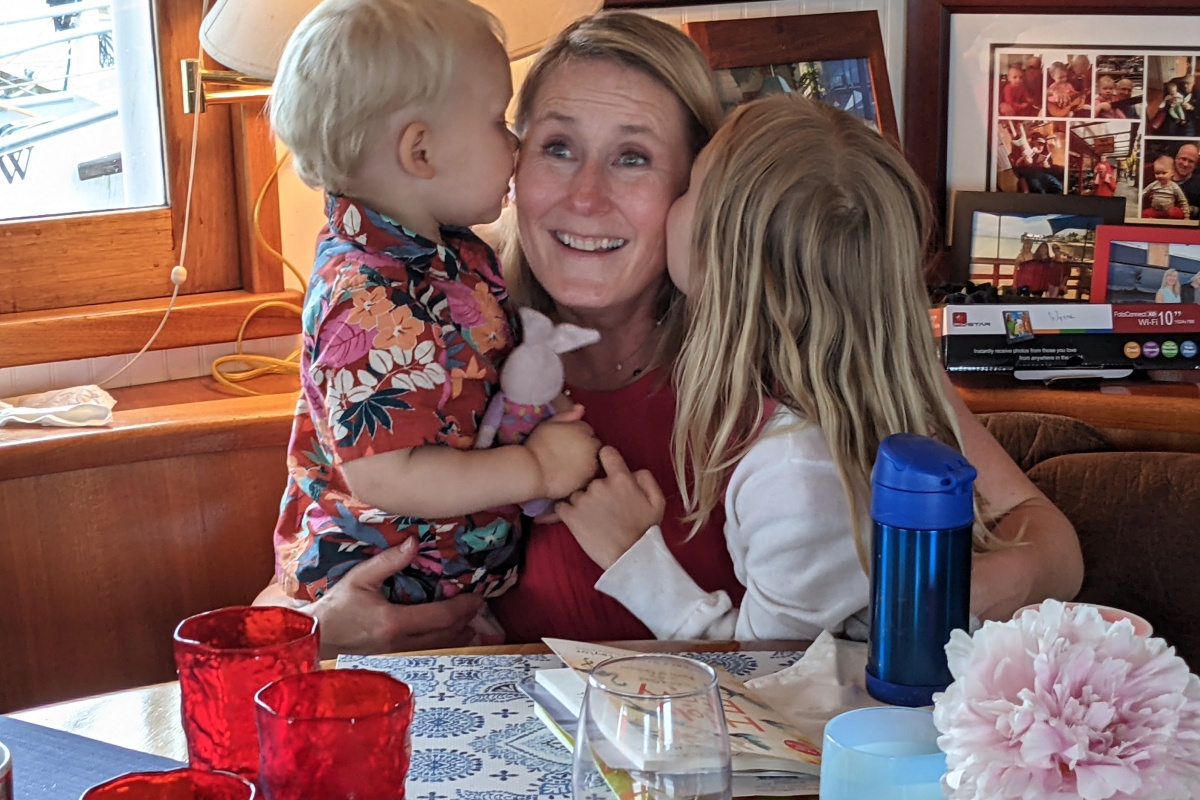
(featured photo is of my kids telling me secrets)

Want to Clip In?

You have a gift that only you can give the world – that’s the whole reason you’re on the planet.” – Oprah Winfrey

I saw this caption on Instagram from author and climber Jon Krakauer the other day.

“Today I watched the sun come up from this perch at 12,000 feet. It’s impossible to overstate how powerful experiences like this are for me, and how grateful I am to have such opportunities on our public lands.” – @krakauernotwriting

It reminded me of a story that my friend Doug told me. Doug was 15 or 16 years old climbing Mt. Hood in Oregon with his grandfather. They reached about 9,000 feet and his grandfather couldn’t climb any further. So he asked a passing rope team if his grandson could climb with them for the remaining 2,200 feet.

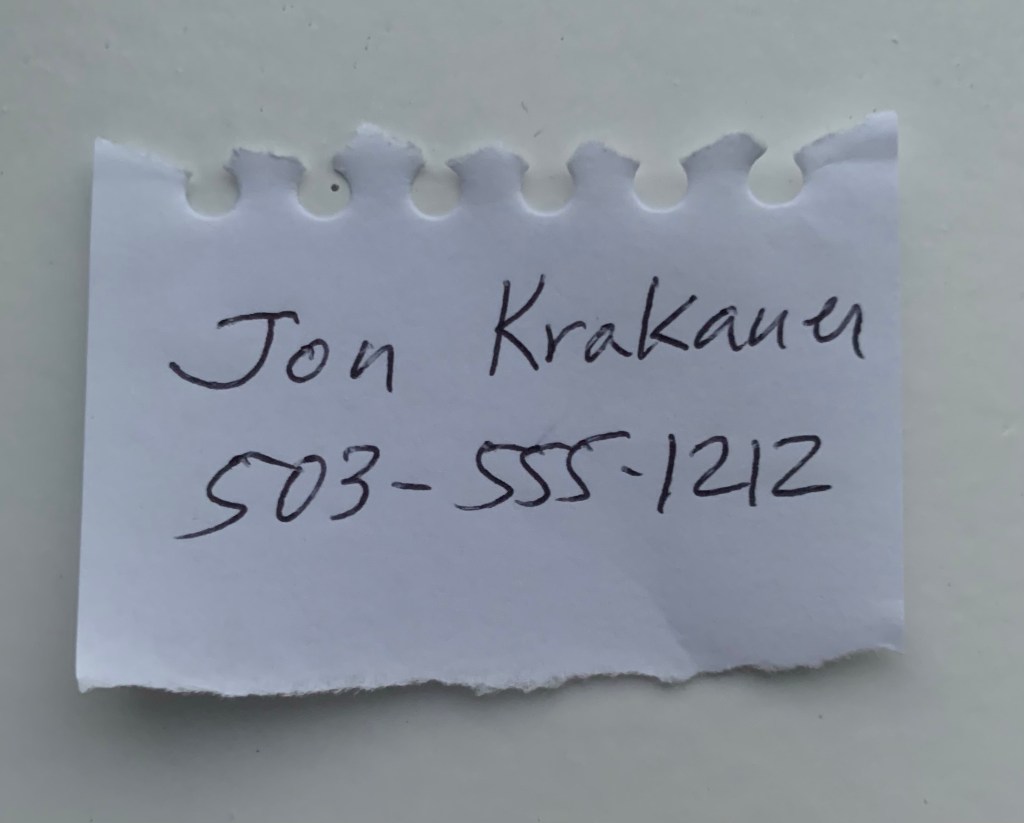
They agreed and Doug had a wonderful summit with these guys in their mid-20’s. When they returned to Doug’s grandfather, he thanked them for being willing to take Doug along. The rope leader said he’d done a great job and he was welcome to climb with them any time. Then he wrote his name down on a napkin and handed it to Doug. This is how I imagine it looked:

Doug never called the team leader – who was in fact THE Jon Krakauer who went on to write Into the Wild and Into Thin Air and many other great books (and climb some great routes). But in his own way, Jon Krakauer has been taking us along on his climbing adventures for 40 years. His passion for the outdoors and for writing has combined to bring us on his rope team for many years. And even when he’s not writing, according to his Instagram moniker, he’s sharing adventure with us and inspiring stewardship of this land.

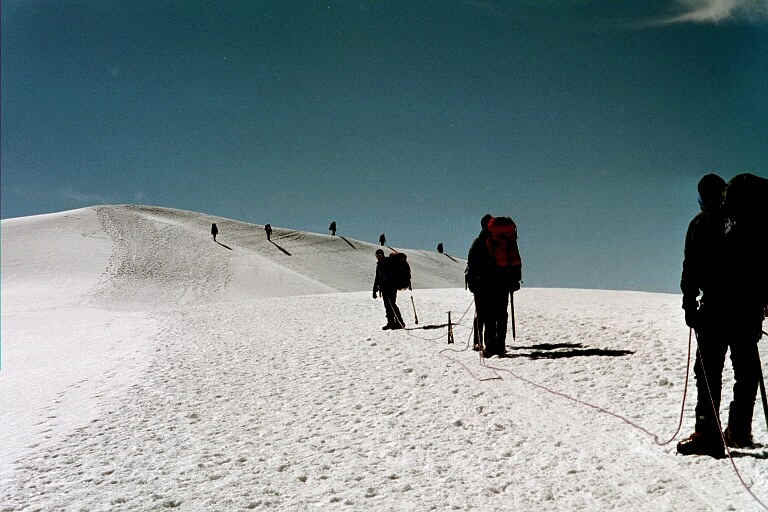
A rope team usually has 5-6 people on it. The leader is most often the strongest climber or navigator, there’s usually someone on the team that organizes and keeps people together but everyone on the team works equally as hard and contributes to the safety and inspiration of all.

This idea of how we all contribute to the rope teams reminds me of what Nicholas Christakis, professor of sociology at Yale, says about his work studying the long view of human history. He’s deeply optimistic about our ability to cooperate, teach others and love because we are one of the only species that does that outside of the family structure.

As Oprah says in the quote for the post, we all have a gift we can give the world, a reason that we are on this planet. Oprah, Nicholas Christakis, Jon Krakauer – they are like the dream team of climbers reminding us all that when we share with our gifts with others, we make the world a better place. Want to clip in?

(featured photo is mine from Mt. Ixtacchuatl, Mexico)