The Genius of Patience: Five Lessons from Thomas Edison

Nothing is impossible. The word itself says ‘I’m possible’!” – Audrey Hepburn

Last night, my six-year-old son, Mr. D, and I were out in our back yard at dusk. When night fell, the solar-powered string of LED lights that my friend Katie helped me string up about 4 years ago switched on. Mr. D wanted to know why some of the bulbs had water in them – a situation that has developed over time.

I’m amazed they still work. Especially after spending a couple of weeks delving into Thomas Edison and his efforts to invent the light bulb. In the time of Edison, bulbs had carbonized bamboo filaments in vacuum sealed glass. We’ve come along way in almost 150 years since his initial design but the light bulb still shines bright.

This episode of The Life of Try podcast is based on Thomas Edison and his methods to reframe progress: not as one perfect breakthrough, but as a steady practice of continuing to try. Behind the famous light bulb moment is a mindset of learning from what doesn’t work, building momentum through small improvements, and staying in motion long enough for the next step to appear.

I gleaned five practical lessons from Edison—be systematic, don’t do it alone, keep improving, apply what you learn across disciplines, and rest (yes, naps count)—plus a bonus insight on the tension between creativity and control.

  • Get unstuck by focusing on the next controllable step
  • Make progress through iteration—small wins that compound over time
  • Keep going with support, structure, and rest
  • Create more, control less

Here’s a snippet of Edison’s commitment to capture ideas:

If you’re working on a project, a habit change, or a long-shot goal, this conversation is an invitation to get unstuck by taking the next try. Here are some ways you can listen and watch this motivating episode:

49: Personal Growth Pivot Points: Pause, Quit or Keep Going? The Life of Try: Personal growth, one try at a time.

How do you know when to stop trying—especially when you’re someone who prides yourself on perseverance? In this episode of The Life of Try, Wynne Leon explores the moments when quitting isn’t failure, but wisdom: when our efforts are overly controlled, when something deep inside says “it’s time,” or when passion turns obsessive and starts costing more than it gives. Along the way, she draws lessons from Marion Jones, Olympic figure skater Alysa Liu, Oprah Winfrey, and Andre Agassi, plus insights on harmoniousvs. obsessive passion.If you’re wrestling with whether to push through or letgo, this conversation offers language, perspective, and permission to choose what’s healthy—and what’s next.The Life of Try podcast: Personal growth, one try at a time.What happens when trying becomes more important thangetting it right?The Life of Try is a personal growth and self‑help podcast about getting unstuck, navigating uncertainty, and choosing to try—even when it’s uncomfortable, inconvenient, or not your idea.Hosted by Wynne Leon, the show explores how real growth, reinvention, and discovery often begin not with confidence or clarity—but with a single attempt. Through thoughtful interviews, reflective conversations, and real‑world case studies, each episode examines what it looks like to keep going when doubt shows up, plans fall apart, or life forces a change you didn’t ask for.This podcast is for anyone who:Feels stuck or uncertain about what’s nextIs navigating change, burnout, or reinventionWants to live intentionally without pretending growth is easyBelieves progress starts by trying – again and againThe Life of Try isn’t about hustle or perfection. It’s about learning as you go, surfacing what matters, and sharing what you discover along the way.If you’re ready to surf the uncertainty, outlast the doubts, and step into your own try‑cycle, you’re in the right place.Links for this episode:The Fun Habit: How the Pursuit of Joy and Wonder Can Change Your Life: Mike Rucker, PhDOpen: An Autobiography by Andre AgassiMarion Jones Reflects on Her Kids Living with 'Reality' of Her Doping ScandalFrom Oakland to Olympic gold: Alysa Liu takes figure skating crownAlysa Liu's Olympic figure skating comeback is golden, true to herselfHow Alysa Liu Found Her Love for Figure Skating AgainWinfrey Announces Show's End in 2011 – CBS News
  1. 49: Personal Growth Pivot Points: Pause, Quit or Keep Going?
  2. 48-How to Get Unstuck: Michael Yang on Saying Yes, Resilience, and Coming Alive
  3. 47-From Stuck to Momentum: Thomas Edison’s Method for Progress (Try, Learn, Improve, Repeat)
  4. 46: The Quiet Transformation That Changes Everything
  5. 45: The Life of Try: Alex Honnold Case Study

Please listen, watch, provide feedback and subscribe.

Links for this episode:

From Stuck to Momentum: Thomas Edison’s Method for Progress transcript

Edison by Edmund Morris

Thomas Edison on Wikipedia

After the Super Bowl, Seahawks Coach Mike Macdonald Kept Repeating 2 Words. It’s a Lesson in How to Win on Inc.com

What Do You Know To Be True?

“You never fail until you stop trying.” – Albert Einstein

I suspect that my podcast guests rarely listen back to the episodes that they record with me. After all, they lived it once, why listen to it again? (Anyone that has podcasted with me or Vicki, feel free to jump in and contradict me on this!)

And, speaking for myself, there’s a smidge of fear when watching myself that I’ll discover something terribly wrong that I said or spinach in my teeth that I can’t undo.

But there’s a huge upside in listening back to what we’ve recorded in that it helps to see ourselves from another angle.

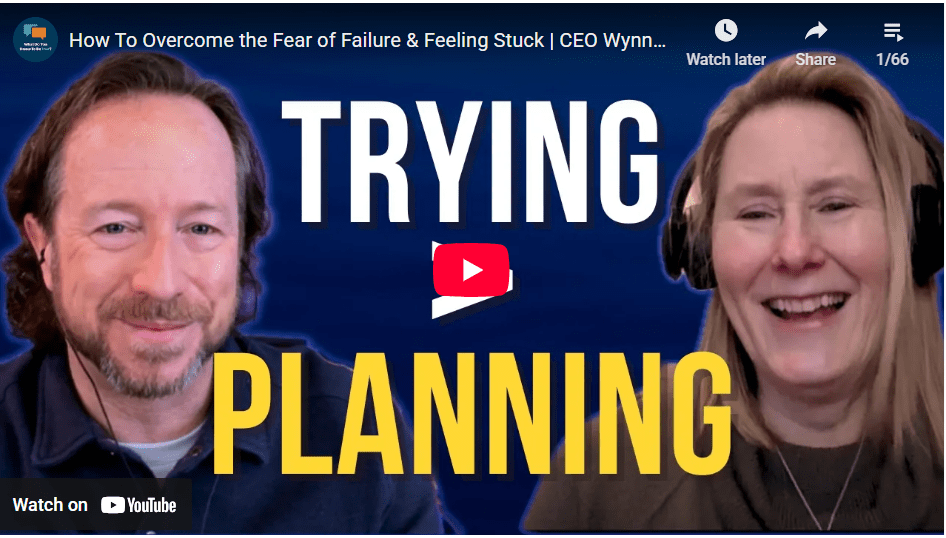
I recently was a guest on the What Do You Know To Be True? podcast with the incredible host, Roger Kastner. What Do You Know To Be True? features conversations at the intersection of leadership, neuroscience, belonging, and personal growth—inviting guests to explore the truths that shape how they lead and live.

Roger is a master at getting his guests to reveal their superpower. Watching back the episode I did with him, I was blown away by how skillful Roger is at digging into the heart of what I know to be true. [It also reminds me that I like to talk with my hands and tell a lot of climbing stories!]

In my case, my superpower is trying. In this conversation, Roger and I talk about:

  • How my electrical engineering background helped me develop my superpower
  • Why trying is different than persistence
  • How mountain climbing helped shape and shift my ability to try
  • What my system is for creating order when trying
  • How trying helps keep us from being stuck
  • How documenting what we’ve tried helps us to pass on the learning to others

Here’s the podcast episode on What Do You Know to Be True?

Other ways to watch this episode:

  • Apple podcasts and Spotify: How To Overcome the Fear of Failure & Feeling Stuck | Wynne Leon
  • YouTube: How to Overcome the Fear of Failure & Feeling Stuck | Wynne Leon on

Links for this episode:

What Do You Know To Be True? website

What Do You Know to Be True? on YouTube

Roger Kastner on LinkedIn

Generationally Speaking

You can never really live anyone else’s life, not even your child’s. The influence you exert is through your own life and what you’ve become yourself.” – Eleanor Roosevelt

Back when I was interviewing my dad about his faith, I came across a passage in psychiatrist and author Dr. Scott Peck’s book Further Along the Road Less Traveled that described four stages of faith. He described an experience of what can happen generationally when kids grow up in stable, religious homes:

What happens to a child raised in such a stable, loving home and treated with dignity and importance? That child will absorb his parents’ religious principles – be they Christian, Buddhist, Muslim, or Jewish – like mother’s milk. By the time the child reaches adolescence, these principles will have become virtually engraved on his heart or ”internalized,” to use the psychiatric term. But once this happens, they will no longer need to depend upon an institution for their governance. It is at this time, which in healthy human development is usually at adolescence, that they start saying, “Who needs these silly myths and superstitions and this fuddy-duddy old institution?” They will then begin – often to their parents’ utterly unnecessary horror and chagrin – to fall away from the church, having become doubters or agnostics or atheists. At this point they have begun to convert to Stage Three, which I call “skeptic/individual.”

Further Along the Road Less Traveled by Scott Peck

I’ve heard this progression described in other contexts as well. From social psychologist Jonathan Haidt who described kids who grow up as beneficiaries of capitalist wealth demanding more socially and environmentally responsible policies as they come of age.

And from therapist Jacob Ham who talks about first generation survivors of war being primarily focused on physical and financial security with little capacity to talk about their emotions. It isn’t until the next generation comes along that they start to unpack emotional intelligence.

How life changes between generations is the topic of my latest post on Wise & Shine: Enough is Enough.