What Do You Know To Be True?

“You never fail until you stop trying.” – Albert Einstein

I suspect that my podcast guests rarely listen back to the episodes that they record with me. After all, they lived it once, why listen to it again? (Anyone that has podcasted with me or Vicki, feel free to jump in and contradict me on this!)

And, speaking for myself, there’s a smidge of fear when watching myself that I’ll discover something terribly wrong that I said or spinach in my teeth that I can’t undo.

But there’s a huge upside in listening back to what we’ve recorded in that it helps to see ourselves from another angle.

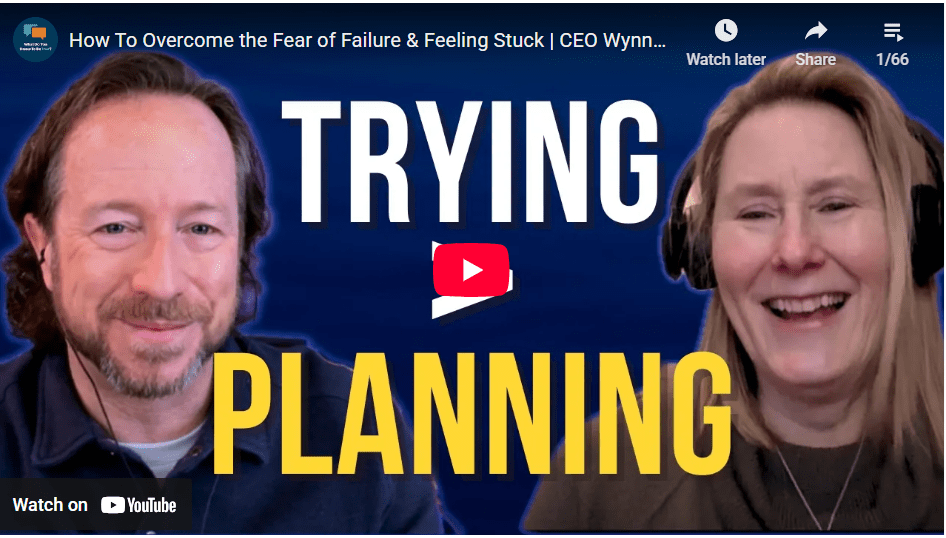
I recently was a guest on the What Do You Know To Be True? podcast with the incredible host, Roger Kastner. What Do You Know To Be True? features conversations at the intersection of leadership, neuroscience, belonging, and personal growth—inviting guests to explore the truths that shape how they lead and live.

Roger is a master at getting his guests to reveal their superpower. Watching back the episode I did with him, I was blown away by how skillful Roger is at digging into the heart of what I know to be true. [It also reminds me that I like to talk with my hands and tell a lot of climbing stories!]

In my case, my superpower is trying. In this conversation, Roger and I talk about:

  • How my electrical engineering background helped me develop my superpower
  • Why trying is different than persistence
  • How mountain climbing helped shape and shift my ability to try
  • What my system is for creating order when trying
  • How trying helps keep us from being stuck
  • How documenting what we’ve tried helps us to pass on the learning to others

Here’s the podcast episode on What Do You Know to Be True?

Other ways to watch this episode:

  • Apple podcasts and Spotify: How To Overcome the Fear of Failure & Feeling Stuck | Wynne Leon
  • YouTube: How to Overcome the Fear of Failure & Feeling Stuck | Wynne Leon on

Links for this episode:

What Do You Know To Be True? website

What Do You Know to Be True? on YouTube

Roger Kastner on LinkedIn

How to Share Feedback

Some of the best advice I’ve been given: ‘Don’t take criticism from people you would never go to for advice.‘” – Morgan Freeman

My dad used the Oreo method when he delivered feedback. It was fitting because he loved Oreos. Perhaps that’s what made him so good at layering in the salty truth between delicious goodness.

He’d start with what was working, add in feedback about what could be better, and then finish it off with a compelling overall vision or motivation. It sounds straightforward when laid out as a formula but as anyone who’s eaten fake Oreos knows, it has to be authentic to work. And the recipient needs to at least be a little hungry for it.

Feedback is tricky, isn’t it? It’s often necessary for us to fuel personal and creative growth, especially with writing, and we sometimes don’t want to hear it. That’s why I love this How to Share podcast episode with Dr. Vicki Atkinson because she is such a pro at both giving and receiving feedback.

Vicki tells us about her project in the works, a novel that builds on her fascinating and intriguing family history. She has done the hard work to not only to write but also to seek out and incorporate feedback. She tells us what she learned from her doctoral dissertation about separating the ego from the work and how that is an essential part of being able to really take in someone else’s input.

We talk about asking the right questions when someone solicits our feedback and also being specific when we want input. And Vicki shows us what having a growth mindset looks like when it comes to incorporating comments.

Vicki walks us through the discernment necessary to pick out what is helpful when it comes to feedback and gives us permission to disregard what doesn’t fit.

This is a great conversation about this tricky subject and Vicki’s wisdom shines brightly through. I know you’ll love it.

Takeaways

  • Feedback is a tricky subject that requires discernment.
  • Separating ego from work is essential for growth.
  • Asking the right questions can lead to more useful feedback.
  • Timing and context matter when giving feedback.
  • Not all feedback is created equal; choose your sources wisely.
  • It’s important to let your work develop before seeking feedback.
  • You can choose which feedback to integrate into your work.

Here’s a great clip of how Vicki practices the art of letting go of the ego:

Here are some ways you can watch this inspiring and helpful episode:

Please listen, watch, provide feedback and subscribe.

48-How to Get Unstuck: Michael Yang on Saying Yes, Resilience, and Coming Alive The Life of Try: Personal growth, one try at a time.

What happens when you say “yes” to an adventure? Host Wynne Leon talks with tech entrepreneur and author Michael Yang about his memoir Coming Alive on the Ride and the way motorcycle travel became both a literal journey and a powerful metaphor for personal growth. Michael shares how stepping outside your familiar environment can help you hear “life’s invitation” to dream, venture, and rediscover what makes you feel fully awake.Together they explore resilience through the Korean concept of han—the accumulated weight of difficult circumstances—and how setbacks can become fuel for perseverance. Michael reflects on immigrating from Korea at 14, building a life through gratitude and hard work, and learning (again and again) that rejection doesn’t have to be the end of the story.From riding thousands of miles with a lifelong friend to a memorable run-in with Steve Jobs at Macy’s in 1982, Michael’s stories remind us that courage grows through companionship and curiosity. They also discuss the Korean guiding philosophy of Hongik—living in a way that benefits all humankind—and how our bravest tries can ripple outward in ways we may not expect.In this episode, we cover:Why “accepting the invitation” is simple—but the road rarely runs straightHow to tell the difference between healthy risk and avoidable dangerHan, perseverance, and turning setbacks into strengthThe immigrant mindset: gratitude, effort, and going for opportunityFriendship as a confidence builder—on the road and in lifeCuriosity, rejection, and holding onto a vision (plus the Steve Jobs story)Hongik: living for the wider benefit and making a positive dent in the worldWhether you’re craving a literal road trip or a fresh start at home, this conversation will nudge you toward your next brave yes.The Life of Try is a personal growth and self‑help podcast about getting unstuck, navigating uncertainty, and choosing to try—even when it’s uncomfortable, inconvenient, or not your idea.Hosted by Wynne Leon, the show explores how real growth, reinvention, and discovery often begin not with confidence or clarity—but with a single attempt. Through thoughtful interviews, reflective conversations, and real‑world case studies, each episode examines what it looks like to keep going when doubt shows up, plans fall apart, or life forces a change you didn’t ask for.This podcast is for anyone who:Feels stuck or uncertain about what’s nextIs navigating change, burnout, or reinventionWants to live more intentionally without pretending growth is easyBelieves progress starts by trying—again and againThe Life of Try isn’t about hustle or perfection. It’s about learning as you go, surfacing what matters, and sharing what you discover along the way.If you’re ready to surf the uncertainty, outlast the doubts, and step into your own try‑cycle, you’re in the right place.Links for this episode:48-How to Get Unstuck: Michael Yang on Saying Yes, Resilience, and Coming Alive transcriptMichael Yang's websiteComing Alive on the Ride at Barnes & Noble, Amazon
  1. 48-How to Get Unstuck: Michael Yang on Saying Yes, Resilience, and Coming Alive
  2. 47-From Stuck to Momentum: Thomas Edison’s Method for Progress (Try, Learn, Improve, Repeat)
  3. 46: The Quiet Transformation That Changes Everything
  4. 45: The Life of Try: Alex Honnold Case Study
  5. How to Share a Reimagined Sci-Fi Trilogy with Dr. Wayne Runde

Links for this episode:

How to Share Feedback transcript

Vicki’s book about resilience and love: Surviving Sue; Blog: https://victoriaponders.com/

My book about my beloved father: Finding My Father’s Faith

(featured photo from Pexels)

The Choices We Have

Life is the sum of all your choices.” – Camus

I was talking with my friend, Betsy of the ParentingisFunny blog (possibly going to be renamed the Chex and Balances blog) but a delightful and fun blog about life, Jui Jitsu and the Universe at any name. We were discussing the idea of choices that behavioral economist Dan Ariely discusses in his book Predictably Irrational. He gives so many great examples of how our brain works to make choices based on the options presented. Like if we are looking to be a house and are comparing two ranch style homes, one that needs work and another that doesn’t, and a colonial, our brain will make the choice based on the price/work of the two ranch homes because they are similar. And even if it isn’t a totally rational choice if you really figured in the third option (the colonial), it’s repeatable because of way the brains anchors the choice by comparison.

Betsy said something lovely about admiring my ability to read and listen to interesting stuff. I replied that being single gives me more free time in which I fill with listening to content. And maybe it even fulfills a need for this intellectual stimulation since I’m not getting that from a partner at this point in life.

Which isn’t to say that I’m recommending being single, it just is a little amazing how much time being in a partnership can take. Choosing to do fun stuff, watch tv or even make dinner together – wonderful things to enjoy in a relationship but it fills time in a way that is hopefully fulfilling but might not leave time for reading behavioral economists. Or it could be deemed rude to put a podcast in at night when folding laundry or working out.

So I have the great pleasure of having time to listen and read great content. And then I have so much life in my house and little ones that I get great joy in processing the ideas and trying them out on them. Like with choices, if I think my little one should wear sneakers instead of rain boots, it works marvelously well to give him the choice of two pairs of sneakers and the rain boots. Just like the houses, it works!

Then Betsy generously added, “Your brain is being so enriched. And then you share your newfound knowledge with others. What a service! Especially when you share the highlights to those of us who don’t have time to learn things ourselves.” Which was a delightful thing to hear but also explained by behavioral economics.

In Predictably Irrational, Dan Ariely describes an experiment they did at a college campus. They had pictures of two attractive people – Student A and Student B. They created a triptych of pictures with student A, Student B and a third picture where they altered student A to be less symmetrical and therefore less attractive.

When students were given the choice of who they found to be most attractive, the majority picked Student A. The third picture, the altered student A gave them something to compare against that steered them towards student A. They did this with several pictures to make sure it wasn’t specific to Student A.

Applying that to life, the choices are

  1. Being single with a rich blogging/writing life
  2. Being in a partnership with a great intellectual conversation
  3. Being single but feeling isolated because I’m not discussing the ideas that have inspired me.

Since option B isn’t really viable right now, it’s a no brainer that I happily choose to listen, write and share since it enriches the option that I have.

(featured photo from Pexels)