Showing Up

Please remember, it is what you are that heals, not what you know.” – Carl Jung

My ten-year-old daughter, Miss O, had a stomach bug this weekend. It hit hard on Friday night and then followed that typical 24 hour course where she felt miserable and threw up a half dozen times and then was mostly done.

When six-year-old Mr D realized that his sister wasn’t feeling well, he set out to make her his famous medium water. You know – not too hot and not too cold. In a lovely confluence where the one thing he knows how to make and the only thing she could keep down met, it was a beautiful gesture.

There was little else that Mr. D and I could do for her. She spent most of her day crying out in agony. Witnessing suffering like that makes me feel crummy. For me, helplessness usually turns into irritability. Fortunately, I was reminded of three things that I’ve heard/read lately:

From poet Mark Nepo, “… someone I love comes along in pain and I start dumping my pockets, looking for the one thing I know that will help them. But time and time again, the only thing they want is for me to open my heart like a sponge to them. They only want to be heard and held.” I swear my pockets are hanging out for how often I dig to try to find something to help only to learn this again and again.

When I talked with Sharon Eubank on the How to Share podcast she related some great lessons from her decades trying to help others as Global Director of Humanitarian Services for the LDS church. The one that really stuck with me was “My solution to your problem will always be wrong.” In this case, the foods that Miss O wanted to eat when she started to feel better wouldn’t have been my picks – but they worked for her.

And then in my most recent podcast conversation with author Amy Weinland Daughters she spoke of not knowing what to do for her friend, Dana, whose teenage son had cancer and then died. Amy started writing letters as a way to show up. She didn’t think it would make a difference but when Dana’s daughters asked Dana when she thought Amy would stop, Dana replied with something like, “I hope never.” We think what we are doing for someone who is suffering or grieving isn’t enough. But it does make a difference.

So I made an effort to pause my productivity efforts that made me feel like I was doing something by washing sheets and sanitizing bathrooms to just show up and stay present when Miss O cried out in pain and discomfort. I rubbed her back or her feet, told stories, and ordered more medium water from Mr. D. It really is what you are that heals. It’s all part of the magic of being there for someone.

(featured photo from Pexels)

You can find me on LinkedIn: https://www.linkedin.com/in/wynneleon/ and Instagram @wynneleon

I host the How to Share podcast, a podcast celebrates the art of teaching, learning, giving, and growing.

I also co-host the Sharing the Heart of the Matter podcast, an author, creator and storytelling podcast with the amazing Vicki Atkinson.

How to Share: Secrets of Collaborative Leadership

The best leader is the one who has sense enough to pick good men to do what he wants done, and the self-restraint to keep from meddling with them while they do it.” – Theodore Roosevelt

I played on a tennis team when I was in my 20’s. It was a loosely organized group of women who played at the public tennis courts. We were part of a league that created matches with other teams, some of whom were the “fancy” ones who belonged to a club with a pro.

But my team had a secret weapon: our coach, Evan. A quiet-spoken man who seemed to take everything in. He’d meet with us at practice and not only run drills to improve our skills but also strategically position who should play singles versus doubles, and forehand versus backhand.

I don’t remember our records of wins and losses so it probably wasn’t that great. But I know we got better as a team and also as individuals. It was largely because of Evan. He could see our strengths and vulnerabilities and help us position them to the best advantage.

I was reminded of Coach Evan when I recently talked with John Hernandez, the Director of IT at Leisure Care on the How to Share podcast. John has an incredibly collaborative leadership style and knows how to balance giving people on his team leadership, agency, and backup when needed.

In short, he’s a very good coach for a strong team.

John told me how he landed on this leadership style and how it’s worked as his team and responsibilities have grown. We talked about how people in technology can sometimes be protective of their knowledge and not want to share. And we discussed how AI changes the game for so many people in technology and how to wrangle it as an asset, not a competitor.

I asked John about how he adapts his message for people who are less technical. He brought it back to the power of telling a story and finding key beats, regardless of the topic.

This is a great episode about how leadership, openness, curiosity translates to infectious passion for sharing – and for team building. I know you’ll love it!

Takeaways

  • John emphasizes the importance of sharing knowledge to build effective teams.
  • A collaborative leadership style fosters a culture of openness and mentorship.
  • Technology professionals often hoard knowledge due to fear of job security.
  • AI is changing the landscape of IT, enabling more collaboration.
  • Storytelling can help convey complex technical concepts.
  • Creating a supportive environment encourages team members to grow.
  • Passion for technology can be infectious and motivate others.
  • Adapting messages for different audiences is crucial in IT.
  • Building a knowledge-sharing culture can lead to better team dynamics.

Here’s a clip of John describing how he landed on his leadership style:

Here are some ways you can listen and watch this infectiously energizing episode:

Please listen, watch, provide feedback and subscribe.

Secrets of Collaborative Leadership transcript

How To Share: From International Lawyer to Thriller Writer How To Share

In this episode of 'How to Share', hosts Wynne Leon andVicki Atkinson engage with author Marc Ross about his latest geopolitical thriller, 'Attacking the Dragon'. The conversation delves into the book's plot, which revolves around China's Belt and Road Initiative, and how Ross's background as a lawyer influenced his writing. They explore the complexities ofChinese politics, character development, and the nuances of storytelling, as well as Ross's personal journey from law to fiction writing.Takeaways:Marc Ross's book 'Attacking the Dragon' explores China's geopolitical landscape.The Belt and Road Initiative is a significant yet under-discussed topic.Ross aims to portray China as a victim rather than an aggressor in his narrative.His legal background provides a unique perspective on the thriller genre.Character names in Chinese culture are complex but manageable for storytelling.Ross's writing journey reflects a long-held dream to become an author.He emphasizes the importance of creating unique protagonists in thrillers.The art of storytelling involves engaging readers through vivid descriptions.Ross enjoys the process of writing and values reader feedback. His experiences as a lawyer enrich his fictional narratives.Links for this Episode:How to Share homeA. Marc Ross's website: https://www.amarcross.com/index.htmlAttacking the Dragon on Barnes & Noble and AmazonFrom the hosts:Vicki’s book about resilience and love: Surviving Sue; Blog: https://victoriaponders.com/My book about my beloved father: Finding My Father’s Faith
  1. How To Share: From International Lawyer to Thriller Writer
  2. How to Share Our Luck with Gil Gillenwater
  3. How to Share 1970's Chicago with Doug. E. Jones
  4. How to Share Feedback with Dr. Vicki Atkinson
  5. How to Share the Next Generation with Mari Sarkisian Wyatt

Links for this episode:

John Hernandez on LinkedIn

How to Share Life’s Challenges

In the middle of every difficulty lies opportunity.” – Albert Einstein

In 2009 when I had to tell my parents that my husband and I had separated, I agonized over having the conversation. It meant that I not only had to manage my emotions about what was going on but also be prepared for theirs. It turned out to be a great conversation because I no longer needed to maintain a veneer that everything was okay.

I’m thinking about this conversation because I was just talking with the thought-provoking and inspiring blogger and retirement coach, Michelle Oram, about how to share life’s challenges on the How To Share podcast. She reminded me that when we share the difficult things we are going through, we open up ourselves to support.

In this podcast episode, Michelle shares her experiences and insights on how to navigate life’s challenges, particularly in sharing difficult news such as a cancer diagnosis. She discusses the importance of prioritizing who to share with, the emotional fatigue that can come from repeated sharing, and the value of support from both close friends and strangers. Our conversation also touches on the nuances of communication in personal versus professional contexts, and how these experiences shape our understanding of support and empathy. I also got to hear about Michelle’s new venture in retirement coaching, emphasizing the emotional aspects of transitioning into retirement.

Takeaways

  • Navigating life’s challenges requires thoughtful communication.
  • Prioritizing who to share difficult news with is crucial.
  • Sharing can open doors to support and help.
  • It’s okay to use different methods to communicate news.
  • Listening is more important than talking when supporting others.
  • People often don’t know what to say, so guidance is helpful.
  • Empathy grows from personal experiences with challenges.
  • Support can come from unexpected places.
  • Retirement can be a significant life change that requires preparation.

Here’s a short clip from our episode to give you a taste of the great conversation. Michelle’s comments about the power of open communication match my experience telling my parents about my breakup and more – when we share life’s challenges, it allows others to be able to support us.

Here are some ways you can listen and watch to the full episode:

Please listen, watch, provide feedback and subscribe.

How To Share: From International Lawyer to Thriller Writer How To Share

In this episode of 'How to Share', hosts Wynne Leon andVicki Atkinson engage with author Marc Ross about his latest geopolitical thriller, 'Attacking the Dragon'. The conversation delves into the book's plot, which revolves around China's Belt and Road Initiative, and how Ross's background as a lawyer influenced his writing. They explore the complexities ofChinese politics, character development, and the nuances of storytelling, as well as Ross's personal journey from law to fiction writing.Takeaways:Marc Ross's book 'Attacking the Dragon' explores China's geopolitical landscape.The Belt and Road Initiative is a significant yet under-discussed topic.Ross aims to portray China as a victim rather than an aggressor in his narrative.His legal background provides a unique perspective on the thriller genre.Character names in Chinese culture are complex but manageable for storytelling.Ross's writing journey reflects a long-held dream to become an author.He emphasizes the importance of creating unique protagonists in thrillers.The art of storytelling involves engaging readers through vivid descriptions.Ross enjoys the process of writing and values reader feedback. His experiences as a lawyer enrich his fictional narratives.Links for this Episode:How to Share homeA. Marc Ross's website: https://www.amarcross.com/index.htmlAttacking the Dragon on Barnes & Noble and AmazonFrom the hosts:Vicki’s book about resilience and love: Surviving Sue; Blog: https://victoriaponders.com/My book about my beloved father: Finding My Father’s Faith
  1. How To Share: From International Lawyer to Thriller Writer
  2. How to Share Our Luck with Gil Gillenwater
  3. How to Share 1970's Chicago with Doug. E. Jones
  4. How to Share Feedback with Dr. Vicki Atkinson
  5. How to Share the Next Generation with Mari Sarkisian Wyatt

Links for this episode:

Michelle Oram’s blog: Boomer Eco Crusader

12 things you should never say to someone with cancer – Boomer Eco Crusader

Best ways to support someone with cancer – Boomer Eco Crusader

Michelle Oram’s Second Life Vision retirement coaching

How To Receive

If you want to be truly understood, you need to say everything three times, in three different ways. Once for each ear…and once for the heart.” – Paula Underwood Spencer

Eight years ago at a birthday party for a friend, I met a remarkable woman. It was a milestone birthday which is why I can pinpoint it that precisely.

This woman stood out not because of what she did (a therapist I later learned) or what we talked about (stand up paddle boarding in Puget Sound) but because she listened like a lake. That was the image that came to me when talking with her. She absorbed the conversation instead of volleying back and forth like tennis. Also it seemed like her words came from her depth.

It reminds me of a phrase I heard in a eulogy almost three years ago. We were honoring a man who was the father of a childhood friend. His grandson said about him, “He loved by listening.”

Two examples that stand out in the last ten years because they were great listeners. I often make the mistake of thinking I need to say something to be remembered – but these examples remind me that just learning how to listen well is remarkable in itself.

Fortunately, I was able to have a great conversation with my dear friend, Dr. Vicki Atkinson about how to receive for the How to Share podcast. In this episode, Vicki discusses the essential skills of listening and receiving in conversations. She emphasizes the importance of reflective listening techniques, being present, and using the SLANT method to enhance communication.

Our conversation explores how to navigate conversations with empathy, the role of affirmation, and the significance of maintaining boundaries while supporting others. Vicki also highlights the growth opportunities that arise from effective listening and the need for authenticity in communication.

Here are some key takeaways:

  • Everyone can learn how to be a better listener (as Vicki says, the runway is wide!)
  • Reflective listening helps slow things down and enhances understanding.
  • Tonality is crucial in reflective listening to ensure the speaker feels heard.
  • Active listening involves being present and engaged in the conversation.
  • The SLANT method is a practical approach to effective listening.
  • Asking clarifying questions shows genuine interest in the speaker’s message.
  • Affirmation and encouragement are key components of effective listening.
  • Setting boundaries is important to avoid taking on others’ burdens.
  • Listening well can mitigate stress and prevent larger issues.
  • Authenticity in communication fosters trust and connection.

And a short clip from the episode to whet your appetite:

I’d be honored if you’d listen, watch, provide feedback and subscribe. Here are some ways you can listen and watch to the full episode:

How To Share: From International Lawyer to Thriller Writer How To Share

In this episode of 'How to Share', hosts Wynne Leon andVicki Atkinson engage with author Marc Ross about his latest geopolitical thriller, 'Attacking the Dragon'. The conversation delves into the book's plot, which revolves around China's Belt and Road Initiative, and how Ross's background as a lawyer influenced his writing. They explore the complexities ofChinese politics, character development, and the nuances of storytelling, as well as Ross's personal journey from law to fiction writing.Takeaways:Marc Ross's book 'Attacking the Dragon' explores China's geopolitical landscape.The Belt and Road Initiative is a significant yet under-discussed topic.Ross aims to portray China as a victim rather than an aggressor in his narrative.His legal background provides a unique perspective on the thriller genre.Character names in Chinese culture are complex but manageable for storytelling.Ross's writing journey reflects a long-held dream to become an author.He emphasizes the importance of creating unique protagonists in thrillers.The art of storytelling involves engaging readers through vivid descriptions.Ross enjoys the process of writing and values reader feedback. His experiences as a lawyer enrich his fictional narratives.Links for this Episode:How to Share homeA. Marc Ross's website: https://www.amarcross.com/index.htmlAttacking the Dragon on Barnes & Noble and AmazonFrom the hosts:Vicki’s book about resilience and love: Surviving Sue; Blog: https://victoriaponders.com/My book about my beloved father: Finding My Father’s Faith
  1. How To Share: From International Lawyer to Thriller Writer
  2. How to Share Our Luck with Gil Gillenwater
  3. How to Share 1970's Chicago with Doug. E. Jones
  4. How to Share Feedback with Dr. Vicki Atkinson
  5. How to Share the Next Generation with Mari Sarkisian Wyatt

How to Receive with Dr. Vicki Atkinson transcript

Links for this episode:

Dr. Vicki Atkinson at the ⁠Atkinson Group Solutions⁠; Vicki’s book about resilience and love: Surviving Sue; Blog: https://victoriaponders.com/

⁠A is for Ambivalence⁠ by Vicki Atkinson

(Featured photo stems from Vicki’s comment about the Chinese ideogram for undivided attention in this episode. It’s sourced from undivided attention from Pinterest by Nancy Sherr)

How to Share Professional Communications with Brian Hannon

Good communication is just as stimulating as black coffee, and just as hard to sleep after.” – Anne Morrow Lindbergh

Twenty-five years ago, long before there was MailChimp, one of my projects for Microsoft was to email out their program offers to their 60,000 partners on a quarterly basis. I remember it as one of the most nerve-racking tasks of my job at the time. Not because of the technology, which was no problem, but because if something was wrong with the message we sent out, it had such visibility.

It really is amazing to think about the potential impact that technology has given us. But it also puts a lot of stress on how we share to a wider audience. Whether it’s work-related, part of volunteering on a committee, or a personal appeal to friends to join a cause, we have the ability to reach a broad group. Like my email project, that puts a lot of pressure on how we do it.

That’s why I love this latest episode of the How To Share podcast with corporate communications professional, Brian Hannon.

Brian and I talk about the nuances of professional communication. We explore the importance of understanding the audience, the timing of messages, and the need for authenticity in sharing information. Brian shares insights from his 30 years in corporate communications and journalism, emphasizing the significance of clarity, repetition, and empathy in effective messaging. The conversation highlights the evolution of communication formats and the challenges of simplifying messages for better understanding.

Here are some key takeaways:

  • Understanding your audience is crucial for effective communication.
  • Timing can significantly impact how messages are received.
  • Repetition helps ensure that important messages are not lost.
  • Segmenting your audience allows for more targeted communication.
  • Authenticity builds trust in corporate messaging.
  • Clear and concise messaging is essential in today’s fast-paced environment.
  • Empathy plays a key role in understanding how messages are perceived.
  • Feedback loops enhance the effectiveness of communication.
  • The evolution of communication formats requires adaptation in messaging strategies.
  • Effective communication is about sharing ideas, not just delivering information.

And a short clip from the episode to whet your appetite:

I’d be honored if you’d listen, watch, provide feedback and subscribe. Here are some ways you can listen and watch to the full episode:

How To Share: From International Lawyer to Thriller Writer How To Share

In this episode of 'How to Share', hosts Wynne Leon andVicki Atkinson engage with author Marc Ross about his latest geopolitical thriller, 'Attacking the Dragon'. The conversation delves into the book's plot, which revolves around China's Belt and Road Initiative, and how Ross's background as a lawyer influenced his writing. They explore the complexities ofChinese politics, character development, and the nuances of storytelling, as well as Ross's personal journey from law to fiction writing.Takeaways:Marc Ross's book 'Attacking the Dragon' explores China's geopolitical landscape.The Belt and Road Initiative is a significant yet under-discussed topic.Ross aims to portray China as a victim rather than an aggressor in his narrative.His legal background provides a unique perspective on the thriller genre.Character names in Chinese culture are complex but manageable for storytelling.Ross's writing journey reflects a long-held dream to become an author.He emphasizes the importance of creating unique protagonists in thrillers.The art of storytelling involves engaging readers through vivid descriptions.Ross enjoys the process of writing and values reader feedback. His experiences as a lawyer enrich his fictional narratives.Links for this Episode:How to Share homeA. Marc Ross's website: https://www.amarcross.com/index.htmlAttacking the Dragon on Barnes & Noble and AmazonFrom the hosts:Vicki’s book about resilience and love: Surviving Sue; Blog: https://victoriaponders.com/My book about my beloved father: Finding My Father’s Faith
  1. How To Share: From International Lawyer to Thriller Writer
  2. How to Share Our Luck with Gil Gillenwater
  3. How to Share 1970's Chicago with Doug. E. Jones
  4. How to Share Feedback with Dr. Vicki Atkinson
  5. How to Share the Next Generation with Mari Sarkisian Wyatt

Links for this episode:

Brian’s blog: Writing from the heart with Brian

Brian Hannon on LinkedIn

Next up!

Stay tuned for next week’s episode when we get great guidance from Dr. Vicki Atkinson on how to receive when others share. A fantastic episode that comes with many great tips about how to deepen our ability to listen.

Sunday Funnies: July 23

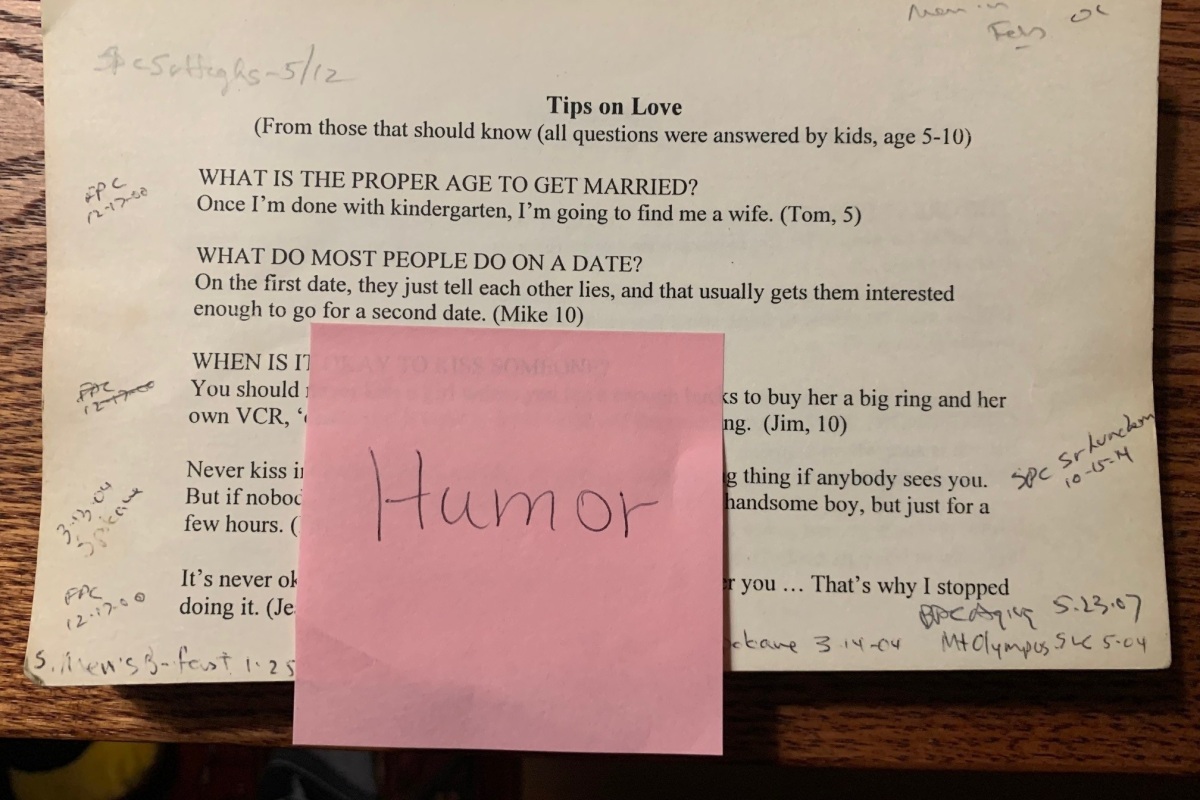
A re-run of my dad’s humor cards. They make me chuckle all over again – so I hope you enjoy them whether it’s the first time or second (first posted on 6/12/2022).

The backstory: My dad was a Presbyterian pastor for 40 years. He kept a well curated stack of humor cards – little stories he heard, found or saw and then typed onto 5×7 cards. Then he wrote in the margins when he used that particular item. His humor was often an easy way to settle in to something deeper – by laughing and thinking about the buried truth in these little nuggets, it paved the way to an open heart.

Be Careful When You Send E-mail

After being nearly snowbound for two weeks last winter, a Seattle man departed for his vacation in Miami Beach, where he was to meet his wife the next day at the conclusion of her business trip to Minneapolis. They were looking forward to pleasant weather and a nice time together.

Unfortunately, there was some sort of mix up at the boarding gate, and the man was told he would have to wait for a later flight. He tried to appeal to a supervisor but was told the airline was not responsible for the problem and it would do no good to complain. Upon arrival at the hotel the next day, he discovered that Miami Beach was having a heat wave, and its weather was almost as uncomfortably hot as Seattle’s was cold. The desk clerk gave him a message that his wife would arrive as planned.

He could hardly wait to get to the pool area to cool off and quickly sent his wife an e-mail, but, due to his haste, he made an error in the address. His message therefore arrived at the home of an elderly preacher’s wife whose even older husband had gone to his reward only the day before. When the grieving widow opened her e-mail, she took one look at the monitor, let out an anguished scream, and fell to the floor dead. Her family rushed to her room where they saw this message on the screen:

Dearest Wife,

Departed yesterday as you know. Just now got checked in. Some confusion at the gate. Appeal was denied. Received confirmation of your arrival tomorrow.

Your Loving Husband,

P.S. Things are not as we thought. You’re going to be surprised at how hot it is down here.

Sunday Funnies: June 12

Another installment from my dad’s humor cards.

The backstory: My dad was a Presbyterian pastor for 40 years. He kept a well curated stack of humor cards – little stories or observations that he typed onto 5×7 cards. Then he wrote in the margins when he used that particular item. His humor was often an easy way to settle in to something deeper – by laughing and thinking about the buried truth in these little nuggets, it paved the way to an open heart.

When we cleaned out his desk after he died 7 years ago, I was lucky enough to stumble on this stack. I pull it out regularly to have a little laugh with my dear Dad. Now when I post one of them, I write my note next to his and it feels like a continuation.

Be Careful When You Send E-mail

After being nearly snowbound for two weeks last winter, a Seattle man departed for his vacation in Miami Beach, where he was to meet his wife the next day at the conclusion of her business trip to Minneapolis. They were looking forward to pleasant weather and a nice time together.

Unfortunately, there was some sort of mix up at the boarding gate, and the man was told he would have to wait for a later flight. He tried to appeal to a supervisor but was told the airline was not responsible for the problem and it would do no good to complain. Upon arrival at the hotel the next day, he discovered that Miami Beach was having a heat wave, and its weather was almost as uncomfortably hot as Seattle’s was cold. The desk clerk gave him a message that his wife would arrive as planned.

He could hardly wait to get to the pool area to cool off and quickly sent his wife an e-mail, but, due to his haste, he made an error in the address. His message therefore arrived at the home of an elderly preacher’s wife whose even older husband had gone to his reward only the day before. When the grieving widow opened her e-mail, she took one look at the monitor, let out an anguished scream, and fell to the floor dead. Her family rushed to her room where they saw this message on the screen:

Dearest Wife,

Departed yesterday as you know. Just now got checked in. Some confusion at the gate. Appeal was denied. Received confirmation of your arrival tomorrow.

Your Loving Husband,

P.S. Things are not as we thought. You’re going to be surprised at how hot it is down here.

The Feelings Expert

The more we sweat in peace, the less we bleed in war.” – Vijaya Lakshmi Pandit

The other day my daughter, Miss O, came home from school upset because she had a little kerfuffle with a fellow 1st grader at school. He kicked down the wall of wood chips she and her friends were building and when she went to talk to him about it, he started talking before she could get the words out. This is the conversation she reported to me.

Miss O: “You can’t take the words out of my mouth.”

Boy: “Yes, I can.”

Miss O: “Er…I’m going to talk to my mom about this. She’s an expert on feelings. I’ll tell you what she says tomorrow.”

I’m amused by the title she’s given me. I remember reading Brain Rules for Baby by University of Washington professor John Medina when she was a baby. It said that to help our kids manage their big emotions, we had to model naming our emotions, even the less desirable ones. I clearly thought “no thank you” to that but I guess I must have made some inroads countering my own resistance and stoic modeling from my childhood.

But more than that, I find my daughter’s story to be so relatable. Communication is hard isn’t it? Especially in those tight moments when you are disappointed or angry and the words, if they come, get muddled.

Last week I was listening to a 10 Percent Happier episode titled How Not to Ruin Your Relationships with Drs John and Julie Gottman and they were talking about situations where we are overwhelmed by emotion. In that case, we are flooded and there’s no point in continuing to talk. They recommended walking away, doing something completely different until we can return to the conversation.

Which is what Miss O did. We talked through not calling any names or labeling the other person and instead just stating what she felt and needed like being able to finish her sentence. When I asked her if she’d said any of that to the boy the next day she said, “Nah, it wasn’t that big of deal.”

It reminded me – learning to talk is one thing and learning to communicate is a whole other thing. One that takes a lifetime to work on. But I’m inspired by the quote at the top of this post from Vijaya Lakshmi Pandit, “The more we sweat in peace, the less we bleed in war.”

(featured photo from Pexels)

Humor: Jan 9th

In the stack of humor cards I inherited from my father, there is one he labeled “Parables.” It’s easy to see how as a Presbyterian pastor he found that these little stories could be used to both get a laugh and subtly make a point.

THE HANDICAPS OF YOUTH: Parents of two teenagers are worried about their kids’ failing eyesight. The daughter can’t find anything to wear in a closet full of clothes and the son can’t find anything good to eat in a refrigerator full of food.

POWERFUL COMMUNICATION: A woman says to her neighbor: “I have a marvelous meat loaf recipe. All I do is mention it to my husband and he says, ‘Let’s eat out.’ “

COMMUNICATION AT SUNDAY SCHOOL: A five-year-old came home from Sunday School very excited. His teacher, he reported to his parents, had told the class about the story of Adam and Eve and how Eve was created from Adam’s rib.

A few days later he told his mother, “My side hurts. I think I’m having a wife.”

SUFFERING IN SILENCE: Most people don’t mind suffering in silence as long as everyone else knows about it.