Creatively Unwinding

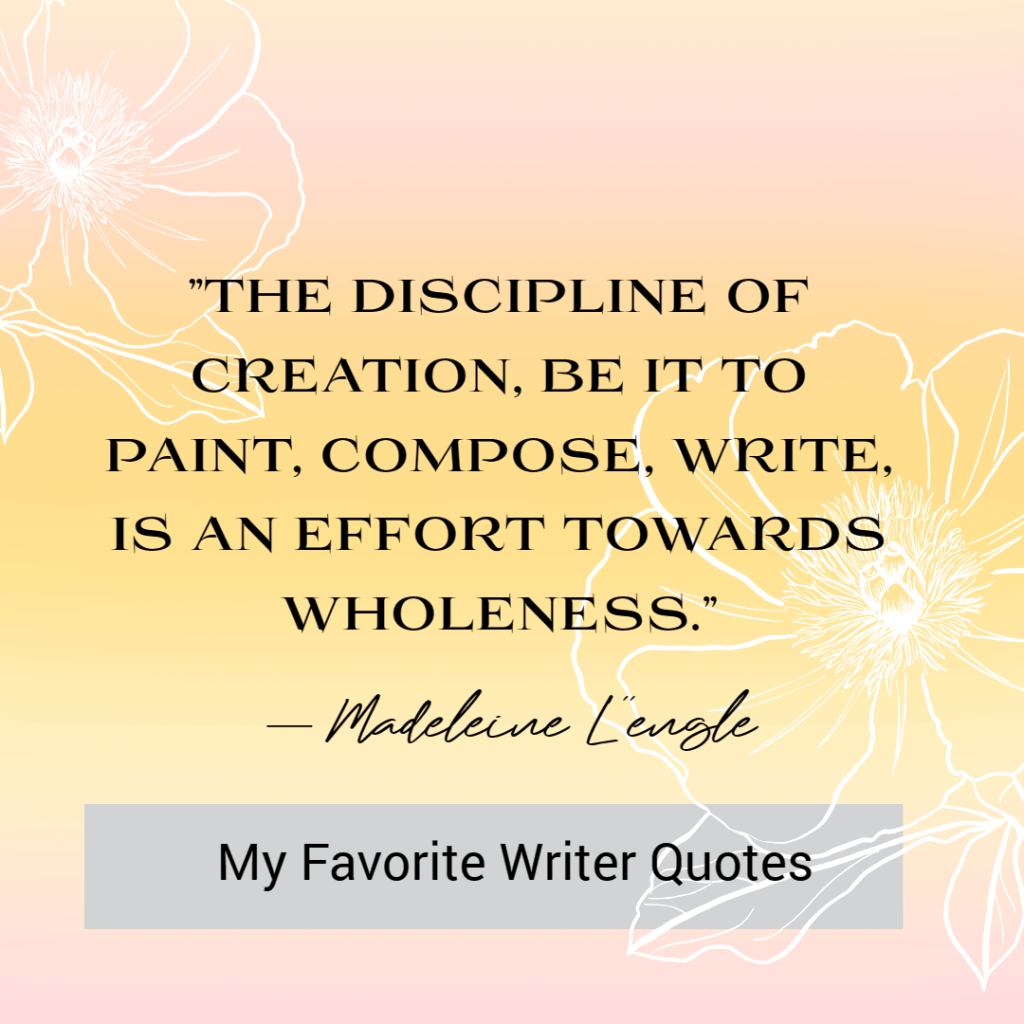
The discipline of creation, be it to paint, compose, write, is an effort towards wholeness.” – Madeleine L’Engle

It’s captivating to watch all the different types of creativity at the beach. Unless someone has found a way to monetize sand castles, I believe what I’m watching is some of the unique ways people use their leisure time.

There are all sorts of way to unwind, aren’t there? Here on this beach in the Pacific Northwest, building forts and sand castles top the list.

Almost nine-year-old Miss O likes to create some version of a crab café every time we come to this beach. It’s got scalloped dishes, seaweed garnish and salt and pepper (sand) shakers made from crab claws.

Others have made beautiful and intricate forts out of driftwood. Some of these structures are so sturdy that they last for months and years between our visits.

Someone else makes driftwood sculptures. And our neighbor on this trip has made a sort of hanging sculpture from the wood on the beach.

When my friend, Katie, was here, she challenged the kids to come up with their own Beach Olympics. Would their event be Shell Shotput or Beach Balance Beam?

As I jot all this down, it reminds me that writing is another activity to add to the list. Not only am I writing this down for a post, but I can also imagine all the poetry, prose, and photography inspired by time away at this place.

I’m struck by how intertwined creativity is in what we do, even when unwinding. Maybe as the quote for this post from Madeleine L’Engle suggests, it’s all part of working towards wholeness.

Writing Worth Doing

Words have magical power. They can bring either the greatest happiness or deepest despair.” – Sigmund Freud

Last Friday was Mr. D’s last day at his pre-school/daycare. He’s been there for nearly four years. In three different classrooms with so many great teachers, this school has been such a wonderful influence.

When I went to write the amazing staff a thank you note, I did so through a veil of tears. When I was done, it felt like a piece of writing as worthy as anything else I’ve composed because:

  1. It was from my heart
  2. I provided others with a perspective on their impact that would be hard for them to know otherwise
  3. The feelings it elicited were worth rippling out in the world

Here’s the note:

This morning before [Mr. D] left for school, he took his plate to the sink, washed his hands after going to the bathroom, and used his words when he wanted to play with something his sister had. Those three skills are just some of the wonderful building blocks that he learned in his time at GLPCC.

I know it’s hard to measure the positive impact that you have on one child or one family’s life. Just as a stream doesn’t count the rocks it touches as it flows, the kindnesses and fundamentals you all bestow with your patience, creativity, and caring make such a difference.

I get choked up thinking about all the ways your consistency and hard work have made my life better during the years D has been at GLPCC. From the pandemic to surviving the hard drop off days, I have been able to navigate life and work because I was absolutely certain D was in good, kind and loving hands.

So I send you all immense gratitude for the amazing work that you do. And if there is any day that feels tough – think about what our world would look like if everyone took their dishes to the sink, washed their hands, and used their words when they wanted something. It would be amazing. You all are building a better world.


Have you written something simple that turned into a worthwhile project?

(featured photo from Pexels)

Along For The Ride

Love doesn’t make the world go round. Love it what makes the ride worthwhile.” – Franklin P. Jones

When Vicki Atkinson first read my book about my beloved father, Finding My Father’s Faith, one of the things she remarked that she loved was the way he described riding on trains when he lived in India.

He was 24 or 25 years old, studying to get a Masters degree from Benares Hindu University. During his school breaks would travel around India third class, sitting on the floor like everyone else, and practicing his Hindi.

I admit I hadn’t thought at length about that aspect of my dad because that was just the guy he was. He didn’t proselytize, mention he was a pastor, or have any agenda – he just liked people. Whether he was golfing, hiking or riding mass transit, my dad enjoyed talking with his fellow travelers in this life.

I mention this because in this week’s podcast, Vicki and I talked with dear friend, marketing man, and creative guru, Eric Knudson about riding the bus.

Eric is a dear friend of mine and a master story-teller. I’ve known Eric for ten years and through the years, he’s regaled me with many stories. I can’t tease out exactly the formula but it’s some combination of his use of humor, timing, and detail that makes him so entertaining to listen to.

He also had the pleasure of knowing my dad and understanding what a whirlwind of energy and good-natured sociability he was.

So in this episode, he brings both his fantastic storytelling and a bit of my dad to a great story about a recent bus ride. It’s hilarious, dramatic, and full of fun. Here’s a sneak peek:

I’m certain you’ll enjoy the scenic and beautiful places we go when we share the power of story.

We know you’ll love it!

Check out the full podcast at: Episode 76: On the Bus with Eric Knudson

(featured photo from Pexels)

Links for this episode:

Vicki’s personal blog: Victoria Ponders

Wynne’s personal blog: Surprised by Joy

Vicki’s recently released book: Surviving Sue

Wynne’s book about her beloved father: Finding My Father’s Faith

Using It All Up

When I stand before God at the end of my life, I would hope that I would not have a single bit of talent left and could say, I used everything you gave me.” – Erma Bombeck

My dad had a motto, especially in his retirement years. “I just want to be useful.” And as a retired pastor, that translated to serving on boards, guest preaching, teaching classes, and family stuff like helping me with my house and yard on Saturdays.

And he was very useful. But his usefulness required a lot of flexibility on my mom’s part.

A month or so ago, my 85-year-old mom asked, “Did you see Eleanor Coppola’s obituary in the paper?”

I hadn’t, so we found it and she read me this part, “ ‘There is part of me that has been waiting for Francis to leave me, or die, so that I can get my life the way I want it,’ Eleanor wrote. ‘I wonder if I have the guts to get it the way I want with him in it.’ “

I have a theory – that a lot of women don’t use up all their talent as the quote for this post by Erma Bombeck so beautifully says. That isn’t to say that it doesn’t apply to men, too.

But when it comes to women, it seems that after a lifetime of being flexible for others (relationships, kids, pets), women don’t often get ASKED in the same way that men do. So then it becomes a doubly-hard question about creating life the way as envisioned because it involves crafting the persona, network, and possibly upsetting the status quo at home.

In the case of Eleanor Coppola, it turns out that she died at age 87 before Francis. But she directed her first feature film at age 80. I hope that means she was able to get life the way she wanted it with him in it. In fact, one more quote from her obituary makes me think he was nudging her along:

“ ‘One morning at the breakfast table my husband said, “Well, you should direct it.” I was totally startled,’ Eleanor told The AP. ‘But I said, “Well, I never wrote a script before, and I’ve never directed, why not?” I was kind of saying “why not” to everything.

As we tune in the deep whisper urging us to be useful and share all our talents with the world, I think we should remember to ask, “Why not?

(featured photo from Pexels)

The Archetypes of Story

Fairy tales are more than true: not because they tell us that dragons exist, but because they tell us dragons can be beaten.” – Neil Gaiman

This was originally published on 7/5/2023. Heads up – you may have already read this!


My kids have been clamoring for me to tell them stories at bedtime. They don’t want made up stories, they want real stories.

One of their favorite protagonists is Simon the Bad Cat. He was a character with a capital “C” – I adopted him from a neighbor when she moved. He proceeded to get into all sorts of trouble breaking into other people’s houses, picking on my dogs, and getting into cat fights. He lived a full life of 19 years and left behind a treasure trove of stories.

Telling these stories has made me think of the hypothesis that are a limited number of plot lines for our stories. I’ve heard this theory in several different ways from nine to twelve archetypal stories. But drawing from overview on Wikipedia of the work of Christopher Booker, The Seven Basic Plots: Why We Tell Stories here they are:

  • Overcoming the monster
  • Rags to riches
  • The quest
  • Voyage and return
  • Comedy
  • Tragedy
  • Rebirth

Can I fit the Simon stories into these categories? Here are our favorite bad cat stories:

Rebirth: Simon the cat got a claw stuck in between his shoulder blades while fighting another cat. It abscessed and made him so sick that I had to take him to the vet so they can drain the wound. Simon died on the operating table and they had to use kitty CPR to bring him back. Did the hero return home transformed as a wiser cat? Well, he did mend his fighting ways so that we never had to drain an abscess again.

Comedy: Five doors down was a neighbor named Steve who hated Simon because he was always getting into his stuff and messing it up. But it was a love/hate relationship because he noticed how smart Simon was as well. One day when Steve was showing some new tenants around the shared laundry room, he told them they must never leave the outside door open because there’s a bad cat that would get in. They pointed to a shelf right about Steve’s shoulder and asked, “Like that cat there?” and Steve turned around to see Simon smugly listening to his speech.

 Voyage and return: Simon the cat had a habit of breaking into houses and garages that he subsequently couldn’t get out of until someone opened a door. So I was used to him occasionally being gone for a night or two. But when he went missing for twelve days, I did all I could to find him: putting up posters, walking round the neighborhood calling for him, calling the pet shelter. Finally, I accepted that he was gone forever and gave away his food. On day 13, Simon nonchalantly walked up to the back door and demanded to be let in.

Overcoming the monster: I met Simon when I had a 150 pound dog, a gentle mastiff named Samantha. When we’d go out for a walk in the morning, Simon would hide in a bush, then jump out and smack Samantha on the rear. Then having “overcome the monster” (or at least scaring her half to death), he’d proceed to join us for our 12 block walk through the neighborhood.

Telling these stories to my children, I wonder if it is just a silly ritual. But I believe it helps them at a deeper level to make meaning out of their lives and days. Maybe one day when they are struggling with a monster or experiencing the rebirth and renewal that sometimes comes with life, there will be a niggling of a Simon story that reminds them they aren’t alone on their journey.

Perhaps it’ll even help them understand my story of the quest and how that led me to have them as a single parent. Even if it just creates a basis for loving stories, I believe it will help them to live fuller and more imaginative lives.

Don’t you still love a good story?

Memoir Writing: Understanding the Why

Growing up as a kid, we don’t notice that our parents are growing up too.” – unknown

This post was originally published on 6/7/2023. Heads up – you may have already read this.


In the summer of 2015, I was pregnant with two projects. The most obvious was my daughter, but I was also about to give birth to a memoir about my father. My father had died in a bike accident the day after I finalized plans to become pregnant by invitro fertilization. His death kicked off an urgency to take the recordings I’d made of my conversations with him, and finish the effort I’d begun before he died to write about his life.

I spent the nine months of my pregnancy nurturing both projects, afraid that if I didn’t finish the book I might not be able to after my daughter was born. Then on a night in August 2015, at the end of the day on which I’d finished the very last line edits for the book, I went into labor with my daughter.

Essentially, I gave birth to both at the same time. And both events were joyous, scary, and full of “what now?”

I’ve also come to realize that there is another parallel between book projects and children – our understanding of them grows with time. This is the thing that surprises me the most – that with the benefit of hindsight, I continue to learn about what I myself have written. Who knew that was possible?

Here’s what I mean. I recently was reading Vicki Atkinson’s book Surviving Sue which is about Vicki’s journey with her mom, Sue, who suffered from anxiety, depression, alcoholism, Munchausen’s by Proxy, and Alzheimer’s. On the surface, I wouldn’t have drawn parallels between that and my memoir about my beloved father who didn’t suffer from any of those things.

But reading Vicki’s incredibly insightful, entertaining, and reflective words about her mom as she charted a trail through Sue’s life, I realized that we all navigate a path in our parents’ shadow. Whether we dig deep into what that was and write a memoir about it, or choose to go our own way and not think about it, the influence of a parent, present or absent, is powerful.

I think my beloved dad was an incredibly helpful influence on my life – and yet there are habits of his that I still carry, like aversion to conflict, that I need to heal. Maybe even more so because he didn’t do that work.

As I devoured Vicki’s well-written and insightful book about Sue, I found myself engrossed in the themes that Vicki wrote about, including:

  • Rethinking our parents as people
  • Understanding complicated family members and finding ways to love them anyway
  • Tending to unresolved childhood pain
  • Secrets and lies and how the weight of distortion impacts mental health
  • Dads and daughters and special bonds
  • Grace and patience

Whether the themes related to something in my life or not, reading a memoir from someone like Vicki who has done the work to understand the patterns in theirs is so inspirational. Whether our parents were hurtful or helpful, being able to tell their stories is an incredible gift to ourselves to uncover the a-ha of how their touch continues.

As we search for our “why’s” in life – the power behind what motivates us and defines us, figuring out our parent’s why’s is incredibly illuminating. Watching the way that Vicki uncovers that for her mom in Surviving Sue is like being at an archeology dig. Instructive to see the way she teases out the gems, suspenseful as we wade through the project, and thought-provoking for how we can apply it to our own lives. Then we can uncover, as Vicki does so masterfully, the objects and knowledge that give us the power and a chance for intergenerational healing.  

(featured photo from Pexels)

My book about my beloved father is available on Amazon: Finding My Father’s Faith

Vicki’s book: Surviving Sue print edition
Vicki’s book Surviving Sue Kindle edition

It’s Just Like Riding a Bike

I have great respect for the past. If you don’t know where you’ve come from, you don’t know where you’re going.” – Maya Angelou

Riding bikes with my kids has given me a new appreciation for the learning process. That is to say, I’ve come to see “two steps forward, one step back,” in a more growth-minded way.

I bought eight-year-old Miss O a bigger bike (24 inch wheel) with gears. She hopped on and owned it. It was like she aged five years in that one move because it was bigger and sat her up higher.

As a result, four-your old Mr. D got her old bike, a medium sized bike (18 inch wheel). I moved the training wheels over from his small bike. But even with training wheels, he got a huge boost in confidence and speed from having a bigger sprocket.

We’ve spent the week riding everywhere and in all sorts of conditions. We’ve gone round the block so many times we must have worn a groove. Then one night we rode around our local little lake to get pizza. The next night we went up the hill to get pie. All the while, I’m riding behind Mr. D watching him wobble back and forth before he gains his balance, my fingers crossed that the training wheels will hold.

Then, we got the small bike out of the garage to pass on to another kid in the neighborhood. Mr. D hopped on his old bike, now without training wheels.

I held the back of the small bike for a moment. Before any of us could really think about it, Mr. D took off – riding the bike without training wheels. So, Miss O and I took turns running up and down the block a dozen times holding the seat for the start until Mr. D mastered that too.

All this has made me think of the rhythm of growth. Sometimes you have to go back a step to see how far you’ve gone.

It makes me think of the feeling I get when I go back to the town where I went to high school. With the swirl of old memories all around, it’s easier to see where I’ve grown.

Or when I dust off an old favorite recipe and discover how I’m better at trusting the timing.

Or when I hike a familiar trail and feel the burn of my muscles within the certainty that I can make the summit.

Or when I re-read something I wrote years ago and I can discern how it’s gotten easier to put my authentic self on the page.

Sometimes we have to go back to figure out how much we’ve learned.

Writing From the Heart

There is a wisdom of the head, and…a wisdom of the heart.” – Charles Dickens

This post was originally published on 3/1/2023. Heads up – you may have already read this.


The other day I read a beautiful post that was a tribute to a dearly departed pet. It was so touching and zinged me right where there’s a sore spot from missing my beloved dog, Biscuit, that died six years ago. I had to walk away for about 30 minutes before I could write a comment.

I find this so often be true – the topics that are the closest to my heart are hard to write about when the tears are still flowing. When I had to say good-bye to Biscuit, the next day the only words I could manage was to put a sign next to the cat who was also grieving the loss of his buddy:

Cat missing his newly departed dog

So this set me off wondering why it is so hard. Loss of perspective? Lack of clarity so I can’t yet make meaning? Inability to see the keyboard when the tears are flowing?

Thinking it could be a left-brain/right-brain kind of thing, I looked up the neuroscience of writing and found this New York Times article: This is Your Brain on Writing. Turns out that left-brain/right-brain isn’t much of a delineation that they make these days. Instead the article describes the results an fMRI study of the brain while writing including the detail that in expert writers, there is a part of the brain, the caudate nucelus, that lights up. The same part of the brain doesn’t light up for novice writers, a result that made sense to the scientists because the caudate nucleus is the part of the brain associated with expertise. Which was interesting but didn’t get me any closer to an answer.

Then I looked to our sacred texts and the spiritual world for wisdom on those moments when I can’t write. I was reacquainted with one of my dad’s favorite quotes from 17th century mathematician and philosopher Blaise Pascal: “The heart has its reasons, that reason does not know.” My dad often cited this quote in an argument about belief in God – that our heart knows even if there isn’t any proof for the head. Maybe those topics that zing me are too close to my heart so they haven’t made it to the head yet?

Next on my list of possible explanations was poly-vagal theory about the three states of our nervous system. When I wrote about it for a post, The Unified Theory of Breathing I summarized the three states as: ventral which is calm and regulated, sympathetic the fight or flight response, and dorsal which is when the nervous system has been so stimulated that it shuts down. Perhaps when I can’t write, I’m flooded, in a dorsal state and can’t write? While this alludes to an answer, I don’t feel like I’m dysregulated and can’t write, just that I can’t find the words.

Finally, I turned to the world of yoga and meditation and found an explanation that makes sense to me. Stillness. When my waters are muddied, I have a harder time seeing into my depths. In times of life when the waves are choppy, I am all churned up inside. It’s only when I reconnect with my inner stillness that I can see well enough to cross the space between me and you.

What I found to be as fascinating as the question itself were the lenses I looked through to find my answer. Brain science, theology, physiology, and meditation – my four go-tos and I usually find the answer sitting in meditation. Must be why I do it every day. A confirmation bias loop because it works for me.

Here’s my take-away from the journey: It’s hard to write when I’m too wet and stirred up in my heart. And it’s also hard when I’m too dry and too much in my head. I have to aim for somewhere in the middle where I’m soft, warm, and clear.

What about you?

The Imposter Syndrome In Blogging

Write without pay until somebody offers to pay.” – Mark Twain

The was originally published on 5/3/2023. Heads up – you may have already read this.


On a recent podcast, Dan Harris was telling a story about when he suggested to his wife, a physician who graduated top in her class from a prestigious medical school and has practiced at some of the best teaching hospitals, that she might suffer from Imposter’s Syndrome. His wife’s response made me laugh out loud. Dan said it was something like “It’s interesting that some other people felt like that but I really AM an imposter.”

This Ten Percent Happier podcast with Dr. Valerie Young, an expert on the syndrome for more than 40 years, is fascinating for their deep dive in Imposter Syndrome or “feeling like a fraud, despite evidence to the contrary.” She also noted that some areas are more susceptible to this kind of thinking and being creative is one of them. According to Dr. Young, “when you are in a creative field, you are only as good as your last book or your last performance.

Or, to expand on the professor’s point — your last blog post. That really resonated with me. Here’s why I think that.

I didn’t go to school for it.

In my professional life, I’m an expert in Microsoft collaboration software – things like creating structure and process about where people put and find their files, and workflow (e.g. how do I submit something for approval?).

Does my electrical engineering degree have any bearing on that? No. Outside of some basic troubleshooting and thinking skills, there isn’t any relationship between my degree and what I do now. I could draw a similarly loose relationship between the writing classes and I took in college and writing now, but I wouldn’t ever call myself an expert because….

Writing has been around a long time.

Writing has been around for about 5,500 years. I’m pulling that number from this delightful Psychology Today article about The Evolution of the Written Word. It’s a lot easier to feel like I know a good deal about collaborative software even though it changes daily and I’m always have to look something up. But writing? Well, there’s been Shakespeare, Fitzgerald, Garcia Marquez, Rushdie, and Hemingway and just typing that list makes me remember all that I don’t even know about the great writers, much less about writing.

No one pays me to write

For whatever I do and do not know about Microsoft software, I’ve been able to make a living out of a career providing consulting services around it. I’ve even published a couple of technical books, some of the least profitable parts of my career, which doesn’t bode well for me making a living from writing. But no one pays me to write, or at least not that I’ve managed to figure out yet, which makes me lack in the most basic form of transactional affirmation.

For some people, and I’m thinking of my colleague, Jack Canfora, who have made a go of writing as a career, the mantel of a writer seems to fit a lot better. Which affirms my inclination to think of myself as just a hobbyist.

And yet…

So why persist as a writer? Because writing feels more meaningful than any single consulting project I’ve ever done. Because writing requires me to dig deep and put myself out there is a way that is not required with computer consulting. Because writing about life creates a goodness in my experience that increases my enjoyment in life.

Here’s what I’ve concluded. Sure, sometimes (or a lot of times), I feel like an imposter as a writer and I know I’m not alone in that feeling. But every one who lives their authentic words out on paper can’t be an imposter to their experience. Any one who has hit the word “publish” has indeed created something. No one who uses words to create feelings in others and communicate should suffer from the distinction that others may have done it better. All who bleed, figuratively speaking, to put themselves out there should be proud of the effort.

What about you? Do you feel like you’ve suffered from Imposter Syndrome as a creative? What have you done to combat it?

(featured photo from Pexels)

Going to the Next Level

I am convinced all of humanity is born with more gifts than we know. Most are born geniuses and just get de-geniused rapidly.” – R. Buckminster Fuller

We are coming to the end of our school year. 28 more school days in third grade for Miss O. And 50 days until Mr. D graduates from his preschool program. Do you remember that feeling as a kid? Being not only ready for summer break but also ready to ascend to that next level?

It has me thinking of what milestones we have in our lives as grown-ups that celebrate our readiness to go on to the next level. There are some big ones like becoming an empty-nester or retirement. Or we have annual ones like birthdays, anniversaries, and New Years. But often, I find myself at those moments planning on what I’m going to do next instead of commemorating what I’ve learned.

Let me suggest that we take a moment to bring back that feeling of finishing a school year. To actually name something we’ve graduated from and celebrate it. I’ll start:

I’ve come to believe that I am enough. Or at least to understand that pretending to be someone else is ineffective. So if a situation or expectations make me feel otherwise, I try to slow enough to double-down on being me long enough to get through.

And by graduating, I don’t mean being done. It brings to mind another graphic from Miss O’s 3rd grade teacher:

It seems fitting on this last day of teacher appreciation week to honor our teachers by naming what we’ve learned. Are you with me? If you are stuck, maybe visit the list from Pick Three Affirmations to find a place to start.

(featured photo from Pexels)

For a story about the circle of life, please listen to our Sharing the Heart of the Matter podcast: Episode 66: The Power of Story with Wynne and Vicki.

We are changing our format starting with this episode. Vicki Atkinson and I are big believers in the power of story – to connect us, to create intergenerational healing, and to make meaning out of the events of our lives. To set the stage, we will be starting with someone telling a story in each episode.

To listen to the podcast, Search (and subscribe!) for Sharing the Heart of the Matter on Apple, Amazon, Spotify or Pocket Casts. Or subscribe to our YouTube channel to see a video clip of each story: @SharingtheHeartoftheMatter.