A Peak Behind the Lens

Only those who attempt the absurd can achieve the impossible.” – Albert Einstein

When I trekked to Everest base camp in 2001, we flew a fixed wing aircraft from Kathmandu to a dusty hilltop in the Himalayas. Then a helicopter swooped in and flew us to Lukla at about 10,000 feet of elevation. And then we trekked about 30 miles to base camp from there.

Base camp, which sits at an elevation of about 17,600 feet, was a small city with each team having a dozen or more tents around a central dining tent and communications tent.
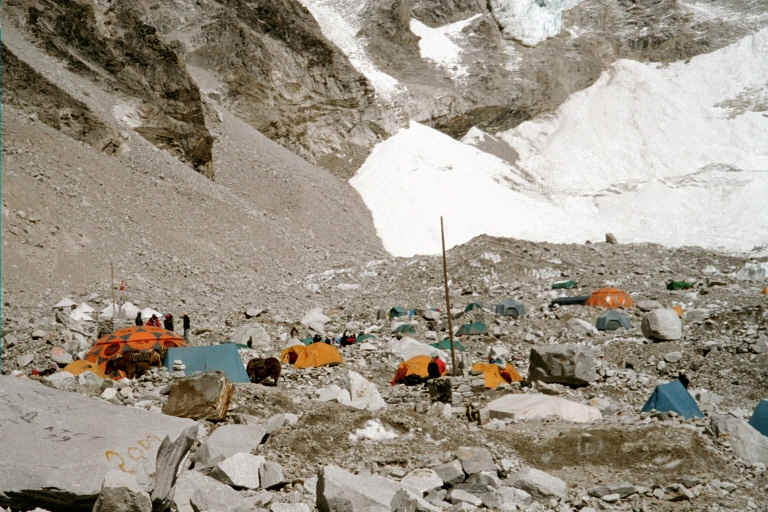
A small section of base camp from my photos taken in 2001.

I recently watched two Everest films. The Man Who Skied Down Everest recommended by Dr. Gerald Stein. It’s a Canadian documentary filmed in 1970 and won the Academy Award for Best Documentary in 1975. Six sherpa were killed during the expedition in a collapse of the Khumbu icefall.

The second was Everest recommended by Vicki Atkinson.  It was a Hollywood film production released in 2015 about the 1996 Everest blizzard that killed eight people.

In the 1975 film, it took a team of 800 people to support getting the supplies the expedition needed to the mountain. But there were very few other climbers on the mountain.

In the Everest film, they got to the mountain much like I did and there were so many more climbers. Teams tried to organize the summit attempts so that climbers weren’t slowed down and freezing while waiting for their turn at choke points like the Hillary Step. In that film, they attributed the change in the number of climbers to Rob Hall, the incredibly infusive and strong guide from New Zealand who died in the storm, being willing to guide amateur climbers up Everest.

In a lot of climbing circles, it’s believed the trend actually started when Dick Bass (who owned Alta ski resort in Utah) and Frank Wells (who was President of Disney) dreamed up the project to climb the tallest peak on each continent, The Seven Summits. Dick and Frank then they hired people like my friend, Phil, to guide them up the mountains.

Regardless, there is no doubt there are challenges climbing Everest today that come from overcrowding and general human behavior like selfishness, ego, and disregard for nature. It’s not hard to imagine the Everest challenges as a fitting allegory about our world overall.

Thankfully, there are also heroes in the story.

When Beck Weathers needed to be helped down the mountain, filmmaker David Breashears and climber Ed Viesturs tied him in between them and basically walked him down as far as they could. David and Ed were up there along filming an IMAX film with Jamling Norgay, the son of the Tenzing Norgay. Tenzing was the Sherpa that successfully achieved the first ascent of Everest with Edmund Hillary.

I am in awe of the filmmakers who capture this incredible climbing footage. In an interview, I heard David Breashears describe how he practiced loading the IMAX film in a special cold room. He had to do it without gloves on because a speck on that film would look enormous on an IMAX screen. Each roll of film only captured 90 seconds of footage.

Filmmakers like David Breashears and Jimmy Chin (Free Solo and Meru), do all the work to film it, manage the extra weight, and execute their creative artistry while they are also doing the hard work of climbing. When they do it well, they make it easy to forget that they are climbing too.

In 1996, when the blizzard hit, the IMAX team was at base camp. They’d seen the crowds and had decided to delay their summit bid. When they heard that people were in trouble and dying, David Breashears told rescuers they could take any of the IMAX team supplies like oxygen tanks, batteries, and food stashed on the upper mountain they needed.

After David and his team offered their supplies and helped evacuate injured climbers, they still managed to summit Everest a couple weeks later and complete their project, albeit with very heavy hearts. The resulting movie Everest (same title as the film above but released in 1998) is the highest-grossing IMAX film.

I was writing this post about the differences on Everest from these two movies when I learned that mountain-climber Lou Whittaker died at age 95. So I switched to writing the post, The Lingering Effects of One Good Person. In the process, I learned that David Breashears also died in March of natural causes. He was 68-years-old. In recent years, David Breashears started Glacier Works, a non-profit highlighting changes to Himalayan glaciers.

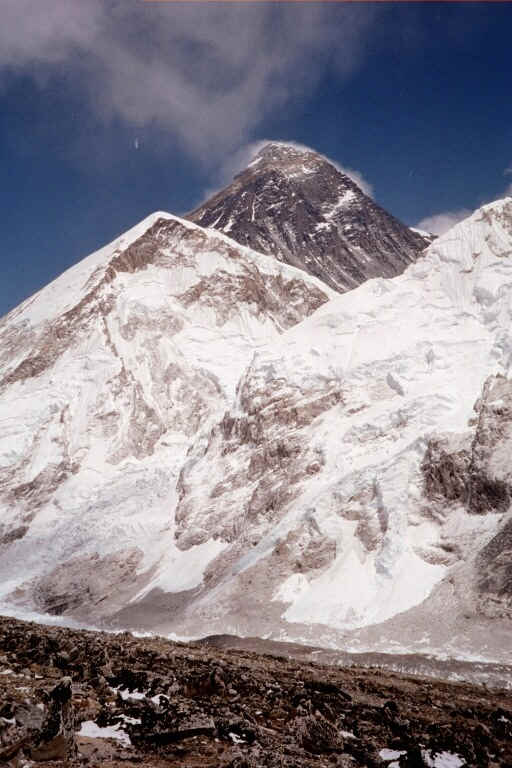
(featured photo is mine of Everest, the dark peak in the back)
The Lens We Look Through

Gotta move different when you want different.” – unknown

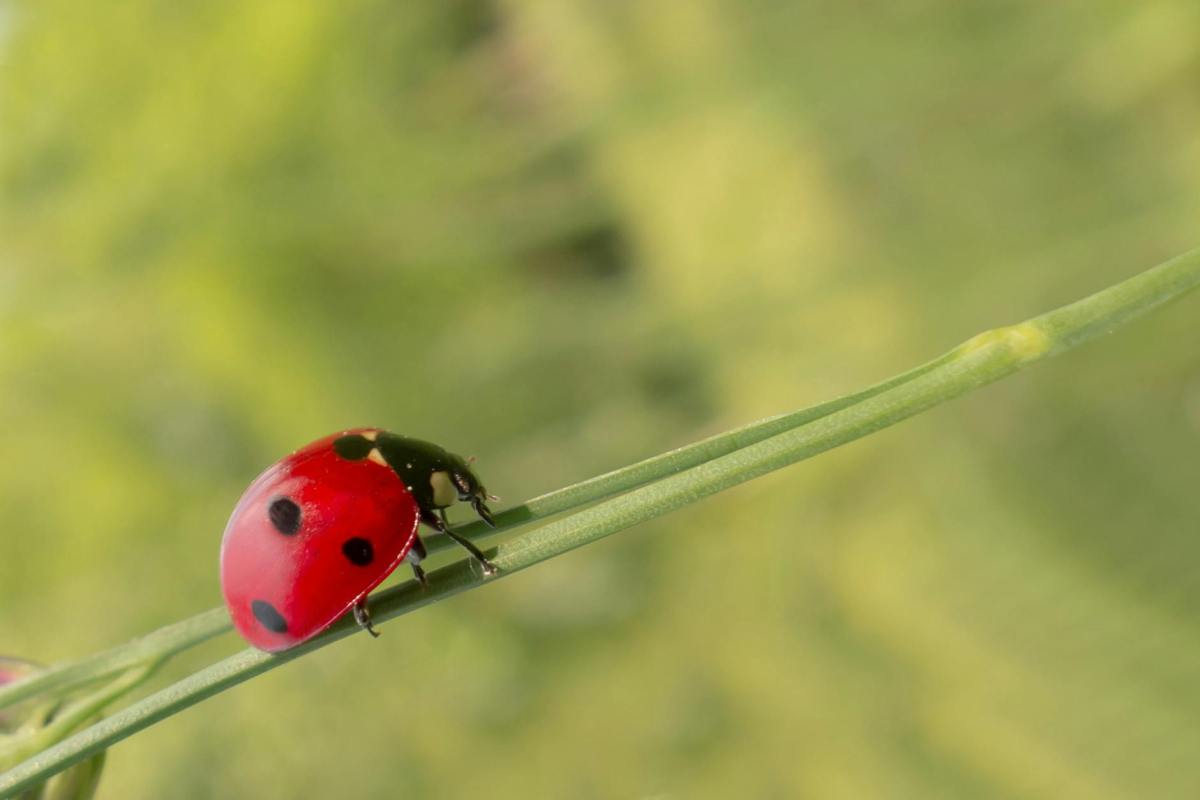
The other day on a weekend I was trying to get my children out the door to go to the zoo. I looked over and both my children were lying on the floor near the back door looking at a lady bug.

When was the last time you laid on the ground to look at something? My dad used to joke that he knew he was getting older because he’d bend over to tie his shoes and look around for anything else he needed to do when he was down there.

There’s a scientific reason that adults aren’t usually found on the floor looking at insects and children are. According to Dr. Alison Gopnik, a professor of psychology at UC Berkeley, young brains are wired to be attracted to the things that can teach them the most. Adult brains are wired to be attracted to things that reward them the most. And unless you are an entomologist, you probably aren’t rewarded for studying bugs.

But there are times when the adult brain gets stuck. In our grooved pathways that Dr. Gopnik likens to boulevards, adults can cruise back and forth much quicker than children but we don’t always rethink how we got there. Kids brains have neural pathways that look more like the streets of Old Paris. Windy, slow-going but able to approach something from many directions.

Getting stuck might be in a mindset or unable to solve a problem. We can be in a rut in a relationship or unable to see the other side of an argument. Or we can just be downright bored and completely unable to see what it could take to change it.

And that’s when we need to do something entirely different.  When we are stuck, the best advice is to do something else. We can go for a walk. Or we can learn to play. Or we can travel. We can even get down onto the floor with some kids. Doing something different will help us come back to what we are doing with newfound perspective and energy.

The other day, my first reaction to seeing my kids on the floor looking at the ladybug was frustration. I was stuck in my mindset of getting us to where we wanted to go efficiently. But after a moment I relented and got down on the floor and looked at the lady bug too. There was awe to be found in a tiny bug spreading her wings and twitching her antennae in a pool on sunlight.

There was also irony that I didn’t want to take time to look at a living creature because I was too busy trying to get us to the zoo. We ushered the lady bug out the door before leaving ourselves, still awash in the wonder of when you do something different.

(featured photo from Pexels)

The Longer I Live, The Less I Know

One filled with joy preaches without preaching.” – Mother Teresa

A few weeks ago, an author replied to a comment I’d made on their blog post about meditation. It was something along the lines that I practice more than I preach. It was a genial comment totally appropriate for the conversation.

But it set me back on my heels. Do I come across as if I’m preaching? Heck no, that was my dear father who had the credentials, platform, and audience who asked for it.

It sparked some introspection. I feel some sensitivity in claiming to be an expert in anything. Even in my career that I’ve done for 30 years and have achieved some external accolades, I tend to play down my credentials.

When I think about what works for me, specifically meditation, I know how personal it is to me. My conversations with my beloved dad about his faith were all about how my expression of faith and his differed. Those conversations taught me much – including that I’m more comfortable with working out what works for me, and less comfortable assuming I know what works for others.

Writing has provided me the opportunity to mine a deep well of stories about my children. I consider my children as the experts at being unapologetically human and naturally close to the Source, especially in these younger years. I write to capture what they teach me and the ever-present challenge it is to love well and keep growing.

If I had to name what I’m good at, I’d say it’s having a willingness to try. In the last ten years, and I credit both meditation and my children, I’ve been able to cultivate an openness to others and to life that has helped me learn.

So I reached the ironic point in my introspection, because I think the more I practice, the less I preach. The more that meditation helps to create space between me and my ego, the less I need to control. The longer I do it, the less I know, but the more I believe.

When I screw it up, like a dozen times a day, I get to practice returning. But when I’m in that flow, it improves my ability to listen to the Divine. It’s solidified my goals to love bigger, show up more vulnerably, and help more.

Is that preachy? I hope not.

My book about the conversations and my journey to find what fueled my dad’s indelible spark and twinkle can be found on Amazon: Finding My Father’s Faith

(featured photo is of my dear dad at a speaking engagement)

Hurrying Never Helps

God did not create hurry.” – Finnish Proverb

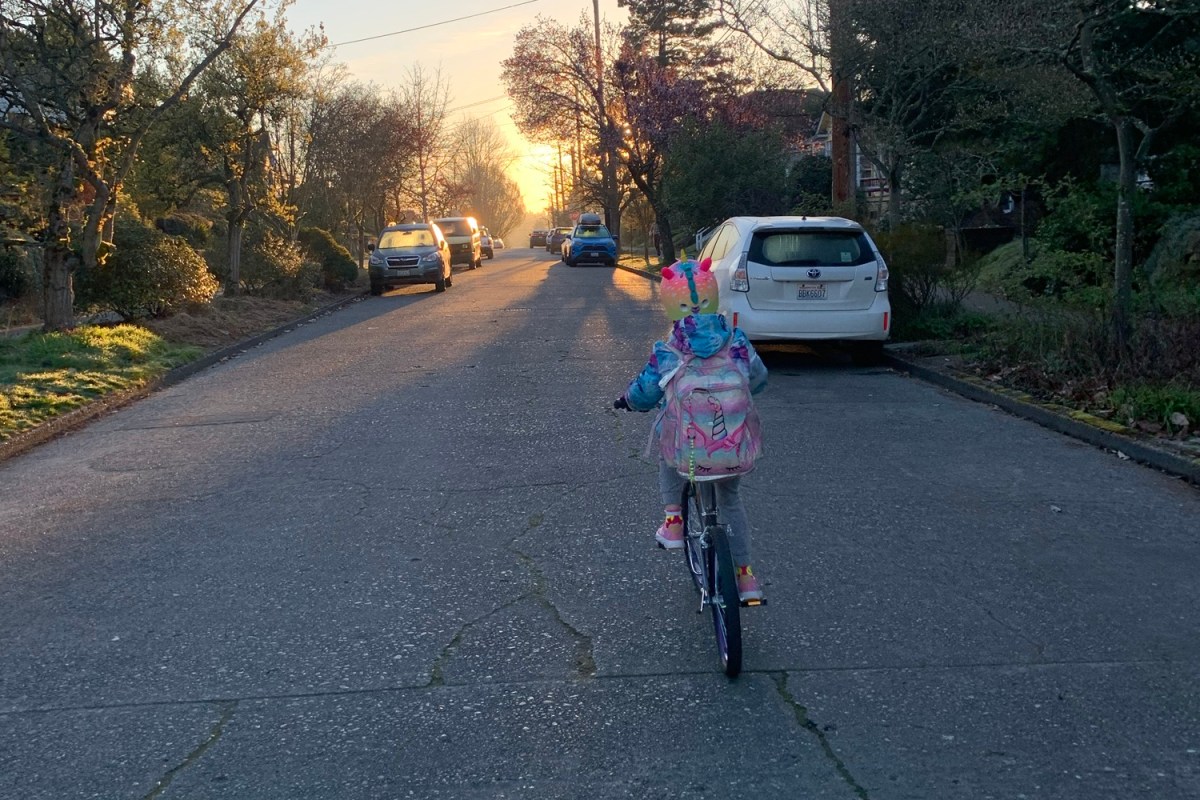
We’ve been riding bikes to school this week. Primarily because it makes four-year-old Mr. D happier to do drop off at his school. Why that is, I’m not sure. Because we get the endorphins flowing? Because it makes him feel strong and successful? Perhaps. It seems that right now he’s realized the world is big and he is small. His inclination is to want to stay home in his safe space. But when we ride bikes to school, the threshold into his classroom doesn’t seem like that big of a deal and he has a great day.

Anyway, the hero of this story is eight-year-old Miss O. She’s been totally game to ride bikes if it helps her brother.

After the first day we did it, I told her it worked to help Mr. D have a great day. She said, “That’s great. But we have to find a different way.” But then she got up ready to ride again the next day.

Sometimes I don’t realize what things are big efforts for my little people, Miss O in particular. In this case, we drop her off first before Mr. D and I continue on to his school. But she rides her own bike while Mr. D rides attached to mine on a third wheel.

We have to get up earlier, it’s uphill for the first six blocks, and she wants to lead, so she’s taking on that responsibility too. It behooves me to remember the things that help me to do hard things: just start, remember to feed and water the body, and to take things one step at a time.

I tend to forget all that if we are running late.

On Wednesday morning we headed off later than usual and Miss O’s bike was rattling. I thought it was just the chain guard pressed against the chain and told her to keep riding. We got around the first corner and she said, “this is really freaking me out.

I did not want to stop. We were late! But I had her get off her bike and found a section of the chain guard that had bent and was clipping the chain at every turn.

We got back on the bikes. About six blocks later when we’d finished the uphill, Miss O said, “I need a break.

Oh holy cow, my inner voice demanded. You’ve got to be kidding me. But I remembered the things that help to do hard things and edited that voice before it came out. “Okay, Sweetie. How about a swig of water?”

The number one thing I need to do in order to help myself and my kids try hard things is to try not to hurry. If I don’t add time pressure to whatever else it is we’re trying to do, including the things I do solo in the day, it always goes better. I am more patient with others, I have less tendency to want to jump in and do it myself, and specific to my kids, we can enjoy more of their lantern brain where they see and observe everything around them. Like on this ride when Miss O heard a woodpecker in a tree somewhere around block four. Such a distinctive and interesting sound.

The number one thing I regularly screw up is not leaving early. Then I have to swallow my own anxiety about being late in order to help them have a positive experience with trying. Fortunately, I managed to do tamp down the time pressure on this ride and we got Miss O to school on time-ish.

Note to self: Hurrying makes life less enjoyable. Keep trying to leave earlier.

Fear and Courage

A man with outward courage dares to die, a man with inner courage dares to live.” – Lao Tzu

This was published previously on 3/22/2023. Heads up – you may have already read this.


Before I left for three-hours the other day, I told my three-year-old son that his favorite babysitter was going to come hang out with him. Because he adores her, I was surprised at his answer and the vehemence with which it was said, “This is dumb. I don’t like her. No, you can’t go.”

It took me a second to realize that the last time I left him with her, it was for four days. I started to explain, “I’m just going to be gone for a few hours.”

He replied, “Mama, I’m scared.

As soon as he said he was scared, his mood changed from angry to calm. It’s like it popped the bubble of fear so that we could move on.

I said, “Right. I can understand that. But I’m not going on a trip. I’ll be back by lunchtime.

He said cheerily, “Kay. How bout this deal? I play with her and then we’ll have lunch.”

Deal.

“Everything you’ve ever wanted is on the other side of fear.”

George Adair

I think somehow I missed the memo about acknowledging fear. Growing up in a household with infectiously joyful and confident parents led me to assume they didn’t have any fears. So I’ve blustered through life without admitting my own.

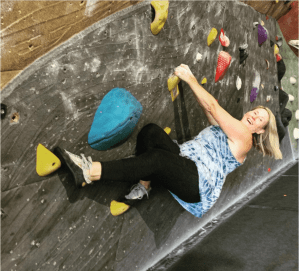
One of the most ironic is that I have a fear of heights and yet I choose mountain climbing and rock climbing as hobbies and tried to just stampede over my fear. I remember a few years back doing a bouldering route at the climbing gym. These bouldering routes 12 -18 feet high and are climbed without ropes in a section of the gym padded with thick mats. I was on a wall that was angled out so I was climbing horizontally, my body almost parallel to the ground, couldn’t see what I was reaching for, and needed to shift my weight carefully to stay on the wall. I was in a position somewhat like I am in the photo below but I wasn’t smiling!

All of a sudden, I felt the full impact of my fear which amped up because I was five months pregnant at the time. I couldn’t move, my arms felt like they weighed two tons, I felt a heat flush all over my body. Then it passed, and I was 10 feet up, completely exhausted and wrung out. I managed to down climb a couple of feet and drop from there, landing on my feet and rolling tiredly onto my back.

I still climb – but not without acknowledging my fear before I get on the wall. It’s like saying “hello” on flat ground so I don’t have to greet it on trickier ground. I also didn’t climb again while I was pregnant. Regardless of all the assurances that babies in utero are fine being jostled, I realized it magnified my anxiety too exponentially.

This incident in concert with becoming more willing to be authentic and vulnerable have led me to understand that there is more room for courage once I let out my fear. That is to say, once I admit I’m afraid, it’s like a full exhale, after which I can take in a deep breath of courage.

“The perfect breath is this: Breathe in for about 5.5 seconds, then exhale for 5.5 seconds.”

James Nestor in Breathe

I bring up the perfect breath as described in James Nestor’s book Breathe because it has a spiritual connection. Nestor also notes that if we recite the Ava Maria or Om Mani Padme Om or the Sa Ta Ma Na (Kundalini Chant) – they all take about the same amount of time of 5.5 seconds.

That ties to the final element to expressing my fear that I’ve found to be at play – the spiritual connection. It isn’t until I own my vulnerability that I can receive help. Sometimes that’s from another person but more often it’s delivered in spiritual and mysterious ways. It’s the element I couldn’t see about my dad – that he didn’t seem to have any fears because he had so much faith.

“Our strength with continue if we allow ourselves the courage to feel scared, weak, and vulnerable.”

Melody Beattie

My lived experience resonates with Melody Beattie’s words. We can’t receive courage until we acknowledge that we need it because we’re afraid. Whether it’s taking on a bully, walking your authentic and individual path, risking to be vulnerable in a relationship, or any of the other million ways we need courage, I’ve found the relief comes much more quickly if we don’t muscle our way through but simply say, as my son did, “I’m scared.

(featured photo from Pexels)

When Life Gives You Lemons, Your Family Should Help You Squeeze

A child can teach an adult three things: To be happy for no reason, To always be busy with something, and To know how to demand with all his might that which he desires.” – Paulo Coehlo

This weekend I found myself in the questionable position of rooting against my four-year-old son, Mr. D.

Mr. D is very good at demanding with all his might that which he desires. When I put it that way, in the words of the quote for this post from Paulo Coehlo, it sounds a lot more romantic than some of the silly situations that we find ourselves in. Like yesterday when Mr. D insisted that we take pickleball racquets to church.

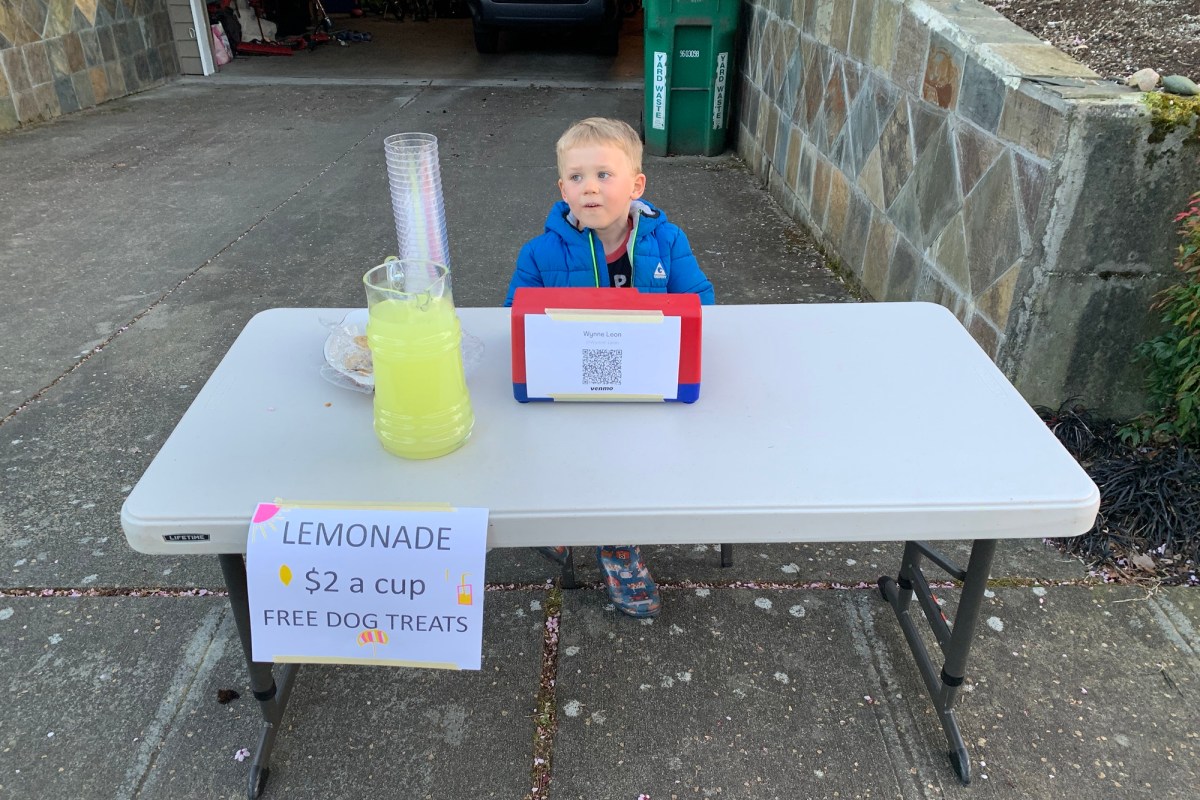
But on Friday night when he stubbornly insisted on having a lemonade stand, it wasn’t entirely out of the blue. He’d asked me earlier in the day and I said he could do it when eight-year-old Miss O came home from school.

When he asked Miss O, she said she’d do it after she had a little iPad time. So by the time everyone was ready to do it, it was 6pm and the March chill had settled in.

Miss O and I tried to convince Mr. D that Saturday, when it was forecasted to be 70 degrees was a better time to do it. He dug in and insisted we do it right then.

Miss O was mad, and I was irritated. But we hauled the table out to the sidewalk, balanced glasses and the toy cash register, and set it all up. Mr. D got into position behind the table and started calling, “Lemonade, get your lemonade” to no one in particular because there wasn’t traffic of any kind.

As I stood off to the side, I realized I was hoping no one would show. And that realization kicked me upside the head. Isn’t one of the big challenges of life and love to support and encourage others even when (or especially if) they choose to do things differently than we would? Maybe this was my opportunity to practice supporting my kids in their age-appropriate decisions, starting with a lemonade stand.

But it’s hard when I’m pretty certain I’m right. After about 20 minutes of no one coming by, I nodded to Mr. D and asked if he wanted to go watch shows. I didn’t start in with a lecture but just held his hand as we walked upstairs together. After all, entrepreneurial failure is disappointing all on its own without your family piling on.

And then Mr. D and Miss O did another lemonade stand on Saturday when it was warmer. If nothing else, I can support a willingness to keep trying. I didn’t agree with Mr. D’s decision to buy paint brushes with his half of the $13 of earnings. But I guess that was my continued opportunity to practice offering my opinion and then keep quiet. The hard work of love…

Wide Angle Moments

We are like someone in a very dark night over whom lightning flashes again and again.” Maimonides

Last weekend, I had a moment of clarity-induced panic. Unfortunately, it happened to come while I was giving a short presentation at a company meeting to about 200+ people.

The company I work for has bi-annual events where families are invited. I’d flown with my kids to this event in New Orleans. The event planners did a great job of getting us all set up at the hotel, arranging group meals, and scheduling some fun outings. It was a nice opportunity to see people face-to-face that we only get to work with remotely.

Then came the company meeting for just the employees. I rushed Mr. D and Miss O through breakfast, got them settled down in our hotel room, and left them with three instructions:

  1. Don’t leave the room
  2. If you need anything, I’m on the 10th floor
  3. Stay together no matter what

When it came time for my five-minute presentation, I walked up to the podium and glanced at my notes. I started with a joke. Then looking at the audience, I had that moment of clarity-induced panic.

  1. I was the only woman leading a business unit and the only woman presenting at the meeting
  2. No one else with small children had traveled by themselves
  3. What the heck was I thinking?

I’ve come to think of these “what the heck” moments as wide-angle views of my life. The ones where I get a glimpse of a little bit more than just the task at hand. I’ve had them in mountain and rock climbing, my marriage, and parenting.

Often they come with panic of wondering, “Am I on the right path?” Sometimes, and I’m thinking of my marriage, the answer is “no,” but they always flash a wider view of purpose and trajectory. Whether I go forward or back, they’ve always required me to muster up some courage in order to proceed.

In the case of my presentation, it was a sense of wondering whether I’d bitten off more than I could chew and if I belonged. I felt my voice waver and looked down at my slides. I knew the material cold, I’d practiced aloud in my room, so I took a deep breath, and let my muscle memory carry me through.

(featured photo from Pexels)

Complicated Compliments

Life doesn’t come with a manual. It comes with a mother.” – unknown

The other day, four-year-old Mr. D said to me, “Mama, you are the bestest in the whole entire moon.”

Sweet. And I don’t want to minimize that, but he said it to me after I gave him a cookie. I’m sure I can’t be the only person who has a complicated relationship with compliments, especially in families. Do they love us for who we are, the role we play, or what we do for them?

Do you feel that nugget of self-doubt in that last sentence? Me too. It reminds me of the few things I’ve been able to glean in the last fifty years about confidence and compliments.

They have to be right sized for the effort.

My kids keep teaching me this lesson. If I over-praise an effort, it feels insincere.

I have to be able to believe it

There isn’t a compliment in the world that can overcome my inner resistance. This one is fraught for me as a parent. My kids frequently compliment me for being the “bestest” or a “good mom.” But, of course, I’m just a mom and I can’t get everything right. My biggest growth area is mindful eating – not eating in front of devices. For a number of reasons this is complicated and I’m getting it wrong more than right.

So I find myself circling back to my driving principles. My priorities are to help them be kind (including to themselves), safe, and healthy (body, mind, and spirit). And to be present and to love them. If I can aim for most of that, then I try to give myself some grace about the rest.

Compliments are best when I would have done the same thing with or without it.

I would have given Mr. D the cookie whether or not he gave me the compliment. It wasn’t conditional on him saying anything.

So, yes, it feels safe to say that this time I can believe I’m the bestest on the whole moon. After all, it’s only me and a probe that’s tipped sideways in the running. Not that I’m on the moon…. but you know what I mean.

(Mary from Awakening Wonders reminded me of the quote for this post)

(featured photo is from Pexels)

Good Mood of the Soul

Find a place inside where there’s joy, and the joy will burn out the pain.” – Joseph Campbell

This post was originally published on 8/10/2022. Heads up – you may have already read this.


Recently, a friend sent me a printout of a sermon that my dad, who was a Presbyterian pastor, gave on parenting 36 years ago. She had a printed copy and kept it filed away. Now that her kids are long grown, she sent it to me.

In it, my dad gives a quick synopsis of his children’s personalities, “We look at our three children and see that their responses to life were distinctly different from day one. Our first child was laid back and relaxed … our second was wound up so tight she couldn’t keep her head still to nurse … our third was happy and charming. They had those marks when they were born … they still have them today.”

I’m the third one. That was written when I was 17 years old. But there’s something about family patterns that keep us trapped in roles from which we need to move on from. For me that was moving from happy to joyful.

In her recent book, Atlas of the Heart, researcher and author Brené Brown defines happiness as “Looking at the data we’ve collected, I would define the state of happiness as feeling pleasure often related to the immediate environment or current circumstances.

And that fits pretty well with the list I can name of the things that make me happy:

  • Dance parties with my kids
  • Finishing a shower without interruption from my kids
  • Hearing a song I loved from college in the grocery store
  • A vanilla milkshake on a hot summer day

When I discovered meditation and mindfulness during my travels through the less pleasant periods of my life, it taught me that joy is a different feeling altogether. Brené Brown says she thinks of joy as “‘the good mood of the soul.’” She defines it based on her research as, “An intense feeling of deep spiritual connection, pleasure and appreciation.”

For me joy comes when I let go of seeking and preference. As poet Mark Nepo said, “One key to knowing joy is being easily pleased.” It’s cultivating my awareness of what is already present and my delight at the magic in the air. It works when I stop narrowing my field of vision to my agenda and open to all there is. Not surprisingly, researchers have connected joy to gratitude and describe the two together as “an intriguing upward spiral.’ (from Atlas of the Heart). Gratitude increases our ability to feel joy, joy makes it easier to find gratitude and so on.

And here are the things that make me joyful:

  • Every time I get to wake up and witness a sunrise
  • Catching a glimpse of my kids in a circle with the other kids in the neighborhood leaning heads in to examine some fascinating part of life
  • Holding hands
  • Hearing the clink of glasses at a dinner with dear friends
  • Witnessing a whale surface to breathe
  • Listening to the Bach Cello Suites played by Yo-Yo Ma
  • The view from the top of a mountain no matter how breathless, exhausted and cold I am
  • Anything that comes out of a conversation that starts with “How can I be of help?”

The conditions of happiness are specific and fleeting. I’m frequently happy but it certainly isn’t a constant.

The conditions of joy are deep and enduring. They represent ties in my life, beauty of this world and things I’ve worked to make priorities. It is the current underneath my mood. It’s the reward for when I’m aligned with my values.

For the times of my life where I’ve felt like I’m stuck, wading through glue or too busy taking care of others to take care of myself – it’s joy that pulled me through, making it worthwhile all the way. I might have been born happy, but I’m grateful to live joyfully.

(featured photo from Pexels)

The March of Time

Patience is a bitter plant, but its fruit is sweet.” – Chinese Proverb

I’m not friends with March. As a month, it’s long and slow. It has no holidays, in the U.S. at least. It feels like a placeholder month to me. March is the month in which I’m more likely to be irritated that my eight-year-old daughter, Miss O, has used my Tupperware for slime, my four-year-old son, Mr. D, only brushes the outside of his teeth, and Cooper the dog thinks that keep away is a fun game.

March wreaks havoc with my already-prevalent tendency towards impatience. It feels like the month that the year is most pregnant. Something great is about to burst onto the scene but for now, it’s nothing we can see or hold.

So, yesterday, on my third day of my penance, also known as March, that I made waffles with jam inside. Miss O said, “We are so lucky. And it’s not just me that’s lucky, but our whole family.

Dang. I’m being an ingrate. But as she said that, I also realized that what I’m pregnant with at this moment is hope. Yes, the laundry hasn’t been done, the dishwasher needs to be emptied, I haven’t started my taxes, and the yard looks like a mud pit interspersed with construction toys.

But I’m hopeful that some of the projects we started will get done. That some of the lessons we’ve been learning will stick. And that I will learn to be patient while the Higher Power works hand in hand with sunshine to make it happen.

For all of my childhood, one of our biggest family celebrations was Easter. My mom would spend all of March making me a new Easter dress, measuring, sewing, trying it on, usually right up to the night before.

Maybe that’s one of the seeds of my impatience with March. Waiting for the resurrection. Whether or not that matches your theology, I think Spring brings the hope of better things to come. I just have to remember to be grateful. And also note that bird song, blooms, and better sunshine are worth waiting for.

(featured photo from Pexels)