The Imposter Syndrome In Blogging

Write without pay until somebody offers to pay.” – Mark Twain

The was originally published on 5/3/2023. Heads up – you may have already read this.


On a recent podcast, Dan Harris was telling a story about when he suggested to his wife, a physician who graduated top in her class from a prestigious medical school and has practiced at some of the best teaching hospitals, that she might suffer from Imposter’s Syndrome. His wife’s response made me laugh out loud. Dan said it was something like “It’s interesting that some other people felt like that but I really AM an imposter.”

This Ten Percent Happier podcast with Dr. Valerie Young, an expert on the syndrome for more than 40 years, is fascinating for their deep dive in Imposter Syndrome or “feeling like a fraud, despite evidence to the contrary.” She also noted that some areas are more susceptible to this kind of thinking and being creative is one of them. According to Dr. Young, “when you are in a creative field, you are only as good as your last book or your last performance.

Or, to expand on the professor’s point — your last blog post. That really resonated with me. Here’s why I think that.

I didn’t go to school for it.

In my professional life, I’m an expert in Microsoft collaboration software – things like creating structure and process about where people put and find their files, and workflow (e.g. how do I submit something for approval?).

Does my electrical engineering degree have any bearing on that? No. Outside of some basic troubleshooting and thinking skills, there isn’t any relationship between my degree and what I do now. I could draw a similarly loose relationship between the writing classes and I took in college and writing now, but I wouldn’t ever call myself an expert because….

Writing has been around a long time.

Writing has been around for about 5,500 years. I’m pulling that number from this delightful Psychology Today article about The Evolution of the Written Word. It’s a lot easier to feel like I know a good deal about collaborative software even though it changes daily and I’m always have to look something up. But writing? Well, there’s been Shakespeare, Fitzgerald, Garcia Marquez, Rushdie, and Hemingway and just typing that list makes me remember all that I don’t even know about the great writers, much less about writing.

No one pays me to write

For whatever I do and do not know about Microsoft software, I’ve been able to make a living out of a career providing consulting services around it. I’ve even published a couple of technical books, some of the least profitable parts of my career, which doesn’t bode well for me making a living from writing. But no one pays me to write, or at least not that I’ve managed to figure out yet, which makes me lack in the most basic form of transactional affirmation.

For some people, and I’m thinking of my colleague, Jack Canfora, who have made a go of writing as a career, the mantel of a writer seems to fit a lot better. Which affirms my inclination to think of myself as just a hobbyist.

And yet…

So why persist as a writer? Because writing feels more meaningful than any single consulting project I’ve ever done. Because writing requires me to dig deep and put myself out there is a way that is not required with computer consulting. Because writing about life creates a goodness in my experience that increases my enjoyment in life.

Here’s what I’ve concluded. Sure, sometimes (or a lot of times), I feel like an imposter as a writer and I know I’m not alone in that feeling. But every one who lives their authentic words out on paper can’t be an imposter to their experience. Any one who has hit the word “publish” has indeed created something. No one who uses words to create feelings in others and communicate should suffer from the distinction that others may have done it better. All who bleed, figuratively speaking, to put themselves out there should be proud of the effort.

What about you? Do you feel like you’ve suffered from Imposter Syndrome as a creative? What have you done to combat it?

(featured photo from Pexels)

Fear and Courage

A man with outward courage dares to die, a man with inner courage dares to live.” – Lao Tzu

This was published previously on 3/22/2023. Heads up – you may have already read this.


Before I left for three-hours the other day, I told my three-year-old son that his favorite babysitter was going to come hang out with him. Because he adores her, I was surprised at his answer and the vehemence with which it was said, “This is dumb. I don’t like her. No, you can’t go.”

It took me a second to realize that the last time I left him with her, it was for four days. I started to explain, “I’m just going to be gone for a few hours.”

He replied, “Mama, I’m scared.

As soon as he said he was scared, his mood changed from angry to calm. It’s like it popped the bubble of fear so that we could move on.

I said, “Right. I can understand that. But I’m not going on a trip. I’ll be back by lunchtime.

He said cheerily, “Kay. How bout this deal? I play with her and then we’ll have lunch.”

Deal.

“Everything you’ve ever wanted is on the other side of fear.”

George Adair

I think somehow I missed the memo about acknowledging fear. Growing up in a household with infectiously joyful and confident parents led me to assume they didn’t have any fears. So I’ve blustered through life without admitting my own.

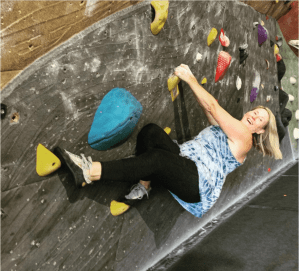
One of the most ironic is that I have a fear of heights and yet I choose mountain climbing and rock climbing as hobbies and tried to just stampede over my fear. I remember a few years back doing a bouldering route at the climbing gym. These bouldering routes 12 -18 feet high and are climbed without ropes in a section of the gym padded with thick mats. I was on a wall that was angled out so I was climbing horizontally, my body almost parallel to the ground, couldn’t see what I was reaching for, and needed to shift my weight carefully to stay on the wall. I was in a position somewhat like I am in the photo below but I wasn’t smiling!

All of a sudden, I felt the full impact of my fear which amped up because I was five months pregnant at the time. I couldn’t move, my arms felt like they weighed two tons, I felt a heat flush all over my body. Then it passed, and I was 10 feet up, completely exhausted and wrung out. I managed to down climb a couple of feet and drop from there, landing on my feet and rolling tiredly onto my back.

I still climb – but not without acknowledging my fear before I get on the wall. It’s like saying “hello” on flat ground so I don’t have to greet it on trickier ground. I also didn’t climb again while I was pregnant. Regardless of all the assurances that babies in utero are fine being jostled, I realized it magnified my anxiety too exponentially.

This incident in concert with becoming more willing to be authentic and vulnerable have led me to understand that there is more room for courage once I let out my fear. That is to say, once I admit I’m afraid, it’s like a full exhale, after which I can take in a deep breath of courage.

“The perfect breath is this: Breathe in for about 5.5 seconds, then exhale for 5.5 seconds.”

James Nestor in Breathe

I bring up the perfect breath as described in James Nestor’s book Breathe because it has a spiritual connection. Nestor also notes that if we recite the Ava Maria or Om Mani Padme Om or the Sa Ta Ma Na (Kundalini Chant) – they all take about the same amount of time of 5.5 seconds.

That ties to the final element to expressing my fear that I’ve found to be at play – the spiritual connection. It isn’t until I own my vulnerability that I can receive help. Sometimes that’s from another person but more often it’s delivered in spiritual and mysterious ways. It’s the element I couldn’t see about my dad – that he didn’t seem to have any fears because he had so much faith.

“Our strength with continue if we allow ourselves the courage to feel scared, weak, and vulnerable.”

Melody Beattie

My lived experience resonates with Melody Beattie’s words. We can’t receive courage until we acknowledge that we need it because we’re afraid. Whether it’s taking on a bully, walking your authentic and individual path, risking to be vulnerable in a relationship, or any of the other million ways we need courage, I’ve found the relief comes much more quickly if we don’t muscle our way through but simply say, as my son did, “I’m scared.

(featured photo from Pexels)

Complicated Compliments

Life doesn’t come with a manual. It comes with a mother.” – unknown

The other day, four-year-old Mr. D said to me, “Mama, you are the bestest in the whole entire moon.”

Sweet. And I don’t want to minimize that, but he said it to me after I gave him a cookie. I’m sure I can’t be the only person who has a complicated relationship with compliments, especially in families. Do they love us for who we are, the role we play, or what we do for them?

Do you feel that nugget of self-doubt in that last sentence? Me too. It reminds me of the few things I’ve been able to glean in the last fifty years about confidence and compliments.

They have to be right sized for the effort.

My kids keep teaching me this lesson. If I over-praise an effort, it feels insincere.

I have to be able to believe it

There isn’t a compliment in the world that can overcome my inner resistance. This one is fraught for me as a parent. My kids frequently compliment me for being the “bestest” or a “good mom.” But, of course, I’m just a mom and I can’t get everything right. My biggest growth area is mindful eating – not eating in front of devices. For a number of reasons this is complicated and I’m getting it wrong more than right.

So I find myself circling back to my driving principles. My priorities are to help them be kind (including to themselves), safe, and healthy (body, mind, and spirit). And to be present and to love them. If I can aim for most of that, then I try to give myself some grace about the rest.

Compliments are best when I would have done the same thing with or without it.

I would have given Mr. D the cookie whether or not he gave me the compliment. It wasn’t conditional on him saying anything.

So, yes, it feels safe to say that this time I can believe I’m the bestest on the whole moon. After all, it’s only me and a probe that’s tipped sideways in the running. Not that I’m on the moon…. but you know what I mean.

(Mary from Awakening Wonders reminded me of the quote for this post)

(featured photo is from Pexels)

Failing Well

Take chances, make mistakes. That’s how you grow. Pain nourishes your courage. You have to fail in order to practice being brave.” – Mary Tyler Moore

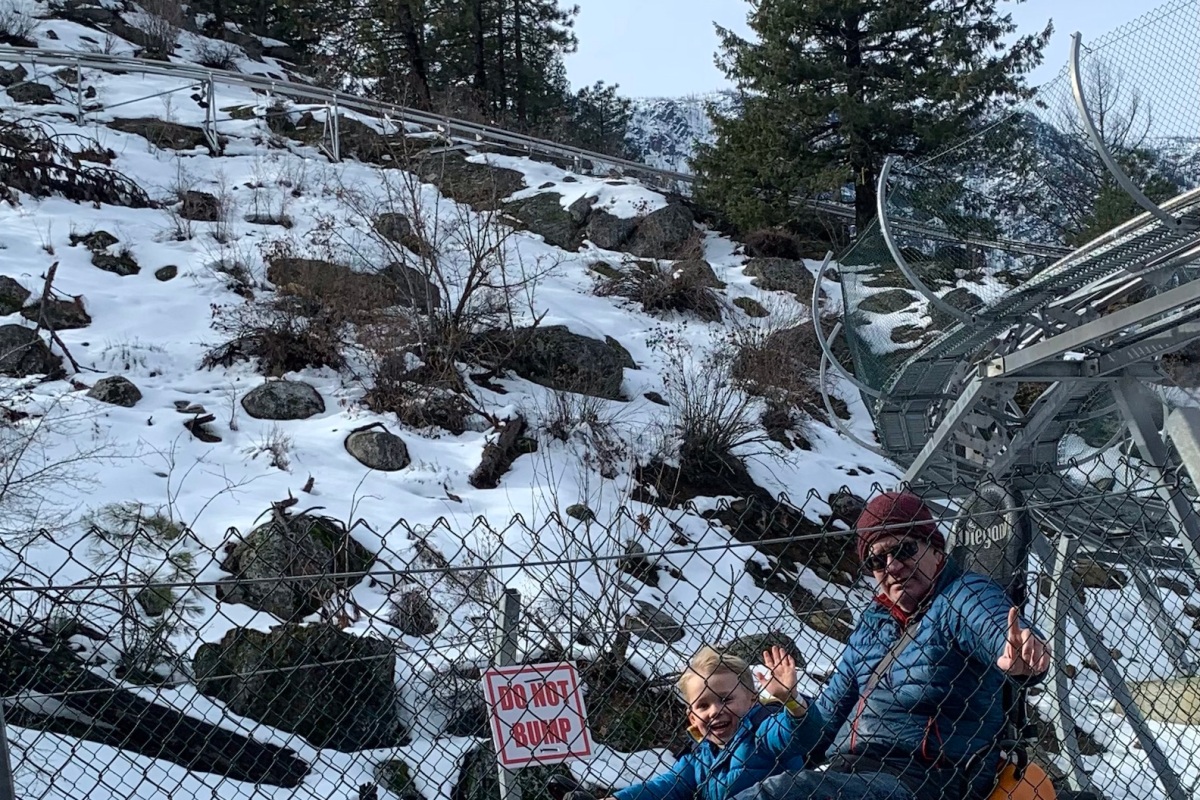
Last weekend when we were in Leavenworth, WA, we went to an adventure park to ride a roller coaster. Or maybe I should say a roller-coaster-ish kind of ride because the cars were individual and the driver could apply the brakes as much as they wanted. Another clarification: by “we” I meant my kids rode with my dear friend, Doug, because I’m an endurance person, not a speed person.

Now that I have all those caveats in place, on with the story.

Eight-year-old Miss O had no hesitation and climbed right in to ride with Doug. Talking with four-year-old Mr. D about it, he was clearly torn. He didn’t want to do it. And then he did. He flip flopped a couple of times. Since I was pretty sure he’d like it, I was trying to figure out how to nudge him in the direction of trying it.

But even though Miss O didn’t hesitate on this challenge, she and I had just been having a conversation about failing when it came to learning to ride her hoverboard. She asserted that life was easier for me because I never failed. I told her I fail all the time which is why is doesn’t faze me much any more. In fact, I rarely think of it as failing but just as a step towards the next thing I need to do.

On the drive to Leavenworth, I’d been listening to the Ten Percent Happier podcast, The Science of Failing Well where Dan Harris was talking with Amy Edmonson, a professor of leadership and management at the Harvard Business School. She had three points that stuck with me about taking risks:

  • Make the risk as small as possible: This point reminded me of gambling – make a bet but don’t put all your chips in.
  • Have a hypothesis: Know what you are trying to test or prove
  • Learn from the attempt: Use the experience and hypothesis to extract information for the next thing you might try.

I think a lot about what creates confidence. What my parents did to create kids who are willing to try hard things because for all the differences between my siblings and me, we are all game to take on new challenges. So I’ve tried to figure out how I can do the same for my kids. While there’s much that remains a mystery to me, what I’ve identified is that my willingness to try and fail might be the single most defining characteristic in the arc of my life.

So, I told Mr. D he didn’t have to do it. But if he did, he only had to try one ride, Doug could go as slow as he wanted, and that I thought he’d like riding in a car on a track. When it came to his turn, Mr. D was a little nervous but resolutely game. Until I greeted him at the exit ramp, that is. He rolled back in with a huge grin on his face!

He had so much fun that he learned he wanted to do it again. And the second time he went up with his hands in the air.

Life is a roller coaster and I’m glad that I continue to ride. The metaphorical kind at least.

(featured photo is mine)

(quote is from Real Life of MSW blog: Being Brave)

Waiting for a Break

We learn how to be resilient and handle difficult things by PRACTICING dealing with difficult things.” – Tina Payne Bryson

We went to our favorite beach on Whidbey Island this weekend. We rented an AirBnB that allowed dogs so it was our puppy, Cooper’s, first vacation.

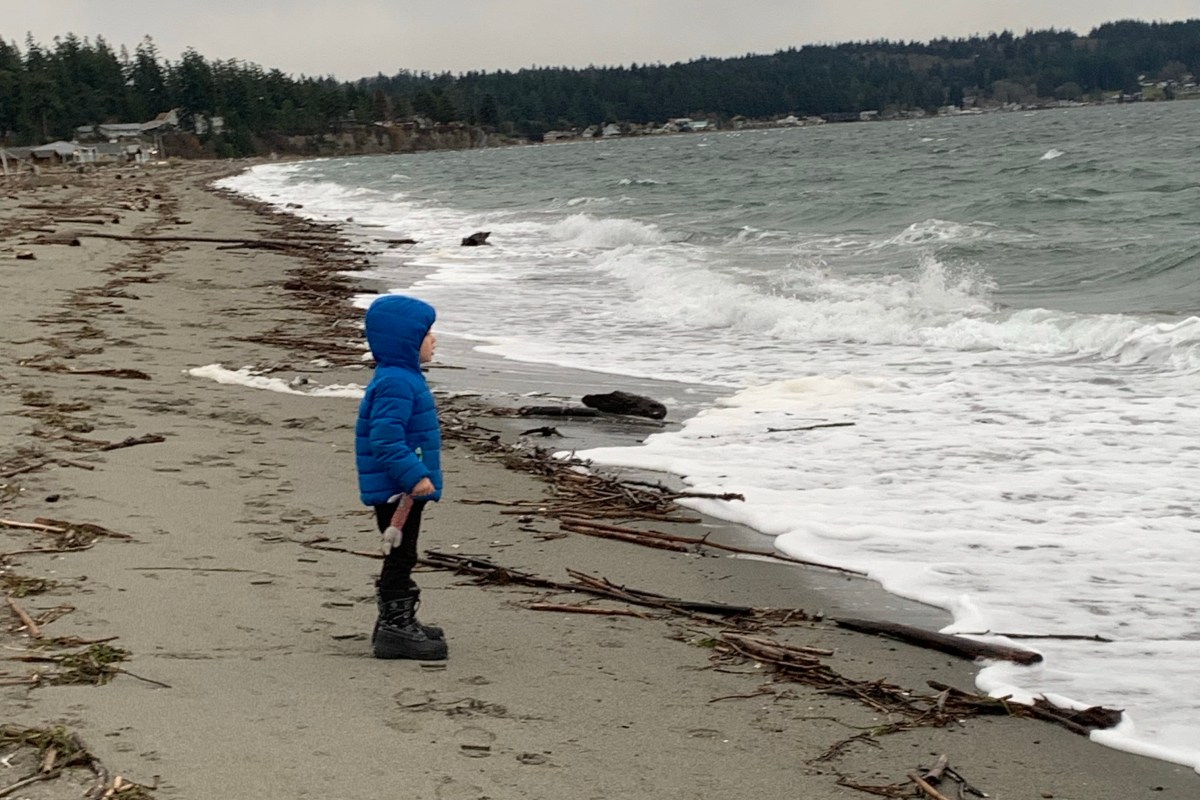
The weather was really blustery. After a particularly stormy week in the Seatle area, there was driftwood all over the beach. When my son, four-year-old Mr. D and my friend, Eric, went down to the beach, Mr D busied himself throwing huge pieces of wood into the water. And by huge, I mean almost as big as he is.

When Eric remarked on this, Mr. D turned to him and said, “I can do hard things.

Here’s the thing about that. Every day for the ten days preceding the vacation, I’d sent Mr. D to school with a note. In the note, it counted down how many sleeps until vacation, explained that we had to go to school/work in order to be able to go on vacation, and ended with the sentence, “We can do hard things.”

Normally Mr. D doesn’t need coaxing to go to school. But coming off of some crud he caught at Thanksgiving, and the dark and stormy days of the last couple of weeks, it felt like he was tired. You know that deep, soul-level tired where even after good night’s sleep it feels like you are exhausted.

Of course, Mr. D cannot yet read but he carried the note with him anyway. He didn’t say much about it. But I knew he was paying attention because the note started ripping in places because it’d been opened and refolded so many times.

Sometimes we have to push through to earn a break. And I’m incredibly heartened to know that when we do, it builds the confidence that “We can do hard things.

Comparing Our Differences

Confidence isn’t thinking you’re better than anyone else, it’s realizing that you have no reason to compare yourself to anyone else.” – Maryam Hasnaa

This was originally published on 6/15/2022. Heads up – you may have already read this.


My 6-year-old daughter came home from school the other day and said she had a bad day. She explained saying that a kid on the playground was comparing her. Not understanding, I asked her to say more. She relayed that he was saying, “I can do the monkey bars faster. I can go longer. I can skip more bars.

Oh, I get it – comparing.

We are all different – so why do we compare? To get some perspective, I turned to research professor Brené Brown’s book Atlas of the Heart. She defines comparison as “Comparison is the crush of conformity from one side and competition from the other – it’s trying to simultaneously fit in and stand out.”

And apparently, we all do comparison: “Researchers Jerry Suls, René Martin, and Ladd Wheeler explain that ‘comparing the self with others, either intentionally or unintentionally, is a pervasive social phenomenon.’”

So we all do comparison but what we have control over is how we let it affect us. I was struck by a comment I heard on a 10 Percent Happier podcast with TV commentator and author Alicia Menendez. She talked about management assessment she once did that measured the difference between who one naturally is with the way one self-presents in the work environment to show how much one is self-correcting. The evaluator said to her “So, you are a very introverted person who is overcompensating to be very extroverted in the environment you are in. You are really tired at the end of the day, aren’t you?

Changing from who we are is exhausting. Maybe we do it because we compare or maybe we do it because we are self-conscious. When I decided to have kids as a single-person at age 46, I was self-conscious of being different. Not that there aren’t other older, single mothers in the world but because there weren’t any in my direct experience.

Comparison to what I thought was the norm made me feel ashamed. It was only after I knew I didn’t want to pass that on to my children that I started owning my differences. That has freed me to do many other things like the post I wrote last week about how I choose to use the time that I otherwise might spend being in a relationship to listen to podcasts and read great books. We are all different, might as well enjoy it. Reading the research that Brené Brown includes in her book reminds me that I don’t have to teach my children not to compare. I only have to teach them to understand how it affects them.

As Brené says about comparing herself to the swimmer in the lane next to hers, “My new strategy is to look at the person in the lane next to me, and say to myself, as if I’m talking to them, Have a great swim. That way I acknowledge the inevitable and make a conscious decision to wish them well and return to my swim.


I also written today about how creativity might be one of our biggest assets for our resumes: Creativity as a Job Skill

(featured photo from Pexels)

Friendship Though the Ages and Stages

Well, you can’t make old friends.” – Zadie Smith

Have you thought back to how you survived middle school? I mean, I think it’s safe to assume anyone that is reading this is past the age of 13. I remember that age as being the start of understanding that there was a whole wide world outside of my family and it involved crushes, hopes and dreams, and weird things happening to my body that I didn’t want to talk about with my mom.

Katie. That’s how I made it through middle school. My dearest friend that I’ve known since age seven. She was over at my house yesterday spending time with me, Miss O, Mr. D and Cooper. I list us all out because we all needed time with her.

She reminds me of a line I got from Mark Nepo in the Book of Awakening. In German, the root of the word friendship means place of high-safety. With old friends, I think that might be especially so because they knew us from before we were anything. We had dreams of what we might become, but now that we’ve hit middle life, we’ve cycled through a lot of different ages and stages, and old friends, like Katie have seen it all.

Because to be friends for this long, I don’t think there’s any way to maintain any artifice. We’ve survived the ups and downs of life as well as testing out the waters of how we meet the world. We’ve had to work out whether we are friendly, trustworthy, and kind – and apologize and make amends when we’ve fallen short.

Watching Katie with my family, I realize that there’s an associative property of friendship. That my little ones trust her as much as I do. Probably because they can sense that ease that comes with old friends. Well, that and because Katie is simply amazing – present, smart, funny, kind, and encouraging.

I think back to my naivety and hopefulness in middle school. It was confusing and emotional as we worked out what came next in life. I’m less naïve now as I know that middle life also brings challenges with family, friends, aging, and loss. But I’m still quite hopeful – probably because I’ve been lucky enough to have a Katie, then and now.

(featured photo is me (left) and Katie (right) – maybe in middle school?)

Try, Try, and Try Again

Courage doesn’t always roar. Sometimes courage is the quiet voice at the end of the day, saying, “I will try again tomorrow.” – Mary Anne Radmacher

I’m sure I’m not the first parent to say that my kids are making me insane. I don’t mean that in a pull-my-hair out kind of way though. I mean it according to the phrase, “insanity is doing the same thing and expecting a different result.”

Because it feels to me that letting my kids do the same thing over and over again, often comes with the different result.

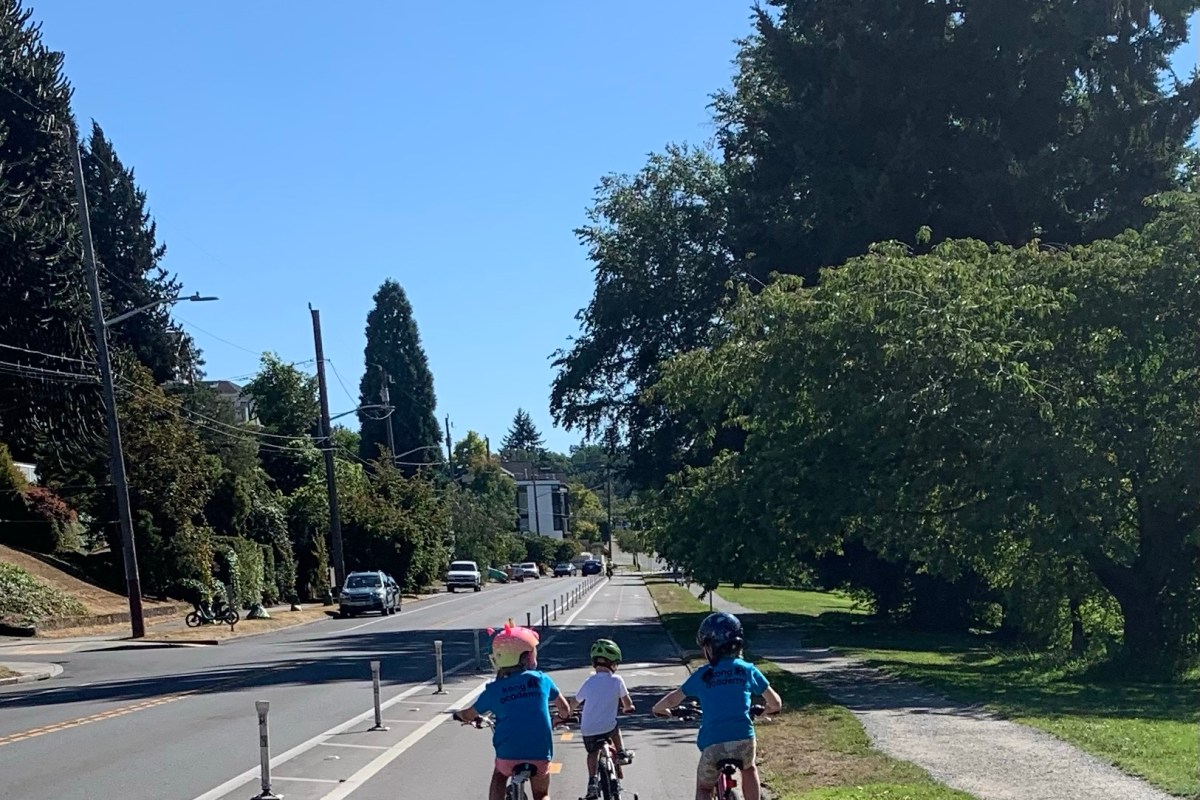
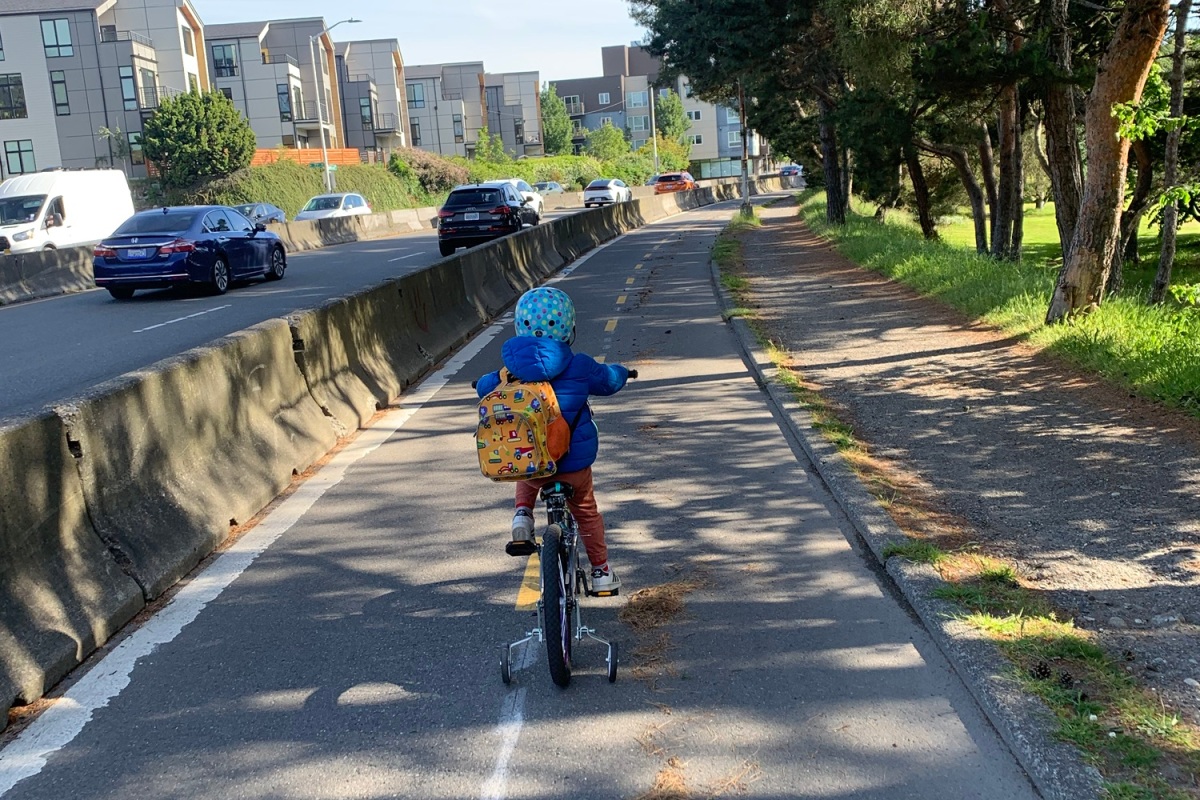
Last week, Mr. D wanted to ride his bike home from pre-school. We couldn’t do it on Monday or Tuesday. But when Wednesday rolled around, I dropped him at school with his bike, that he proudly rolled in to park next to his teacher’s bike, so that we could ride home.

I had Miss O and her friend with me that afternoon so the three of us rode to Mr. D’s school to pick him up. It took us about 10 minutes to get there. Mr. D sagely choose to walk his bike down the hill to the bike path to begin the mile-and-a-half home. Which is a long way on a bike with training wheels, but he, as our leader, bravely started out.

And then 50 yards later stopped and said he couldn’t do it. Uh-oh. We were a long way from home. So I suggested we take a snack break. After a nice snack break in the shade, we were back on the bikes. Mr. D again set off as the leader and this time went about 100 yards before stopping and declaring he couldn’t do it. That time we stopped to look at ants.

In that fashion, we slowly made our way home with a great deal of tension between the two girls who were antsy to race ahead and Mr. D taking breaks. It took us almost an hour-and-a-half.

The next day, Thursday, when we got in the car to take Mr. D to school, he said, “I want to ride my bike home from school.”

Oh boy. I might have rolled my eyes when no one was looking. But here’s the thing – I know he can do it. He’s done it before, just not at the end of the day. So I loaded his bike in the car and dropped him at school. This time when I picked him up, Miss O wasn’t with me and I attached a third wheel seat to the back of my bike so that if he chose not to ride his own, he could sit back there.

For that attempt, he made it about halfway round the lake before he decided to try out the third wheel. I chained his bike to a tree and we rode home that way, even though he’d never wanted to try that “trail-a-bike” before. Then I had to pack up both kids into the car, drive back around the lake to pick up his bike chained to the tree. The result – another hour-and-a-half expedition to pick up Mr. D from school a mile and a half away.

So then Friday rolled around. When we got in the car to take Mr. D to school, he said, “I want to ride my bike home from school.”

This is where the insanity comes in — I said “Okay” and loaded the bike into the car. On the way home, he made it half way round, I chained the bike to the tree and he rode the rest of the way on the third wheel. But it was easier this time and I popped by the tree to pick up his bike when I went to get Thai food after my friend Eric arrived for dinner.

And each time? Well, there were moments of tension but we also had a good time, and had fun trying. My kids constantly remind me that life is insane – in the best way. That the boundaries of what I previously thought I could do are just mental barriers to blow through. That there is joy in trying the same thing over and over again – and getting a different result.


I’ve written a companion piece about kids and joy: Bundle of Whose Joy? on the Heart of the Matter blog. Please pop over there if you have a minute.

Sacred Spaces for Stories

Our actual job as writers is to make the world a little more clear. A little less cluttered. A little less ugly.” – Ann Handley

In my favorite coffee shop, there are three cushy chairs by the window, organized around a low coffee table. I’m usually early enough to get my seat, the one where I can put my tea on the windowsill and plug in my laptop, and then the other chairs eventually fill up. Usually it’s two people by themselves like me but sometimes it’ll be two people together and then since they are facing me, we’re all in it together.

A while back I heard two 50-something women sitting in the chairs together catching up after a while. One was talking about her process for measuring progress on her diet, lamenting the fact that any weight gain or loss she experiences happens three days after she eats (or doesn’t), making the intervening days till the scale registers seem interminable.

She sighed and said she had a friend who was overweight and very happy. “Somedays I think I should just give it up and follow her example. She’s not sweating over everything she eats.”

Her friend replied, “No! For goodness sakes, stay the course.

And then the first woman smiled and said, “Thank you, that’s what friends are for.

As far as blog fodder goes, this seems like totally safe territory. I don’t know these women and will likely never see them again to report on whether the first, who I couldn’t pick out of a lineup, stayed with her eating regimen.

It reminds me of right after I found out about my husband’s (now ex) infidelities and told my friend, Bill, about the drama over dinner in a tiny Japanese restaurant with tables barely a foot apart.

I started the story with my business partner inviting me out to lunch even though we’d never socialized just the two of us. Then I showed up and he’d asked to be seated in a booth in a section of the restaurant that wasn’t open. At this point, I was on pins and needles and felt like I was going to throw up, so that when he finally started down the list of my ex’s infidelities, it was pretty awful but almost a relief from the anticipation.

Then my business partner cooked up a scheme that he’d send me an “anonymous” email with the information so that I didn’t have to tell my ex how I’d found out.

By that evening, the email hadn’t arrived and I had gone out to dinner with my dear friends, Jill and Sue, as planned before the whole drama unfolded. The business partner called to ask if I had gotten the email and I said I hadn’t. He said he was okay if I told my ex I found out from him.

At 5am the next morning when I finally opened the conversation with my ex, “Have you ever been unfaithful to me?” and he answered, “no,” the ball was rolling. His primary question was “how did you find out?

When I couldn’t keep it secret any longer, I revealed the business partner’s role. My ex packed a bag of clothes to check into a hotel and then told me he was going to the business partner’s house. “He betrayed me!” he shouted, completely missing the irony of the comment that we were talking about his infidelity.

As I launched into the part of the story about calling my business partner on 8am that morning (which happened to be New Year’s Eve) telling my ex was heading his way to confront him, I noticed that all the tables around us in that small Japanese restaurant were silent. I didn’t mind. It seemed they all deserved to find out that my ex barged in to the business partner’s house without knocking but didn’t hit him or inflict any other physical damage. He didn’t ever forgive him though.

So maybe I ended up as blog fodder for someone else. Fair enough – I don’t mind on many levels, the most obvious one being that I shared it in a public space.

Of course, this becomes a trickier balance when we blog, talk, preach, about people we know. Talking with a fellow blogger last week, I know I’m not the only one that wrestles with how to make sure that people in my life know that I honor a sacred space for their shared stories.

I take my cue on how to navigate this from my father. Growing up as a pastor’s kid, there was a definite likelihood that you could end up in a sermon. My dad would share stories or funny things we said – but didn’t share secrets or embarrassing moments, and he had a way of making the point about what he learned, instead of ever making us the butt of the joke.

Of course, I could not write about the characters in my life at all but they are a great deal of my inspiration – for learning, laughing and, loving. So I walk the line of asking for permission and (hopefully) being gently respectful because in these post-Covid days, I don’t often hear conversations in coffee shops.

For more about creativity, please check out my Heart of the Matter post this morning, The Creative Rhythm and subscribe to that blog as well! The theme for the month is creativity so there will be great inspiration to be found!

(featured photo is of my kids telling me secrets)
Leaps of Faith

Sometimes your only available transportation is a leap of faith.” – Margaret Shepard

When I was 6-months-old, and my sister and brother were 4 and 6-years-old respectively, my dad took an offer to be a pastor of the church in Manilla, Philippines. It was 1970, the Vietnam war was raging. Ferdinand Marcos was the President of the Philippines. Six months after our family moved there, there was a phony insurrection and Marcos declared Martial Law. We stayed for almost 6 more years after that.

I’ve often wondered if that gutsy move by my parents set up a pattern in us kids. Bigger than any theological belief, did they show us that leaps of faith are possible? It’s the topic of my Heart of the Matter post today. Heart Dreams That Call For Big Leaps

(featured photo from Pexels)