Share the Load

It’s not the load that weighs you down, it’s the way you carry it.” – C.S. Lewis

When my kids and I recently watched the movie, “A Boy Called Po,” 10-year-old Miss O asked what the description “heavy” meant. The movie is about a widowed father struggling to take care of his autistic son in the wake of his wife’s death and a lot of work pressure. Heavy applies but it’s also a delightful drama.

We’ve had some really interesting family conversations about this movie. Miss O really empathized with the boy in the story who seems to be about 10 or 12-years-old. She was also pretty critical of the dad who she thought should be more patient.

This came on the wake of comment she made to me that the staff at school working with disability students should be more patient. From my point of view, both the dad in the movie and the staff at school are doing the best they can and a pretty good job. So I countered that adults need empathy too.

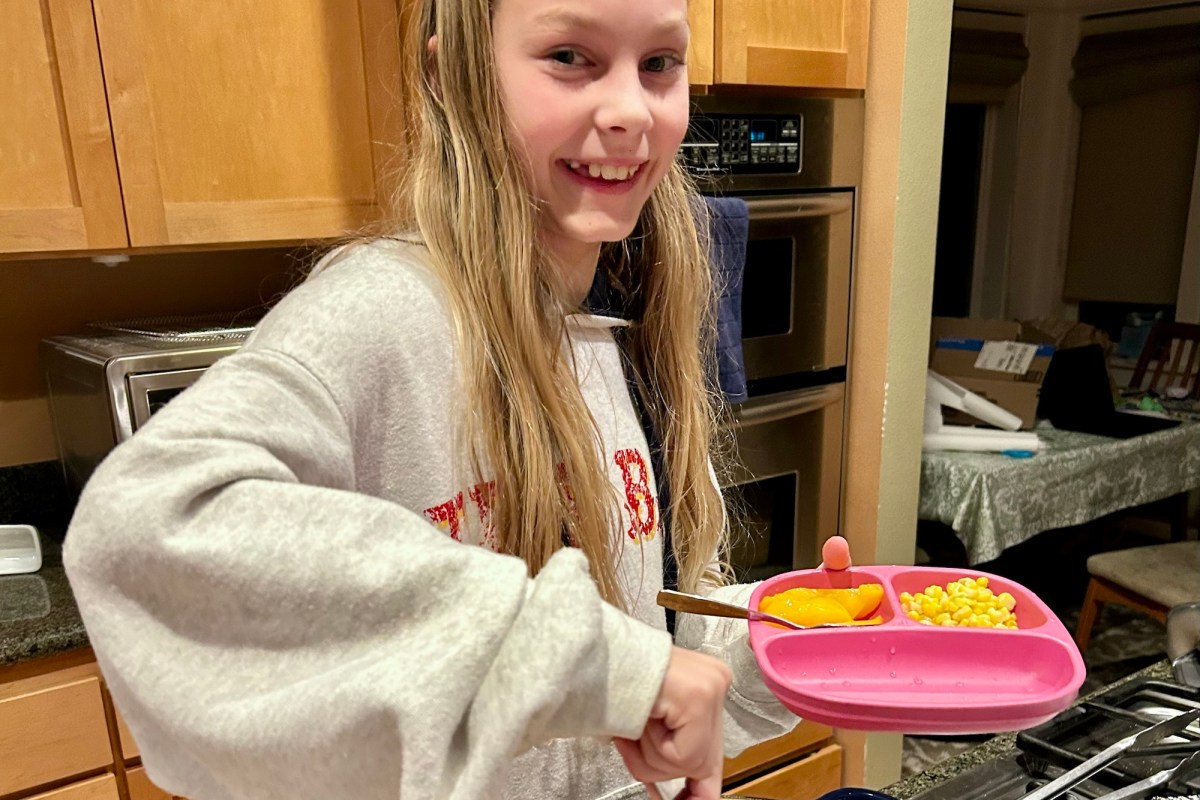
This is where it gets interesting – because then Miss O said she wanted to do everything I do in a day just to see. We picked Saturday of this weekend. I gave her a list of all the food prep, pet care, chores, and special projects we had for the day.

I checked in to see how she was feeling at lunchtime. She said, “Right now I feel okay. We’ll see how I feel at the end of the day. I can see it might be okay to do for a day but it would be tiring to do all day, every day, for years.

Then we returned home a little before 5pm after a fun outing, and it was time feed the dog, the cat and make dinner. She made a plan of what she wanted to cook, then discovered she had to empty the dishwasher she’d run earlier, and in the midst of doing that, her younger brother said, “I’m hungry.”   

I offered to help and even so, it was almost two hours between when we came home from our activity and when she got to sit down and eat her dinner. Then the kitchen had to be cleaned, the gecko had to be fed, and there were snacks to prepare for while we watched shows.

At the end of the day she said, “I don’t know how you do it. It’s impossible to get it all done.” She’d finished one load of laundry but it needed to be pulled out of the dryer to fold so the second load could be dried. She observed, “it’d be okay if you could carry things over to the next day but then you have to start everything else all over again.”

For my part, I just tried to let her do it, do everything she asked, and roll with her decisions and timeframe. So I experienced what it’s like to not be in control of the flow and the timing. It was a great lesson for how adaptable my kids are. I also felt far more rested at the end of the day and it gave me an idea of how much wear and tear what I’m trying to do is.

So I’m scripting my own movie, “A Girl Called O.” It’s a comedy, with a side of drama, and the lead is pretty heroic. She cares enough to want to understand and try it all. In the end, not everything is tidied up but the characters care enough for each other to show up and share the load.  

(featured photo is mine)

You can find me on LinkedIn: https://www.linkedin.com/in/wynneleon/ and Instagram @wynneleon

I host the How to Share podcast, a podcast celebrates the art of teaching, learning, giving, and growing.

I also co-host the Sharing the Heart of the Matter podcast, an author, creator and storytelling podcast with the amazing Vicki Atkinson.

How To Share Optimism

“Light and shadow are opposite sides of the same coin. We can illuminate our paths or darken our way. It is a matter of choice.” – Maya Angelou

You know the skit about positivity? It goes something like this:

Johnny: “We have to drive three hours to have lunch with relatives I’ve never met? This is going to suck!”

Mom: “Johnny, you haven’t even met these people. You need to be more positive.”

Johnny: “I’m positive this is going to suck.”

I’m a congenital optimist. It’s taken me decades to understand my own filter and figure out how it effects others. As a parent, an entrepreneur and as a leader, I’ve come to see that optimism can be helpful when encouraging others, but it has to be tempered with genuinely acknowledging the ups and downs. In the end, I see optimism more as fuel to keep trying than an expectation about an outcome.

Which aligns with the How to Share podcast conversation I had with the incredible author and blogger Mark Petruska. He also is an inveterate optimist and together we explore the concept of optimism, discussing its definition, the importance of timing when sharing optimistic views, and the audience’s receptiveness to such messages.

We delve into the relationship between optimism and empathy, the balance between optimism and realism, and the idea that optimism can be cultivated as a skill. Our conversation emphasizes the significance of understanding individual circumstances and the stages of acceptance and grief when offering encouragement.

How To Share Optimism Takeaways

  • Optimism is defined as a favorable view of the future.
  • Timing is crucial when sharing optimism, especially during difficult times.
  • People may not be receptive to optimism until they reach acceptance
  • Empathy plays a significant role in how we share optimism.
  • Optimists may live longer due to lower stress levels.
  • Optimism can be cultivated and strengthened like a muscle.
  • It’s important to balance optimism with humility and realism.
  • Sharing personal experiences can enhance the impact of optimistic messages.
  • Understanding your audience is key to effectively sharing optimism.

This is a great episode that will get you thinking about the lens you look through – and how to share it with others. I’m optimistic that you’ll love it.

Here’s a sneak peek of the great conversation with the amazing Mark Petruska:

Here are some ways you can listen and watch to the full episode:

Please listen, watch, provide feedback and subscribe.
How to Share Our Luck with Gil Gillenwater How To Share

In this enlightening conversation, Gil Gillenwater is with host Wynne Leon and shares his experiences and insights from over 35 years of philanthropic work along the US-Mexico border. He discusses his book, 'Hope on the Border,' which highlights the transformative power of education and community service. Gil emphasizes the importance of enlightened self-interest over traditional charity, advocating for a model that empowers individuals and fosters dignity. He explores the duality of poverty, the need for sustainable opportunities, and the joy found in serving others, ultimately presenting a vision for a more connected and compassionate world.TakeawaysEducation is the key to breaking the cycle of poverty.Enlightened self-interest can lead to personal and communal growth.Charity should not be viewed as a sacrifice but as a mutual benefit.Volunteering provides a sense of purpose and fulfillment.Welfare can disempower individuals and communities.Community service fosters connections and shared humanity.The disparity in wealth is a significant issue that needs addressing.Experiencing poverty firsthand can change perspectives.Creating opportunities in one's home country can reduce migration.The joy of service is a pathway to personal happiness.Links for this episode:How to Share homeHope on the Border at AmazonGil's organization: Rancho FelizGil Gillenwater on FacebookWynne’s book about her beloved father: Finding My Father’s Faith; Blog: https://wynneleon.com/; Substack: https://wynneleon930758.substack.com/
  1. How to Share Our Luck with Gil Gillenwater
  2. How to Share 1970's Chicago with Doug. E. Jones
  3. How to Share Feedback with Dr. Vicki Atkinson
  4. How to Share the Next Generation with Mari Sarkisian Wyatt
  5. How to Share Impactfully with Social Media Friends with Amy Weinland Daughters

Links for How To Share Optimism podcast episode:

Storyteller and writer Mark Petruska

Is Optimism Something We’re Born With? | Psychology Today

Hope and Optimism as an Opportunity to Improve the “Positive Mental Health” Demand – PMC

The Difference Between Hopeful Optimism and Toxic Positivity | Psychology Today

(featured photo from Pexels)

Writing In the Dark

Go into yourself and see how deep the place is from which your life flows.” – Rainier Maria Rilke

This post was originally published on 4/12/2023. Heads up – you may have already read this.


I wrote this post early Monday morning. Around 3:43am that is. I have all sorts of things I do in the middle of the night when I can’t sleep. Mostly worry. Then I review my to-do list. Then I go back to worrying some more. Usually after about a half an hour of tossing and turning, I remember to start meditating and praying. After a few minutes of meditating, I kinda just flow into writing.

It’s all in my head in the dark. I know that there’s a lot of sleep wisdom that says to keep a notebook beside the bed for writing things down. But this composing in my head works for me. It’s not that I remember everything I write, it’s just that it slips me into a different mode. Eventually I’ll write myself back to sleep. The best part is that I even retain some of it when I awaken.

I recently learned of some interesting research from a Ten Percent Happier podcast with Professor Lindsey Cameron. She studied whether meditation helps at work, specifically focused on customer facing jobs, and the results were fascinating. She found that traditional breath work meditations helped with centering the person in a bigger perspective so that the ups and downs weren’t as jarring. And she found that loving-kindness meditation increased the ability to place ourselves in other’s shoes.

There’s research that shows loving-kindness practice reduces activity in part of the brain that’s active when we are anxious. And a study that showed we don’t want to practice mindfulness when doing emotionally taxing work. The example I heard in that case was a flight attendant who is having to pleasantly telling people to buckle their seat belts over and over again does not benefit from being more mindful in those moments.

Back to the point about writing in the dark. It seems our brain research is catching up with what our spiritual traditions have taught us for millennia. There are practices that help to literally change our minds. They’ve given us a tool set that we can use to help put ourselves in the best frame of mind to create, to understand, to be less anxious, to change, to be more altruistic, and so on. It’s no wonder I start writing in the dark after I start meditating, because the practice helps to shut down worry, and then I open up to creativity.

And it matches what works for me during daylight hours. In my post When I Write, I looked at what time of day works for me and it’s always after I’ve done the work to be quiet, to meditate, and to get a little perspective on life.

It feels a little clinical to separate out the meditation and prayer practices from the spiritual traditions and beliefs that tie us to a Higher Power. But in the middle of the night as I’m settling into a rhythm of breathing and repeating “faith over fear,” it’s also kind of fun to know I’m setting up the conditions for calming my brain. And that I might even get a post out of it.

(featured photo from Pexels)

Mama, Why Would We Want to Feel Their Pain?

Your ability to understand and empathize with others depends mightily on having a steady diet of positivity resonance, as do your potentials for wisdom, spirituality, and health.” – Barbara Frederickson

This was originally published on 4/5/2023. Heads up – you may have already read this.


My 7-year-old daughter, Miss O, bumped her 3-year-old brother with her backpack when they were getting into the car yesterday morning. As he started to cry, she offered an uncharacteristically flippant, “Sorry, Dude.

I gathered him in my arms to check on the little pinky finger that got jammed and added something like, “I’m sure your sister wants to offer some sympathy but can’t find the words right now.”

As we got underway, Miss O said, “I thought sympathy was a bad thing?” The curiosity about learning about emotions moved her away from her defensiveness and we talked about the continuum of responses in the face of pain: denying it, indifference, sympathy and empathy. Off the cuff, I said that empathy was something like leaning in to relate to someone else’s pain.

Miss O asked, “Why would we want to feel their pain?”

It seems I’ve spent the better part of my 53-years trying to understand the answer to that question. I suspect that it was becoming a parent that truly changed my willingness to really sit with the distress of others.

I’ve found that unacknowledged wounds weep the most. Jack Canfora’s post, There’s Nothing Wrong With Everything Being Wrong, spoke to me about the cleansing act of being honest. When we pretend everything is okay either with ourselves or others that are hurting, we add a layer of BS that hardens over time.

But when we talk about hard things and are able to lean in to the sorrow and pain of others, we are blessed by getting to know someone deeply. I imagine we are all a little like icebergs, carrying the pain of life as the big unseen part beneath the water. And when we empathize with each other, we get to see all of us, and even witness the growth that comes with healing after things fall apart.

Which isn’t to say that I’ve found it to be easy to embrace the discomfort of others. I find myself stumbling for words, unsure how to ask, or if to ask, and it becomes worse if I fear I’ve had a part in causing pain. But when I avoid it, it only becomes bigger, sometimes big enough to sink the Titanic.

I remember my dad, who was a Presbyterian pastor for 40 years, describing the first time he had to do a funeral and a wedding on the same day. He said the sheer emotion of going through those extreme emotions almost buckled him at the knees.

I’ve found that the times I have the most access to empathy are when I’ve done my own work to manage my emotions, to understand that I don’t have to carry other people’s loads, and to clean my own wounds. Then I have a much bigger capacity to sit in the dark with others. I can’t go deep when I’m swimming in the shallow end of my self-care and grace pool. For me, that work is in the form of meditation, writing, and creating but I know we all have different tool kits.

So I circled back to my daughter and said, “Sometimes we start trying to empathize because we think it’s the right thing to do or because our mom told us we should. But sooner or later we learn that pain is a lot like the dark – only scary because we don’t look. We lean in to feel other’s pain so that it goes away and it doesn’t become a monster in the closet, threatening to pop out when we least expect it.

We lean in because we all take turns hurting and healing and then have to do the work of repair.


I’ve also published today on the Wise & Shine blog: Just Start

(featured photo from Pexels)

Self-Awareness and Reflection

Do you not see how necessary a world of pains and troubles is to school an intelligence and make it a soul?” – John Keats

When I was hanging out with my friend, Scott, yesterday over a cup of tea – well, tea for me, coffee for him, if we want to be particular about it – Scott said something like “I’m not the most empathetic person. I have to remind myself to be empathetic.” Since he’s been a friend for 25 years, I was a little surprised by this news and asked if there was a time when he realized this. He responded about 5 or 7 years ago.

So I followed up to ask what happened to change this. Scott replied that the guy that he hired as a business partner would go into companies where Scott had worked for years and then say things to him like, “Did you know Susie lives in our neighborhood too?” And Scott would be absolutely flabbergasted that he had missed all the personal information and conversation by being purely focused on business for years.

It reminds me of something I heard Dan Harris talk about on his Ten Percent Happier podcast with NYU Stern School of Business professor, Scott Galloway. That in the pursuit of economic success, they have missed many opportunities to be nicer and they’ve realized it.

I’m paraphrasing here, but what I walked away from these comments by middle-aged white men, including Scott, who I would have never labeled as insensitive, is #1, that there is a ton of pressure as men to wrap up their self-worth and identity in economic success. And #2 that some of them realize that as missed opportunities when that pressure abates. Then #3 is that they are remarkable when they do the work to change it.

You know what I love about hanging out with reflective and self-aware people? They make me smarter about my journey. In this case, about my ability to acknowledge pain in myself and others and to empathize. And it helps me when I have to answer questions from my kids so that maybe a smidgen of this reflection is passed along.

This all relates in a beautiful, big picture way to the question Miss O asked me yesterday: “Mama, Why Would We Want to Feel Their Pain? It’s my post on the Wise & Shine blog today.

(featured photo from Pexels)

Carrying Stuff for Others

I am becoming water; I let everything rinse its grief in me and reflect as much light as I can.” – Mark Nepo

Last week there was an open house at school so all the kids could meet the new principal and find out their teachers. Before we had a chance to check the official list, the 2nd grade teacher that Miss O wanted to have saw her and said, “Yay, you are in my class!”

This was great news – two of her best school friends were also on the list and she was thrilled. Except as we walked away, a dad of one of her good friends gently said to me, “There are two O’s this year and I think your daughter is in the other class.”

Devastating! We checked the official list and he was right, she was not in the class she preferred. Her body mirrored her mood as she went from elated to deflated. I watched in horror as she crumpled even as she tried to hold it together in the crowd.

Just bearing witness to this made me feel terrible. It was as if had taken on the disappointment for my daughter’s 2nd grade hopes dying. And this happens not just with my kids but in other relationships too – I feel the heart ache of my friend going through relationships troubles. Or the exhaustion of another friend who didn’t get the job she wanted.

I suspect I’m not alone in taking on the feelings of others that I care about. As I listen to their experience, I can feel myself take on the rise and fall of their journey. Long after I’ve left them or hung up the phone, I carry the echo of their experience. It goes beyond being an empathetic listener because I’m carrying an emotion that isn’t mine to carry.

Which is a bit ridiculous because it’s a feeling of how I would react to having the same experience which is more or less meaningless. That is to say, my feelings may or may not match those of the person who is actually going through it.

So, I don’t think this makes me a better parent of friend. In fact, I suspect it diminishes my effectiveness. Thinking about the Buddhist Tonglen practice where you imagine a specific suffering in the world and you breathe it in, there is also the completion of the practice where you breathe out relief for everyone experiencing that suffering. It’s a full circle practice. Looking at it another way, the river doesn’t hold on to the water that flows through it.

This reminds me of every mountain guide I’ve climbed with. First, their stuff is well-organized so that they can be efficient and also carry a lot of gear for the group. They don’t often carry stuff for the climbers but when someone is really struggling, they will take part of their load for a time. However, they always give it back when we get to camp. They don’t keep carrying it on top of their own load.

At the school event, Miss O was upset and her first reflex was to go back to that teacher she wanted to tell her that she wasn’t in her class. Once she did that, she was able to move on and meet the teacher she’s assigned to for 2nd grade. Her new teacher is also lovely and nice.

Miss O moved on much more quickly than I did as I still feel echoes of that disappointment. I’m trying to learn from her example and shake off the feelings that I don’t need to carry for those I love.

Do you take on the feelings of loved ones? How do you shake them off?

Bossy Pants – Confidence and Leadership

Kid, you’ll move mountains.” – Dr. Seuss

The other day my 6-year-old daughter Miss O, came home from school and told me about a conversation she had with a friend at recess.

Miss O: You are bossing me.

Friend: You’ve been bossing me since Kindergarten

There are times as a parent that I try not to laugh. This wasn’t one of them – I burst into laughter and my daughter laughed right alongside me. It sounds so dramatic that way – so much better than just last year. It also reminded me how early that word bossy is introduced for these young and precious girls.

It’s the fear of being called bossy that has made my confidence as a leader falter. I say that after 20 years of having my own business, teaching employees and subcontractors and being accountable to a bottom line for both my family and my company.

In the years that I’ve had business partners for my computer consulting business, they’ve always been male and I’ve been far more comfortable with them providing the visible leadership. Even when I’ve had better ideas, more experience and am the one calling the shots.

About a dozen years ago, I owned a small office building with two business partners that housed my consulting company offices. We’d purchased the building in 2007 at the height of the market. When things got messy because one business partner told me of my husband’s infidelities and my husband was the other business partner, our partnership in my consulting business fell apart and I bought back their shares in that company. But we still owned the building together and after the 2008 crash, the value of the building was less than its mortgage.

My partners were no longer interested in being involved, the building couldn’t make ends meet and I had to do something. So I went to the Small Business Administration and asked them to restructure the loan for the building. The advisor gave me a list of things I had to do like changing all the tenant leases and restructuring the accounting.

Five months later I scheduled an appointment with the SBA advisor, showed him the list and all that I had done to meet each point. He sat back and said, “I’m impressed.” I wondered why because all I’d done was what he’d told me. He replied, “Because not many people come back after I give the list of what needs to be done.” I burst into tears. Even through my tears, he restructured the loan for me anyway and when the market came back enough so we could sell the building, I finally sold it and ended the partnership with those guys.

And still after all that, I didn’t have the confidence to call myself a leader until about age 50 when I had children as a single person and they looked at me asking “what are we going to do today?”

Brené Brown defines a leader as “anyone who holds him or herself accountable for finding potential in people or processes.”  Fortunately that’s a definition that is broad enough for me to confidently own my leadership. Given that I’ve been leading for years, one wonders why I haven’t had the confidence to do so til now.

“Bossy” says it in one word. I don’t want to be called that word that people use for girls as early as first grade (and maybe earlier).

Brené Brown has a model of types of power as they relate to leadership (link goes to a PDF of the model). She differentiates people who lead using power overbelieve that power is finite and use fear to protect and hoard power” from those who lead using power with/to/within. Those leaders in the latter category “center connection and humanity with empathy-driven agendas, policies and values.

Those are a lot of big words for a first-grader but I think it’s worth trying to talk to my daughter about how to build confidence in leadership and power. I think any leader, male or female, who works with the power with/to/within is more effective because they believe that “getting it right is more important than being right.” And building on my daughter’s sense of empathy, she can learn the confidence to work with others to lead and not fear being called bossy.

Have you ever been called bossy? Do you think of yourself as a leader? If so, what gives you confidence as a leader?

This is my fourth post about confidence. Here are the others:

I Can

Fear and Confidence

Growth Mind-set

(featured photo from Pexels)

The Deep Story

Our days are happier when we give people a bit of our heart, rather than a piece of our mind.” – unknown

I have a perception problem that caused a disagreement. I adore my brother. I see him as smart, likeable, responsible, resilient and industrious. I also know he has faults and avoids conflicts, will disengage instead of work things out or stand up for himself and has trouble being vulnerable.

We have another family member that sees him as manipulative, irresponsible, underhanded and arrogant.

Generally, we know the same history of my brother with the ups and downs of his life and interpret the story with our own lenses. I see him as the older brother I can always call and she seems him as the schmuck that dated her best friend in junior high.

In this On Being podcast, sociologist and Professor Emeritus Arlie Hochschild talks about the idea of a deep story which she defines as what you feel about a highly salient situation that’s very important to you. A story that explains how we can look at the same set of facts but come up with different conclusions because of the emotions that underlie the story. Her work has been primarily about our political divide – the deep stories of the red states and blue states.

But I see it at work in the stories of my family. It explains why we see things differently and have this perception problem that no amount of facts can solve. It points to the amount and type of work my brother and our family member would have to do in order to rewrite the deep story.

It also predicts that my brother and I will probably always be in accord through the rest of our lives. For me it makes some sense out of the unconditional love and adoration I have always felt and acted on through our many different phases of life.

Finally, it reminds me that the work of empathy for and listening to others is not only necessary for our relationships but also possibly the most transformative. Because even when we don’t agree on the facts, understanding someone else’s deep story at least brings the a-ha moment of understanding.

Are their deep stories in your family? Are there places where facts don’t seem to matter?

(featured photo from Pexels)

In Feeling

The problem with this world is that we draw our family circle too small.” – Mother Teresa

Here’s the way sickness travels in my family. One kid gets sick, the other one gets it and then finally I get sick. Fortunately, I don’t always get sick but if I do, I’ll be last to get it. And when I do, I learn how brave my kids have been.

This time it was my daughter who got a stomach bug first last weekend. She spit up a few times and then said, “Wow, I’ve never thrown up 4 times in a day before. When are we going to go hiking?” I replied that I thought she might want to rest given that she didn’t feel well. She exclaimed she felt fine so we went.

Then my son got it mid-week. It was very clear because I opened his door to get him out of his crib in the morning, and instantly got hit with the smell. “I sneezed it out!” he exclaimed, not all that upset. He stayed home from school but he too said he felt “good” and was pretty peppy playing around all day.

I thought I’d avoided getting it too until this weekend when my body, probably exhausted from all the cleaning, just gave up and succumbed. I wondered how the heck my kids were so delightful when their bodies were fighting this bug. It always looks easier when someone else is doing it, doesn’t it? As usually happens with getting sick, it comes with a huge heap of humility and admiration too.

This made me think of the words sympathy and empathy. Sympathy from the Greek of sun (with) + pathos (feeling). Oxford languages defines sympathy understanding between people, common feeling.  

Empathy, a word I hear so often these days in conjunction with raising emotionally intelligent kids, is from the Greek of em (in) + pathos (feeling). It is defined by Oxford languages as the ability to understand the feelings of another.

In my little family we have so many opportunities to have sympathy for each other because we share so much context at this stage – the people we know, the many hours we spend all together, the illnesses we pass along. It may be the easiest time for us to all stand in common feeling. And if we get that right, at least some of the time, it helps us become more empathetic toward others because we have the family experience of feeling understood.

The other thing I was reminded of as the illness ran its course is how much energy I spend resisting being sick. I didn’t want to throw up and I managed not to. But in hindsight, it may have made it last longer overall. Sometimes we just have to let the bad out so that the healing can begin, a lesson I keep having to repeat.

It’s funny as I type this thinking of my gratitude towards this stomach bug. It created a shared family experience, reminded me that resistance to uncomfortable things is often a harder route to go and most of all, makes me so thankful that we all feel well again. If only there was a virus that could unite our bigger human family….

(featured image photo from Pexels)

Friends for All Seasons

A friend accepts us as we are yet helps us be what we should.” – unknow

I hosted a birthday brunch for my friend this past weekend. It was all great – my kids worked super hard to color the wrapping paper for gifts, set the table and make signs, I cooked and cleaned for a day in order to have friends over to our house which doesn’t happen much in this COVID era. It was all great — except my friend didn’t show up.

She sent her husband to come alone because she was throwing up from a bad oyster that she’d eaten the night before at a wedding for someone she barely knows but felt like she had to go. She didn’t call or text because I’m guessing she thought it was sufficient that he would let us know. Which he did and the disappointment meant I spent the first five minutes of the party holding my daughter as she cried.

So, I’m upset with my friend. Obviously not for being sick but because this is about the 20th example (and most dramatic) of how she hasn’t shown up for us literally and figuratively since she took a new job 6 months ago. At first I was all grace and understanding but by now my grace pool has been diminished to the point that I’m out of empathy at the time when she really was sick. I’m tired of watching her seeming to try to be best friends with all of her new co-workers and in so doing, impacting her existing relationships and her ability to care for herself.

I spent the whole rest of the weekend brooding about this. I didn’t want to gossip so I kept it to myself and it simmered under the surface. Until I was finally ready to deal with it yesterday. As irked as I was, I couldn’t sit and meditate about this so I tried a walking meditation.

When I’d bled enough energy off so that I could get some space from the hurt of it, I realized this isn’t about me. My friend appears to be undergoing a transformation in her life and from my experience transformations are often messy, painful and not well communicated. From my experience, it’s like being in a washing machine just trying to find out which way is up while hopefully something gets clean.

I suppose we can all give up on each other as we transform and I’m sure we give each other plenty of excuses to bail. But that’s when we need each other most, even if just hold space for each other and occasionally shout “this way is up.” Perhaps my friend and I will end up on the other side of this with not enough common ground to be close and that will be okay. But I know that for my friends that have stood with me through the messy transformations, we have a deeper relationship as we’ve been friends through all seasons.

All of this makes me wonder – maybe the one small step in making the world a more peaceful place is holding space for others as they change?