How to Share: Secrets of Collaborative Leadership

The best leader is the one who has sense enough to pick good men to do what he wants done, and the self-restraint to keep from meddling with them while they do it.” – Theodore Roosevelt

I played on a tennis team when I was in my 20’s. It was a loosely organized group of women who played at the public tennis courts. We were part of a league that created matches with other teams, some of whom were the “fancy” ones who belonged to a club with a pro.

But my team had a secret weapon: our coach, Evan. A quiet-spoken man who seemed to take everything in. He’d meet with us at practice and not only run drills to improve our skills but also strategically position who should play singles versus doubles, and forehand versus backhand.

I don’t remember our records of wins and losses so it probably wasn’t that great. But I know we got better as a team and also as individuals. It was largely because of Evan. He could see our strengths and vulnerabilities and help us position them to the best advantage.

I was reminded of Coach Evan when I recently talked with John Hernandez, the Director of IT at Leisure Care on the How to Share podcast. John has an incredibly collaborative leadership style and knows how to balance giving people on his team leadership, agency, and backup when needed.

In short, he’s a very good coach for a strong team.

John told me how he landed on this leadership style and how it’s worked as his team and responsibilities have grown. We talked about how people in technology can sometimes be protective of their knowledge and not want to share. And we discussed how AI changes the game for so many people in technology and how to wrangle it as an asset, not a competitor.

I asked John about how he adapts his message for people who are less technical. He brought it back to the power of telling a story and finding key beats, regardless of the topic.

This is a great episode about how leadership, openness, curiosity translates to infectious passion for sharing – and for team building. I know you’ll love it!

Takeaways

  • John emphasizes the importance of sharing knowledge to build effective teams.
  • A collaborative leadership style fosters a culture of openness and mentorship.
  • Technology professionals often hoard knowledge due to fear of job security.
  • AI is changing the landscape of IT, enabling more collaboration.
  • Storytelling can help convey complex technical concepts.
  • Creating a supportive environment encourages team members to grow.
  • Passion for technology can be infectious and motivate others.
  • Adapting messages for different audiences is crucial in IT.
  • Building a knowledge-sharing culture can lead to better team dynamics.

Here’s a clip of John describing how he landed on his leadership style:

Here are some ways you can listen and watch this infectiously energizing episode:

Please listen, watch, provide feedback and subscribe.
Secrets of Collaborative Leadership transcript

How to Share Our Luck with Gil Gillenwater How To Share

In this enlightening conversation, Gil Gillenwater is with host Wynne Leon and shares his experiences and insights from over 35 years of philanthropic work along the US-Mexico border. He discusses his book, 'Hope on the Border,' which highlights the transformative power of education and community service. Gil emphasizes the importance of enlightened self-interest over traditional charity, advocating for a model that empowers individuals and fosters dignity. He explores the duality of poverty, the need for sustainable opportunities, and the joy found in serving others, ultimately presenting a vision for a more connected and compassionate world.TakeawaysEducation is the key to breaking the cycle of poverty.Enlightened self-interest can lead to personal and communal growth.Charity should not be viewed as a sacrifice but as a mutual benefit.Volunteering provides a sense of purpose and fulfillment.Welfare can disempower individuals and communities.Community service fosters connections and shared humanity.The disparity in wealth is a significant issue that needs addressing.Experiencing poverty firsthand can change perspectives.Creating opportunities in one's home country can reduce migration.The joy of service is a pathway to personal happiness.Links for this episode:How to Share homeHope on the Border at AmazonGil's organization: Rancho FelizGil Gillenwater on FacebookWynne’s book about her beloved father: Finding My Father’s Faith; Blog: https://wynneleon.com/; Substack: https://wynneleon930758.substack.com/
  1. How to Share Our Luck with Gil Gillenwater
  2. How to Share 1970's Chicago with Doug. E. Jones
  3. How to Share Feedback with Dr. Vicki Atkinson
  4. How to Share the Next Generation with Mari Sarkisian Wyatt
  5. How to Share Impactfully with Social Media Friends with Amy Weinland Daughters

Links for this episode:

John Hernandez on LinkedIn

How to Share SCI Support and Advocacy

Once you choose hope, anything’s possible.” – Christopher Reeve

I recently watched the original 1979 Superman movie with my kids – the one with Christopher Reeve, Margot Kidder, and Gene Hackman. Such a classic.

My 10-year-old daughter started asking questions about Christopher Reeve, the accident that left him paralyzed, and when he died. Christopher Reeve was 44 years old when he was paralyzed in a horse riding accident, he died 9 years later.

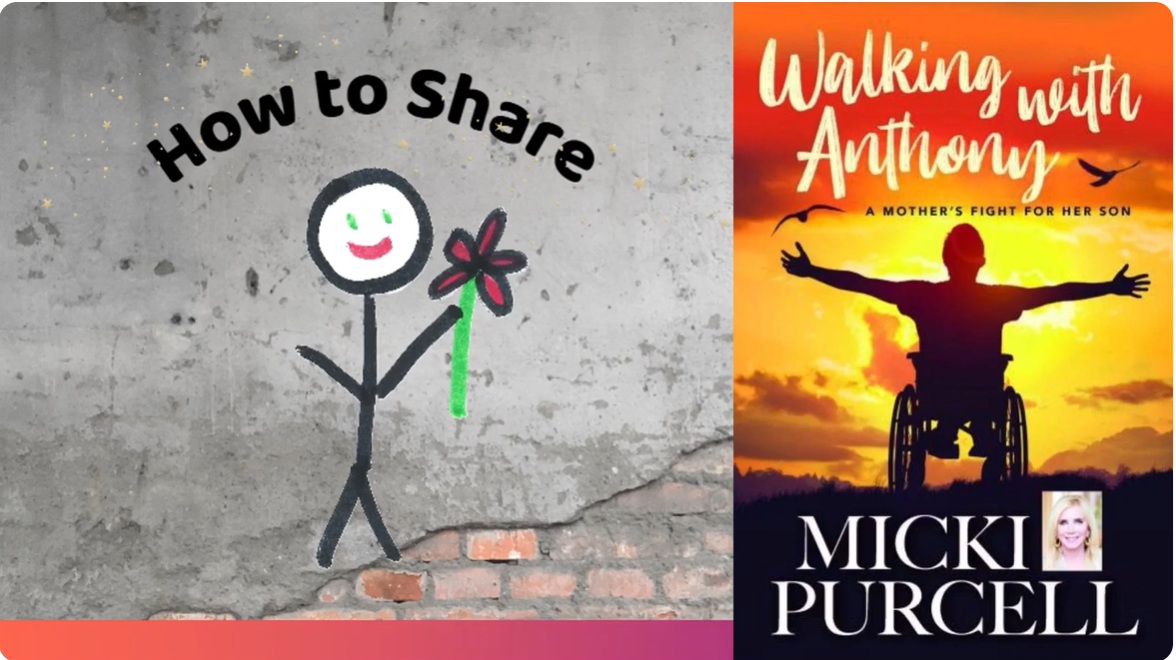
Looking this up clarified a point that arose when Vicki Atkinson and I recorded this week’s How to Share podcast conversation with the amazing activist and author, Micki Purcell. Micki’s son, Anthony, was paralyzed in a diving accident 15 years ago. Micki spent seven years by Anthony’s side navigating the difficult hurdles of rehab and recovery.

Along the way, Micki and Anthony started the Walking with Anthony foundation. It is the go-to foundation for helping individuals and families navigate the physical, mental and financial challenges that come with this life-changing injury.

Here’s where Superman meets Super Mom. The Christopher Reeve foundation focuses primarily on research related to spinal cord injuries. In contrast, Walking with Anthony mentors individuals and families through the process of recovery: connecting them to rehab, personally spending time with them, and by providing grants for caregiving, rehab and special equipment.

In our podcast conversation, Micki tells us how Anthony is doing now and we get to heartwarming stories about how all of their large family is involved with Walking with Anthony. Micki’s hands-on advocacy will grip and delight you!

Micki shares some details about their Stand up for a Cause event in Newport Beach on October 24th. The event will honor courageous medical staff doing incredible Spinal Cord Injury work and a Tony award winning actress, Ali Stoker. Micki’s goal is to raise $1 million to fund grants for people with spinal cord injuries.

September is spinal cord injury awareness month and 2025 marks the 35th anniversary of the American with Disabilities Act. Vicki and I are so grateful to be able to bring you this episode to honor both.

This is a powerful episode that will inspire and touch you. We know you’ll love it.

Takeaways

  • Micki Purcell founded Walking with Anthony to help families affected by spinal cord injuries.
  • Insurance often fails to cover necessary rehabilitation for spinal cord injury patients.
  • The organization has become a vital resource for those in need of support and guidance.
  • Recovery from spinal cord injuries requires a strong desire and commitment to progress.
  • Micki’s advocacy work is deeply personal and driven by her family’s experiences.
  • Community support plays a crucial role in the recovery process for individuals with disabilities.
  • Micki emphasizes the importance of mental health and emotional support for patients and families.
  • The upcoming event aims to raise funds to help more individuals receive necessary care.
  • Micki’s family is actively involved in the charity, showcasing the power of collective support.
  • There is a pressing need for systemic change in healthcare coverage for spinal cord injuries.

Here’s a clip of Micki describing how insurance falls short for individuals with a spinal cord injury.

Here are some ways you can listen and watch this incredibly inspiring episode:

Please listen, watch, provide feedback and subscribe.

How to Share SCI Support and Advocacy transcript

How to Share Our Luck with Gil Gillenwater How To Share

In this enlightening conversation, Gil Gillenwater is with host Wynne Leon and shares his experiences and insights from over 35 years of philanthropic work along the US-Mexico border. He discusses his book, 'Hope on the Border,' which highlights the transformative power of education and community service. Gil emphasizes the importance of enlightened self-interest over traditional charity, advocating for a model that empowers individuals and fosters dignity. He explores the duality of poverty, the need for sustainable opportunities, and the joy found in serving others, ultimately presenting a vision for a more connected and compassionate world.TakeawaysEducation is the key to breaking the cycle of poverty.Enlightened self-interest can lead to personal and communal growth.Charity should not be viewed as a sacrifice but as a mutual benefit.Volunteering provides a sense of purpose and fulfillment.Welfare can disempower individuals and communities.Community service fosters connections and shared humanity.The disparity in wealth is a significant issue that needs addressing.Experiencing poverty firsthand can change perspectives.Creating opportunities in one's home country can reduce migration.The joy of service is a pathway to personal happiness.Links for this episode:How to Share homeHope on the Border at AmazonGil's organization: Rancho FelizGil Gillenwater on FacebookWynne’s book about her beloved father: Finding My Father’s Faith; Blog: https://wynneleon.com/; Substack: https://wynneleon930758.substack.com/
  1. How to Share Our Luck with Gil Gillenwater
  2. How to Share 1970's Chicago with Doug. E. Jones
  3. How to Share Feedback with Dr. Vicki Atkinson
  4. How to Share the Next Generation with Mari Sarkisian Wyatt
  5. How to Share Impactfully with Social Media Friends with Amy Weinland Daughters

Links for this episode:

⁠Walking with Anthony⁠ Foundation

Micki’s Book: Walking with Anthony on Barnes & Noble and Amazon

From the hosts:

Vicki’s book about resilience and love: ⁠Surviving Sue⁠; Blog: ⁠https://victoriaponders.com/⁠

My book about my beloved father: ⁠Finding My Father’s Faith⁠;

How to Make a Difference

Not all of us can do great things. But we can do small things with great love.” – Mother Teresa

I try pay extra close attention when I hear the same message from many sources. It’s like a wake-up call that is too powerful to ignore.

Here’s a message that I keep hearing: Getting involved with an issue or cause you are passionate about will change your life as well as do good for the world. To make a difference, start small, stay local, and be consistent. I’ve heard that in conversations with filmmaker Peter Samuelson, activist Sam Daley-Harris and now in this latest episode of the How to Share podcast with Sharon Eubank.

Sharon is the Global Director of Humanitarian Services for the church of Jesus Christ of Latter-day Saints. We are talking about her book Doing Small Things With Great Love. It is such a helpful and hopeful book that provides a blueprint for effective service.

Sharon shares a few of the 92 stories in her amazing book that she provides as illustrations of the 12 principles for effective and lasting service. Based in her years of experience working in communities near and far, Sharon has distilled some thoughtful truths that inspire us to action.

We talk about how we sometimes don’t feel we can make a difference as individuals and why sometimes it seems easier to contribute to project far away than the ones in our own cities and towns. Sharon gives some great examples of why local solutions for local problems are more effective.

We talk about how service and volunteering can make such a difference in our own lives. Sharon not only provides a blueprint for effective and lasting service, she also provides some suggestions to get us started doing small things with great love. I highly recommend this book!

This is an incredible episode that gets to the very heart and soul of collaboration – how we can be useful to one another. I know you’ll love it.

Takeaways

  • Sharon emphasizes the importance of local solutions for local problems.
  • Volunteering can be a transformative experience for both the giver and receiver.
  • Mentorship plays a crucial role in personal and professional development.
  • Small acts of service can lead to significant community impact.
  • Overcoming barriers to service often starts with individual passion and energy.
  • Building bridges of understanding is essential in a polarized world.
  • Effective service requires understanding the needs of those being helped.
  • Storytelling enriches the experience of service and community engagement.
  • Creating opportunities for connection can foster a sense of belonging.
  • The cycle of replenishment is vital for sustaining service efforts.

Here’s a delightful taste of Sharon describing the magic of volunteering:

Here are some ways you can listen and watch this inspiring episode:

Please listen, watch, provide feedback and subscribe.

How to Share Our Luck with Gil Gillenwater How To Share

In this enlightening conversation, Gil Gillenwater is with host Wynne Leon and shares his experiences and insights from over 35 years of philanthropic work along the US-Mexico border. He discusses his book, 'Hope on the Border,' which highlights the transformative power of education and community service. Gil emphasizes the importance of enlightened self-interest over traditional charity, advocating for a model that empowers individuals and fosters dignity. He explores the duality of poverty, the need for sustainable opportunities, and the joy found in serving others, ultimately presenting a vision for a more connected and compassionate world.TakeawaysEducation is the key to breaking the cycle of poverty.Enlightened self-interest can lead to personal and communal growth.Charity should not be viewed as a sacrifice but as a mutual benefit.Volunteering provides a sense of purpose and fulfillment.Welfare can disempower individuals and communities.Community service fosters connections and shared humanity.The disparity in wealth is a significant issue that needs addressing.Experiencing poverty firsthand can change perspectives.Creating opportunities in one's home country can reduce migration.The joy of service is a pathway to personal happiness.Links for this episode:How to Share homeHope on the Border at AmazonGil's organization: Rancho FelizGil Gillenwater on FacebookWynne’s book about her beloved father: Finding My Father’s Faith; Blog: https://wynneleon.com/; Substack: https://wynneleon930758.substack.com/
  1. How to Share Our Luck with Gil Gillenwater
  2. How to Share 1970's Chicago with Doug. E. Jones
  3. How to Share Feedback with Dr. Vicki Atkinson
  4. How to Share the Next Generation with Mari Sarkisian Wyatt
  5. How to Share Impactfully with Social Media Friends with Amy Weinland Daughters

Links for this episode:

Doing Small Things With Great Love by Sharon Eubank at Barnes & Noble, Amazon and Audible

Sharon Eubank on LinkedIn

How to Make a Difference with Sharon Eubank transcript

(featured photo from Pexels)

How to Share Creativity

Creative people are curious, flexible, persistent, and independent with a tremendous spirit of adventure and a love of play.” – Henri Matisse

I’ve often joked that I have a math brain. But have I mentioned how much of a math geek I am? When I was in college, I loved math so much that I looked through all the engineering majors to see which one required the most math classes. That’s how I ended up with an electrical engineering degree.

Nothing in the more than 30 years after I graduated from college has convinced me that I’m a natural creative. Not the three books I’ve published (because two of which are technical so that doesn’t count, right?), more than 2,000 blog posts I’ve written, or anything else.

Until now.

Because Pia Mailhot Leichter’s book, Welcome to the Creative Club, is a myth-busting, research-based, fantastically inspiring book that will change your perspective and power. The clip below gives a small taste of that.

Vicki Atkinson and I were recently blessed enough to be able to talk with the amazing creative director, entrepreneur, and author Pia Mailhot Leichter on the How to Share podcast.

Pia’s book is an incredible invitation into our own creative power. She beautifully weaves agency and awe together in a way that helps bring us alive again. Pia delivers a reminder to move out of autopilot and a perspective to help with adversity, and everything else!

She tells us the story of how coming undone was a trip back to knowing herself and remembering that she’s the creative director of her life. We talk about creating evidence of our resilience.

Pia’s view of creativity will leave you feeling empowered. Which is part of her mission helping others live and lead from creativity.

Takeaways

  • We often need to lose ourselves to find our true selves.
  • Creativity is a response to life’s challenges.
  • Creativity is not just for artists; it’s for everyone.
  • Embracing uncertainty can lead to greater joy and creativity.
  • Vulnerability fosters connection and understanding.
  • Storytelling is a way to honor our journeys and experiences.
  • Collaboration enhances the creative process and outcomes.
  • We are all natural born creators, regardless of our paths.
  • Reclaiming our creativity is essential for a fulfilling life.

This is a great conversation full of energy and inspiration. Buckle up for a beautiful ride. We know you’ll love it!

Here are some ways you can listen and watch this powerful episode:

Please listen, watch, provide feedback and subscribe.

How to Share Our Luck with Gil Gillenwater How To Share

In this enlightening conversation, Gil Gillenwater is with host Wynne Leon and shares his experiences and insights from over 35 years of philanthropic work along the US-Mexico border. He discusses his book, 'Hope on the Border,' which highlights the transformative power of education and community service. Gil emphasizes the importance of enlightened self-interest over traditional charity, advocating for a model that empowers individuals and fosters dignity. He explores the duality of poverty, the need for sustainable opportunities, and the joy found in serving others, ultimately presenting a vision for a more connected and compassionate world.TakeawaysEducation is the key to breaking the cycle of poverty.Enlightened self-interest can lead to personal and communal growth.Charity should not be viewed as a sacrifice but as a mutual benefit.Volunteering provides a sense of purpose and fulfillment.Welfare can disempower individuals and communities.Community service fosters connections and shared humanity.The disparity in wealth is a significant issue that needs addressing.Experiencing poverty firsthand can change perspectives.Creating opportunities in one's home country can reduce migration.The joy of service is a pathway to personal happiness.Links for this episode:How to Share homeHope on the Border at AmazonGil's organization: Rancho FelizGil Gillenwater on FacebookWynne’s book about her beloved father: Finding My Father’s Faith; Blog: https://wynneleon.com/; Substack: https://wynneleon930758.substack.com/
  1. How to Share Our Luck with Gil Gillenwater
  2. How to Share 1970's Chicago with Doug. E. Jones
  3. How to Share Feedback with Dr. Vicki Atkinson
  4. How to Share the Next Generation with Mari Sarkisian Wyatt
  5. How to Share Impactfully with Social Media Friends with Amy Weinland Daughters

Transcript for How to Share Creativity with Pia Mailhot Leichter

Links for this episode:

Welcome to the Creative Club on Amazon, Audible and Barnes and Noble

Famished a spoken word album on Spotify

Pia’s site: kollektiv studio

From the Hosts:

Vicki’s book about resilience and love: Surviving Sue; Blog: https://victoriaponders.com/

Wynne’s book about her beloved father: Finding My Father’s Faith; Blog: https://wynneleon.com/

(featured photo from Pexels)

How to Share Passwords

Rarely is anyone thanked for the work they did to prevent the disaster that didn’t happen” – Mikko Hypponen

A few weeks ago I was carpooling with another family to the kids’ camp for the week. I was responsible for dropping the kids off in the morning. When I got all four kids there on the first day, the counselors asked me for a password that would need to be given at pickup time.

I set the password and then immediately communicated it to the other family so they could successfully pickup all the kids. It reminded me that we think of passwords as secret, when in fact they are private – we just want only trusted individuals to know at the right time.

So in this episode of the How to Share podcast, I talk with banker, adventurer and my friend, Jill Jones, about the complexities of password sharing. We emphasize the importance of trusted access and the evolving methods of password management. We explore personal experiences, the impact of technology on security practices, and provide practical tips for navigating password storage and sharing in both personal and professional contexts.

Note: Passwords are a small piece of the overall planning that needs to happen in a crisis. The amazingly thoughtful and prepared Edward Ortiz of the Thoughts about Leadership, history, and more blog has a great post about What if The Unthinkable Happens at Home to help plan for household crisis.

Takeaways

  • Passwords are often thought of as secrets, but they are actually private.
  • It’s essential to have trusted individuals who can access passwords when needed.
  • Old methods of password storage, like writing them down, are becoming obsolete.
  • Digital vaults can provide a secure way to store important documents and passwords.
  • Two-factor authentication adds an extra layer of security but can complicate access.
  • Banking experiences offer valuable lessons in password security and fraud prevention.
  • Regularly changing passwords can lead to reliance on easily guessable information.
  • Technology is changing how we manage and share passwords.
  • Planning for unexpected events, like sudden death, is crucial for password access.
  • Having a system in place for sharing passwords is necessary for security.

Here’s a preview of some of the pros and cons of common password practices:

Here are some ways you can listen and watch this informative episode:

Please listen, watch, provide feedback and subscribe.

How to Share Our Luck with Gil Gillenwater How To Share

In this enlightening conversation, Gil Gillenwater is with host Wynne Leon and shares his experiences and insights from over 35 years of philanthropic work along the US-Mexico border. He discusses his book, 'Hope on the Border,' which highlights the transformative power of education and community service. Gil emphasizes the importance of enlightened self-interest over traditional charity, advocating for a model that empowers individuals and fosters dignity. He explores the duality of poverty, the need for sustainable opportunities, and the joy found in serving others, ultimately presenting a vision for a more connected and compassionate world.TakeawaysEducation is the key to breaking the cycle of poverty.Enlightened self-interest can lead to personal and communal growth.Charity should not be viewed as a sacrifice but as a mutual benefit.Volunteering provides a sense of purpose and fulfillment.Welfare can disempower individuals and communities.Community service fosters connections and shared humanity.The disparity in wealth is a significant issue that needs addressing.Experiencing poverty firsthand can change perspectives.Creating opportunities in one's home country can reduce migration.The joy of service is a pathway to personal happiness.Links for this episode:How to Share homeHope on the Border at AmazonGil's organization: Rancho FelizGil Gillenwater on FacebookWynne’s book about her beloved father: Finding My Father’s Faith; Blog: https://wynneleon.com/; Substack: https://wynneleon930758.substack.com/
  1. How to Share Our Luck with Gil Gillenwater
  2. How to Share 1970's Chicago with Doug. E. Jones
  3. How to Share Feedback with Dr. Vicki Atkinson
  4. How to Share the Next Generation with Mari Sarkisian Wyatt
  5. How to Share Impactfully with Social Media Friends with Amy Weinland Daughters

Links for this Episode:

Jill Jones on LinkedIn

How to Share Passwords transcript

(featured photo from Pexels)

(Quote comes from Rarely Is Anyone Thanked – TheEnlightenedMind622 )

How to Share Risks

Remember: Not all positive change feels positive in the beginning.” – S.C. Lourie

This is a friendly warning: It’s risky to comment on this blog. I’m joking, of course, but have a great example of no good comment goes unpunished. 🙂

A couple of weeks ago Brian Hannon commented that he approached finding positivity from another perspective on the How to Share Optimism podcast I did with Mark Petruska. To hear Brian describe it, it’s like peeling back an onion. The outer layers are the risks of a thing, whether it be an idea, invitation, initiative, or something else. Those layers need to be dealt with before reaching the savory goodness on the inside.

At which point, I invited Brian on the podcast to talk about his approach of sharing risks.

As a corporate communications professional, Brian Hannon has incredible wisdom about identifying risks and communicating effectively. In this episode of the How to Share podcast, Brian shares his unique perspective on optimism, emphasizing the importance of acknowledging risks and challenges before moving towards a positive outlook.

Brian discusses the role of authenticity in communication, the balance between optimism and realism, and how humor can help navigate difficult conversations. Our conversation also touches on parenting and the lessons learned from life’s challenges, ultimately highlighting the value of embracing discomfort for personal growth.

Takeaways

  • Brian sees risks and challenges first before finding positives.
  • Acknowledging failure is crucial for a realistic perspective.
  • Authenticity is essential in communication and leadership.
  • Humor helps in delivering downsides without negativity.
  • Writing helps clarify thoughts and learn from experiences.
  • Embracing discomfort can lead to long-term growth.
  • Balancing perspectives can enhance collaboration and understanding.
  • Life’s challenges often provide valuable lessons.
  • Parenting influences how we perceive risks and challenges.
  • Finding a middle ground between optimism and realism is key.

Here’s a preview of Brian’s grounded and resilient approach:

Here are some ways you can listen and watch this incredible episode:

Please listen, watch, provide feedback and subscribe.

How to Share Our Luck with Gil Gillenwater How To Share

In this enlightening conversation, Gil Gillenwater is with host Wynne Leon and shares his experiences and insights from over 35 years of philanthropic work along the US-Mexico border. He discusses his book, 'Hope on the Border,' which highlights the transformative power of education and community service. Gil emphasizes the importance of enlightened self-interest over traditional charity, advocating for a model that empowers individuals and fosters dignity. He explores the duality of poverty, the need for sustainable opportunities, and the joy found in serving others, ultimately presenting a vision for a more connected and compassionate world.TakeawaysEducation is the key to breaking the cycle of poverty.Enlightened self-interest can lead to personal and communal growth.Charity should not be viewed as a sacrifice but as a mutual benefit.Volunteering provides a sense of purpose and fulfillment.Welfare can disempower individuals and communities.Community service fosters connections and shared humanity.The disparity in wealth is a significant issue that needs addressing.Experiencing poverty firsthand can change perspectives.Creating opportunities in one's home country can reduce migration.The joy of service is a pathway to personal happiness.Links for this episode:How to Share homeHope on the Border at AmazonGil's organization: Rancho FelizGil Gillenwater on FacebookWynne’s book about her beloved father: Finding My Father’s Faith; Blog: https://wynneleon.com/; Substack: https://wynneleon930758.substack.com/
  1. How to Share Our Luck with Gil Gillenwater
  2. How to Share 1970's Chicago with Doug. E. Jones
  3. How to Share Feedback with Dr. Vicki Atkinson
  4. How to Share the Next Generation with Mari Sarkisian Wyatt
  5. How to Share Impactfully with Social Media Friends with Amy Weinland Daughters

Links for this episode:

⁠Brian’s blog: Writing from the Heart with Brian⁠

⁠Brian Hannon⁠ on LinkedIn

(featured photo from Pexels)

How to Share Advocacy

A very small degree of hope is sufficient to cause the birth of love.” – Stendhal

There are two guys I regularly see at Starbucks. I’m guessing they are in their late 60’s. One gestures animatedly and with disgust at the paper and his friend patiently listens.

Once I heard the patient one suggest to the animated one that he get involved.

The animated one replied, “But the system is broken!

I hope next time that I see them that I have a copy of Sam Daley-Harris’ book Reclaiming Our Democracy: Every Citizen’s Guide to Transformational Advocacy with me. Sam gives us a great formula for overcoming cynicism and hopelessness and suggestions for how to get started.

Vicki Atkinson and I were recently lucky enough to be able to talk with activist and author Sam Daley-Harris on the How to Share podcast. In this episode, we discuss his journey in advocacy, the importance of facing hopelessness, and the power of transformational advocacy.

We also explore the difference between transactional and transformational approaches, the impact of cynicism on political engagement, and the necessity of community support in advocacy efforts.

Sam shares personal stories and insights on how individuals can reclaim their power and make a difference in their communities and the world.

Takeaways

  • Advocacy requires facing our own hopelessness to find purpose.
  • Transformational advocacy involves deeper engagement than transactional actions.
  • Cynicism can lead to inaction; we must choose to engage.
  • Community support is crucial for effective advocacy.
  • Building relationships with legislators can lead to meaningful change.
  • The state of democracy is influenced by citizen engagement and activism.
  • Progress and positive changes are not often featured in today’s news reporting.
  • We need to encourage optimism and action in our communities.
  • Commitment to advocacy can lead to personal transformation.
  • Every individual has the power to make a difference.

Here’s a preview of Sam’s powerful story-telling and encouragement to get involved:

Here are some ways you can listen and watch this incredible episode:

Please listen, watch, provide feedback and subscribe.

How to Share Our Luck with Gil Gillenwater How To Share

In this enlightening conversation, Gil Gillenwater is with host Wynne Leon and shares his experiences and insights from over 35 years of philanthropic work along the US-Mexico border. He discusses his book, 'Hope on the Border,' which highlights the transformative power of education and community service. Gil emphasizes the importance of enlightened self-interest over traditional charity, advocating for a model that empowers individuals and fosters dignity. He explores the duality of poverty, the need for sustainable opportunities, and the joy found in serving others, ultimately presenting a vision for a more connected and compassionate world.TakeawaysEducation is the key to breaking the cycle of poverty.Enlightened self-interest can lead to personal and communal growth.Charity should not be viewed as a sacrifice but as a mutual benefit.Volunteering provides a sense of purpose and fulfillment.Welfare can disempower individuals and communities.Community service fosters connections and shared humanity.The disparity in wealth is a significant issue that needs addressing.Experiencing poverty firsthand can change perspectives.Creating opportunities in one's home country can reduce migration.The joy of service is a pathway to personal happiness.Links for this episode:How to Share homeHope on the Border at AmazonGil's organization: Rancho FelizGil Gillenwater on FacebookWynne’s book about her beloved father: Finding My Father’s Faith; Blog: https://wynneleon.com/; Substack: https://wynneleon930758.substack.com/
  1. How to Share Our Luck with Gil Gillenwater
  2. How to Share 1970's Chicago with Doug. E. Jones
  3. How to Share Feedback with Dr. Vicki Atkinson
  4. How to Share the Next Generation with Mari Sarkisian Wyatt
  5. How to Share Impactfully with Social Media Friends with Amy Weinland Daughters

Links for this episode:

Sam’s Sign-up Sheet for resources on how to get started

Reclaiming Our Democracy website

Reclaiming Our Democracy: Every Citizen’s Guide to Transformational Advocacy, 2024 Edition on Amazon

(featured photo from Pexels)

How to Share Reporting

Good people bring out the good in people.” – unknown

A few years ago I took my kids to a gathering where they met a lot of grown-ups. They did a few minutes of chit chat with them all and then we went off to play.

After a few minutes, my son, Mr. D, who was three years old said to me, “Where’s the New Guy?”

It took some back and forth but I figured out he was talking about one of the many grown-ups he’d met, Steve Rubenstein. As a long-time reporter for the San Francisco Chronicle and a substitute kindergarten teacher, Steve had captured Mr. D’s interest. No surprise, Steve is full of great stories and delight for all ages.

Steve heartily embraced the new moniker. My daughter, Miss O, who was seven at the time, memorialized it by making a New Guy friendship bracelet for him.

I recently had the privilege of podcasting with Steve Rubenstein and I’m sure you’ll agree – Steve has an incredible knack for sharing stories.

In this episode of the How To Share podcast, we talk about the art of storytelling that resonates with all ages. Steve shares insights from his 50-year journalism career, including his unique experiences interviewing notable figures and the therapeutic journey of writing. Learn why 13 miles per hour is the perfect speed to encounter life and how to leave a lasting impact through the stories we tell.

Takeaways:

The Art of Storytelling: Steve emphasizes the importance of knowing what to leave out in storytelling, highlighting that most of writing is about omission rather than inclusion.

Interviewing Insights: Steve shares his approach to interviewing, focusing on asking questions that resonate with both the interviewer and the audience, and getting subjects off their prepared remarks.

Therapeutic Writing: Writing can be therapeutic, as Steve experienced when he wrote about personal moments, like dropping his son off at college, which helped him process emotions.

Life at 13 MPH: Steve’s cross-country bike trip taught him that 13 miles per hour is the perfect speed to encounter life, allowing for meaningful interactions and observations.

Human Connection: Despite the contentious times, Steve’s journey across America revealed that the country is full of wonderful people, emphasizing the power of human connection beyond politics.

This is a great episode filled with how to share stories. Steve’s storytelling will leave you charmed and ready to tell your own. I know you’ll love it.

Here’s a short clip to give you a taste of the great conversation with the witty and wise Steve Rubenstein:

Here are some ways you can listen and watch to the full episode:

Please listen, watch, provide feedback and subscribe.

How to Share Our Luck with Gil Gillenwater How To Share

In this enlightening conversation, Gil Gillenwater is with host Wynne Leon and shares his experiences and insights from over 35 years of philanthropic work along the US-Mexico border. He discusses his book, 'Hope on the Border,' which highlights the transformative power of education and community service. Gil emphasizes the importance of enlightened self-interest over traditional charity, advocating for a model that empowers individuals and fosters dignity. He explores the duality of poverty, the need for sustainable opportunities, and the joy found in serving others, ultimately presenting a vision for a more connected and compassionate world.TakeawaysEducation is the key to breaking the cycle of poverty.Enlightened self-interest can lead to personal and communal growth.Charity should not be viewed as a sacrifice but as a mutual benefit.Volunteering provides a sense of purpose and fulfillment.Welfare can disempower individuals and communities.Community service fosters connections and shared humanity.The disparity in wealth is a significant issue that needs addressing.Experiencing poverty firsthand can change perspectives.Creating opportunities in one's home country can reduce migration.The joy of service is a pathway to personal happiness.Links for this episode:How to Share homeHope on the Border at AmazonGil's organization: Rancho FelizGil Gillenwater on FacebookWynne’s book about her beloved father: Finding My Father’s Faith; Blog: https://wynneleon.com/; Substack: https://wynneleon930758.substack.com/
  1. How to Share Our Luck with Gil Gillenwater
  2. How to Share 1970's Chicago with Doug. E. Jones
  3. How to Share Feedback with Dr. Vicki Atkinson
  4. How to Share the Next Generation with Mari Sarkisian Wyatt
  5. How to Share Impactfully with Social Media Friends with Amy Weinland Daughters

Links for this post:

As student gains bearings, father loses his by Steve Rubenstein (ping pong story mentioned in the podcast)

Steve Rubenstein, San Francisco Chronicle

(featured photo is Miss O with Steve and the New Guy bracelet)

Touchstone

When it’s over, it’s the happy memories that hurt.” – unknown

This car is packed with memories,” Miss O said as we pulled into the lot of the company we were selling it to.

I’d aimed to sell the car earlier in the day. But it was so old that the title was in my married name. Even with the proper documentation, it took longer than I’d anticipated so I had to return with my kids to finalize the deal.

Miss O was right – the car was packed with memories from the 18 years I owned it. And about a thousand goldfish crackers stuck in the cracks. We’d tried to get all the goldfish out but probably missed at least a dozen.

This was the car I’d trepidatiously drove Miss O home from the hospital in almost ten years ago. And made that same trip with Mr. D about six years ago filled with awe and a little bit of overwhelm. Speaking of family members, it was the car we picked up Cooper the dog in as a puppy two years ago. Miss O sat with him in a box on our lap in the back seat and explained the world, “This is a freeway. That is an airplane. And you are my new best friend.”

It’s carried us, our well-worn hiking shoes, and our stuffies to school, our favorite vacation spots, and the best hiking trails.

The car was the last car of mine that my dad rode in and helped fix. I can still see him taping plastic over the rear window on the driver’s side when it stopped working on a stormy November day.

Along with the goldfish crackers, the car probably has two pounds of dog hair even after we vacuumed and vacuumed. It was the car that carried me to say good-bye to my beloved dog, Biscuit when it was time for him to cross the rainbow bridge at nearly 14 years of age in 2017.

Like all touchstones, the car is just a gateway for all the tender, tense, and touching moments my family has stored in our hearts. Funny how touchstones make feelings so accessible. The car feeling was that life is adventurous, rich, and full of beloved characters we love.

The kids and I hugged the car and walked into the building a little teary-eyed. We sold the car but we are keeping the memories.

(featured photo is of our parking lot car hug)

You can find me on LinkedIn: https://www.linkedin.com/in/wynneleon/ and Instagram @wynneleon

I host the How to Share podcast, a podcast about collaboration – in our families, friendships, at work and in the world.

I also co-host the Sharing the Heart of the Matter podcast, an author, creator and storytelling podcast with the amazing Vicki Atkinson.