“You are the sum total of everything you’ve ever seen, heard, eaten, smelled, been told, forgot – it’s all there.” – Maya Angelou
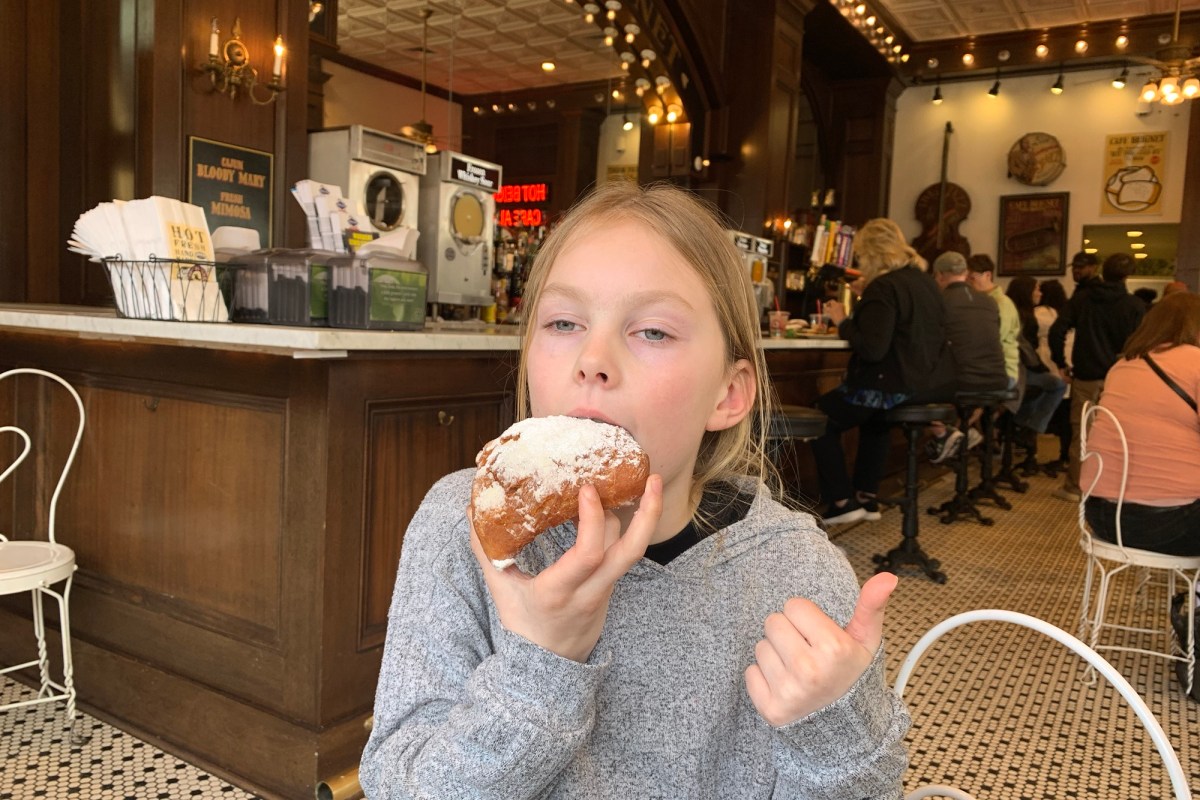
My mention of our trip to New Orleans brought a lot of comments about trying the beignets there. Which reminded me that in addition to my favorite word associations, I also have food and drink associations for cities. Here are some:
Bagels in New York City
Pizza in Chicago
Baked beans in Boston
Rocky Mountain oysters in Denver
Irish coffee in San Francisco
Key lime pie in Key West
Arroz con pollo in Quito
Coca tea in Cusco
Momos in Kathmandu
Fish and chips in London
Prosecco in Venice
I’m curious if these match yours or what other ones you have. Tell me what’s good in the places you frequent!
“When anxious, uneasy and bad thoughts come, I go to the sea, and the sea drowns them out with its great wide sounds, cleanses me with its noise, and imposes a rhythm upon everything in me that is bewildered and confused.” – Rainier Maria Rilke
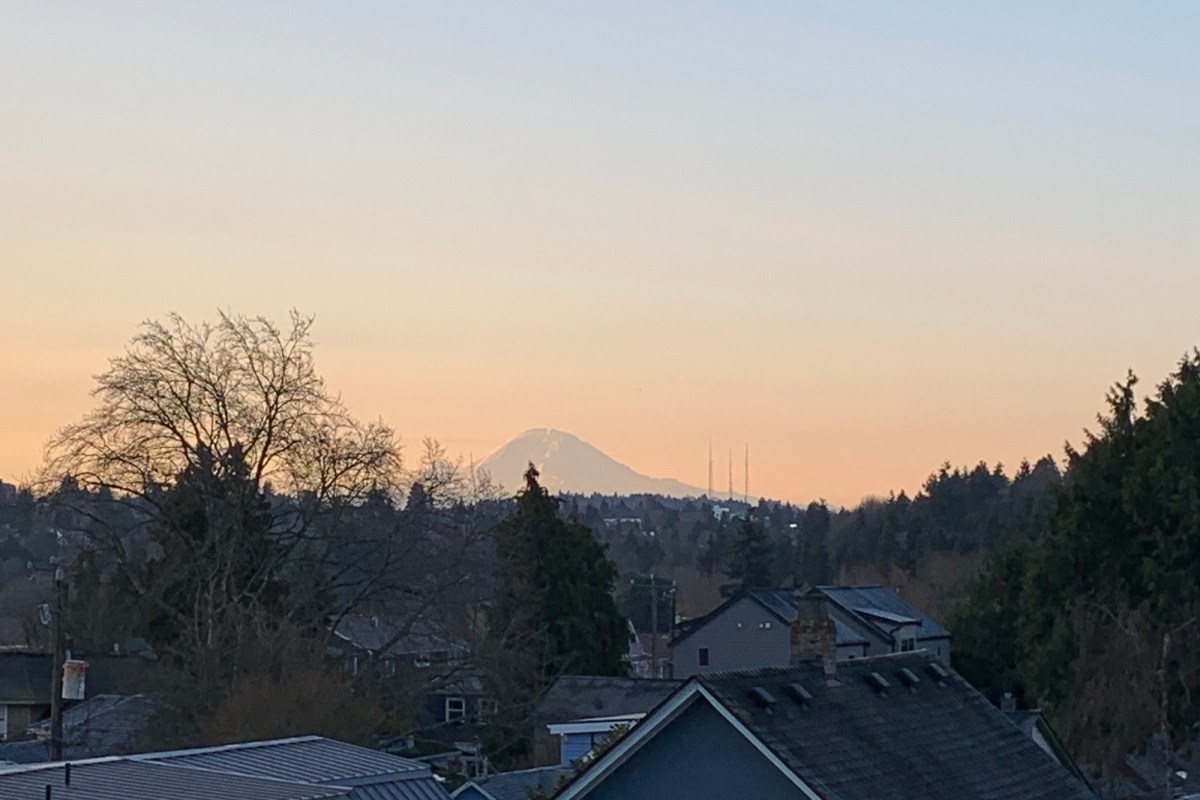
On my first mountain climbing attempt, a guided climb of Mt. Rainier in the summer of 1998, the lead guide introduced us to the poetry of Robert Service. Whether you or not you like his poetry, he delivers a cadence that I found helpful in keeping a climbing rhythm:
“There’s a race of man who won’t give in A race that can’t stand still. So they break the heart of kith and kin And roam the world at will.”
The Men Who Don’t Fit In by Robert Service
Climbing depends on a steady pace. If you go too fast when roped to your teammates, you create too much slack ahead, and end up pulling the climber behind. If you go too slow, you create drag on someone else. When climbs would get tough, I’d recite the poems in my head and it would regulate my head, heart, and feet.
Thought I don’t climb any more, I still find evidence of pacing in all of the rest of my life. At work, knowing the cadence of team meetings helps to know when we can address issues. At home, rhythm is such a large part of how my little family stays stable. The waking up, eating breakfast, packing lunches, off to school rhythm is the cornerstone of our weekdays. When we get out of sync, it’s like a band that’s lost the beat.
Miss O recently learned to play Ode to Joy on the piano. When feeling like she wants to show off her mastery, she plays it somewhere between double and triple time. Played like that, it quickly becomes Ode to Indigestion.
Jack describes himself as a rhythmic writer. I’m thinking of You Make a Mean Salad as an example of his writing and humor. Or perhaps it’s best heard in a play. Step 9 is available as a theatrical podcast.
Thinking of my own writing as someone who tends to extended sentences, I have a lot to learn about calibrating sentences from Jack. Here’s a clip from our podcast where he talks about how Shakespeare balances sentences.
“The deep irony, in order to be social, we first have to be individual.” – Nicholas Christakis
This was originally published on 2/16/2022. Heads up – you may have already read this.
When I was climbing mountains, I’d regularly sign up for a guided climbing trips, sometimes with a friend and sometimes by myself. It was a great way to travel and also get to climb a mountain or two. Typically we’d all converge in a meeting place and do the initial meet and greet and then go from there.
The groups of people that would come together were always interesting. I’m thinking about a particular climb of two volcanoes in Mexico. We all flew to Mexico City where we met our guides and fellow climbers before riding in a van to the base of Mt. Ixtacchuatl for our first climb.
The group was mostly Americans but otherwise there wasn’t an easily defined demographic, not gender, education level, personality type other than love of mountains. On this particular trip, there were very outgoing people like my friend, Jill, and man named Trent who loved to talk and help anyone with anything. Most of the group was like Paul from Greenfield, NY who was really nice to talk to but more reserved about initiating conversations. There was our guide, Phil, who like to just spit out wisdom or quips in one line but not talk endlessly (e.g. “Watch out Jill, that guy has more moves than an earthquake.”)
As we went around doing introductions, one man named John stated very clearly, “I don’t like people. I’m just here to climb the mountains.” Which was fine because that’s what we were there to do.
We summitted the first mountain, Mt Ixtacchuatl (17,338 feet) on October 31 and then headed down to celebrate the Day of the Dead in Puebla. After a day of rest, we started up our second mountain, Mt. Orizaba (18,491 feet).
After being dropped by trucks on the mountain, we spent the evening in a hut. At this point, we’d been together as a group for about 5 days and we were having a great time and working together pretty well as a team. The guy that didn’t like people was a very good climber and mostly stayed to himself, grabbing his share of dinner and finding a quiet place to eat it.
Around midnight, we got up from the few hours of rest we’d gotten and started preparing for our summit attempt in the dark using the light of our headlamps. We climbed steadily in the dark for about 6 hours until we reached an exposed couloir. We paused as the guides tried to get some ice screws deep enough into the fractious ice to secure our trip across the steep gully. Eventually we realized that the conditions wouldn’t allow us to cross safely over that part of the mountain and our summit bid had ended.
As we sat on the mountain watching the sun come up in no hurry to get anywhere, John, the climber who didn’t like people, pulled off his boot and found a Payday bar. He’d put the candy bar in his boot while preparing in the dark and then forgotten to take out. After being climbed on for 6 hours, it was shaped like an orthodic. He pulled it out, showed it around and we all had a good laugh alongside him as we imagined the journey of that candy bar. Even John enjoyed for that moment being part of a group that understood the crazy things that happen on a climb.
That particular event created an idea of community for me. One where we don’t have to all be best friends or come out of our comfort zones but can still enjoy the camaraderie of a shared experience focused on a common interest.
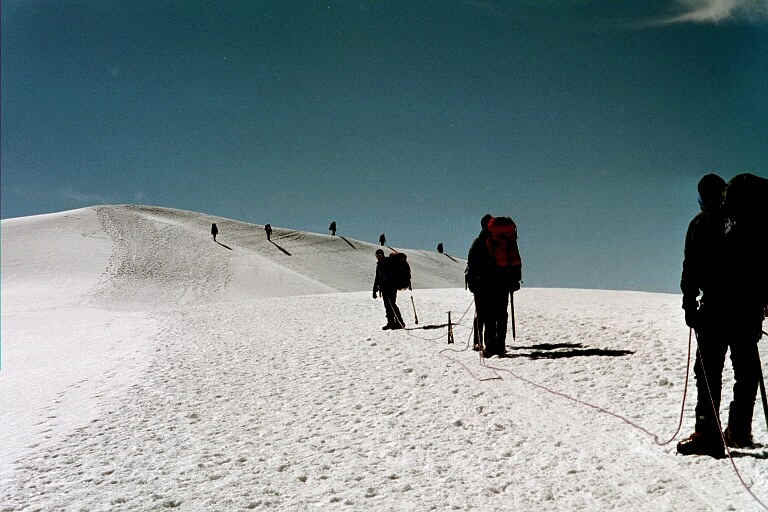
(featured photo is mine of the group leaving the top of Mt. Ixtacchuatl)
“When you love someone the best thing you can offer is your presence. How can you love if you are not there?” – Thich Nhat Hanh
We were sitting in the family room of the small AirBnB cabin we’d rented for President’s Day weekend when I heard my four-year-old son, Mr. D quietly say to my friend, Eric, who had joined us. “I’m glad you’re here.”
It’s a sentiment that I’ve heard both of my children say on different occasions, locations, and to different friends. I’m glad you’re here. I’m glad we’re here.
It’s completely unprompted by me and I’ve never noticed them saying it at the moment of arrival. Usually it’s uttered calmly in genuine camaraderie for an adult that has shown up – physically and emotionally.
I find it to be one of the most remarkable compliments a kid can give. After all, at ages eight and four, they aren’t in charge of where we go or who comes along. But when they find the presence of another person to be comforting/fun/engaging/stimulating, they say so. Genuinely.
Upon reflection, it’s another thing my kids are teaching me. To know when I’m happy to be somewhere and in good company, and to express it.
So, dear blogging friends, I’m glad you are here. Thank you for reading.
“Take chances, make mistakes. That’s how you grow. Pain nourishes your courage. You have to fail in order to practice being brave.” – Mary Tyler Moore
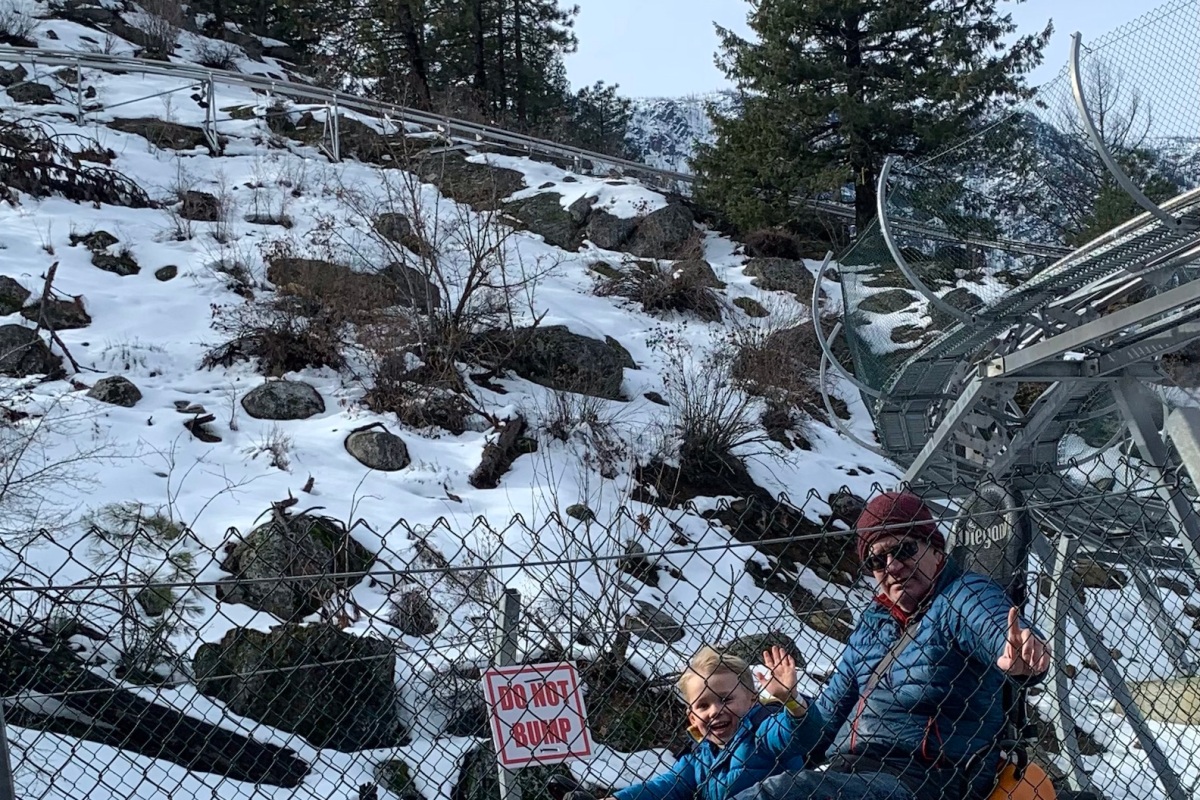
Last weekend when we were in Leavenworth, WA, we went to an adventure park to ride a roller coaster. Or maybe I should say a roller-coaster-ish kind of ride because the cars were individual and the driver could apply the brakes as much as they wanted. Another clarification: by “we” I meant my kids rode with my dear friend, Doug, because I’m an endurance person, not a speed person.
Now that I have all those caveats in place, on with the story.
Eight-year-old Miss O had no hesitation and climbed right in to ride with Doug. Talking with four-year-old Mr. D about it, he was clearly torn. He didn’t want to do it. And then he did. He flip flopped a couple of times. Since I was pretty sure he’d like it, I was trying to figure out how to nudge him in the direction of trying it.
But even though Miss O didn’t hesitate on this challenge, she and I had just been having a conversation about failing when it came to learning to ride her hoverboard. She asserted that life was easier for me because I never failed. I told her I fail all the time which is why is doesn’t faze me much any more. In fact, I rarely think of it as failing but just as a step towards the next thing I need to do.
On the drive to Leavenworth, I’d been listening to the Ten Percent Happier podcast, The Science of Failing Well where Dan Harris was talking with Amy Edmonson, a professor of leadership and management at the Harvard Business School. She had three points that stuck with me about taking risks:
Make the risk as small as possible: This point reminded me of gambling – make a bet but don’t put all your chips in.
Have a hypothesis: Know what you are trying to test or prove
Learn from the attempt: Use the experience and hypothesis to extract information for the next thing you might try.
I think a lot about what creates confidence. What my parents did to create kids who are willing to try hard things because for all the differences between my siblings and me, we are all game to take on new challenges. So I’ve tried to figure out how I can do the same for my kids. While there’s much that remains a mystery to me, what I’ve identified is that my willingness to try and fail might be the single most defining characteristic in the arc of my life.
So, I told Mr. D he didn’t have to do it. But if he did, he only had to try one ride, Doug could go as slow as he wanted, and that I thought he’d like riding in a car on a track. When it came to his turn, Mr. D was a little nervous but resolutely game. Until I greeted him at the exit ramp, that is. He rolled back in with a huge grin on his face!
He had so much fun that he learned he wanted to do it again. And the second time he went up with his hands in the air.
Life is a roller coaster and I’m glad that I continue to ride. The metaphorical kind at least.
(featured photo is mine)
(quote is from Real Life of MSW blog: Being Brave)
“Faith gives flight to the imagination.” – Lailah Gifty Akita
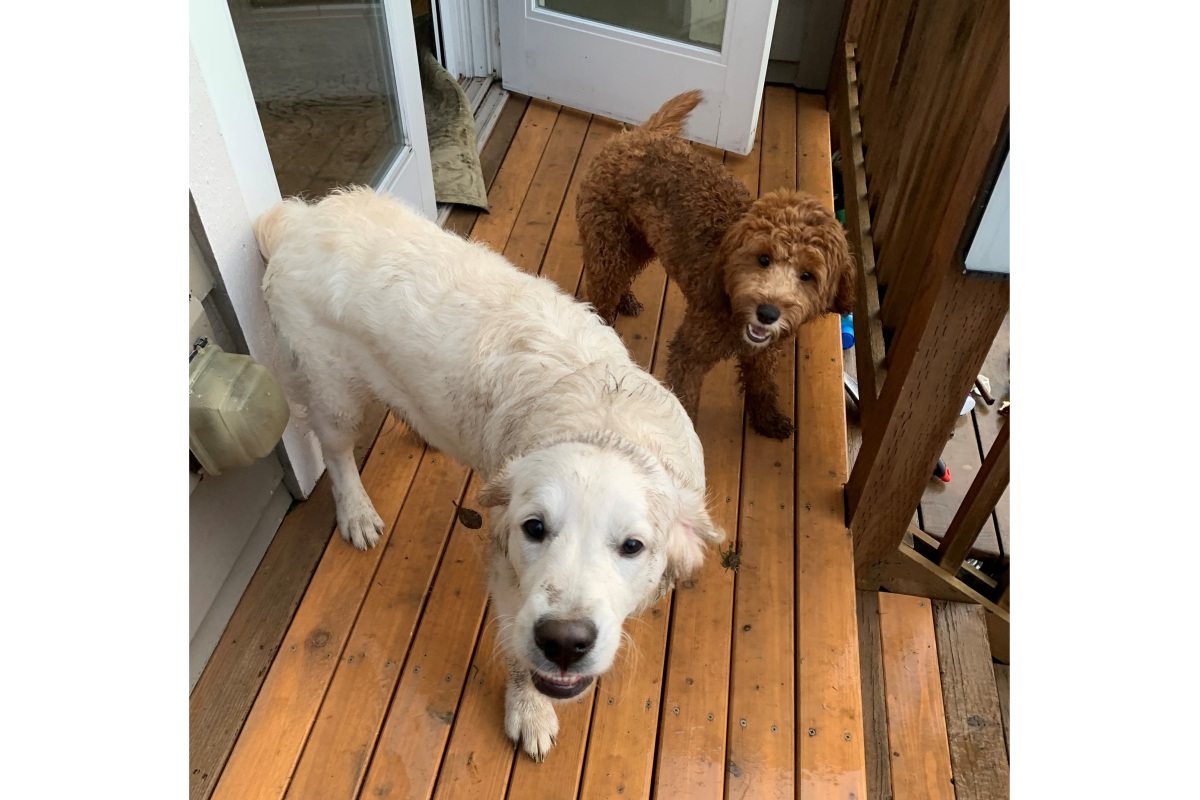
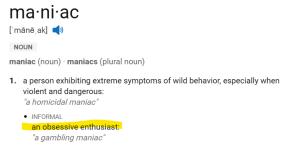
The other day Cooper (the dog) had a play date with a neighbor’s puppy, Ziggy. Four-year-old Mr D. heard me say to the pups, “What are you two maniacs up to?”
And Mr. D fell in love – with the word “maniac.“
We were at the store a short while later and he yelled from the other end of an aisle, “Mom, call me a maniac!”
And he sometimes greets me, “Hi Mom. You maniac!”
It’s a rule in our house that we don’t call each other names but maniac seems like a term of affection to me. At least, I was saying it affectionately when I used it on the dogs.
So I looked it up in the dictionary and found that the informal definition matched my liking: An obsessive enthusiast (from Oxford Languages).
As I mentioned in My Love Affair with Words post, the word enthusiastic or enthusiast always reminds me of my dad since it comes from the root, en-Theos or “with God.” I’m at my best when I leave my logical nature and go with the flow of God, life, and the Universe.
So, yes, call me a maniac. On fun days, I have a whole houseful of them!
“Jobs fill your pocket, adventures fill your soul.” – Jaime Lyn Beatty
Last weekend I took my kids to IKEA. I had to borrow my brother’s truck to do it. When the kids and I joined up with our family and friends later that day, and were sitting out on the stern of my brother’s boat to watch the Blue Angels, my sister-in-law commented that she couldn’t believe I took my kids with me. She said she gets stressed just going on her own. My friend, Eric, chimed in with a good-natured smirk, “She thinks of it as an adventure.”
Bahaha (I’ve gotten that laugh in writing from the delightful blogger and Cheryl Oreglia). But hey, he might have a point. I had the itinerary completely mapped, and packed a snack for each break. There were even ropes involved. It might not be a mountain climb, but it had some of the same elements.
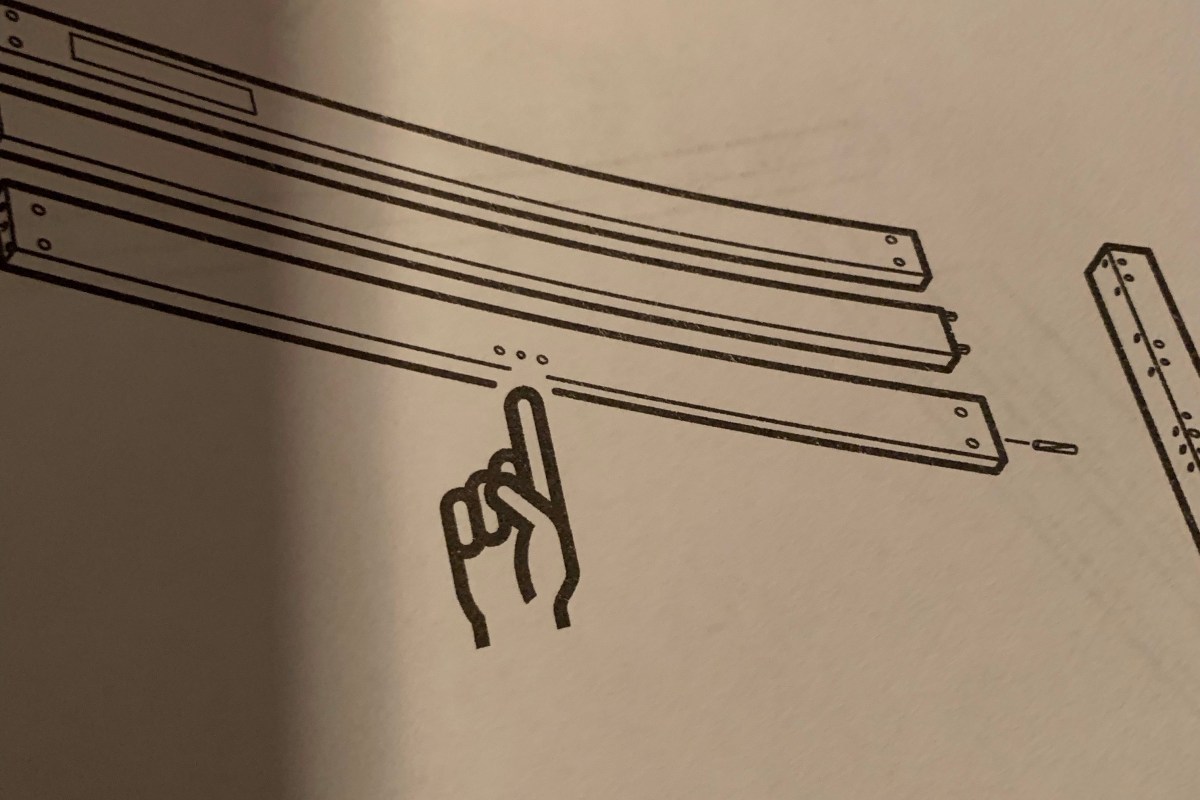
I don’t know you all, but there isn’t anything like a project from IKEA to make me feel completely stupid. I say that even though I really love putting things together. But that first page, the one where you have to start assembling, and are looking at a wordless page indicating three or four parts from the dozens strewn around, and six or more screws, bolts, barrels, and dowels from the hundreds? Well, ugh!
Invariably, I do something wrong. Usually right out of the gate. This time it was to put those short wooden dowels in the wrong holes. And because I often get am racing to “completion,” I like to do it systemically, and did it for all the boards on the page. Then to make sure I was extra diligent, I hammered them in. Only to find out on wordless page number two that was wrong.
There was no way I found to get the dowels out, not pulling, or using pliers, or trying to make them cold in case the wood would contract. I had to drill them out. As I sat on the floor of Miss O’s bedroom with sweat running down my face and her loft bed still in pieces around me, I had to face that I was already on the wrong path, and had to go back to step one.
Huh, not entirely unlike a mountain climb after all.
Eric’s remark, even though delivered smirk, might have been right on the mark. It’s reminded me that of the adventures I’ve been on, they have all come with hard moments – and also learning and growth. The other thing they’ve all had, whether I’ve made it to the top or not, laughter, the satisfaction that comes with trying, and joy.
Last weekend I took my kids to IKEA. We got a loft bed with a side of adventure. Not a bad deal….
If you have a moment, please check out my Heart of the Matter blog post today about happiness versus joy: Good Mood of the Soul.
“Pushing through your fear. If there’s something you want, it usually worth the risk. I’ve found that on the side of fear is rebirth.” – Paula Whaley
One of the guides that I climbed mountains with, Phil, taught the skill of weighing objective risks versus subjective risks. Objective risks in the mountains include avalanche danger, weather forecast, rock fall areas, and navigating around crevasses. It is because of objective risk that we’d often leave for the summit in the middle of the night, when things like big blocks of rocks and ice are still frozen to the mountain. That way we reduced the risk of climbing in the heat of midday when the sun warms things up and they pop off to crush you.
As an aside, I found climbing at night to be one of the most beautiful things to do. While it was exceedingly painful to leave a warm sleeping bag, the intimacy of my steps enveloped only in the circle of my headlamp was a way to be both big and small. In a huge arena but only focused on a small area. Groups ahead look like a caravan crossing through the desert because the landscape could be anything. And, crossing things like ladders laid horizontally over crevasses is way more doable when you can’t see the gaping hole below.
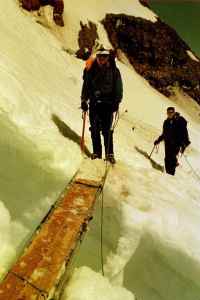
A friend ready to cross a crevasse on Mt. Rainier (image mine)
But subjective risk, as I understood it from Phil, is what we internally sense and measure. How do I feel? Does this seem doable today? Subjective risk is more personal, trickier to plan for, and different for everyone.
But this is a post about life, not climbing
I’d argue that in my life now, I have very little objective risk. Perhaps the most hazardous thing I do is forget to wear eye protection when I’m using the weed whacker.
But the subjective risks I’ve found in middle age to be plentiful. Daring to be vulnerable, trying to learn something new, opening to new friendships, asking to be seen, and offering grace instead of judgment – all those things lay bare my heart in a way that can be terrifying and precarious.
I think meditating and writing both are huge subjective risks to my perceived well-being. Hazarding a look inside at the goopy mix of who I am, taking on attempts to change myself, the conditions for my children, and generational patterns of my family. Geez, that’s harder stuff than I ever faced in the mountains.
And yet, I find when I try these things that are subjectively risky, they get me somewhere. Not always, and I haven’t kept track but I think it’s safe to say not usually, where I intend to go but with a receptiveness that moves me forward.
It’s a round-trip sport
As my guide friend, Phil, says, “Climbing is a round-trip sport.” It’s both the up and the down. And the risks are often greater on the down when I’m exhausted from the climb. And now have to cross the crevasse on a ladder in the daylight when I can see the gaping hole beneath me. It’s the same in life for me, taking the risk to extend myself in vulnerability and openness is hardest when I’m tired and depleted but it’s often necessary to lead me home.
I don’t think you have to have climbed to imagine how life can be a slog, both uphill and downhill. But whatever the slope looks like, thinking about it this way has helped me to take the steps to evaluate and take on subjective risks in order to get to my best and highest place.
There is no way to get to the summit, whatever our personal summit may be, without exposing ourselves to risk. But the view from the top and the learning from the trip change us forever.
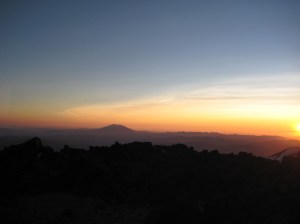
View from Mt. Adams (image mine)
What do you think about risk? Any tips for how you face risk?
(featured photo is mine from Ixtacchuatl a 17,160ft mountain in Mexico)
“Surrender to what is. Say ‘yes’ to life — and see how life suddenly starts working for you rather than against you.” – Eckhard Tolle
[I almost titled this post “Being a Yay-Sayer” as a joke for anyone that has read about the spelling mistake that I made at Everest Base Camp. Featured photo is from there. If you haven’t, here’s the post on HoTM: Yay, Yeah, Whatever.]
One of the most transformative books that I’ve ever read was Year of Yes by Shondra Rhimes. I remember being pregnant with Mr. D and sitting in a Mexican restaurant eating chips and salsa as I read. So I clearly was at least on speaking terms with “yes,” if getting pregnant with my second child by IVF as a single person was any indication.
Shondra Rhimes, the creator of hit shows such as Grey’s Anatomy and Scandal to name just two of her many accomplishments, sets up the book as a response to something one of her sisters says to her. It was something like, “You never say yes to anything.” So she sets out to say “yes” to all of life’s invitations for a year, even things that terrified her. Public speaking – yes. Media appearances – yes.
Here’s how it was transformative for me. My natural response to life is mostly a “yes.” But somewhere down the line I began to think that it was cool and discerning to say, “no.” Like it indicated that I was a busy person in demand and that showed a level of sophistication. It was a subtle thing when I switched from telling people what I couldn’t do instead of what I could do.
[An aside here: I’m not talking about drawing healthy boundaries and maintaining a line of separation between what are my responsibilities to take care of versus someone else’s responsibilities. I’m not advocating contorting myself to make everything fit, I’m focusing on saying yes/no to adventures and opportunities.]
That small change meant that when someone asked if I could meet them for lunch on Wednesday, I’d respond with something like, “No, I can’t. I have back-to-back meetings that day” instead of “I can’t meet Wednesday but I can meet Tuesday or Friday.”
So reading Shonda’s book reminded me that there is an openness when you face life with “yes” in mind. Not only that, it fits better with my natural way of being. It’s an approach that defaults to a response that starts with “here’s what I can do.” It engenders a flexibility to other ideas, opportunities, and adventures that I might not think of myself.
I am sometimes accused of doing too much by the people in my life. But I’m not sure they are accounting for the euphoria and joy that comes with being aligned with that openness that feeds me in so many ways. And when I’m sick, my “yes” pretty quickly turns to “no.” It feels like that is as it should be as well.
This isn’t about giving up discernment as Shondra demonstrates so well in the book when she says “yes” to herself and ends her engagement. She also shows us it takes practice. But in the end, it’s about opening to all the opportunities that come our way with the deep knowing that we can try and see what happens.
Speaking of saying “yes,” Vicki and I were able to get Mark Petruska to come back on the Sharing the Heart of the Matter podcast to talk about personal anthems and resiliency. It is a great episode about using songs that energize and motivate us during the tough times in life. You can search for Sharing the Heart of the Matter on Amazon Music, Apple Podcasts, Spotify, or Pocketcasts or play it from the web here: Episode 26: Eye of the Tiger with Mark Petruska