Failing Well

Take chances, make mistakes. That’s how you grow. Pain nourishes your courage. You have to fail in order to practice being brave.” – Mary Tyler Moore

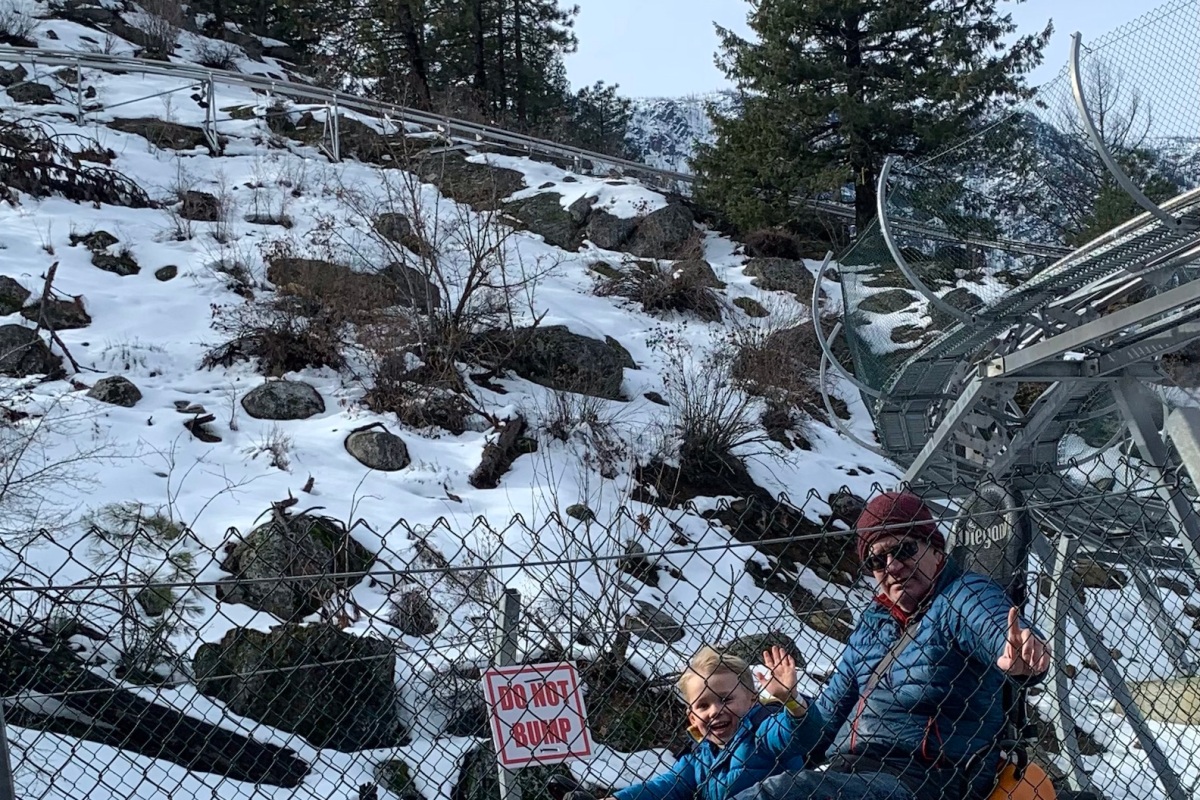
Last weekend when we were in Leavenworth, WA, we went to an adventure park to ride a roller coaster. Or maybe I should say a roller-coaster-ish kind of ride because the cars were individual and the driver could apply the brakes as much as they wanted. Another clarification: by “we” I meant my kids rode with my dear friend, Doug, because I’m an endurance person, not a speed person.

Now that I have all those caveats in place, on with the story.

Eight-year-old Miss O had no hesitation and climbed right in to ride with Doug. Talking with four-year-old Mr. D about it, he was clearly torn. He didn’t want to do it. And then he did. He flip flopped a couple of times. Since I was pretty sure he’d like it, I was trying to figure out how to nudge him in the direction of trying it.

But even though Miss O didn’t hesitate on this challenge, she and I had just been having a conversation about failing when it came to learning to ride her hoverboard. She asserted that life was easier for me because I never failed. I told her I fail all the time which is why is doesn’t faze me much any more. In fact, I rarely think of it as failing but just as a step towards the next thing I need to do.

On the drive to Leavenworth, I’d been listening to the Ten Percent Happier podcast, The Science of Failing Well where Dan Harris was talking with Amy Edmonson, a professor of leadership and management at the Harvard Business School. She had three points that stuck with me about taking risks:

  • Make the risk as small as possible: This point reminded me of gambling – make a bet but don’t put all your chips in.
  • Have a hypothesis: Know what you are trying to test or prove
  • Learn from the attempt: Use the experience and hypothesis to extract information for the next thing you might try.

I think a lot about what creates confidence. What my parents did to create kids who are willing to try hard things because for all the differences between my siblings and me, we are all game to take on new challenges. So I’ve tried to figure out how I can do the same for my kids. While there’s much that remains a mystery to me, what I’ve identified is that my willingness to try and fail might be the single most defining characteristic in the arc of my life.

So, I told Mr. D he didn’t have to do it. But if he did, he only had to try one ride, Doug could go as slow as he wanted, and that I thought he’d like riding in a car on a track. When it came to his turn, Mr. D was a little nervous but resolutely game. Until I greeted him at the exit ramp, that is. He rolled back in with a huge grin on his face!

He had so much fun that he learned he wanted to do it again. And the second time he went up with his hands in the air.

Life is a roller coaster and I’m glad that I continue to ride. The metaphorical kind at least.

(featured photo is mine)

(quote is from Real Life of MSW blog: Being Brave)

Pause to Celebrate

Sometimes you will never know the value of a moment until becomes a memory.” – Dr. Seuss

The first time I summitted a mountain, 14,411 foot Mt. Rainier, I was too cold to stand around and celebrate. I huddled with about five other climbers in the lee of some rocks waiting for the rest of the group to be ready to start the descent.

For the big summits I’ve stood on, that first one was the most uncomfortable, but none have been particularly pleasant.

I was thinking about this recently after we finished a big work project. The feeling upon a successful completion wasn’t that we were ready to celebrate – but that we were collectively exhausted.

Putting it together with mountain climbing, I realized that often, success feels like exhaustion. That applies to growth too. It’s only in retrospect that I can feel or recognize that something remarkable is finished.

Of course, the really good and experienced climbers that I climbed with would always say “Climbing is a round trip sport.” But even when we finished our round trip and went to the pub afterwards, we’d toast the summit, and quickly move on to spending most of the time talking about what we were going to do next.

Sometimes, we just need to take a pause to celebrate. Like now. Even on a Monday. If nothing else, we deserve a moment of applause for just showing up. Happy Monday!

I’ve written a post about recognizing our courage on the Heart of the Matter blog: We’ll Call it Courage Anyway

Ying and Yang

We spend the first year of a child’s life teaching it to walk and talk and the rest of its life to shut up and sit down. There’s something wrong here.” – Neil deGrasse Tyson

The other day I was driving in the car with my kids when my 2-year-old son, who’s favorite show these days is the British cartoon Peppa Pig, started doing a great imitation of Daddy Pig snoring.

My 6-year-old daughter laughed and then asked, “When we get a daddy will he always be falling asleep, snoring and messing up the map reading like Daddy Pig?”

Which made me want to snort with laughter like Mommy Pig does.

It seems like toxic masculinity is a term we bandy about these days. It reminds me of when I was a kid in the 70’s and Bobby Riggs and Billie-Jean King played their Battle of the Sexes and male chauvinism was such a hot topic.

But years ago I read something from University of Toronto psychology professor Jordan Peterson that made me think that this topic is deeply seeded in humans. In his book 12 Rules for Life, he talked about selection of male partners.

Woman are choosy maters (unlike female chimps, their closest animal counterparts). Most men do not meet female human standards. It is for this reason that women on dating sites rate 85 percent of men as below average in attractiveness. It is for this reason that we all have twice as many female ancestors as male (imagine that all the women who have ever lived have averaged one child. Now imagine that half the men who ever lived have fathered two children, if they had any, while the other half fathered none).

I thought that was a stunning statistic of the big picture view that only 50% of men, averaged over all time, have fathered children. But then it’s the next part of the passage that gave a hint about toxic masculinity:

It is Woman as Nature who looks at half of all men and says, “No!” For the men, that’s a direct encounter with chaos, and it occurs every time they are turned down for a date. Human female choosiness is also why we are very different from the common ancestor we shared with our chimpanzee cousins, while the latter are very much the same. Women’s proclivity to say no, more than any other force, has shaped our evolution into the creative, industrious, upright, large-brained (competitive, aggressive, domineering) creatures that we are.

I know Dr. Peterson is a controversial character. But taking this argument at face value, but it doesn’t seem like too much of a leap to believe that women have sought out men who are certain, successful, strong and seemingly invulnerable. And so perhaps women can help to change that nature too, or at least I’d like to think we can help:

By raising sons who are free to grapple with their emotions.

By being a safe place for our brothers and friends to talk about the pressures they feel.

By helping out with map reading.

By letting our daughters know that it’s great to choose men who let their non-aggressive flags fly.

By listening and supporting everyone who says this is hard.

Maybe when I have a partner in life again, he’ll fall asleep and snore. But like Daddy Pig, he’ll be able to laugh about it because he knows we don’t expect him to be perfect, just true.

What do you think? Can women help with toxic masculinity? Is it too much of a buzz word to have much meaning? Is it okay to quote someone like Dr. Peterson even if I don’t agree with how he’s been politicized?

(featured photo from Pexels)

No Name Calling

Success is going from failure to failure without losing your enthusiasm.” – Winston Churchill

About ten days ago, a week before my daughter’s elementary school let out for the summer, there was a school Field Day where the entire student body of 400 kids played games at 28 stations to earn food and prizes. They were looking for volunteers so I tended the soccer kick station with another parent.

It was an easy 10 feet kick into a goal. We had a lot of kids come by – Kindergartners who had feet about the size of a deck of cards, differently abled kids that came by with their instructional aides, and most of the student body including the 5th graders who looked like they were ready to take on the world.

Everyone was displaying great spirits until one girl, perhaps in the 4th grade came by with a friend and gave the ball a kick. I shouted “Wuhoo” and she said, “Don’t say ‘Wuhoo.’ I’m a failure.” And I said that she kicked the ball with lots of strength and she repeated, “I’m a failure.”

Her ball hadn’t gone in (we didn’t really require that) but most kids could get it in, even the little Kindergartners. So I gave it her the ball again and said, “Kick it again.” And she did – without even really trying and it didn’t go in. She said, “See, I’m a failure.”

I was flummoxed. Her assertation that she was a failure was a wall that seemed to keep everything from going in. With that up, it didn’t seem like anything could penetrate.

With the first post I wrote about confidence, I can, I quoted author and psychiatrist Neel Burton who distinguished confidence from similar concepts by explaining confidence is feeling “I can,” self-esteem is feeling “I am” and pride is the feeling of “I did.”

When the little girl came to the soccer kick station, she both asserted that she couldn’t and that she was a failure. And once that was in the air it seemed to operate like a foregone conclusion for which there was no quick fix.

Because we can fail over and over again and still be confident. Here are some examples.

I’ve missed more than 9000 shots in my career. I’ve lost almost 300 games. 26 times I’ve been trusted to take the game winning shot and missed. I’ve failed over and over and over again in my life. And that is why I succeed.” – Michael Jordan

Failure is only an opportunity to begin again more intelligently.” – Henry Ford

A woman who never gives up can’t fail.” – Abby Wambach

The distinction seems to lie between admitting we’ve failed without calling ourselves a failure. I hadn’t thought much about that small difference until I heard researcher and author, Brené Brown tell a story about when her daughter was in pre-school. The pre-school teacher told Brené that one day after Brené’s daughter had been doing art at the glitter table the teacher said to her, “You are a mess.” And the daughter retorted, “I might be messy right now but I’m not a mess.”

In the retelling, Brené laughed and said that her roots as a shame researcher were visible. We can describe our current situation without calling ourselves names. No name calling is a rule in my household since I heard that story, and I apply that to the conversations I have with myself as well.

My daughter overheard me telling my mom about the little girl who called herself a failure at Field Day and was fascinated by the story. It was a great opportunity to talk with her about what happens if we believe the names we call ourselves. I hope the ripple effect is that she won’t call herself names and maybe even say something if she hears someone else doing it.

This is my fifth post about confidence. Here are the others:

I Can

Fear and Confidence

Growth Mind-set

Bossy Pants – Confidence and Leadership

Back on Top

When one tugs at a single thing in nature, he finds it attached to the rest of the world.” – John Muir

Sometimes I think I can more easily name mountain climbing trips where I didn’t summit than the ones I did. Like that time on Mt. Elbrus in Russia where I was throwing up at our camp at 13,500 ft and stayed in the hut with the really funny, nice guy from California who had a headache. Or the time on Mt. Orizaba in Mexico when we couldn’t cross that exposed couloir because the ice was too fractious to get a screw in. In both cases I was a long way from home not to succeed and maybe that’s why they stand out — though I can name the ones closer to home as well.

Looking back at those climbs now, I see they were a way for me to practice two elements of life “in play” before having to live them. I started climbing mountains in my late 20’s before I had racked up any big life losses.  So the first thing I was practicing is trying, that decision to tackle something that is really gutsy for me, not knowing whether or not I would succeed. And the second I was developing was being able to fail without seeing myself as a failure.

There’s a critical element of letting go for me when I don’t succeed. It is humility, recognizing limits. It’s all about accepting that I don’t have to be finished in order to be loved, even by or especially by myself. That self-acceptance has come with practicing failing. A choice between leaning in towards the love that has always held me or branding myself unworthy.

Here’s what climbing has taught me. Standing on top is great, especially if I’m mindful of the sacredness of what I see up there. It is a moment to take in all the commitment and teamwork it took to get there. But failing to get to the top just means I get to spend more time in the mountains and I practice that key part of life – trying. Lucky me!

I’ve also learned a secret — no one else in my life really cares whether I summit or not. As long as I walk back into the parking lot upright and smiling, it’s good enough for the people who know and love me. Of course they care if it’s important to me but often it’s what I try that sticks in their minds, not what I succeed at. No one else is tallying a score card of my life.

None of these things are only about climbing because now that I’ve failed plenty in my “real” life, I know they are just as true about life in general. It’s not easy to keep trying big things and its hard to fail – but practicing it makes it easier.

Years ago I had a friend who said to me in a moment of vulnerability when his dad died suddenly, “I just wish he’d been able to see me back on top.” He’d gone through some really hard life losses right before his dad passed and the pain of wanting to be successful in his dad’s eyes was palpable.

I can’t speak authoritatively for my friend’s father but I knew him as a gentle and wise man. I believe he already saw his son back on top. Because my friend was still trying and still smiling.