Learning From Experience

“Turn your wounds into wisdom.” – Oprah Winfrey

Ten years ago (I know because I found the picture), I was walking my dog on a busy neighborhood street and he found a stuffed animal. A cute little tiger with a soft white belly and my dog proudly picked it up and carried it all the way home until he could stow it away on one of his dog blankets.

While I didn’t think much of it at the time, I now realize with great horror that it likely was some child’s precious stuffy that got tossed out of a car in a moment of great emotion. I’ll never actually know if the family went to look for it but by allowing my dog to carry it home, we certainly made it unfindable.

Before bed, my 6-year-old daughter and I take turns reading. She practices her reading skills and then I read a few pages of something longer we are working on. We just finished J.K. Rowling’s The Christmas Pig in which a child loses his most precious friend, a stuffy that his step-sister throws out the window in a moment of rage. The child then takes a precarious Christmas Eve trip to the Land of the Lost to try to retrieve it. In J.K. Rowling’s incredibly imaginative tale, there are several places the things we lose go – Mislaid (think eyeglasses), Disposable (e.g. batteries), Bother-Its-Gone (that poem you penned on the back of a napkin), The Wastes of the Unlamented (the tchotchke you never wanted to buy in the first place), The City of the Missed (where we meet someone’s Principles) and The Island of the Beloved (where Santa lives).

In the story, she includes not only things that we lose like a diamond earring but also the intangibles – the bad habits, the tendency to bully, our pretenses, ambition, power and hope. It is so incredibly insightful that it is one of those books that was a pleasure for me to read as much as my daughter to listen to.

Which brings me back to the stuffy I let my dog take home. Often it’s only through experience that we can relate to someone else’s pain. This is the case now that I realize that stuffy was likely a well-loved object of a kid’s affection. Fortunately, my kids have not (yet) thrown a stuffy out the car window, but I have spent many fretful moments in a full sweat looking for the item that we just HAVE TO HAVE before going to sleep.

Suffering, as much as we might not like it, helps us to know each other.

At the Core

Whether you think you can, or you think you can’t — you’re right.” – Henry Ford

Last weekend we drove about 15 minutes down to Shilshole Bay on Puget Sound to see a dock where sea lions like to congregate. It was packed with sea lions – usually a dozen on the dock and I counted a least a dozen more swimming in the water.

Every once in a while, a sea lion would launch itself out of the water in an attempt to land on the dock. The new weight would make the dock roll one way or the other causing all the sea lions to bark. But there was one sea lion in the center who was doing most of the work to keep the dock level. It would lift its head high and shift its weight this way or that to stabilize the dock again.

It made me think of how impactful what is at the center is. As I was pondering what was at my core, Life, in that beautiful way that sometimes happens, delivered the answers to the question I’d just uncovered. In this case it was through the latest the Unlocking Us podcast about living into our values. In it, Brené Brown had an exercise to determine our core values.

Her research shows that when in a tight spot, most people call on their one or two go-to values. So on her site, there is a pdf of about 120 values. Her recommended approach was to circle the ones that called to you and then distill them to the two values that encompass what is central for you. It may change over time but this exercise was to identify what is key for right now.

Doing the exercise, I came up with faith and usefulness. Faith, which for me encapsulates confidence, courage, adventure, integrity, spirituality, openness, love, optimism and gratitude. Usefulness I thought did a good job of rolling up my other values of reliability, learning, kindness, growth, family, and independence,.

Over the years I’ve done a lot of work to strengthen my physical core. It has enabled me to carry heavy loads up mountains and I feel it most now when I hoist my toddler onto my shoulders. But thinking about my core values, faith and usefulness, I realize that they are what I go to again and again to power me when I have to dig deep. Like with the sea lions, when I am living into my values, they are the center that brings me back to level when the world is rocking.

Growing and Blooming

What we love, others will love and we will show them how.” – Wordsworth

When I was 22-years-old and moving into my first post-college rental, my dad helped me find some used furniture. Some people he knew where moving into a retirement community so we looked at the items they were getting rid of and bought a kitchen table, two chairs and a Christmas cactus. I donated the table and chairs when I bought my first house a few years later but the Christmas cactus has been with me now for 30 years.

It was my first proof that I could keep something other than myself alive. Now I look at that cactus and see it as a reminder of my most important lessons.

It blooms beautifully once a year and then sheds all those flowers as it prepares for its next feat. It’s best to shed the past so you can work towards the next thing.

The cactus does not appear to be doing anything for 50 weeks but then bursts with color for 2 weeks. Most of our work happens on the inside.

Every now and then it’s drooped in the soil it is in and needs to be repotted as its roots grow deeper. We need some new perspective/work/material from time to time in order to stay vivid.

Sometimes it blooms closer to Thanksgiving rather than Christmas. As you get older, you learn to care less about expectations and more about flourishing in the way that works for you.

The growth on the side nearest the light blooms first but eventually, the darker side blooms too. If you water all of yourself, both your bright side and the shadow side will bear fruit.

 Although it’s a cactus, it has no prickly parts. It’s possible to live a long and beautiful life without thorns to protect you.

This weekend I came across my son picking up the dropped flowers with some tweezers and putting them on the stand. It made me think of my most important work. Trying to create a calm, loving space in which others treat things with kindness.

Some Things Can’t Be Dropped

If peace comes from seeing the whole, then misery stems from a loss of perspective.” – Mark Nepo

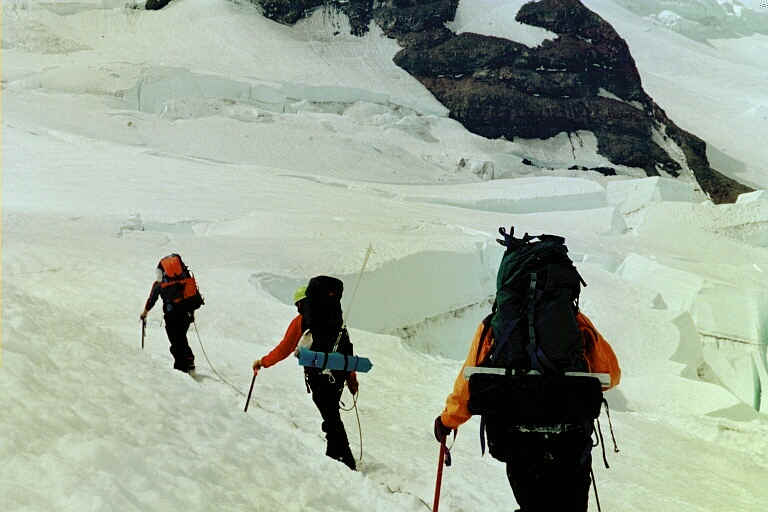
The year after I’d summitted Mt. Rainier for the first time with a guided group, my friends and I put together a team of four of us to make an attempt on our own without a guide. We left on a Friday afternoon, climbed three and a half hours to ascend about 3,500 feet in altitude and started to make our camp.

It was dark by this time and as we hurried around with our headlamps on, I went to pull the tent poles I was carrying out of my pack. One of the poles slipped from my hand and started to slide down the mountain. Panicked by my mistake, I leapt forward and fell on it before it could disappear out of the spotlight of my headlamp.

I was thinking about that pole as I hurried around making Christmas plans yesterday. In a season where it seems like there are a hundred things to do, some things can’t be dropped.

The slipperiest sometimes is the whole point in all we are celebrating. In my family, we celebrate the birth of Jesus and the promise that love, light and kindness spread generously can make a difference in this world. As we celebrate the delight of this year, we also recognize that there are many ways we can do it better next year.

On that climb twenty years ago, fortunately I caught that tent pole because without it, there wasn’t going to be a tent. At 9,000 feet of altitude on a dark night with a whole lot of mountain to search, we weren’t going to find it if it slipped out of sight. But with it, we went on to climb and summit the mountain safely with a warm, dry tent as our base.

I keep coming back to that story as a way to keep me centered this Christmas season. With the point of all we are celebrating in the spotlight, it gives us a solid base from which to attempt everything else we are doing.

In Feeling

The problem with this world is that we draw our family circle too small.” – Mother Teresa

Here’s the way sickness travels in my family. One kid gets sick, the other one gets it and then finally I get sick. Fortunately, I don’t always get sick but if I do, I’ll be last to get it. And when I do, I learn how brave my kids have been.

This time it was my daughter who got a stomach bug first last weekend. She spit up a few times and then said, “Wow, I’ve never thrown up 4 times in a day before. When are we going to go hiking?” I replied that I thought she might want to rest given that she didn’t feel well. She exclaimed she felt fine so we went.

Then my son got it mid-week. It was very clear because I opened his door to get him out of his crib in the morning, and instantly got hit with the smell. “I sneezed it out!” he exclaimed, not all that upset. He stayed home from school but he too said he felt “good” and was pretty peppy playing around all day.

I thought I’d avoided getting it too until this weekend when my body, probably exhausted from all the cleaning, just gave up and succumbed. I wondered how the heck my kids were so delightful when their bodies were fighting this bug. It always looks easier when someone else is doing it, doesn’t it? As usually happens with getting sick, it comes with a huge heap of humility and admiration too.

This made me think of the words sympathy and empathy. Sympathy from the Greek of sun (with) + pathos (feeling). Oxford languages defines sympathy understanding between people, common feeling.  

Empathy, a word I hear so often these days in conjunction with raising emotionally intelligent kids, is from the Greek of em (in) + pathos (feeling). It is defined by Oxford languages as the ability to understand the feelings of another.

In my little family we have so many opportunities to have sympathy for each other because we share so much context at this stage – the people we know, the many hours we spend all together, the illnesses we pass along. It may be the easiest time for us to all stand in common feeling. And if we get that right, at least some of the time, it helps us become more empathetic toward others because we have the family experience of feeling understood.

The other thing I was reminded of as the illness ran its course is how much energy I spend resisting being sick. I didn’t want to throw up and I managed not to. But in hindsight, it may have made it last longer overall. Sometimes we just have to let the bad out so that the healing can begin, a lesson I keep having to repeat.

It’s funny as I type this thinking of my gratitude towards this stomach bug. It created a shared family experience, reminded me that resistance to uncomfortable things is often a harder route to go and most of all, makes me so thankful that we all feel well again. If only there was a virus that could unite our bigger human family….

(featured image photo from Pexels)

Feedback Loops

Life is an echo. What you send out — comes back.” – unknown

My son and I were reading before bedtime. He climbed up on my bed with the pile of board books, snuggled in and then said, “Come up.” After I did, he said with a clap, “Good boy, Mama!”

When I put my daughter to bed, after we say our prayers and I snuggle her up so only her little face is showing above the comforter, I say “Good night, beautiful girl.” And she replies “Good night, beautiful mama.”

I studied feedback and control systems in college when getting my Electrical Engineering degree. But nothing has been more effective and more immediate than parenting in reminding me that life is an echo. My kids show me every day that what I send out comes right back to me, usually in the same tone.

Sibling Supportiveness

There’s a sun in every person – the you we call companion.” – Rumi

My kids and I were sitting on my bed reading books before bed and my 6-year-old daughter leaned over and kissed my toddler on the head and said, “Love you, Baby.” He said, “No kiss, La-la.” And so I kissed him on the head and he said, “No kiss, Mama.” But he was smiling so we kept kissing him and he kept saying “no kiss” and laughing.

My kids have such a sweet relationship. When they are in the car and my toddler hears a siren or other noise that scares him, he’ll say, “cared”, my daughter will say, “Want to hold my hand?” and he does.

I work hard to make this happen. I sit with them as they work things out and act as interpreter. I also narrate why he mimics her so much because he thinks she’s the coolest thing ever. I do this because I grew up as the younger sibling of someone who hated me. She was four years older than me which is the same age difference as my two kids. When we’ve talked about it as adults she said, “I don’t know why I was so mean to you.”

My opinion is that my sister has always struggled with feeling like she didn’t belong in our family because she was the one “realist” amongst a pack of optimists. I came along and the easy, happy disposition I was born with challenged her fighter, questioning nature and it is her makeup to push back.

Whatever my sister’s reason was, I find it fascinating to think about the dynamic now. Having kids that are the same age difference has been fear-inducing and healing for me. I was terrified that the same pattern would repeat itself. And now I’m starting to trust that there isn’t any scary truth that four years difference makes siblings not like each other.

There isn’t a more influential factor on my parenting style than the wounds of my childhood. I was scared to live with my sister – scared that anything I professed to love she would destroy. If I had long hair, I was scared she’d cut it off at night, if I liked a particular stuffed animal, I was scared she’d take it or destroy it. To be fair, I don’t think she ever did – but she threatened a lot. And I think I’m still scared of admitting I love something in case that means it’s taken away.

My mom was tired of kid squabbles by the time I came along as the third child. She was ready to move on with her own professional and personal development and given how talented and smart she is, that was only natural. But it meant that telling her my fears or about the conflict was not a fruitful path. She’d call it tattling or say we both caused it, no matter what happened. There was no path to resolution for me as a child – no understanding, no naming it and no way out of fear.

So every day I work at building trust between my kids and making sure they are source of comfort, not anxiety for each other. It heals me alongside helping them. It’s another reminder to me that nothing is wasted in this life – every wound can become a source of knowledge and inspiration. I hope that long after I’m gone, when they are scared, they will still talk to each other about it and hold hands.

Difficult Compassion

It’s not how much we give but how much love we put into giving.” – Mother Teresa

Recently my kids and I have had a couple of encounters with apparently homeless people that along with the proliferation of tents in the parks that came with COVID have my almost 6-year-old daughter asking a lot of questions. In one encounter, a man with a belt still tying off his arm for shooting up was hollering and trying to take off his pants and another man was threatening him with a baseball bat to emphasize that he should keep his pants on. In another, a man was crawling down the busy street near where we live with a look of sheer agony on his face and one arm outstretched.

I often am confused about how to talk with my daughter about these matters. She may only be going in to first grade but she talks like she is a 9-year-old, is very observant and asks a lot of good questions. To top it off, the homeless problem is so apparent and pervasive that I certainly don’t have any great ideas about how we are going to fix it. But we came up with an idea that she could draw something and we could make some care packages for people that we see.

Yesterday she wrote this note without any help from me:

We nowe you are homeless but we care. Sorry you are homles.

Do not smoc. Do not take drugs becus they make you feel bedder for a few minets but wen it goes a way it makes you feel wurs.

My daughter – age 5.9 years

She then started taping on extra pieces of paper so that she could continue. In addition to being fascinated about what content she’s taken in from our many discussions, I noticed how hard it is to stay in empathy before moving to advice or judgment.

The other day my friend, Doug, asked if I could remember the name of a guy we used to work with. He said something like, “You know, the guy who’s wife left him, house burned down and his dog died?” “Oh my goodness,” that’s terrible I thought and still had no idea who he was talking about. But it wasn’t long before the thought crossed my mind that this poor man really must have pissed off God.

So I know first-hand how hard it is to stay in empathy. I start moving to judgment or advice because it feels like having an explanation of why bad things happen makes me feel safer that they won’t happen to me. Understanding that tendency has helped me practice a better kind of compassion, one that tries not to presume to know the journey another person has walked but is willing to help. It haven’t gotten any less confused about how to talk about these huge problems with my kids but I think it has helped me to have more open-ended conversations with them where we can recognize the humanity of others and be curious about how we can help.

In that spirit, my daughter and I settled on just drawing hearts that say “we care” on the back. I don’t think they will solve homelessness but I do hope that they bring a moment of being seen.

Five Pieces of Writing that Inspired Me: #5 Showing Up

“He is able who thinks he is able.” – Buddha

Sometimes the problems of the world seem overwhelming so that I feel anything that I could do wouldn’t matter in the slightest. Then I think of this story that Frederick Buechner told as part of a sermon he delivered and I remember that we just have to show up.

The Best She Could

In any case, it was this same George Shinn who in 1880, five years before being asked to start your church here in Chestnut Hill, was summoned once at midnight to the bedside of an old woman who lived by herself without much in the way of either money or friends and was dying. She managed to convey that she wanted some other woman to come stay with her for such time as she might have left, so George Shinn and the old woman’s doctor struck out in the darkness to try to dig up one for her. It sounds like a parable the way it is told, and I am inclined to believe that if someone were ever to tell the story of your lives and mine, they also would sound more like parables than we ordinarily suppose. They knocked at doors and threw pebbles at second story windows. One woman said she couldn’t come because she had children. Another said she simply wouldn’t know what to do, what to be, in a crisis like that. Another was suspicious of two men prowling around at that hour of night and wouldn’t even talk to them. But finally, as the memoir of Dr. Shinn puts it in the prose of another age, “The rapped at the humble door of an Irish woman, the mother of a brood of children. She put her head out of the window, ‘Who’s there?’ she said ‘and what can you want at this time of night?’ They tell her the situation. Her warm, Irish heart cannot resist. ‘Will you come’ ‘Sure and I’ll come, and I’ll do the best I can.’ “And she did come,” the accounts ends, “She did the best she could.”

Listening to Your Life – Frederick Buechner

Five Pieces of Writing that Inspired Me: #4 Leaving a Mark

“Be kind whenever possible. It is always possible.” – Dalai Lama

This meditation from Mark Nepo made me think about how we touch the people we are closest to all the time. Even if not physically, our presence and especially our words shape everyone around us. Whenever I think of how we rub off on each other with every encounter, this meditation is what I’ve come to see in my head.

The Work of Love

“Love courses through everything.” – Fakhruddin Iraqi

I recently learned that the first form of pencil was a ball of lead. Having discovered the lead, if scratched, would leave markings, people then wrestled with chunks of the stuff in an attempt to write. Through the work of many, the chunks were eventually shaped into a useable form that could fit the hand. The discovery became a tool.

I am humbled to confess after a lifetime of relationship that love is no different. Be it a lover or a friend or a family member, the discovery of closeness appears in our life like a ball of lead – something that if wrestled with, will leave markings by which we can understand each other.

But this is only the beginning. The work of love is to shape the stuff of relationship into a tool that fits our hands. With each hardship faced, with each illusion confronted, with each trespass looked at and owned, another piece of the chunk is whittled and love begins to become a sacred tool.

When truth is held in compassionate hands, the sharpness of love becomes clear and not hurtful.

The Book of Awakening by Mark Nepo