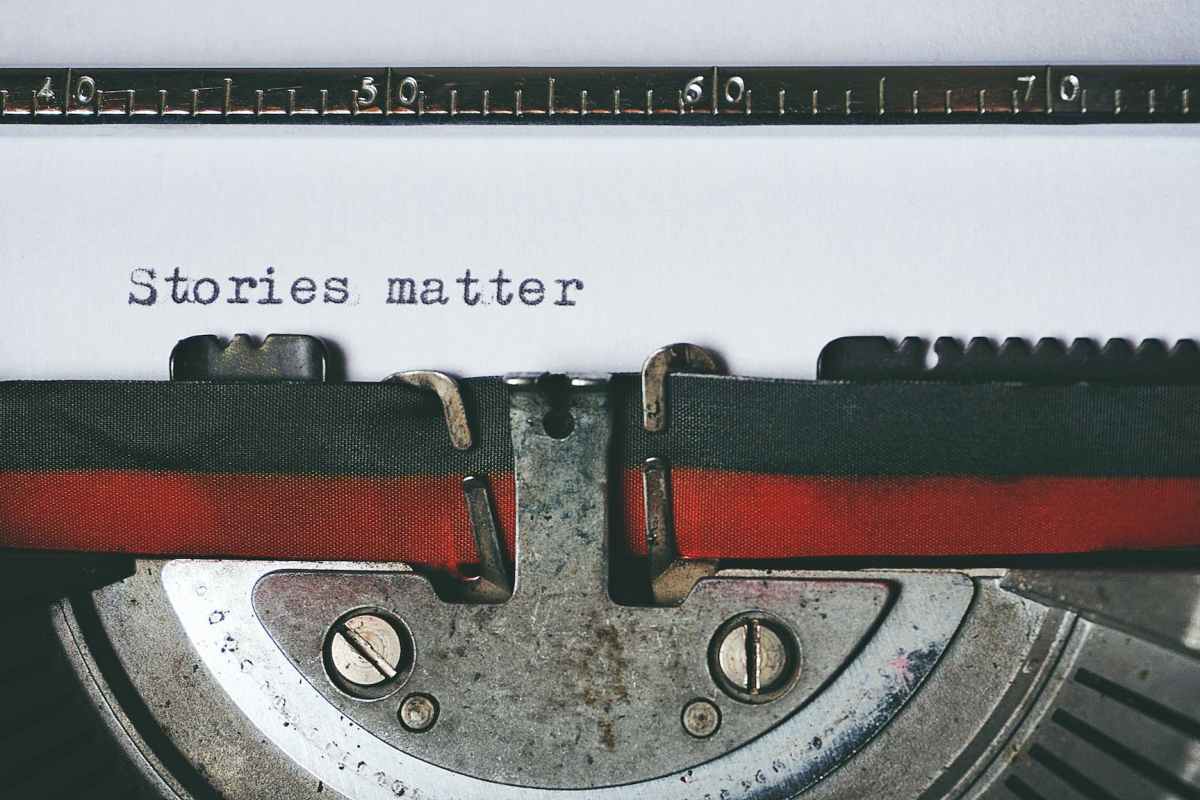
Editing That Six-Word Story

The other day we were holding a family meeting where eight-year-old Miss O and I where hotly debating the next thing to do and I asked four-year-old Mr. D if he had an opinion.

“No, I’m not a good talker,” he replied.

Whoa, there’s a six-word story!

I’m sure with his very verbal older sister and his mom that is fascinated by words, it feels like he can’t get a word in edgewise. Funny thing is that he is interested in following along. I notice that the more we talk, the more still he gets. And then when we least expect it, he pops off with a perfectly positioned sentence like on January 1st when he said, “I told you last year not to step on lava.”

It feels like helping these young people write and change their stories as they grow is one of my biggest responsibilities and honors. In this case, I’m hoping to convince Mr. D that his six-word story is better said as, “I’m not a good talker…yet.”

And for more about six-word stories, please tune in to my podcast with Dr. Victoria Atkinson. We know and love her as our blogging, writing, and podcasting friend. But in this case, she brings all her experience as a therapist, professor, college dean, and author to bear to teach us how potent these little stories can be.

Search for Sharing the Heart of the Matter on Apple podcasts, Amazon Music, Spotify, and Pocket casts. And please subscribe! Or click here for the show notes and link to listen to the podcast on Anchor.

(featured photo is mine. I offer these six words as a caption: Despite our care, another worm died)

My Love Affair With Words

Be sure to taste your words before you spit them out.” – unknown

The other night I was fixing dinner while my seven-year-old daughter was in the family room working on her very first short story. “Momma, how do you spell persevere?” she asked. As I replied, I took in the really sweet scene and thought to myself “there’s another leaf that’s going to stick on my word associations tree.”

Because that’s how my brain likes to work — by creating associations to words. Like with smells or sights, words themselves conjure memories and the older I get, the more associations I have – or in my mental image, leaves on my word tree.

For example, enthusiasm – from en-Theos or with God – reminds me of my beloved father who was a Presbyterian pastor. There isn’t a word that describes his remarkable energy better and I can’t hear it without thinking of him.

Or plethora which is my best friend’s favorite word. And since we’ve been friends since we were seven-years-old, there are a plethora of memories that come to mind when I hear that word, especially of high school when life was abundant in opportunity, boys, and screw ups to learn from.

Then there’s the phrase “pit stop” that with the hard “t” and “p” sounds reminds me of my sister. She used the phrase in a letter she sent to the whole family when we were in 20’s when she was mad at my brother for not breaking off a relationship with one of her friends properly. In trying to smear him for using others as a “pit stop from himself,” she instead attached that phrase in my mind to my image of her, along with “misdirection” for her ability to distract from the work she needs to do.

Plenitude is a recent favorite that comes in accordance with meditation which almost always leaves me with the reminder that at that moment I have enough.

When I first started going to meditation class ten years ago as I was healing from my divorce, there was a bowl of inspirational words on a table to pick from. I kept getting “transformation” and I was so completely tired of it I just want to scream, “Haven’t I changed enough for a life time? Leave me alone.” And fortunately when I vented that thought, I was usually down on my knees in prayer pose and from there could bend to accept more renewal.

Because renewal has a friendly association for me. That means my cup is being refilled and hopefully my energy too. I’m friends with renewal in a way that I will never be with transformation.

Calibrating sentences” is one of my recent favorites that comes from playwright and writer, Jack Canfora, on a podcast that he did bout the creative process. Isn’t that a beautiful way to measure the weight and balance the best utterances come with? And given that it comes from such a gifted writer, it gives me hope that if I work at it too, I might be able to calibrate a few great sentences in my lifetime.

Fledgling gained new attachment for me when I had kids. Never before had I been able to appreciate the delicate nature of holding newness in my arms combined with the potent desire to provide a platform strong enough to see them take flight.

Bivouac reminds me of my climbing friend, Phil, who is always joking that it’s French for mistake. It’s not, it means a temporary camp without cover according to Oxford languages, but since Phil bivouacked high on Mt. Everest during the climb when he became the first American to climb the North Side of Everest, it’s a well-earned attachment.

Say the word “authentic” and I think of my meditation teacher and friend, Deirdre. It’s the attribute that makes it so she can somehow manage to lead a yoga class and yell, without missing a beat, “Move on, Motherf*$)#^!” out the door at someone she thinks is casing her car.

The word I associate with me three-year-old son is observer. The other day I turned on some kitchen lights I don’t usually use for a house guest. When my son saw them, he took me by hand to show me where other lights of that same type were in the house. He sees the quarter moon and says, “The moon is missing a piece.” And most recently, in one of his most profound observations, we were watching a storm out the window and he said to his sister, “Sshh, I can’t see.

There’s “constellation” and it reminds me of my brother and one of his favorite songs by the same name by Jack Johnson and Eddie Vedder. It also is attached because my brother is always seeing the patterns in things.

Love has so many associations that it has become cluttered. But dedication, commitment, intimacy, fun, play, expansiveness, laughter, loyalty, selflessness and desire each conjure a particular person or memory in my life so that all together, they jumble into a delicious mix of how love feels to me.

I can’t hear the word “condensation” without thinking of my very verbal daughter. As a four-year-old, someone was telling her he had water forming on the inside of his camper van on cold nights and she responded, “You mean condensation?”

My love of words has infected me so much that for almost any person in my life, I have a word association for them. It makes me wonder that if, by the time I’m really old, if I’m lucky enough that my body perseveres that long, every time I construct a sentence, there will be a memory and person hanging off of it.

Maybe that will be my tree of life and I’ll be able to enjoy each delightful word with the memory that comes with it.

(featured photo from Pexels)

Talk, Talk, Talk

We spend the first year of a child’s life teaching it to walk and talk and the rest of its life to shut up and sit down. There’s something wrong here.” – Neil deGrasse Tyson

My daughter, Miss O, learned the power of words early on. She started talking at 10 months and it’s been off to the races ever since. Now she’s eight-years-old, and I’ve learned to get worried when she isn’t talking.

One Sunday when it was just the two of us and Miss O was about three-years-old, I was feeling overwhelmed by the constant talking, singing, and narrating. We were sitting and drawing at the dining room table as the last rays of fall afternoon sunshine filtered into the room. I said to Miss O, “Do you think we could just be quiet for 10 minutes?”

Miss O paused for a moment and then said, “Why?”

About a year later, a friend was at our house trying to troubleshoot a problem with his van. Four-year-old Miss O asked him what was happening and he started, “When hot air meets a cold surface and water forms…” She interrupted him and asked, “You mean condensation?

I confess, I don’t always listen to her every word. But I recently had the honor of editing a podcast that Miss O did with Vicki and me. As I tuned in with ears to make sure the conversation flowed, I was stunned with the perspective of this delightful young person talking with the incredibly interesting and supportive Vicki Atkinson.

Am I biased? No doubt! But most of all what I noticed is that Miss O has learned to use her words well. And she’s found her voice – to express herself, to give voice to her feelings, to convey her delightful enthusiasm, and at the end, to share her delightful glow with everyone around.

Ha – I just realized this post could have been reduced to one sentence. Miss O is on the Sharing the Heart of the Matter podcast with the always amazing Dr. Vicki Atkinson and me – please listen. Perhaps wordiness runs in the family….

Caring Less Without Being Careless

Be teachable. Be open. You’re not always right.” – unknown

This was originally published on 11/2/2022. Heads up – you may have already read this.


When American actor James Caan died in July of this year, I heard that his least favorite words were “I don’t care.”

Obviously, I can’t ask him to elaborate on that. But if I’m trying to take his point, I’m guessing he was aiming for “I don’t care” – as in, it is of no consequence to me. I don’t care – as in, it will fail to penetrate my reality one way or the other. I don’t care – as in, it or you are not worth getting worked up about.

But sometimes I think we take caring too far. As if we should have an opinion about everything from what kind of brands are okay to wear, the exact specifications for the type of liquor we’ll drink and whether we can only shop at boutique and artsy stores.

When I’ve mistakenly worn my opinions as some armor of sophistication, I’ve found that it’s closed me off from life. It becomes a barrier between me and experience so that I have to surmount my own expectations before I can taste curiosity.

My dad had a mantra that he used for golf, “You need to care less without being careless.” And I think it works for more than just that silly sport (sorry golf lovers). It speaks to a balance that we can create between being involved in the world without gripping too tight.

We can have opinions, beliefs and wisdom while still holding space for not knowing. It means that sometimes we can embrace our lack of control and be entirely open to what comes next. And it suggests that we can maintain a curiosity even when we think we are right.

There is one more way that I believe caring can get in our way, especially when trying to find our authentic voice. We can care too much about the opinion of others, especially in our social media age. And then what we say and what we write becomes performative instead of real. This brings to mind a quote from Mark Nepo, one of my favorite poets:

This is at once the clearest of spiritual intents and yet the hardest to stay true to: how to stay open to what others feel and not what they think.

The Book of Awakening by Mark Nepo

So, I applaud James Caan for having a phrase that he said often enough to make it repeatable. But I have to admit, I don’t care for it.


I written about some of the ways we use language on the Wise & Shine blog today: Use Your Words

(featured photo from Pexels)

Smells Like Vacation

Only a child sees things with perfect clarity, because it hasn’t developed all those filters which prevent us from seeing things that we don’t expect to see.” – unknown

I love words. Use them all the time. But every once in a while, something happens to remind me that perhaps I’m using too many.

The other day my kids and I were driving an hour to get to the Washington State Fair. It wasn’t a vacation, or bay-cation as Mr. D says, but it was a special day. And my kids are great in the car – they generally get along and are happy to be there.

So, there we were, sunnily driving down the road. Mr. D, who Vicki (from the Victoria Ponders blog and my partner on the HoTM blog and podcast) refers to as a poet, pipes up from the back seat,

I can smell bay-cation. It smells like orange mixed with rainbow.

What do your vacations smell like?

If you are going on a road trip or just want some great listening around the house, check out the Sharing the Heart of the Matter podcast with author and blogger Pete Springer on our latest episode: Episode 36: They Call Me Mom with Pete Springer

Pick Three Affirmations

With all the stress and change at the beginning of the school year, I’ve been writing notes for Miss O in her lunch every day. Mr. D can’t yet read but his teachers asked for notes to read to kids when they miss their families.

The notes I find myself writing aren’t exquisite masterpieces that have any poetic resonance. They are simply affirmations in the stye of The Help by Kathryn Stockett

To the degree that I’ve figured out what works best, it is things that are specific, not too aspirational, and that resonate with what they might already believe about themselves. Writing them for my children is not very hard.

But if I was to turn the lens around the other way and have to pick three things to say to myself? Well, it’s a hard practice. So I’ve written some down for you all. Pick three things that you could really believe about yourself. Just so you know, I’ve written these with you all in mind:

You are clever.

You are kind.

You bring out the best in others.

You have come so far and are so generous to share your lessons with others.

You are a bright light.

You make others laugh.

You make others cry, in the best way ever.

You are such a good encourager.

You make the world a better place.

You are resourceful.

You are resilient.

You are creative.

You are so faithful.

You are a good listener.

You are wise.

You are patient.

You are a great storyteller.

You can figure anything out.

You have integrity.

You are empathetic.

You carry your load well.

You are strong.

You are brave.

You make me laugh.

You are a person I am delighted to know.

Really — pick three. Write them down and look at them when you eat lunch. I have it on good authority that they make the day better.

The podcast I did with Dr. Vicki Atkinson about how to Savor September goes nicely with lunch as well: Episode 35: September … Savor with Vicki and Wynne

Give Me A List

To meditate means to go home to yourself. Then you know how to take care of things that are happening inside of you, and you know how to take care of the things that happen around you.” – Thich Nhat Hanh

This post was originally published on 10/26/2022. Heads up – you may have already read this.


Have you thought about the effectiveness of lists in writing? Take a moment and think of the famous lists that come to mind like My Favorite Things from The Sound of Music or the Ten Commandments from the Bible. Even when we can’t name them all, I bet we can name a few or most.

Lists can help us as writers be concise, ordered and on topic. They also let the reader draw their own inferences. One of my favorite lists is Jack Canfora’s post, Dear Lord, Not Another Post on This Blog about Gratitude and I’m grateful it made me want to continue to write. AP2 polled the readers on the Wise & Shine blog and created 9 Pieces of Indispensable Life Advice From Your Future Self. And Dr. Gerald Stein’s list of How to Become Your Own Best Friend has so many nuggets of wisdom to mine. I can name those lists as impactful off the top of my head plus some items on them because at least I find lists are more memorable.

So, here’s a list I’ve written.

Why I Meditate

I meditate because it is the one thing that has improved the quality of my life the most.
The quality prior to meditation was only manageable if I drank a bottle of wine a day.

Meditation helps me live in my heart, not my head.
Because the voice in my head is an asshole.*
And I was sometimes an asshole when I listened to it.

Meditation has helped me to eat at the table of what IS and stopped begging at the table of what ISN’T.

I meditate to so that at least once I day I’m listening to the right things instead of the wrong things.
Right things include love, empathy, patience, wonder, awe, curiosity, grace, laughter.
Wrong things include judgment, self-flagellation, anxiety, comparison.

Meditation has helped me give up two key stories: that situations are win/lose and that choosiness leads to joy.

Instead I believe in bowing down to openness and creating porous boundaries where I try not to hang out to things as they come and go.

I meditate because it helps me exercise my grace muscle instead of my judgment reflex.

Sitting quietly in meditation has helped me to hear the heartbeat of life and trust in its timing and flow.
I almost always get this wrong and push ahead of the envelope but I’ve learned to respect it, especially in hindsight.

Meditation has helped me find internal quiet and be able to rest there.
When resting in that space, I can more easily find my way to others.

It takes repetition but meditation in five-fifteen minute daily increments has been the most gentle way of changing my life.
The other ways change has come to my life through loss, suffering and chaos have been a lot less fun.

And when I get all of the above wrong, which I do all the time, meditation helps me not judge myself too harshly, breathe and begin again.

How’s that for a list? Do you use lists in your writing? How about meditation?

*I give credit to former newsman Dan Harris, a self-described cynical but committed proponent of meditation and mindfulness for the phrase “the voice in my head is an asshole.” His podcast, Ten Percent Happier has great guests who discuss the science of mindfulness and it also has free, short 8-10 minute guided meditations. And for anyone looking for an app, Healthy Minds has 5-minute meditations. I am not affiliated with either.

** Update on 9/5: Another related post on meditation: Does Loving-Kindness Actually Matter?


Speaking of lists, I’ve compiled a list of favorite writer quotes submitted by bloggers in response to my poll of favorites on the Wise & Shine blog: Your Favorite Writer Quotes

(featured photo from Pexels)

The Power of Story

Quiet the mind and the soul will speak.” – Ma Jaya Sati Bhagavati

This is a piece was published previously on 10/19/2022. Heads up, you may have already read this.


Among the many stories my ex-husband told me of his precarious childhood, there is one that sticks out. He was five or six years old, living in Florida and his mom was dating the Hat Man, a man who wove and sold palm frond hats to tourists by the side of the road.

One night after he went to bed, my ex-husband woke up and smelled smoke. He tried to get out of his bedroom but his mom had locked him in from the outside. Finally he escaped out of a window to discover that his mom and the Hat Man had fallen asleep while smoking and drinking too much and set the house on fire.

Now that I’m a parent, I often think of my ex-husband’s story even though we divorced years before I ever had kids. The story of the precocious and energetic young boy who was probably a little bit of a pain in the ass locked into a room so his mom could drink in peace and set the house on fire.

I think of it when I need more patience to coax cooperation instead of compel it. I think of the story when I need extra capacity to provide good care to little ones when I am needing care myself. I think of it when I’m digging deep to do my best when my kids seem to be bringing their worst. I think of the story when I’m grateful that my parents modeled kind and consistent care with me as I was growing up.

When we tell our stories, or when we as writers tell other people’s stories, we often can’t see the effect they have on those who read them. Our narratives have the power to inspire others and become fuel for good and bad decisions. When we do a good job of humanizing the trauma that comes with life, we pass on the comfort of being seen and open the source for healing. We can lay the ground for growth by telling the stories of when life wasn’t so good.

I thought of my ex-husband’s story again the other day when I heard a Ten Percent Happier podcast with therapist Dr. Jacob Ham. He was talking about relational trauma, the small moments of neglect, abuse and fear some children experience from a very early age.

Dr. Ham described this trauma, “What’s really screwed up is as a baby that the only way to deal with fear and terror is to run toward your caregivers. They are supposed to protect you. You scream out hoping that they’ll come to your rescue but if they are the ones hurting you, then it puts you in a terrifying loop where you want to run from them but at the same time your body tells you to go find them. And then you spend the rest of your days trying to figure out how to resolve that paradox.

I have seen it [the paradox] be worked through. The key term that and I haven’t found a good layman’s term for is reawakening the capacity for mentalization. And mindfulness is a very close overlap to mentalization but the term means knowing that other person has a mind and that I have a mind and being curious about what’s happening in your mind as well as being curious about what’s happening in my mind.”

Which I interpret as that Dr. Ham works with his patients uses mindfulness to notice the deep stories in their minds and unpack their reactions that are fueled by them. In other words, the power of the story runs through this all – to tell where we’ve been, to inspire and inform others and to discover our internal paradoxes when we face ourselves.

No wonder being a writer is such a rich pursuit. Rich in power to change that is, because rich in monetary reward doesn’t necessarily follow. But it should – because it’s important work.


I’ve also published a post today on the Wise & Shine blog today with my favorite quotes about writing: My Favorite Writer Quotes

(featured photo from Pexels)

The Ultimate Reader

No two readers can or will ever read the same book, because the reader builds the book in collaboration with the author.” – Neil Gaiman

This is a repost of something I posted 2/22/2023. Heads up that you may have already read this!


When I started putting together the memoir I wrote about my father, I had the good fortune of connecting with a great writing coach, Sheila. As she explained it to me, her job was to be the “ultimate reader” – the person who asked the questions about temporal lapses, gaps in the storyline, or unexplained references to make the final product more cohesive.

I’d written a number of drafts before I sent a version to her but the first thing she had me do on our first telephone consultation was to tell her the story. As I ticked off the points:

I finally got to the detail that when my dad died, I’d been in the process of becoming a single parent at the age of 45 and was pregnant. I hadn’t told my beloved dad about this decision, expecting that I’d do it after my pregnancy was confirmed.

I could practically hear Sheila groan over the phone because I’d left out a pretty big part about family in my book about MY FAMILY. She gently said, “Oh, I think we need to tell that part of the story too.” And she had me re-order the whole book and write a letter to my dear departed dad telling him that I was pregnant.

It was just one of many spots where I didn’t yet understand my own narrative and couldn’t see the full-circle perspective that it added to the book I was writing. But with her help as my ultimate reader, I was given a gift of synthesis that other people can help us create.

No two readers can or will ever read the same book, because the reader builds the book in collaboration with the author.

– Neil Gaiman

I usually think of the WordPress community as a group of creators; whether we write essays, poetry, fiction, or have blogs focused on photography. But even more ubiquitously – we are readers. Perhaps we are reading to learn something, to feel something, be transported to another place, or maybe to be inspired about what we need to write. But I think we sometimes forget that we are also helping someone else put their story together.

The act of being an ultimate reader is, in my eyes, one of the most generous. We connect to what someone else is putting out there, imagine what their story is, make comments about how it lands for us, and become a part of the cycle of creativity.

Even when we write for ourselves, once we hit “publish” it becomes something different because it’s a shared space with readers.

Recently, Davy D wrote a charming post about some of his first memories of becoming a reader: What Kind of Reader Are You?. It was easy to understand the roots of his lifelong passion as he described the competition between his neighbors growing up. In that post he also pointed to a book that helps us understand that we have a style of reading as well – fascinating.

Back to Sheila, she was one of the most generous readers I could have asked for. In that space of writing a book about my dad while spending every day nurturing the tiny, little life in my body, she helped me understand better the arc of my narrative. One of the many things Sheila taught me was being a reader is a big responsibility. We have the chance to make writing not feel so lonely. We can laugh together.  We co-create this space and story together. Isn’t it wonderful?

Thanks for being one of my readers.

I’ve posted a related piece on the Wise & Shine blog: The Art of the Comment

(featured photo from Pexels)

Love at First Write

Write what you need to read.” – adage

I’ve been mulling over online relationships, specifically the WordPress blogging buddy ones, lately. Mostly because last week when I was in NY, I got to hang out with two blog friends, Libby Saylor aka The Goddess Attainable, and Jack Canfora, from The Writing on the Padded Wall blog.

So now I’ve met three bloggers that I regularly read, including a wonderful hike with the amazing Deb from the Closer to the Edge blog. And a fourth, Betsy Kerekes from the Motherhood and Martial Arts blog is coming to visit this week.

In all these cases, I love to read the writing of these wonderful people – and when I’ve met them, they’ve been exactly who I’d expected they’d be, with the added bonus of being able to feel their energy and presence.

If you add to that Vicki Atkinson from the Victoria Ponders blog and my partner in the Heart of the Matter blog, with whom it feels like we are like-minded sisters even though we’ve only met by Zoom or Teams video calls, and all the lovely people we’ve gotten to meet doing podcasts – it feels like I’ve been lucky enough to meet a lot of bloggers.

And in all the cases, they are as delightful to interact with in real-time as they are to read. This makes me realize that when we write from our authentic, deep and vulnerable places, it speeds our ability to get to know each other. In fact, I regularly have more vulnerable conversations in the blogging community than in real life because I’m writing and reading about topics that are really meaningful to me or the author.

So yesterday, when I was reading Vicki’s blog, Finding Our People, it brought the topic full circle for me. I’m grateful to be part of this wonderful and supportive community of people that I cherish. It’s an honor to read everyone’s deep, fun, and beautiful writing. It’s a pleasure to meet people in person. And it’s a leg up on wonderfully meaningful and authentic friendships when we get to do both!

I’ve written a companion piece to this one on the HoTM blog about being open to new people: Love at First Sight. Check it out!

(featured photo from Pexels)