The Glass is Refillable

Only the closed mind is certain.” – Dean Spanley

This was previously published on 9/28/2022. Heads up – you may have already read this.


I was traveling last week, something I haven’t done without my kids in 7 years. I’d perfectly engineered the school drop-off and transfer to the nanny, filled the fridge with food, done all the laundry, and even unloaded the dishwasher. I thought I had everything well in-hand.

But then I got to the airport and all my planning fell like a stack of cards. My flight was delayed. My transportation to the hotel when I arrived at the destination changed so I needed a last minute rental car. I took a wrong turn and had to back up in a strange car on a dark road. I didn’t know how to navigate New Jersey turnpike tolls and was guessing. I got to the hotel so late that they were no longer serving food so I ended up eating the cup-of-soup noodles you get by pouring hot water over and they are only marginally less chewy than styrofoam. Then as I gave up and just tried to sleep, I could hear a very faint security beep if I lay on my left side so I had to only lie on my right. Anytime I forgot and turned over, I woke up.

I was tired, pissy, disappointed and completely spent.

More than that – I was surprised. My congenital optimism as described in  Rose-Colored Glasses had predicted none of this. When a couple of days later I talked this over with my friend who is a self-proclaimed pessimist, I asked if optimists and pessimists suffer the same amount: optimists from disappointment and pessimists from catastrophizing.

My friend asked something like, “Why can’t you set your expectations differently?” Well, I’m pretty sure I wouldn’t get that right either. I could imagine how things would go wrong but I doubt I’d be any closer to reality.

“People who wonder if the glass is half empty or full miss the point. The glass is refillable.”

unknown

Refillable – yes! But first I have to empty it of all the bubbly stuff I put in there to begin with. What works for me is to get up every morning and meditate to make friends with uncertainty. That practice of mindfulness helps me to embrace that I have no idea how things are going to unfold, no matter how much I’ve planned…or maybe even more poignantly, how much I’ve dreamed.

Whether we come at it from a perspective that everything is going to be great or that nothing is going to work, the truth remains that we don’t know. Even the people that I’ve met who identify as realists don’t know how something will unfold. Being optimists, pessimists or realists might set the tone of how we feel about the day before us but the mystery of life remains that we can’t predict how life will turn before us.

This brings to me something I heard Franciscan Priest Father Richard Rohr say about certitude.

“The thing called certitude is a product of the enlightenment, and it did so many good things for us, science and medicine but it made us feel that we have a right to something that we really don’t. Our ancient ancestors grew up without expecting that. So they were much more easily able to hold on to mystery in general, God in particular. Whereas we worship workability, predictability, answers – we like answers.

We think we have a right to certitude.”

Father Richard Rohr

With the help of meditation, I come back to knowing that I don’t know and then I feel more able to improvise. When I touch uncertainty, I let go of my plans. When I empty my head and hands of the vision of me being in charge, I more readily accept the mystery unfolding before me.

The glass is refillable. Indeed it is. I concede that it might be my optimism that gets me up and ready to practice refilling it. But whatever it is, I have to work at it every day, meditating in order to make friends with uncertainty in a practice to embrace the mystery again and again.

Meditating on uncertainty on my recent trip helped me enjoy the experience: it wasn’t as I had expected but it had lots of twists and turns that fed me in significant way. That interpretation might sound optimistic but it’s much deeper than that – its meaningful. And isn’t that part of what we ultimately want from life?

(featured photo from Pexels)
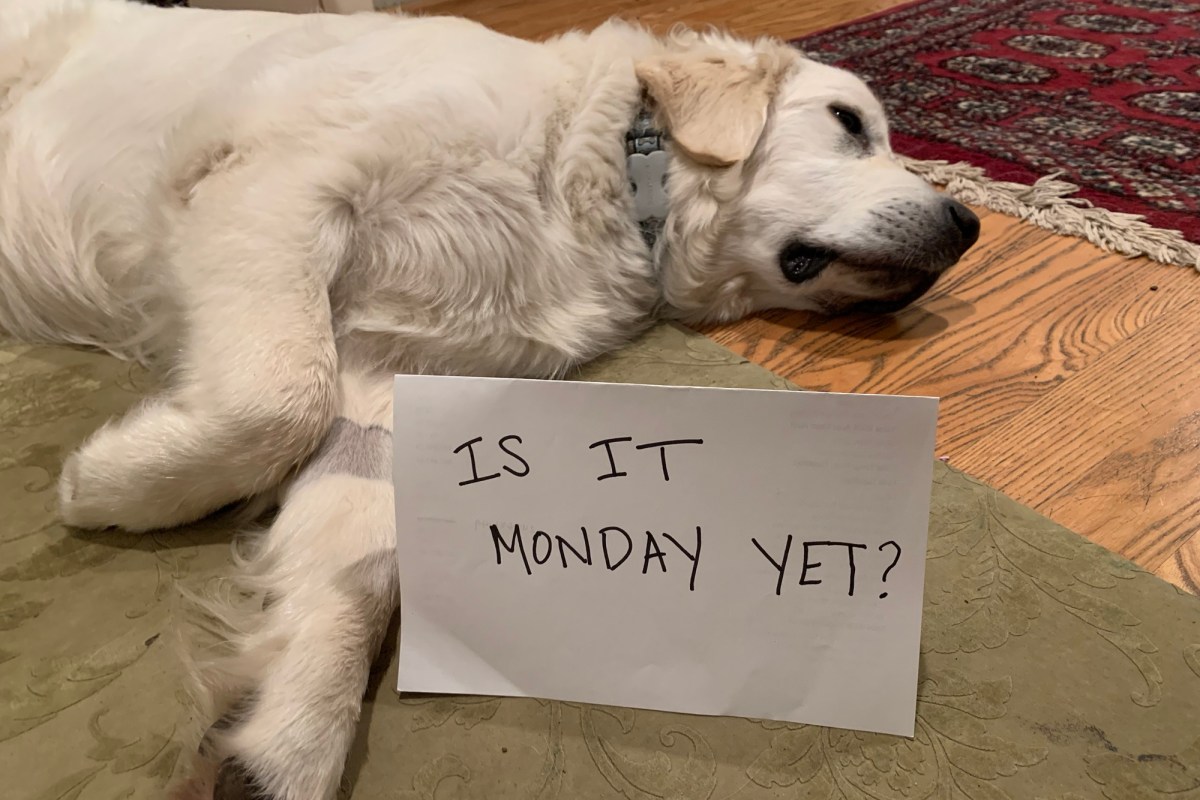
Thank Goodness It’s Monday

If we want stability in our family, society, nation, and the world, we need to create stability in individual human beings.” – Sadhguru

This weekend I:

  • Walked a half marathon (27k steps over 2 ½ days)
  • Celebrated the achievements of this youngest generation of scientists and explorers (took my kids to a 5 year old birthday party and set up marble tracks, cheered for kids figuring out how to slide fast and slow, )
  • Practiced medicine (2 boo-boos, and tummy ache)
  • Work to help prevent disease and disorganization (did 5 loads of laundry, supervised young hands wiping down counters and sinks, changed the sheets, mowed the lawn, organized a utility closet, and did at least 1000 dishes)
  • Exercised hearts and minds (played 2 games of family soccer, reenacted light saber scenes, played Chinese checkers, read a half a dozen books aloud, and told a dozen stories, played at least a dozen rounds of keep away with Cooper the dog)
  • Fed the hungry (prepared seven meals, a bazillion snacks, five meals for the dog, three meals for the cat)
  • Coached positive techniques for conflict resolution and expressing healthy boundaries (settled at least a half dozen power struggles and fits of big emotion)

No, I’m not aiming to do a victory lap here (for one thing I’m too tired 🙂 ). But my weekend reminds me that:

  1. We don’t give caretakers nearly enough credit for the amount of energy and skill it takes to keep other beings alive.
  2. I’m a much better parent because I work. The dozen things I need to get done at work on Monday seem like child’s play… compared to a weekend of playing with children.
  3.  Kids and pets reflect the care they get…and so do caregivers. None of it is possible unless caregivers fill up their tank.

Happy Monday, everyone!

Sharing Wisdom

Resolve to be tender with the young, compassionate with the aged, sympathetic with the striving, and tolerant with the weak and wrong. Sometime in your life, you will have been all of these.” – Buddha

This is something I posted on 1/26/2022. Heads up – you may have already read this.


In March of 2001, I trekked to Everest Base Camp with my friends Phil and Sue who were attempting to summit Mt. Everest that year. They had invited a few of their friends to join them on the 30 mile trek in and we’d assembled in Katmandu, Nepal to gather our last few supplies before flying in to the starting point of the trek.

It was on a rickshaw trip around the city, that one of my fellow trekkers that I’d just met, a 59-year-old man told me “Life begins at 40.” Given that I was only 31-years-old at the time, this particular piece of wisdom irked me. Taken literally, it implied that I should just waste the next 9 years.

Over the next few weeks as we were trekking, I found out his back story. He had been married in his early 20’s, had two kids but that marriage had broken down and he was divorced by the time he was in his mid-30’s. It was a contentious divorce and his relationship with his sons suffered.

By the time he was in his 40’s, he’d found success as a business owner, gotten remarried to a woman he adored, and shaped his life to look more or less like the balance of freedom and love he’d always wanted. Hence his statement that life begins at 40.

Why is it so hard to pass wisdom from one human to another? We have to pack it up in a suitcase so that it’s portable and then the recipient needs to have some hooks to hang it on when they unpack it.

In this case, I didn’t think much about the wisdom he’d offered me until I was about to turn 40-years-old. It was a tough time in my life – I’d recently been told of my husband’s infidelities, and I was struggling with the idea of failing at marriage while trying to hold it all together.

While I believe the age was just a coincidence, when I thought back to my fellow trekker’s story, it held a lot of comfort for me. Because it represented an example that life can rebuild itself even better after it’s all fallen apart. The wisdom, when I distilled it for me, was that we can have multiple chapters in our lives that still add up to a glorious story.

Isn’t that why we share our wisdom and stories? So that someone else can take them, draw strength from them when needed and they repackage them in a way that’s meaningful?

On that trip in 2001 to Everest Base Camp, after we’d been trekking for a few days, I woke up one morning a couple of hours before anyone else was up. I was so excited to be in the Himalayas, I decided to hike around to see if I could see Everest in the first light of the day. After about 40 minutes, I finally found a place to sit and watch the sunrise illuminate one of the most distinctive mountains in the world.

When I’d finally hiked back 40 minutes, everyone else was up. One of our guides said, “Does anyone want to get a first look at Everest?” and I joined the group. About a 5 minute walk from our campsite, in the opposite direction I’d gone, was a magnificent view of Everest.

Packaging up this story, I’d pass along this wisdom. “You will take some wrong turns in life, go down the wrong path and expend a lot of extra energy. But even in that case, enjoy the view, laugh about how you got there. Whether you go the short way or whether you go the long way, always look out for the presence of Wonder.”

What’s a piece of wisdom you share?


I’ve posted a related piece about wisdom gleaned during my podcast conversation with playwright and author Jack Canfora in a story about Laurence Olivier on the Wise & Shine blog: Do It Again: The Gift of Having to Repeat Ourselves

(featured photo is mine – a view of Mt. Everest from the Tengboche Monastery. Everest is the one with the snow plume caused by winds from the jet stream.)

What Blocks the Way

We tend to make the thing in the way the way.” – Mark Nepo

In The Book of Awakening, Mark Nepo tells the story of the time he and his friend, Robert, drove 400 miles to visit the Botanical Gardens of Montreal to visit the largest bonsai collection in the world outside of Asia.

“We strolled toward the Chinese Temple Garden, a lush yet simple retreat from the streets that covers acres, a place of renewal originally constructed in the 1600’s in China and moved stone by stone to Montreal in 1990.”

The Book of Awakening by Mark Nepo

Only to find it locked. Mark feels grumpy as he follows his friend as he starts to walk the perimeter.

“Suddenly, when we had walked farther than was originally in our view, the walls disappeared. It turned out that the Garden had no walls, save for the façade at its entrance. So we simply walked through the open grass to a path that welcomed us.”

The Book of Awakening by Mark Nepo

That lesson in having enough resilience and belief to find the way around what seems locked resonates with me. In fact, it’s the topic of my post for The Heart of the Matter today: Stuck on the Path to Freedom.

And while you are there, check out the rest of the site and subscribe!

(featured photo from Pexels)

Called Out

May your choices reflect your hopes, not your fears.” – Nelson Mandela

The other day I received a message from Mr. D’s preschool, “Good afternoon families. Since we have several new families who have recently joined us, I thought it might be a good time to remind everyone that our classrooms are parent free zones.”

Even though this message was sent to the about 45 families in the school and I’m not a new parent to the school, I knew this message was aimed at me. Because I love going in the classroom and getting to know the teachers, especially in the last couple weeks as Mr. D has moved up to a new classroom. These COVID years as a preschool parent have been tough and the drop-off at the door is the worst. Mr. D does fine but I suffer from lack of community and continuity when it comes to my darling son and the people important to him.

I could feel the shame creeping up my cheeks as I read the message. It was like I imagined they all got together and cooked up a message to nicely keep me out. Which is very ego-centric of me but I think not uncommon when we feel called out.

I think staying open to feedback is one of the biggest growth areas for me. Not shutting down with shame or defensiveness. Sitting openly long enough to feel the meaning and intent and then react. It’s a very meditative response to life for me instead of reactive.

As Victor Frankl said, “Between stimulus and response there is a space. In that space is our power to choose our response. In our response lies our growth and freedom.

Freedom to find what need I was trying to meet, growth to expand into other ways to meet it, power to find my center and respond from that true space.

What I really want is to show affection and interest for the amazing people who are caring for and teaching my son. So I’ve written them all cards and put chocolate bars inside. It’s not perfect, but I find if I don’t wither from the shame of being called out then I can still engage and get to know them from afar.

How do you react when you feel called out? Any thoughts on the situations in which we can take our loved ones only so far and the rest they have to go on their own?

(featured photo from Pexels)

Growth and Comfort

In any given moment, we have two choices: step forward into growth or step backward into safety.” – Abraham Maslow

“How’d the paddle boarding go?” my friend Rachel asked Miss O who responded, “Good.”

Unfortunately that wasn’t the case. I’d planned a special outing for me and my almost 7-year-old to rent paddleboards and go out on the small lake near our house one afternoon after camp last week. Both of us were so excited to have the time together and to get out on the lake. Miss O has paddleboarded in a little inlet by my brother’s boat and seemed to get the hang of handling the board and the paddle so it was going to be a great expedition to be able to go together. We’d talked about the fact that it would be a little choppier and windier where we were going and made a plan if either of us fell in. Miss O said she was prepared.

But when we got out there, the wind pushed her around and at her light weight, she had trouble controlling the board. She got frustrated and it seemed like every sentence that she said out there started with “I can’t…” I offered to tow her and she didn’t want to do that because she wanted to do it herself. We talked about setting our sights on somewhere she could paddle to but she said she couldn’t do anything but circles. I asked her what she thought she could do and the answer was nothing.

I was flummoxed. I know Miss O can step it up to a level of toughness with teachers, coaches and other family members. She has been going to a different camp every week of the summer and when she’s nervous she takes a deep breath and says, “I can’t skip this first day because if I do, then tomorrow just becomes the first day” and then she squares her shoulders and walks inside.

But when I’m around, and this has happened in many different scenarios, she doesn’t show the same resolve and instead tends towards tears and hugs. In the choice Maslow presents in the quote for this post, she chooses to step backwards into safety more often than not when I’m present.

I asked her about paddleboarding in the quiet, calm time before bed that night and, she said it’s because she doesn’t want to cry for anyone else but she can with me.

It strikes me that this might reveal that support and education are mutually exclusive for most of us. That is to say, we can’t be in our comfortable spot and grow. I think about all the times that I’ve done business projects with more experienced colleagues or climbed mountains when someone else was leading the group. I know in those cases I relaxed in a way that made it harder for me to access mental toughness.

That is a beautiful part of being part of a group or family or partnership. But I’m starting to see that when I’ve grown the most, it’s when I’ve moved outside my comfort zone and in many cases, done things alone.

Which brings me to the heart of her answer to my friend, Rachel. Miss O knew that paddle boarding hadn’t gone well but has reached the age where she wanted to cover it over with a “good.” But that makes me very grateful that she, at least for now and maybe forever, can cry with me.  She’ll have plenty of other opportunities to learn from other people and experiences but even when growing, we all need a comfortable spot to come home to rest.       

No Name Calling

Success is going from failure to failure without losing your enthusiasm.” – Winston Churchill

About ten days ago, a week before my daughter’s elementary school let out for the summer, there was a school Field Day where the entire student body of 400 kids played games at 28 stations to earn food and prizes. They were looking for volunteers so I tended the soccer kick station with another parent.

It was an easy 10 feet kick into a goal. We had a lot of kids come by – Kindergartners who had feet about the size of a deck of cards, differently abled kids that came by with their instructional aides, and most of the student body including the 5th graders who looked like they were ready to take on the world.

Everyone was displaying great spirits until one girl, perhaps in the 4th grade came by with a friend and gave the ball a kick. I shouted “Wuhoo” and she said, “Don’t say ‘Wuhoo.’ I’m a failure.” And I said that she kicked the ball with lots of strength and she repeated, “I’m a failure.”

Her ball hadn’t gone in (we didn’t really require that) but most kids could get it in, even the little Kindergartners. So I gave it her the ball again and said, “Kick it again.” And she did – without even really trying and it didn’t go in. She said, “See, I’m a failure.”

I was flummoxed. Her assertation that she was a failure was a wall that seemed to keep everything from going in. With that up, it didn’t seem like anything could penetrate.

With the first post I wrote about confidence, I can, I quoted author and psychiatrist Neel Burton who distinguished confidence from similar concepts by explaining confidence is feeling “I can,” self-esteem is feeling “I am” and pride is the feeling of “I did.”

When the little girl came to the soccer kick station, she both asserted that she couldn’t and that she was a failure. And once that was in the air it seemed to operate like a foregone conclusion for which there was no quick fix.

Because we can fail over and over again and still be confident. Here are some examples.

I’ve missed more than 9000 shots in my career. I’ve lost almost 300 games. 26 times I’ve been trusted to take the game winning shot and missed. I’ve failed over and over and over again in my life. And that is why I succeed.” – Michael Jordan

Failure is only an opportunity to begin again more intelligently.” – Henry Ford

A woman who never gives up can’t fail.” – Abby Wambach

The distinction seems to lie between admitting we’ve failed without calling ourselves a failure. I hadn’t thought much about that small difference until I heard researcher and author, Brené Brown tell a story about when her daughter was in pre-school. The pre-school teacher told Brené that one day after Brené’s daughter had been doing art at the glitter table the teacher said to her, “You are a mess.” And the daughter retorted, “I might be messy right now but I’m not a mess.”

In the retelling, Brené laughed and said that her roots as a shame researcher were visible. We can describe our current situation without calling ourselves names. No name calling is a rule in my household since I heard that story, and I apply that to the conversations I have with myself as well.

My daughter overheard me telling my mom about the little girl who called herself a failure at Field Day and was fascinated by the story. It was a great opportunity to talk with her about what happens if we believe the names we call ourselves. I hope the ripple effect is that she won’t call herself names and maybe even say something if she hears someone else doing it.

This is my fifth post about confidence. Here are the others:

I Can

Fear and Confidence

Growth Mind-set

Bossy Pants – Confidence and Leadership

The Sleepover Test

If you are walking down the right path and you’re willing to keep walking, eventually you’ll make progress.” – Barack Obama

When I had a dog, one of my goals was to make him an easy dog for someone else to take care of. It was a practical limit on how much I spoiled him because boy, did I spoil him! But he had to be trained so that if he was inside a house, he didn’t destroy things that weren’t his toys and his routine was simple enough (2 meals, 2 walks) that it wasn’t unreasonable to ask someone else to do. Outside of that, I thought it was fine to let him go everywhere with me, rub his belly and sing to him and say our prayers together at the end of the day with a kiss goodnight but those were extras.

I was thinking about this yesterday as I packed a suitcase so that my 6-year-old could sleep over at her aunt and uncle’s house. It’s only been a handful of times that she’s been away from me for a night and it’s been a long time – maybe a year or 18 months?

But as I got her ready, I was pleasantly surprised that I every confidence that she could go spend one night away and be okay getting herself ready, going to bed, and paying attention to what they told her to do. In fact, I had no written instructions to go with her at all. At one point I thought to text her aunt what time she went to bed but my daughter had already told her.

This seems like a parenting milestone I feel proud to reach. Like with my dog, I’ve raised a human being to a level that another person could reasonably care for. Yay!

Of course, I packed the suitcase mostly with stuffed animals, it’s good she’s only gone overnight because she might not eat anything that they serve and it’s only this stress free with about 3 people in this world. But hey, she’s only 6-years-old so I have more time to work on the rest 😉

Postscript: In contrast to the other day where I had high expectations that my son and I were going to have a great time alone and all he did was miss her — this time I had low expectations because I feared all he was going to do was miss her. And he only asked about her once and had a BALL being the center of attention. 🙂

Dispelling Shame

What you cannot turn to good, you must make as little bad as you can.” – Thomas More

We bumped up against shame a couple times this past weekend. As always, it left a mark.

The first time was when a group of young kids, including my 6-year-old daughter and her friend were looking into a stream that’s on the way to the salmon spawning grounds. They weren’t doing anything wrong and I believe the grown-up that was with them was making sure they weren’t going to but an activist yelled at them in case they were thinking of stepping into the water.

The second was when my daughter dropped an old iPhone that I’d given her to play with. It’s so outdated that it doesn’t have any value to a grown-up and can’t connect to the Internet but it does turn on and take pictures. She’s old enough now to understand the cachet of a phone and was so excited that she even put on jeans so that she’d have a pocket to carry it in.

But when she discovered that after dropping it a few times the screen had cracked, she followed suit and cracked. Her melt down was in part because she accurately assessed that I wouldn’t replace it. But more than that, she was ashamed that people would know she was a person who couldn’t take care of a phone.

Shame reminds me of an incident when I was 18-years-old. I was with a group of guys in a bar in Idaho. We were too young to buy drinks so we were just standing around when someone who we’d helped tow his boat earlier in the day offered to buy us a pitcher of beer. I was the closest and because I didn’t drink, I said, “no thank you” even though I meant “not for me.” The guys I was with could have killed me. But no one said anything.

This incident still marks me more than 30-years-later because I’ve never talked about it. I felt like a goodie-two-shoes even though I didn’t care – I just misspoke. Even typing it makes me feel that burn all over again. It’s because it’s so trivial and yet I still remember that I know how powerful shame can be.

After the incident at the stream this weekend, my daughter and her friend bumped into each other and they got into a kerfuffle about space. As an observer, it was clear it had nothing to do with who bumped whom and everything to do with discharging the shame of being yelled at by a stranger when they very much like to follow the rules.

The night the phone cracked I sat with my daughter at bedtime and we talked about shame. About how silence and secrecy are the things that shame feeds on and if we want to stop the shame spiral, we have to talk about it lest we give it the power to make us feel unworthy.

As we talked, I realized that I was confused as a parent about which message to emphasize because I think taking care of the things we own is important. But making the distinction between it was bad to drop the phone and being a bad person because she couldn’t take care of the phone was more important to me. Because shame leaves a mark. But how deeply etched the mark is depends on how quickly we can pull out of the shame spiral.  

As a postscript, when my mom came over last night, my daughter pulled out the phone she had hidden when she was ashamed and talked about what was on the phone, how it got cracked and what we need to do to take care of our stuff. It was like getting immediate feedback on a test and we passed. Phew!

Rock On

The real voyage of discovery consists not in seeing new landscapes but in having new eyes.” – Marcel Proust

As my six-year-old daughter and I walked in the rock climbing gym yesterday she pointed to a corner of the bouldering room and asked, “What are they doing there?” I responded that they were redoing all the routes in that section of the gym and she exclaimed, “But I was working on that one! I really liked it!” And then we went upstairs and commiserated with the camp coaches who were feeling the same thing.

I totally understand that sense of loss. In order to make room for new things, old ones have got to go. But sometimes I’m not ready to move on and the Universe does it for me. I’m talking about rock climbing routes — and also relationships, phases of life and things I find comfort in. Like my pajama pants that are exactly perfect so I’ve worn them forever and I loved them until they are almost in tatters and will likely disintegrate if I wash again. I’ll probably put them in the wash only to find they have “been disappeared” by some Divine force.

When I was little I had this blanket that I carried with me everywhere, my binky. We lived in the Philippines but came to the United States on extended vacation every two years. It was on this trip when I was five years-old that my mom decided that I shouldn’t need the blanket anymore, hid it from me and told me it was lost. I have a vague memory of looking for it everywhere – even in my parent’s luggage. Sooner or later I moved on but not without a lot of grief for Binky.

I think about this as a parent because I try to have infinite patience for my kids to grow out of things instead of creating timelines and thresholds. I seem to be doing a lot of work so that they won’t experience grief and I wonder if I’m doing them any favors. After all loss and renewal is one of the most elemental cycles of life.

When I went to pick my daughter up from rock climbing camp yesterday, I brought my climbing shoes with me so we could work on finding a new bouldering route together. We grieved for the great routes we’d lost like that purple one where she was just one hold from the top practicing her lean back technique. Then we climbed, fell and laughed together trying out new ones. It was a great way to experience resilience in the aftermath of loss. I left feeling so strong and inspired, I may actually get rid of those pajama pants myself. But don’t hold me to it…