Exceptions

“The most common way people give up their power is by thinking they don’t have any.” – Alice Walker

My mom doesn’t get hot meals often these days. In her senior living residence that is so concerned about COVID, meals either come in boxes delivered to her door and then she can microwave them or on the rare evenings she can go to the dining room, the kitchen is so short-staffed the food comes out lukewarm.

So I worked hard to make a great, hot meal for my mom when she came over for dinner last night. Not that she complains about the food at her place but I know she is tired of cold meals in boxes after two years of this protocol.

My rule at our house is that no devices are allowed during meals. My son, tired after his first day back to daycare, protested that rule but it was short-lived and we got everyone to the table.

Mid-way through the meal, my daughter was done, left the table and was playing around while the rest of us ate. My mom was telling me a story and went to pull out her phone to find a meme that was in her story. My son was distracted by what my daughter was doing and might not have noticed but I put my hand over my moms and quietly reminded her of the rule.

I felt a twinge of embarrassment enforcing my own rule with my mother who I was trying hard to please. It’s not like my mom is always on her phone. It’s also quite possible that the kids wouldn’t have noticed. And, I had the power to make the exception.

But it struck me that’s the thing with leadership that’s important – to live by the rules that you set even when you have the power not to have to. And although I rarely feel like I have any power, I do have the responsibility of living up to the standards that I set, which is a power in and of itself.

It was fine – my mom just told me the meme. It was about Barack Obama writing Betty White a birthday card when she turned 90 years old. In it he said he couldn’t believe she was 90. In fact, he was so skeptical that he thought she should send him a copy of her birth certificate. 😊

(featured photo by Pexels)
Humor: Dec 26

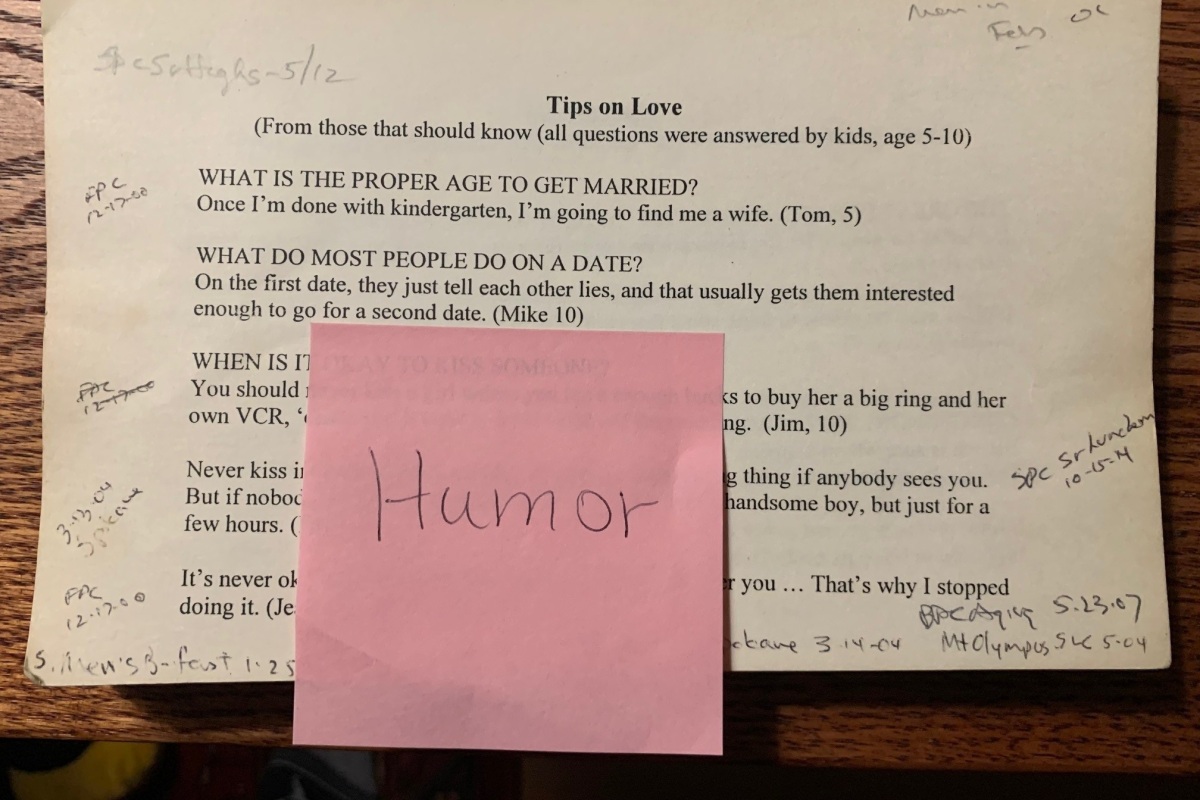
I’ve gone back to my dad’s humor notecards again this week so I can post the kids love advice that is teased in the featured photo. Enjoy!

Tips on Love
(All questions answered by kids age 5-10)

WHAT IS THE PROPER AGE TO GET MARRIED?

Once I’m done with kindergarten, I’m going to find me a wife. (Tom, 5)

WHAT DO MOST PEOPLE DO ON A DATE?

On the first date, they just tell each other lies, and that usually gets them interested enough to go for a second date. (Mike, 10)

WHEN IS IT OKAY TO KISS SOMEONE?

You should never kiss a girl unless you have enough bucks to buy her a big ring and her own VCR, ‘cause she’ll want to have videos of the wedding. (Jim, 10)

Never kiss in front of other people. It’s a big embarrassing thing if anybody sees you. But if nobody sees you, I might be willing to try it with a handsome boy, but just for a few hours. (Kally, 9)

It’s never okay to kiss a boy. They always slobber all over you… that’s why I stopped doing it. (Jean, 10)

CONCERNING WHY LOVE HAPPENS BETWEEN TWO PARTICULAR PEOPLE

No one is sure why it happens but I heard it has something to do with how you smell. That’s why perfume and deodorant are so popular. (Jan, 9)

I think you’re supposed to get shot with an arrow or something, but the rest of it isn’t supposed to be so painful. (Harlen, 8)

ON WHAT FALLING IN LOVE IS LIKE

Like an avalanche where you have to run for your life. (Roger, 9)

If falling in love is anything like learning how to spell, I don’t want to do it. It takes too long. (Leo, 7)

The Sleepover Test

“If you are walking down the right path and you’re willing to keep walking, eventually you’ll make progress.” – Barack Obama

When I had a dog, one of my goals was to make him an easy dog for someone else to take care of. It was a practical limit on how much I spoiled him because boy, did I spoil him! But he had to be trained so that if he was inside a house, he didn’t destroy things that weren’t his toys and his routine was simple enough (2 meals, 2 walks) that it wasn’t unreasonable to ask someone else to do. Outside of that, I thought it was fine to let him go everywhere with me, rub his belly and sing to him and say our prayers together at the end of the day with a kiss goodnight but those were extras.

I was thinking about this yesterday as I packed a suitcase so that my 6-year-old could sleep over at her aunt and uncle’s house. It’s only been a handful of times that she’s been away from me for a night and it’s been a long time – maybe a year or 18 months?

But as I got her ready, I was pleasantly surprised that I every confidence that she could go spend one night away and be okay getting herself ready, going to bed, and paying attention to what they told her to do. In fact, I had no written instructions to go with her at all. At one point I thought to text her aunt what time she went to bed but my daughter had already told her.

This seems like a parenting milestone I feel proud to reach. Like with my dog, I’ve raised a human being to a level that another person could reasonably care for. Yay!

Of course, I packed the suitcase mostly with stuffed animals, it’s good she’s only gone overnight because she might not eat anything that they serve and it’s only this stress free with about 3 people in this world. But hey, she’s only 6-years-old so I have more time to work on the rest 😉

Postscript: In contrast to the other day where I had high expectations that my son and I were going to have a great time alone and all he did was miss her — this time I had low expectations because I feared all he was going to do was miss her. And he only asked about her once and had a BALL being the center of attention. 🙂

Together In Sickness

“A year from now, what will I wish I had done today?” – unknown

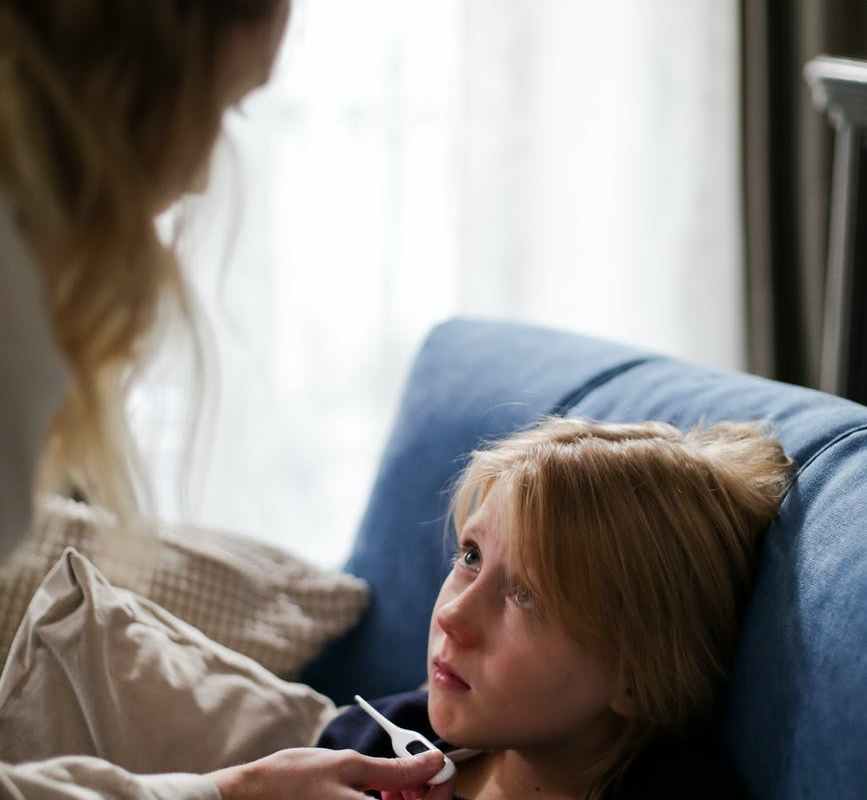
This week of my family coming down with a cold has made me think of attitudes about getting sick. Rina, my best friend in college, was the first person I learned from that being sick could be fun. From her stories, I gathered that her mother made the days she had to be home sick to be like spa days with lots of good food, sympathy and glossy magazines. Rina is Finnish and I’ve wondered if this particular way to embrace sick time is cultural.

By contrast in my family when you were sick, you stayed in bed, had no special privileges and if you were sick in the morning, you had to be sick all day so you couldn’t go play with your friends in the afternoon, even if you felt better. It was an experience designed to make sure there was no psychological advantage to being sick. In our house of Protestant productivity, being sick and the resulting impact on our usefulness was to be avoided at all costs.

So I find myself torn when my kids have to stay home from school because they are sick. On one hand I want to enjoy the break from routine and sympathetically help them feel better. On the other hand, it usually represents a stress to my work productivity that I have a hard time setting aside. But more than that, it goes against the grain of the self-worth as measured by productivity that was ingrained in me from the early days.

When I heard of the word hygge (pronounced hooga) it made me think of Rina and her mom. Hygge is a Danish word without any direct translation to English but according to this article on Quartz, has a meaning that encompasses both coziness and togetherness. It makes me think of that warmth that comes from deep companionship through better and worse.

The warmth of that word and idea, combined with my sense that being together should be celebrated in a family plus the lack of compassion I have for myself when I’m sick has spurred me to try to forge a new path for my little family when we are sick. I’ll probably never be able to reform so much that I drop everything, buy glossy magazines and bath bombs but I think a little fun and great food to help make it through when we feel crummy is worth aiming for. May it bring a sense of hygge to us, especially when we aren’t feeling well.

(featured photo from Pexels)

Expectations

“You can’t depend on your eyes when your imagination is out of focus.” – Mark Twain

On Friday, I was so excited to spend a morning with my toddler whose preschool was closed for a teacher in-service day. His sister had her last day of school before the holiday break so it would just be the two of us. I expected that he would soak up all the individual attention and enjoy all the fun we could cook up. I expected it would be a lot like spending time with my daughter when she was two-years-old and it was just the two of us.

What actually happened is that he spent the whole morning missing his sister and coming up with ideas like biking. I was happy to oblige only to find out the only route that he wanted to go was the one to his sister’s school so we could go get her. He wouldn’t listen to reason that it was too early to pick her up (after all, he is two-years-old) and my patience was frayed by not only his disappointment but also my own.

You know what they say – expectations are a bitch.

So I opened Dr. Brené Brown’s recently published book Atlas of the Heart to the section entitled “Places We Go When Things Don’t Go as Planned”

She does a beautiful job of defining disappointment – “Disappointment is unmet expectations. The most significant the expectation, the more significant the disappointment.”

And then she delves into expectations. The whole section is so illuminating but here is the part that caught my eye:

“When we develop expectations, we paint a picture in our head of how things are going to be and how they’re going to look. Sometimes we go so far as to imagine how they’re going to feel, taste and smell. That picture we paint in our minds holds great value for us. We set expectations based not only on how we fit in that picture, but also on what those around us are doing in that picture. This means that our expectations are often set on outcomes totally beyond our control, like what other people think, what they feel or how they’re going to react. The movie in our mind is wonderful, but no one else knows their parts, their lines, or what it means to us.”

Dr. Brené Brown – Atlas of the Heart

And the antidote to this disappointment? “Communicating our expectations is brave and vulnerable. And it builds meaningful connection and often leads to having a partner or friend who we can reality-check with.”

Reading over this, I thought of all the expectations that come with holidays – like that someone else will love the gift you got them or that loved ones will be able to perfectly see what you most desire and give that to you as a gift.  With little ones, I expect that they will treasure the gifts I spent time and money to get them – and not just the box that it came in!

While I couldn’t reality check my expectations about our morning together with my two-year-old, thinking through this process has helped me immensely to uncover my own hidden expectations. And then to recognize in turn how they lead to disappointment. It also made me see that my expectations that he will ever have moments of acting like a first child are completely silly. This helps me relax into the beautiful relationship that we do have so I can enjoy the time we have together for what it is, not what I imagine it should be.

Culture Shift

“All joy in this world comes from wanting others to be happy, and all suffering in this world comes from wanting only yourself to be happy.” – Shanti Deva

I have contracted my son’s cold so when I went over to see my mom last night, I kept my mask on even inside her apartment. It reminded me of something one of my college-aged friends told me. She said that even before the COVID era, she observed that Asian students would wear masks if they had a cold. That way they could still be diligent about their studies and also be respectful of others.

Watching the news it makes me think that mask mandates have been controversial in this country. It seems that I regularly catch a story about some airline passenger acting out because they don’t want to wear a mask.

But walking around my neighborhood and going into stores, I haven’t seen any of that push back in person. My daughter has been able to go to first grade full-time in person this fall because the kids are really good at wearing their masks.

All this makes me hopeful that as we come out of COVID, as I’m sure one day we will, we Americans can take away that wearing masks is effective against spreading germs and is respectful of others. That maybe this era has a lasting impact enough to create a culture shift because we are so grateful that we can see each other in person, we can just remember to wear a mask if we aren’t feeling well.

(featured photo from Pexels)

Cracked Open

“Never get so busy making a living that you forget to make a life.” – unknown

Yesterday I canceled all my work meetings and stayed home with my toddler who needed one more day of recovery from a cold. It was a hard thing to do. Like generations of parents before me, I found it difficult to put aside all the urgency my own life to support someone else when needed and not according to plan.

It was also the right thing to do. As my dad often said, “If it’s the hard thing to do, it’s probably the right thing to do.”

Sometime in the middle of the day, pinned down with a sleeping kid on my lap, frustrated the illusion of predictability in life being shattered yet again, time slowed enough for me to notice his heart beat. Once I felt that, then tuned in to his breathing and the weight and warmth of him, I was overcome with the sensation of the deepest meditation. That feeling that there is no doubt there is a Universal center that we all belong to and can reach. A sacred place of timelessness and love. The Divine heartbeat.

It never fails to surprise me that beneath my narrative is a rich and deep experience. Like a nut, when I crack open the hard exterior of my perspective, I am always rewarded but the meaty contents within. At the end of the day, my son felt better and I, surprisingly, found myself rested and restored even though not a single thing on my to-do list was done.

(featured image from Pexels)

Naming and Owning

“The limits of my language mean the limits of my world.” – Ludwig Wittgenstein

I was driving in the car with my kids talking about envy. It oftens happens in our house when one of my kids discovers a toy long hidden and invents a new game for it and the other wants to grab it from their hand. Or, as I heard a child quoted in a sermon once, “Why do I always want what’s in my brother hands?”

In response my 6-year-old daughter asked me, “How do you know so much about feelings?”

The voice in my head, a little exasperated, wanted to reply, “Because you two have so many of them! And guiding you through this minefield of growing up emotionally intelligent has required me to come to terms with my own emotions when I’d prefer just to always to say I’m happy and call it good!”

Dr. Brené Brown, research professor and author, lays the groundwork for mapping human emotions in her book Atlas of the Heart by describing a survey she used in workshops for five years. It asked people to list all the emotions that they could recognize and name as they were experiencing them. The average number named was three: happy, sad and angry.

Many of the parenting books I’ve read about raising resilient children have advised to help children move through situations that we have to help them name their emotions.

 In trying to help my kids identify what it is they are experiencing, I’ve found that I’ve had to name and face my own emotions. In this way I have learned so much nuance about my own interior, sometimes grudgingly, but always resulting in better color and effect in my own life.

So instead of voicing the snappy retort in my head, I responded from that place in my heart that holds love, warmth and awe for the lessons I continue to learn, “Because I love you two so very much that I want to help you grow up so healthy, inside and out.”

The Conditions for Change

“A careful inventory of all your past experiences may disclose the startling fact that everything has happened for the best.” – unknown

I heard a story about a woman complaining about her ex-husband. When they were married he drank heavily but once divorced, he stopped drinking, remarried and turned his life around. His ex-wife said, “Why couldn’t he quit when he was married to ME?” and the punch line of the story was “People change, but not when and how we want them to.”

When I was married, I refused to have children. I had an instinct based on raising a dog with my now ex-husband. It was difficult enough that I didn’t want to extend that experience to kids. My husband would ask and I would say, “I don’t want to have kids.” But in my head, I knew the whole sentence was “I don’t want to have kids with you.”

My ex was not a bad guy. But he had a difficult childhood where he was both beaten and neglected. Before we were together, he’d raised a puppy with a previous partner. He told me he’d hit it with a newspaper if it peed on the floor. Only by experience did he find out that made the dog afraid of him and he stopped hitting it. To his credit, he then learned so that when we got a puppy together, he didn’t hit it.

But every step of the way was my husband having to learn a lesson directly before it sank in. He wouldn’t take my suggestion for how something needed to be done, he couldn’t trust an experts work for what might be best, he had to do the cause and effect himself. I didn’t want to raise kids with someone who had to experiment with them to find out what did, or more painfully, didn’t work.

I imagine that it’s pretty obvious now that I’ve had two kids on my own, that the whole sentence was “I don’t want to have kids with you.” But fortunately I’ve never had to say that sentence directly to him. We are on fine terms with each other but he’s moved away and gotten remarried to someone who has grown children so we rarely interact.

More than that, I am grateful for that divorce because it turned me to meditation, strengthened my faith and set me on the path that I’m on. The bigger issues of my marriage such as his infidelities and the things we valued created a relationship that was not meant to survive. But it still gives me rich ground to learn from.

People change, but not when and how we want them to. I think of that now that my life is so different than when I was married. We can’t control how others change but as I watch my children change every day, I see that we can control the conditions that help change to happen. Curiosity, openness and support work like the seed, soil and sunshine with which people grow.

I see as I create the conditions for my kids to change, I also create the curiosity, openness and support for myself to change. As I grow, I realize that even I don’t know when and how I’ll change but in these rich conditions, I trust it’ll be towards something good.

Building Trust

“Kindness in words creates confidence. Kindness in thinking creates profoundness. Kindness in giving creates love.” – Lao Tzu

I come by conflict avoidance honestly. By that I mean it’s deeply steeped in my family history. I never heard my parents argue when I was growing up. Assuming that they did instead of just avoid all conflict, they must have done it entirely behind closed doors. As a Presbyterian pastor, my dear dad was so good being with people suffering crisis and loss but when it came to conflict, he also had a gift for just not responding.

I remember when I was in college, I took the car I had to him because it was overheating. He was refilling the radiator from the garden hose as I trailed around behind him. At one point I said, “Dad, I think there is a better way to do that.” He didn’t respond. He didn’t argue that he had been around cars a lot longer than I had or point out that I brought the car to him, he just simply didn’t say anything until it was refilled. Then he looked up with a big, bright smile and said, “There, it’s done!”

Read the rest of this post that I posted here at the Pointless Overthinking blog