Hurry Scurry Worry

Enough is abundance to the wise.” – Euripides

Of the things I think about, time and love have to be the top two topics. Sometimes they are separate thoughts, but often time they are combined in the same thought. Struggling with how to love and appreciate the moment, and the dear ones I’m with, when I’m often in a hurry.

It doesn’t help that June comes with six birthdays of family, including Cooper the dog, and dear friends, including mine in mid-June. That’s always a reminder of time with a “capital T.”

On a recent Sunday morning, I was deep in the vortex of hurry worry. This year, my mom signed Miss O up for a youth choir in a neighborhood church.  Miss O has a lovely voice and it was a fantastic activity for her. My mom managed all the transportation, and even took Mr. D along for some of the practices. All good.

But on the Sundays the choir performed, it was a struggle to both watch Miss O sing and keep Mr. D entertained throughout the service. So, on the particular Sunday morning in question, I came up with the idea that Mr. D and I would walk to the church to expend a little of the morning energy while Miss O went ahead with my mom.

Mr. D and I left with enough time to walk the eight blocks, but not extra. As we were walking, I was feeling the time pressure to get there. Enough so that it prompted me to remember the meditation practice I’ve been working on to not hurry. I said a prayer.

When I told my mom about this later, she asked, “What did you pray for? That Mr. D wouldn’t find anything interesting along the way?”

No,” I answered. “I prayed that we’d have enough time. Then I enjoyed the walk without looking at the time and it all worked out.”

It’s funny. We can either pray/hope/wish/focus on everything to go right. Or pray/hope/wish/focus on being okay with how things work out. The latter has worked better for me.

For another way to stretch capital T time please listen to our Sharing the Heart of the Matter podcast: Episode 69: All You Have to Do Is Ask with Wynne and Vicki

Vicki Atkinson and I are big believers in the power of story – to connect us, to create intergenerational healing, and to make meaning out of the events of our lives. Each episode of our podcast will start with someone telling a story in each episode.

To listen to the podcast, Search (and subscribe!) for Sharing the Heart of the Matter on Apple, Amazon, Spotify or Pocket Casts. Or subscribe to our YouTube channel to see a video clip of each story: @SharingtheHeartoftheMatter.

Five Ways to Be a Happier Parent

Children are great imitators, so give them something great to imitate.” – unknown

A friend who is pregnant asked if I had any tips. There are so many parenting philosophies and opinions out there. I can’t imagine I have anything to add. Besides, each kid and each parent is so unique.

But I do know what has made me a happier parent.

  1. Finding a way to ground the central nervous system. I remember walking into a room where my kids had spent a happy day hanging out with my brother and his wife. Miss O was about five-years-old and Mr. D was about one-years-old. As soon as they saw me, they started crying and clamoring for my attention.
    It wasn’t that they were unhappy. It’s just that they had spent the longest time away from me so far. I was the lightning rod for the relief they felt after all the bravery and novelty they had experienced.
    Having a way to calm myself – meditation, breathing exercises, time spent in nature – has lessened the overwhelm I feel when my kids need that extra boost.
  2. Understanding that life is a science experiment. One morning when Miss O was about three-years-old, I was trying to get us ready to leave the house to meet my friend, Katie. I found Miss O at the art table where she’d made a huge mess cutting into a squishy into her scissors. I was incredulous, “Why would you do that?”
    When I saw Katie, whose kids are grown, she laughed and said, “Life is a science experiment.” Understanding that has made such a difference to my parenting attitude. We all try things to see what happens next. Sometimes the kids will do this and it messes with my sense of order. But it isn’t personal, just a part of learning.
  3. Following their lead. On a recent Saturday morning, Mr. D and I were out front as he drove a remote control car down the sidewalk. When we were in front of our favorite neighbors’ house, Mr. D said, “Let’s ask them to play.” I demurred, thinking we might bother them, but Mr. D said, “Follow my lead.” I did and my neighbors, a couple in their 70’s were delighted to see us and have a turn to drive the remote control car.
    Dr. Alison Gopnik, a research psychologist at UC Berkley says kids’ neural pathways look like the streets of Old Paris, many, windy paths where you don’t go very fast. They are wired to look for what can teach them the most. On the other hand, our adult brains have neural paths that look like boulevards. Not very many but you can go faster. We are wired for getting things done.
    When we follow kids’ leads, they get us out of our ruts and help us be creative.
  4. Being creative to connect. The early years of parenting can be so isolating. Spending time with other parents who are also overwhelmed, and conversations that are constantly interrupted by attention to little ones often isn’t satisfying. Working, blogging, pursuing one interest that puts you in the path of adults you can connect with has made such a difference.
  5. Accepting that a great and happy parent is perfectly imperfect. I remember walking my dog past a house where a kid was crying when I was pregnant with my first child and thinking, “I’ll never let my kids cry it out.” Hah!
    Giving up the idea that I would be a perfect parent – always calm, with a clean and orderly house, and full of ideas that would keep my kids entertained and screen free – is the best thing I’ve done for myself and them.
    Instead I have come to see that a perfect parent knows if they lose it and yell, they can also show kids how to own it and apologize. And laugh at themselves, and be okay with being flexible with any no screen, all organic, and any other high-minded ideals to do their best for that moment.  

Anything you would add to the list?

(featured photo from Pexels)

I pulled this list from other parenting story posts I’ve told:

Lost and Found People

The good road and the road of difficulties, you have made me cross; and where they cross, the place is holy.” – Black Elk, Oglala Lakota Medicine Man

The other day I was sitting at the kitchen table with Miss O. One of the 20-somethings in our lives had just shared with us that she was pregnant and Miss O was so excited.

She asked, “Mommy, how did you tell Nana [my mom] that you were pregnant with me?

I replied, “Well, it wasn’t that much of a surprise with IVF because she knew I went in to have an embryo implanted. Then 10 days later they did a blood test to determine whether I was pregnant. So I think I called her or I texted her.

Then she surprisingly asked, “And she was happy?”

Trying to figure out the phrasing, I raised an eyebrow and replied. “She was thrilled.”

And then Miss O revealed why she’d asked like that, “Even though Bumpa [my dad] had just died?

Oohhh, she was putting together the news with the story that she already knew which is that my dad died just as I was getting pregnant with her.

And then, my not quite 9-year-old daughter, replied, “We are the lost and found people.

Whoa.

I’ve often thought of those months when I was writing a book about my dad, his remarkable life, our connection, and the reward for being open with him when Miss O was in utero. It felt like a dance between birth and death. I was saying good-bye to having him present in life as I waited for Miss O to come. Such a sacred dance.

But Miss O’s comment about lost and found people made me think that maybe we all are. It seems like many new chapters are ushered in after we’ve given something up: a job, a partner, a story we believe about ourself.

And then, when we’ve given it up, we can proceed. Seems like the trick is not to get mired in the lost, so that we keep working towards the found.

We are the lost and found people. I couldn’t be more grateful to my beautiful daughter for pointing that out.

(featured photo is my dad and me when I was 2-years-old)

My book about my journey to find what fueled my dad’s indelible spark and twinkle can be found on Amazon: Finding My Father’s Faith.

Frozen Heart

The best and most beautiful things in the world cannot be seen or even touched — they must be felt with the heart.” – Helen Keller

I was digging around in my hiking gear this weekend and came across one of my CamelBak backpacks. Such an amazing concept to carry your water with an attached hose so that you could take a drink without stopping.

CamelBaks came with their own downsides though too. Slow leaks, fast leaks, and the time my friend Jill, had a hose that was stuck open. She kept turning around to try to grab as it sprayed in 360 degrees around.

A guide on Mt. Rainier once told me why they never recommended clients wear them while climbing. It surprised me because staying hydrated is so important to performance. The issue was that on the upper mountain above 10,000 feet, CamelBaks often froze. The result is that a climber ends up carrying an ice block next to their heart. If that happens, it cools blood flowing in and out, sometimes accelerating hypothermia.

That was an aha moment for me. It totally made sense why it would be detrimental to staying warm and having functioning extremities when climbing but I’d never thought of it. And well, you know how I like climbing metaphors. It also works to describe how dangerous it is to hold some things close to the heart. In my case, I’m thinking how anger, blame, guilt, shame, or fear reduce my overall warmth if I carry them around.

For better or for worse, what we hold next to the heart affects everything that’s pumped out.

(featured photo is mine of our group leaving the 17,160 foot summit of Mt. Ixtaccihuatl, October, 2000)

A Full-Circle Story

Be kind to yourself and share it with the world.” – unknown

The other day I opened my door to an older gentleman who was going door-to-door on behalf of Greenpeace. Let’s call him John. He was warm and friendly and told me he’d grown up in this neighborhood and named the elementary school he attended.

As we were talking about plastic in the ocean, he mentioned that he’d just been talking to a neighbor. She wanted to subscribe for an annual payment. She knew she’d remember to do it because the day he came by was her birthday.

Clearly this neighbor had made an impact on his day. He went on to explain that she and her husband invited him in to sit down as they did the paperwork. It gave him some rest for his aching knees.

I hazarded a guess based on the story he’d told me, “Was it Donna and Bruce?”

Yes,” he laughingly confirmed even though they are two streets away. There are about 25 houses per block in this neighborhood so he must have knocked on about 50 doors between my house and theirs.

So, I told him the story about how I met Donna and Bruce one evening about four years ago. It was early on in the pandemic and my daughter was doing on-line Kindergarten. I was trying to optimize her desk situation. Someone up the street had put a great kids desk out on the curb to give away. I was trying to carry it home with my 5-year-old daughter, my 6-year-old neighbor, and my 1-year-old son in tow.

And then Donna, who I’d never met before, offered to step in and help. Her delightful spirit is just one of the reasons she’s one of my favorite people to run into in the neighborhood.

[The next time I saw Donna after my conversation with John, the Greenpeace guy, I told her that how John told me the story of how her warmth and kindness had made such a difference to him. It was so fun to see her reaction to one of the many touchpoints of positive impact she must deliver in a day.]

After John, the Greenpeace guy left, my kids and I went out for a walk. We came across him sitting on a garden wall on the next street over resting his aching knees. Because of the stories we’d shared, it felt like he was an old friend. We sat down for a moment and chatted with him before we all moved on, still connected by the thread of narrative.

For a story about an a-ha moment Vicki had as a child about the roots of her dad’s big heart, please listen to our Sharing the Heart of the Matter podcast: Episode 67: Love the Ones That are Different with Vicki and Wynne

Vicki Atkinson and I are big believers in the power of story – to connect us, to create intergenerational healing, and to make meaning out of the events of our lives. Each episode of our podcast will start with someone telling a story in each episode.

To listen to the podcast, Search (and subscribe!) for Sharing the Heart of the Matter on Apple, Amazon, Spotify or Pocket Casts. Or subscribe to our YouTube channel to see a video clip of each story: @SharingtheHeartoftheMatter.

The Most Important Work

Children are not a distraction from more important work. They are the most important work.” – C. S. Lewis

Sometimes I think Hallmark has it backwards. Take Mother’s Day for example. My kids didn’t do anything to choose me. I, on the other hand, took a very intentional path to become a mom.

From the realization that I wanted to have kids later in life because I cried whenever I saw Princess Kate pregnant with her oldest child nine years ago, to deciding to do it without a partner (for now), then through IVF three times (I had one miscarriage), I made very deliberate choices to parenthood. I couldn’t be more grateful that I’m a mom.

Here’s the top three reasons why:

I’m so much healthier

You didn’t know me before I had kids. I didn’t write in the period of life when I was numbing my feelings with wine every night. Meditation changed that pattern so that I had a different way to irrigate my irritations.

But having kids has given me so much more practice. That’s a funny sentence. I didn’t mean that they give me many more irritations to irrigate but on some days that’s true too.

Mostly I meant that these beautiful and honest beings have shown me what emotional honesty is. By helping them name their emotions, I’ve learned how to name and feel mine too.

Every day is an adventure

I’m a creature of habit. Without kids, I’d have likely continued my pattern – hike every Saturday, do a big trip every two years. Like my trips to Everest Base Camp, climbing the Via Ferrata routes in the Dolomites, or biking from Vermont to Canada to New York – great trips that totaled about two weeks out of every 104.

But with kids – every day is an adventure of curiosity and learning. We rescue bunnies, dig in the dirt, ride bikes, or sell lemonade. I’m learning to be flexible and adventurous on a daily basis instead of a bi-annual one.

Big messy love

Parenting is the messiest form of love I’ve known. Not just sticky hands and faces but so much laundry, picking up detritus, territorial incursions because of changing boundaries, and spilled over spats between siblings.

But it seems to me, that the messiness that makes it stick like Velcro instead of slide off like a glossy surface. It’s proof that nobody is perfect any we love each other anyway. The repetitiveness reminds me how many chances we have to get it right. Over and over we make a mess. And over and over we get to come together and make it right.

The news has all sorts of stories about what isn’t working in this world. But then a day like Mother’s Day comes around and I look at all the people who are trying their best to love wholeheartedly – with young kids, and old kids, and/or other people’s kids. For me it’s a celebration that love wins.

Going to the Next Level

I am convinced all of humanity is born with more gifts than we know. Most are born geniuses and just get de-geniused rapidly.” – R. Buckminster Fuller

We are coming to the end of our school year. 28 more school days in third grade for Miss O. And 50 days until Mr. D graduates from his preschool program. Do you remember that feeling as a kid? Being not only ready for summer break but also ready to ascend to that next level?

It has me thinking of what milestones we have in our lives as grown-ups that celebrate our readiness to go on to the next level. There are some big ones like becoming an empty-nester or retirement. Or we have annual ones like birthdays, anniversaries, and New Years. But often, I find myself at those moments planning on what I’m going to do next instead of commemorating what I’ve learned.

Let me suggest that we take a moment to bring back that feeling of finishing a school year. To actually name something we’ve graduated from and celebrate it. I’ll start:

I’ve come to believe that I am enough. Or at least to understand that pretending to be someone else is ineffective. So if a situation or expectations make me feel otherwise, I try to slow enough to double-down on being me long enough to get through.

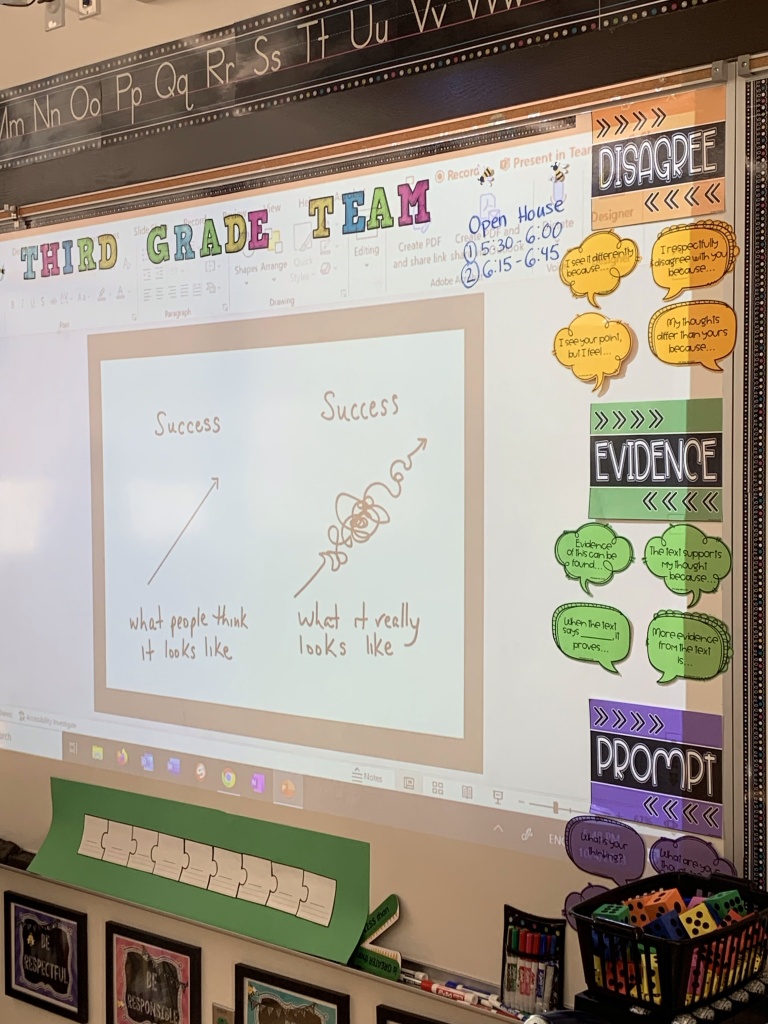
And by graduating, I don’t mean being done. It brings to mind another graphic from Miss O’s 3rd grade teacher:

It seems fitting on this last day of teacher appreciation week to honor our teachers by naming what we’ve learned. Are you with me? If you are stuck, maybe visit the list from Pick Three Affirmations to find a place to start.

(featured photo from Pexels)

For a story about the circle of life, please listen to our Sharing the Heart of the Matter podcast: Episode 66: The Power of Story with Wynne and Vicki.

We are changing our format starting with this episode. Vicki Atkinson and I are big believers in the power of story – to connect us, to create intergenerational healing, and to make meaning out of the events of our lives. To set the stage, we will be starting with someone telling a story in each episode.

To listen to the podcast, Search (and subscribe!) for Sharing the Heart of the Matter on Apple, Amazon, Spotify or Pocket Casts. Or subscribe to our YouTube channel to see a video clip of each story: @SharingtheHeartoftheMatter.

Great Teachers

Those who know, do. Those who understand, teach.” – Aristotle

Last week when I was dropping off Mr. D at his pre-school, I heard one of the teachers in his class encouraging a little girl who was starting potty training. In a class with 20 kids aged three to five, and three teachers, it surprised me that they could tackle potty training as well. I thought all the kids did this in the younger classes before ascending. Hats off to teachers who teach skills, mold social behaviors, and tend emotions as well. And I’m not just talking about teachers for kids.

It’s teacher appreciation week in our schools this week. So I am pulling together some lessons I’ve learned from the amazing teachers in my life.

Call and Response

In Mr. D’s preschool classroom, whenever a teacher says, “Holy Moly,” the kids answer, “Guacamole” and it gets their attention. It makes me think of how effective it is to train some automatic responses.

Fall! Or Falling! is called in climbing when someone is falling and others need to try to anchor a fall. It’s intended to get an immediate reaction to drop down and arrest. When trained well, no one stops to look around to find out what’s happening before they act – it’s action first and assessment after.

It’s Going to Be Great is a phrase my dad used to say when we were early on in the envisioning and creation stages of a project. When I say this to myself like he used to say to me, especially when working on a project, it gives me a shot of confidence to overcome the self-doubt.

Calm the Body to Facilitate Learning

My friend, Katie, does some specialized tutoring with kids. In her teaching space, she has a wobbly chair that allows kids to bounce, stuffies for hiding, and games. Her thoughtful approach gives a nod to the conditions in which we learn as much as the content.

It reminds me of the classes I’ve taken from my meditation teacher, Deirdre. We never go straight to sitting in meditation, it’s a series of exercises to help us drop-in to a calm and receptive state.

Vicki Atkinson has written about the snacks she kept when she was a professor. Minds can’t learn when the body is screaming for something.

Nonetheless, I often forget this when I sit down to learn a new technology. I’m on the clock and then get right to it as if I can just think myself ready. But soon enough, I’ll find myself frustrated and pacing. The body wins sooner or later to get its part in learning.

Portable Lessons

My dad liked to talk about making his sermons portable. Something people could take away with them as they walked through life and unpack when needed. I can think of several examples that are take-aways from great teachers:

Keep small things small: Miss O’s second grade teacher had this catch phrase to remind kids not to let mistakes or distractions take away from the bigger point.

Is it a window or a mirror?: This question from Miss O’s third grade teacher is a writing lesson. Writing can be a window for experiences others haven’t shared. Or it can be a mirror when we write about something familiar that is an opportunity for readers’ self-reflection.

Parked in my small space: This phrase from my meditation teacher, Deirdre, has transformed my awareness of when I’m feeling small and closed. When I’m working from my small space, my reactions are often guarded, judgmental, or defensive. Awareness has given me the choice to stop, take a deep breath, and try to shift into my more expansive and curious mode.

So hats off to all the teachers in this world. Thank you for bringing your mind, body, and spirit to the job so all of us can grow and learn!

(featured photo from Pexels)

Writing Last Lines That Count

Vulnerability sounds like truth and feels like courage. Truth and courage aren’t always comfortable but they’re never weaknesses.” – Brene Brown

This post was originally published on 4/19/2023. Heads up that you may have already read this.


On the last morning I saw my beloved dad, he greeted me with a hearty “You look great.

His untimely death a short time later has permanently etched all the details of that breakfast into my treasure box of memories: the yellow walls of the Varsity Restaurant on NE 65th street, the booth in the open section, the jeans and sweater I was wearing, the cupcakes I gave my parents for their upcoming drive to Arizona, the eggs and waffles, but it is those words that are most precious.

Because both my dad and I both knew that he wasn’t talking about anything to do with my hair, make-up or clothes – he was talking about the light in my eyes. How did I know that it wasn’t just my dad being his effusive self? Let me explain.

Here’s the thing I’ve learned about last lines. As much as we’d like to prepare for them, many (most?) don’t happen how and when we think. Take my dad’s line – neither of us knew that in 6 days time, after arriving and unpacking for a winter in Tucson, that he’d get on a bike, hit a car, and die almost instantly.

That might be an extreme example, but even for the end of a friendship or relationship, the speeches we plan are not what end up expressed. Life, interplay, and random things happen to make things unexpected. So we have to instead do the work to speak honestly and communicate authentically whenever we can.

For me, that work began when three years before my dad’s death when I went on a whim to a meditation class. After 90 minutes of seemingly innocuous visualization and breathing exercises, I spent the rest of the day weeping. It turned out to be just what I needed to start opening all the compartmentalized boxes within and let life flow again. The grief, and shame that came from my recent divorce and that I wasn’t as successful at everything I believed I was supposed to be, came pouring out and I was given openness in return.

So that in the two years before my dad died I was able to choose to broach the subject of spiritual beliefs with him. To talk about what mattered the most to him as a Presbyterian pastor of 40 years. It was a risk because we didn’t talk about religion in my family once all of us kids were grown. Out of respect for keeping things amiable, we’d just stopped talking about our differences.

When we braved the waters of deep beliefs and possible differences to engage in conversation about why he believed what he did and vice versa with me, that meaningful dialogue changed the perception of difference between us and removed the barrier of what we thought were off-limits zones.

Peeling back that veneer of friendly and loving banter in which my dad and I always talked, to delve into deeper issues created a closeness that was precious. My dad knew I was interested in him, I’d spent hours recording our conversations, and I gained relief from my fear that I was doing life “wrong” in his eyes by focusing on meditation instead of theology.

And that is how I knew that my dad’s last line to me was not about the surface details of appearance but instead about a light that had dulled in the last years of my troubled marriage and then divorce. And then through meditation, openness, and vulnerability, that light had been stoked back to its full glow. Sharing that journey with my dad made it possible for him to comment on it.

His death affixed all the details of that breakfast in my mind. But my heart will always remember, “You look good.” It was a gift that started with changing our patterns long before the last line. It’s so hard to talk with our loved ones about the topics that seem most fraught. But in the grief of losing someone, knowing that kinship was there helps.

If we want to have great last lines, we have to risk the vulnerability to be seen.

You look good.” Which as last lines go, was pretty damn amazing.

My book about our conversations and my journey to find what fueled my dad’s indelible spark and twinkle can be found on Amazon: Finding My Father’s Faith.

Sometimes The Dead Speak

See, broken things always have a story to tell, don’t they?” – Sara Pennypacker

Funny how much we want the voices of the dead to weigh in on some subjects. I published a post on Monday, The Set Up, that told the story of a family incident that happened 35 years ago. The code of secrecy between kids being what it is, it’s an incident that I never told my dad about. Especially as the youngest kid, it would have been a serious breach to tell my dad what happened so I don’t know what his response would be.

But I found a sermon that he wrote almost 38 years ago that gives me a pretty good idea of his approach. It’s long as a piece of writing. If you want to skip down to the family story, skim down to the paragraph near the end that starts with “Several years ago Carolyn and I.” Carolyn is my mom’s name.


Parenting

October 12, 1986

Dr. Richard H. Leon

This is the both the worst of themes and the best of themes to address. It is the worst because who can speak with clean hands about parenting? Surely not I. We all have so much to learn and so much we would like to forget that it is a bit ludicrous to stand up and speak about parenting as if we knew best!

But this is also the best of themes because it is the arena of our lives that consumes the most energy and that concerns us the most. Every small group experience I have had reminds me that when we talk about the rhythms of daily life they nearly always revolve around our family-life… relationships with our parents, our spouse, our children, their children…etc., etc., etc..

From the start I want to say tha the church has not always been the best place for honest parenting-talk. I don’t know your experience. But in my lifetime I have seen the church err more often than not in two ways: in an effort to uphold moral law we have come down hard in judging wrong behavior… and in an effort to celebrate successful family life we have made it hard for people to face their pain openly. Tolstoy said, “Happy families are all alike, but every unhappy family is unhappy in its own way.” And this morning I want to open the door to the Biblical perspective on the painful side and the grace-ful side of parenting.

Coping with guilt and grief

The first concern I have is the painful side of guilt over ways we fail our children as parents and the grief that comes when children do not live up to our dreams and ideals. Life tells me these feelings are almost universal in parents. Don’t we all feel like we have failed in one way or another in raising our children? And don’t we all feel the grief for lost dreams for our children? I can still recall the first time I felt this…it was when one of our children first defied Carolyn and me and refused to follow our direction and meet our expectations. And that was at age 3…not to mention the broken dreams during their teen-years!

How do we keep from concluding that their failures are all our fault? How can we learn to accept that each of our children are separate from us with a mind and will and personality of their own?

It is helpful to me to name the full sweetp of the realities that shape us. The point here is to note that although parents have a great influence over children … there are many other ingredients in the recipes for our children’s lives. Let me list at least seven of these ingredients.

Genes – from the first moment of birth, before parents can do anything to influence children, it is clear that every child is different. It is a simple matter of genetics. We look at our three children and see that their responses to life were distinctly different from day one. Our first child was laid back and relaxed…our second was wound up so tight she couldn’t keep her head still to nurse…our third child was happy and charming. They had those marks when they were born…they still have them!

Growth patterns – every day is a time of growth and development and the setting for each child is different so that given their different temperaments and these different circumstances they all follow different patterns of growth. A lot has been done lately with our birth-order. First children grow accustomed to take the lead (bossing others around, some say), middle children get caught between not being the oldest in the lead or the youngest who is always the “cute” one; and youngest children come into their world with experienced parents who are too tired to push like they did the first times around!

Parenting – make no mistake about it. How we raise our kids does make a difference. We bear a heavy weight here … but it is not the only force at work in our children’s lives.

Culture – I have lived in enough different countries to see both the common humanity that we share and the cultural differences that train us up with different beliefs and values and realities. The irony of this matter of culture is that those places the western world calls “backward” are the same places where children are raised to respect and obey their parents!

Peers – a graph would show that the degree of parental influence in a child’s life starts high and steadily declines, and the degree of peer-power starts at nothing and steadily increase until by the teen years these two lines cross and the end is near! The force of peers soon becomes the dominant force in life… until a time in early adulthood … sooner for some and much later for others… when self0rule takes over from peer-control.

Church – I may seem strange to include church as an influence in many of our children’s lives..but hopefully this is true. The place of Christian families and friends, teachers and church school and worship and young leaders … all this is potentially a great force for balance and health.

God – We are born by god’s grace, created in God’s image and we all one day return to face God. And the force of God in our lives is something we acknowledge by faith even though we know many cannot see it. Scripture teaches that God seeks us all out as a shepherd searches for his single lost sheep. If we simply give God a chance he will move mightily in our lives and the lives of our children. I must confess that this truth gives me more comfort, hope and confidence in the future than anything else I may say this morning. God loves our children even more than we do and he is not idle about his love!

So, there are at least seven forces at work in the lives of our children. Our places a parents is central and strong … but all that happens in our children’s lives is neither all our fault … nor all to our credit!

Coping with the tension between “law” and “grace”

Let me speak second about another prime issue in parenting … the constant tension between laying it on (the law) and laying off (grace).

One of the best passages in scripture to examine in this regard is the parable of the Prodigal Son … or better yet, the Loving Father. This may be the most astounding store in all literature. It touches every one of us on several levels and all at once.

The story builds on a father’s relationship with two sons. Both are raised in the same household with the same values. Notice how different the sons are in their views of life. Is it the parent’s fault that one is strong-willed and self-centered and the other is compliant enough to stay at home? (We also learn that the older son was jealous, harbored hurt and anger, was unforgiving and self-righteous … but that’s a different story!)

Look at the tension in the father’s life when his son asks for his inheritance and wants to leave home. We have to assume the son was old enough to leave. We have to assume that the father did not respond with this same generosity and grace when his son said that at 3 years old … or at 10 … or even 16. Can you picture what the father must have thought about at this request? Like:

  • “…What will my neighbors think?”
  • “…is this fair to my oldest son?”
  • “…will I look weak?”
  • “…if he squanders it will I be responsible?”
  • …”my father would never have let me do this!”
  • “…and I never would have thought that way!”
  • “…if I hit him hard enough will he change his views?”

The tension was between reading his son the law … or giving his son his freedom. And the amazing turn of the story is that contrary to his culture and his own family values the father in Jesus’ story lets his son go free. It is almost as if the father is saying … “the only way I can win my son’s heart is to let my son go.”

Lessons from the gospel to guide parents

I would like to see if we can extract some lessons from Jesus’ story of this loving father than can help us in the task of parenting. It should be noted from the start, however, that these lessons are not given in the passage just because it worked with this second son but because these lessons are consistent with a parent’s love. In other words, the justification is not one of success … do it because it always words … but one of love … do it because you love your child and this is how God loved you!

There really is only one lesson to note, it is the lesson of unconditional love. There is no other way to describe this father’s love for his son. He loves his son without asking him to conform to his standards, expectations, or dreams. He loves his son even though it brings great pain to himself … and as he might have guessed, even to his son. There are three choices the father made that mark unconditional love as a parent.

The first mark is in 15:12 “So he divided his property” and it is the choice between acceptance-release or rejection-restraint. For a father to release a son with his inheritance in that culture was to invite mockery. It meant taking the insult of one’s son who in effect is saying “I wish you were dead” and not fighting back. The temptation to reject his son must have been enormous.

And this may help us see that unconditional love is not an instinct, it is a decision. We do not love like this with our feelings … we love like this because we make a decision that it is most loving. And this truth applies to our relationships as husbands and wives as well as parents and children. When insulted you need to ask a question that short-circuits your feelings: “what is the loving response?” It may not always be acceptance and release. There are times for discipline and restraint. But it will only be acceptance and release if you decide it will be that!

A second issue is waiting and hoping or giving up on someone. Look at the 20th verse: “he saw him a long way off.” You only see someone a long way off if you are looking for him and waiting for him.

When he gave his son his portion and saw his son off to the far country it would have been very easy to conclude the son has chosen his own way and there was no way he would ever take him back.

The pain of separation must have been so intense that it is not hard for us to imagine a response of simply trying to forget that this son was still living. You and I see this often, don’t we? I recall one family that we were very close to in our pastorate. When one of their daughters got pregnant and had to get married it hurt the mother so much that she simply dismissed her from her life. Even though she lived only a few miles away in the same little township the mother chose to terminate the whole relationship.

But this father in Jesus’ story did not give up. He must have gone to a view-point that looked out on that road to the far country every day to watch for his son’s return. He prayed for his son and waited for his son to come home. He did not hurt less by doing this. But he hurt better. That is he did not let the pain of the separation destroy the hope of his love.

And thirdly, we see unconditional love as making the choice between forgiveness or punishment. Verse 22 goes like this: “But the father said to the servants, quick bring the best robe and put it on him. Put a ring on his finger and sandals on his feet. Bring the fattened calf and kill it. Let’s have a feast and celebrate. For this son of mine was lost and is found.

This is not cheap restoration, it is as costly to the father as letting him go because all the village would have expected the father to punish the son for his insult and foolishness. But love sees the beauty of the future relationship rather than holds the pains of the past rejection. His son has paid for his sin in his own way and it is now for the father to celebrate his return not punish for his wrong.

Several years ago Carolyn and I were going through a time of considerable pain and struggle with our middle child. At that same time I was studying this passage for my own sake and for helping others. We tried to shape our love with the encouragement of these lessons. It was not easy. Let me see if I can describe the situation without too many details that betray trust.

We had had one of those summers-at-home-after-a-first-year-of-college situations. We were trying to let her live on her own as she had at college while at the same time stay sane when that meant doing things at considerable variance with our wishes. The summer went well by avoiding conflict … not the best model to follow, by the way. When school started and we began writing to each other, the issues then surfaced again and it was just plain painful. By November it moved beyond pain to trauma for all of us. Then Carolyn and I received a letter that opened up a new dimension… in it she spilled out long-held feelings of being the “least-loved” of the kids and “most criticized” for what she did when the others were just as “bad!”

Well, this time it was my turn to reply and I found myself faced with several choices. How did I handle her anger? How did I respond to her judgment of our treatment of her? I could have lashed back and defended our side of the relationship. I could have tried to document the ways she deserved any anger or judgment we had shown her. I could have closed the door to the whole issue and pushed her further away. But largely because of the prodigal’s story and lessons I wrote back and said: “You’re right … we have not loved you in the way you needed. Please forgive us. We are really sorry for our part in your hurt.” It was not just a posture … it was genuine sadness and a genuine apology.

The response to that letter was like a shaft of light in a dark storm. She actually had a dream about it. In the dream, she was waiting with Carolyn for me to come to church … I was late … she asked Carolyn why and finally was told I was dead. She didn’t believe it, she went to see for herself, and found it was true. And then she came back to Carolyn and asked, “Is it too late?” Carolyn asked, “Too late for what?” And she answered: “Too late to tell Dad how much I love him.” She called the next night and told us about the dream and about her love. The dream was so strong that it turned our whole relationship around … and I believe it was God’s way of intervening in our relationship. We are closer now than ever before.

I am convinced that the letters that uncovered those deep feelings, the encouragement of scriptures that helped Carolyn and me respond through prayer and confession rather than through emotional reactions and self-defense, and God’s intervention through a dream (a familiar tool of God!) all brought about a miracle.

There are no guarantees when it comes to parenting … but the pattern of the prodigal’s father is God’s way with us. It is a pattern of swallowing pain and accepting the person … waiting, praying, hoping for that return from the far country … and forgiveness and restoration to the fullness of relationship. I do not believe this because it always works … I believe it because it is the way of health and truth and love. It is God’s way with us and in Christ it is God’s call to our love for one another.


I wish I could say that my dad’s relationship with my sister was all sunshine and rainbows from then on. It wasn’t. But by the time my dad died in a bicycle accident, they were probably as close as ever. A blessing for sure.

P.S. If you ever wonder if it’s worth writing down your stories and thoughts for future generations, here’s one example of how it absolutely does matter.

P.P.S. My book about my journey to find what fueled my dad’s indelible spark and twinkle can be found on Amazon: Finding My Father’s Faith.