“Life is an echo. What you send out — comes back.” – unknown
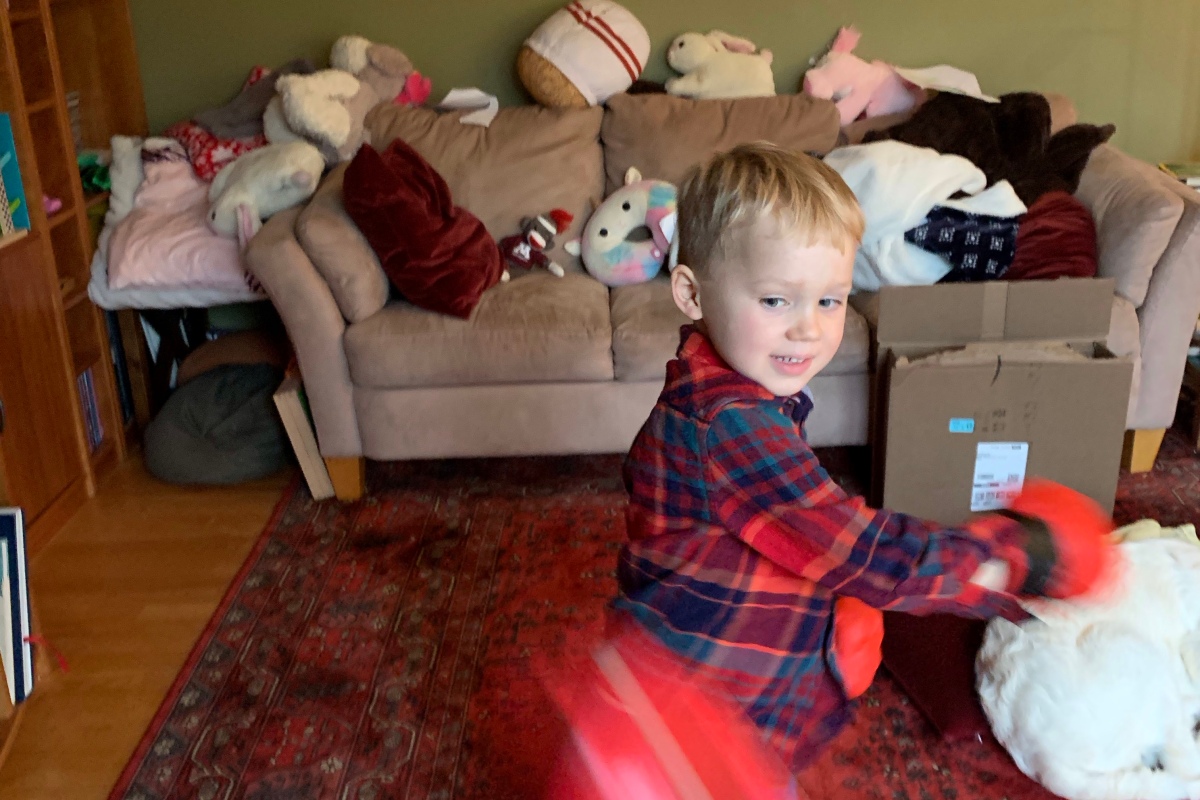
A couple of weeks ago, my son, four-year-old Mr D, got a new boxing toy, a small punching bag anchored on a vertical stick. We were home alone together when we assembled it and then went a couple of rounds with it.
We took a break in the yard to cool off and play with our dog, Cooper. As we were throwing the ball, I was coaching Mr. D on what he’d say when his eight-year-old sister came home and asked to play with his toy.
“What are you going to say when Miss O asks to box with your toy?” I started.
“Well, ummm, uhhh.” Mr. D stalled
“Say, ‘yes.’” I whispered.
And we went a couple of rounds practicing that which was every bit as hard as actually boxing.
Then Mr. D asked where his shovel was. As I looked in one hidey-hole and then another, he asked, “Want to go find some worms with me?”
“Uhhh,” I stalled.
“Say, ‘yes.’” he whispered.
And I did.
If we ever need a reminder that what we put out in the world comes back to us, just spend time with children.
“We spend the first year of a child’s life teaching it to walk and talk and the rest of its life to shut up and sit down. There’s something wrong here.” – Neil deGrasse Tyson
My daughter, Miss O, learned the power of words early on. She started talking at 10 months and it’s been off to the races ever since. Now she’s eight-years-old, and I’ve learned to get worried when she isn’t talking.
One Sunday when it was just the two of us and Miss O was about three-years-old, I was feeling overwhelmed by the constant talking, singing, and narrating. We were sitting and drawing at the dining room table as the last rays of fall afternoon sunshine filtered into the room. I said to Miss O, “Do you think we could just be quiet for 10 minutes?”
Miss O paused for a moment and then said, “Why?”
About a year later, a friend was at our house trying to troubleshoot a problem with his van. Four-year-old Miss O asked him what was happening and he started, “When hot air meets a cold surface and water forms…” She interrupted him and asked, “You mean condensation?”
I confess, I don’t always listen to her every word. But I recently had the honor of editing a podcast that Miss O did with Vicki and me. As I tuned in with ears to make sure the conversation flowed, I was stunned with the perspective of this delightful young person talking with the incredibly interesting and supportive Vicki Atkinson.
Am I biased? No doubt! But most of all what I noticed is that Miss O has learned to use her words well. And she’s found her voice – to express herself, to give voice to her feelings, to convey her delightful enthusiasm, and at the end, to share her delightful glow with everyone around.
“Above all, watch with glittering eyes the whole world around you because the greatest secrets are always hidden in the most unlikely places. Those who don’t believe in magic will never find it.” – Roald Dahl
This was originally published on 6/29/2022. Heads up – you may have already read this.
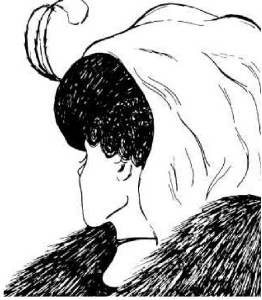
The other day, my 6-year-old daughter and her best friend asked me what an optical illusion is. I didn’t have the Merriam-Webster definition, “something that deceives the eye by appearing to be other than it is” at the tip of my tongue so we talked about examples of when you think you see something but your brain knows it can’t be real or vice versa. I showed them the classic example of the picture that is either the young lady with a necklace or an old lady with a prominent chin.
They were fascinated. But of course this is more than a trick for amusement, it’s one of the pillars of our life. As Albert Einstein said, “There are two ways to live your life. One is as though nothing is a miracle. The other is as if everything is a miracle.”
It reminds me of a person I knew who believed she had to check on everything that someone did for her otherwise she would be cheated. In one memorable instance, she had left her dog with someone who was staying at her house and became convinced the dog sitter wasn’t walking the dog as far as she claimed. So she devised a series of questions to trip up the dog sitter when she picked her up from the airport. What time does the sun rise this time of year? What is the favorite route that you walk with my dog? How many times does my dog poop on her morning walk?
She was convinced that these questions would help her find the TRUTH which was predetermined in her head as a story that the dog sitter didn’t get up as early and walk as far as she thought.
In the meantime, she completely missed that the dog was safe, happy and healthy and that the dog sitter was willing to drive her to/from the airport, that the dog sitter loved to watch movies and also worked from home so that the dog had almost constant companionship while she was gone.
Because none of that mattered if the dog sitter LIED about the morning walk. No gentle reminders from me or anyone else could change the perspective.
This person might be an anomaly in that she didn’t believe anyone, more or less, in her life. She believed that the only reliable person was herself and everything that she got, had, earned was only because of her personal efforts. There was no idea of grace, coincidence, faith, or even luck.
The rest of us are probably not as extreme but I think what Albert Einstein implies is that it’s a way of seeing. We can’t consistently believe that life is completely up to us in one area of our life (work, relationships, money) without it affecting all the others.
We have to believe in miracles to see them. Whatever we have faith in – be it God, the Universe, optimism, magic – will deliver goodness if we develop our ability to discern it. When we open ourselves up to the possibility that miracles happen in our life, it’s amazing to find how many we see.
As an example, my daughter was sad because her best friend, the one that was with her when asking about optical illusions, is moving at the end of the summer. Then as we worked through that reality, she discovered that a family with three kids that she already knows and likes from school happened to move in one block from us. They’d been up the street for 7 months and we hadn’t even realized until one day we saw them on the street. What a gift! The miracle didn’t save us from having to say good-bye to one friend, but instead it was the gift of new friends.
How do you interpret Albert Einstein’s quote? What miracles have you seen lately?
Have you thought back to how you survived middle school? I mean, I think it’s safe to assume anyone that is reading this is past the age of 13. I remember that age as being the start of understanding that there was a whole wide world outside of my family and it involved crushes, hopes and dreams, and weird things happening to my body that I didn’t want to talk about with my mom.
Katie. That’s how I made it through middle school. My dearest friend that I’ve known since age seven. She was over at my house yesterday spending time with me, Miss O, Mr. D and Cooper. I list us all out because we all needed time with her.
She reminds me of a line I got from Mark Nepo in the Book of Awakening. In German, the root of the word friendship means place of high-safety. With old friends, I think that might be especially so because they knew us from before we were anything. We had dreams of what we might become, but now that we’ve hit middle life, we’ve cycled through a lot of different ages and stages, and old friends, like Katie have seen it all.
Because to be friends for this long, I don’t think there’s any way to maintain any artifice. We’ve survived the ups and downs of life as well as testing out the waters of how we meet the world. We’ve had to work out whether we are friendly, trustworthy, and kind – and apologize and make amends when we’ve fallen short.
Watching Katie with my family, I realize that there’s an associative property of friendship. That my little ones trust her as much as I do. Probably because they can sense that ease that comes with old friends. Well, that and because Katie is simply amazing – present, smart, funny, kind, and encouraging.
I think back to my naivety and hopefulness in middle school. It was confusing and emotional as we worked out what came next in life. I’m less naïve now as I know that middle life also brings challenges with family, friends, aging, and loss. But I’m still quite hopeful – probably because I’ve been lucky enough to have a Katie, then and now.
(featured photo is me (left) and Katie (right) – maybe in middle school?)
“We live in a world where there is more and more information, and less and less meaning.” – Jean Baudrillard
For this week, I’ve actually had to leave the house to go to work. It’s made me realize how much technology has changed our lives. I’ve worked remotely for years so somehow it was lost on me how different it is to have to walk out the door every morning, until I experienced a stab of anxiety at the beginning of this week.
Especially with two kids and a dog, the number of things I had to plan for was enormous. Knowing that I can dial-in to a meeting even if any one of the three is sick is an amazing benefit. I’ve been spoiled not having to plan transportation and care outside of their schools for my three when I work from home.
But this week I’ve been attending a Microsoft conference that is here in Seattle. No surprise – but the most predominant topic is Artificial Intelligence (AI). [Is it somewhat ironic that as I started to type Art…that Word suggested Artificial Intelligence to fill in?]
Microsoft has made something like a $20 billion investment in AI. The conference was awash with examples of all the things we can do with AI. I will never claim to be a prognosticator, but as someone that’s been in the computer consulting field for 30 years, it’s interesting to puzzle through the application of this technology. All of the below is just my opinion so take it for what it’s worth.
Fine line between helpful and creepy
The most recognizable use of AI is in natural language search. We can type in or say search terms and Bing (Microsoft’s search product) will return results that are (hopefully) right on target for what you want. I question whether it’s helpful to have that abstraction from where the data comes from which makes it harder to verify the veracity of the source of the research.
And then there’s a line between helpful and creepy. The other day a search result popped up about whether to store your open cheese block in a Ziploc bag. It was something I’d recently pondered but hadn’t done any research on. It must have been just a coincidence? Either way, I refused to click on the result – it was too creepy.
Fine line between cool and useful
I was talking about AI with a Microsoft program manager that was in the booth next to me. As we talked through some of the examples, he offered “that’s there’s also a fine line between cool and useful.” All the prototypes and fun demos that have been shown, there’s a cool factor – that still leaves most people scratching their heads over the utility. No doubt humans will figure out how to leverage it but for now, it’s still an idea that is not very real-world.
We’re not getting replaced
This brings me full-circle to the start of the post and why I’ve been leaving the house every day. Because there’s no substitute for in-person relationships. Meeting others, reading body language, having collaborative conversations – there’s no short-cut for that. Even online there’s a palpable difference between a real conversation and a bot supported one.
As I’ve been away from my computer this week, there’s no AI I can set to read my favorite blogs and leave meaningful comments. Not to mention that I wouldn’t get the benefit of reading them. [Yes, this is a roundabout apology for being behind on my blog reading.] So for many reasons, I’m looking forward to staying home, sitting on my couch, and catching up.
“A friend accepts us as we are yet helps us be what we should.” – unknown
This was originally published on 2/9/2022. Heads up – you may have already read this.
After I wrote that post on Vulnerability last week, I had lunch with my friend Doug. He was the person I mentioned in the post as the friend who’d asked about the blog and then not responded when I shared it with him. Turns out that he’d both read and liked the writing very much but just had forgotten to respond. We had a good laugh about that. Fortunately I’d written another post about him on my personal blog that we could also talk about.
Doug is planning a climb of Mt. Adams with his son this summer. It’s a 12,280 foot mountain in Washington State – tall enough to be a challenge but not technical enough to need a lot of equipment and training. The last time we summitted this mountain was with his daughter about 10 years ago when she was 14 years old.
Doug asked if I remembered what packs we carried between our camp at about 9,000 feet and the summit. He is a meticulous packer and doesn’t carry anything more on his back than necessary.
I have a long history with backpacks – picking them out, carrying them, feeling relieved to take them off. At one point when I was in my thirties and planning a lot of climbing trips, I got one that was almost 6000 cubic inches. I can’t even describe how large that is but suffice it to say that when you have a backpack that big, your friends start believing you have room to carry their stuff.
Which is what happened when we were planning a climb on Mt. Rainier that would take place over Doug’s birthday. His wife asked me if I would carry some brownies up to celebrate Doug’s birthday. It was only after I happily agreed that she told me that Doug said he wouldn’t carry them because he didn’t want that unnecessary weight in his pack.
It is probably all this carrying of loads that makes one of my favorite meditations the one where I imagine I sit down, empty everything out of my pack, look carefully at each thing I’m carrying. When I’m done sorting through the worries, the presumptions, and fears as well as the love, the purpose, the nostalgia, the energy stored for digging deep, I mentally load the pack again with only what I need. I always carry a lighter load after that meditation.
But in thinking about those brownies, I realize that friendship means we are willing to carry things for other people that they won’t carry for themselves.
We hold in our packs a version of our friends at their brightest and most creative that can be shown to them when they are in a slump. We carry memories of the times we laughed, did silly things, failed and succeeded. We store all the depth of the ways we have walked side by side on the path as well as the times we waited at an intersection while they took a detour and vice versa.
Then at just the right moment, we unpack the brownies we’ve carried so far and celebrate our friends. There are some things worth the extra weight and friendship is one of them.
“You are not a drop in the ocean. You are the entire ocean in a drop.” – Rumi
To whoever thought of building a kid’s hair salon in the neighborhood toy store – wow, you are brilliant.
The other day, Mr. D needed to get his hair cut. So Miss O and I accompanied him to the back of the toy store so he could climb in to the fire engine shaped seat to hang out with “his best friend,” also known as Jenny, the stylist.
I sat on the couch in the toy store positioned just outside the salon while Miss O, and Mr D, when the haircut was done, roamed around to look at everything on the shelves. I was reading my book, but really was mostly reading the people.
I’ll start with my kids. Eight-year-old Miss O knew within minutes that she wanted slime and was willing to spend her own money on a second slime because it was worth it to her to have two fancy slimes, even though it was over the budget I had given her. She had a full story of why each one was important and how the characters portrayed for the slimes related to things she’d learned at school. In other words, she had an endless monologue for her shopping experience.
Four-year-old Mr. D roamed the store for an hour looking at everything, playing with display items, enjoying the experience but eventually rejecting each toy as not the right thing. Mr. D wasn’t aware of budget and so it wasn’t price that was informing his decisions. He either had something similar at home or it didn’t sing to him.
But he did pair up with Mikey who was about his same age. Mikey had $10 to spend which at a toy store in this day and age, doesn’t buy much. He was interested in a police car, and the small ones they had didn’t match his idea. But he didn’t complain about that, he just enlisted Mr. D in his help to find more options.
And then there was Teddy. I’d guess Teddy was halfway between Miss O and Mr D age-wise, probably 6-ish. He was playing with my kids at the train table by the couch I was sitting on. He was declaring all the demo trains were his, and might have taken a thing or two directly from the other kids. Miss O was facilitating play and just shrugged her shoulders and accommodated him, somehow sensing it was more important to him than to anyone else.
His mom was sitting next to me tried to get Teddy to modify his behavior. Seeing it was okay with the kids, she sighed, and said to me that Teddy was emotionally fragile at that moment. It was his dad’s birthday and he was having trouble sharing the spotlight. He’d had quite a few hard “no’s” to things he’d wanted that morning.
Holy cow! Great people watching. Each of the characters mapped to people I’ve known in my life and their approaches. Disappointment, idealism, pragmatism, story-telling, alliances. Yes, bravo to whoever thought of a salon (and couches) in a toy store.
The other day something touched me at a deep level. I’ve been trying to peel back why ever since.
I’d picked four-year-old Mr. D up from preschool and he’d scrambled in the car and closed the door. I’d stopped to talk to a man walking his dog, and so it was a minute or two before I got around to my side of the car and realized Mr. D was crying. He’d tried to do his own seat belt and had gotten frustrated when the thing wouldn’t click. Then he got more frustrated when the belt got tangled as he tried to fix it.
When I opened his door to help, he reached up and with the back of both hands, swiped away the hot, frustrated tears from his eyes.
Something about that gesture just hit me deep down where it counts. I’m not sure I can even put it into words why. To the best of my translation, it’s some combination of the following:
Witnessing the dignity of another person
Gratitude that my kids’ problems are small at this age and I can mostly fix them
Realization of Mr. D’s sudden self-consciousness about crying
Commiseration with how frustrating technology and systems can be
Relating to how fiercely we want to do things for ourselves
The deep gut punch of how much I love my kids.
Whatever it was, it started to change how I think of perfect moments. They may have nothing to do with when we’re smiling and posing for a picture or spending a gazillion dollars on an experience.
I think perfect moments might be when the inside of me meets the inside of another, and in the process learns something real about being human.
“There is no where you could go that I won’t be with you.” – Moana
In a tradition suggested by a Jewish friend, I burn a Yahrzeit candle every year on the anniversary of my dad’s death. The ritual, as I understand it, is supposed to celebrate our loved ones and bring them close as the candle burns for 24 hours.
I’ve had to modify the tradition slightly since I’ve had kids since Mr. D in particular is fond of blowing out candles. So I light the candle and then hide it around the house until the kids leave. [“Sorry if the candle brings you to the laundry room, Dad.”]
With or without the candle ritual, my dad seems to be especially close at this time of year. The anniversary of his death is November 7th. On November 6th of last year, I received an incredible email from my soon to be dear friend, the amazing, talented, and incredibly wise Vicki Atkinson, with notes from a wonderfully deep read of my book about my dad, Finding My Father’s Faith.
The conversation then went on to be the beginning of our close friendship, even though we’ve never met in person, as well as our partnership in creating the Sharing the Heart of the Matter blog and podcast. But it started with my dad. And Vicki’s incredibly open heart, of course.
And then on November 4th of this year, I got a delightful email from another wonderful blogging friend, Jane Fritz of the Robby Robin’s Journey blog with some great humor. In our email exchange, Jane said, “They made me think of your father, and I never even knew him!”
Two things that strike me about this. [I’d like to make it three because my dad loved having three points in his sermons but I’ll just leave it at two for now.]
The power of writing is amazing. In these examples provided by Vicki and Jane, they have a sense of my dad because I write about him so often. Putting words around the people we love creates connection to know us and them. Writing about my dad has not only helped me to clarify and cement what I learned from him, but it has also allowed others to meet him, even after his death.
Which is my segue to the next point – death isn’t as final as it seems. Of course I don’t know what happens when our loved ones are beyond the veil, but I can feel times when they are tantalizingly close. I’ll forget it’s the anniversary of my beloved dog Biscuit’s death until I see the golden patch of sunlight on his favorite place to lie that oddly shows up on January 13th, even though sunshine that time of year is not a given.
Or the touch of my dad in these emails from others, bringing him close and making me comprehend that there is no where that I can go that he won’t be with me.
For a post about a way that I found to move through my grief, please see Gratitude versus Greed on the Sharing the Heart of the Matter blog.
“And then the day came when the risk to remain tight in a bud was more painful than the risk to bloom.” – Anais Nin
In the ten years or so before my dad died, my parents started spending their winters in Tucson. I’d go visit whenever my bones needed drying out, usually in February.
In one of my favorite stories that I tell in my book, on a visit to Tucson three years before my dad died, my mom and I were in the living room and Dad yelled to us from his study, “Isn’t the sunrise beautiful this morning? We are so lucky.”
And Mom yelled back, “Dick, it’s absolutely wonderful!”
I could see my mom wasn’t really paying attention and said to her in a low tone, “It’s okay, Mom, I won’t tell him you didn’t even look.”
Mom replied, “He can’t even see the sunrise from where he’s sitting.”
I love that story because it showcases my dad’s enthusiasm as well as my mom’s delightful ability to go along. But it also reminds me of the flip side of our family. My parents didn’t argue at all when I was growing up. There was no playing Mom off Dad because they were a unified front. Certainly they must have had conflict but they were so good at covering it up or having it out behind closed doors that there was no sign of it in front of the kids.
This is all to say that I suck at communicating hard feelings, and I come by it honestly. It doesn’t help that when I was married, my ex-husband”s response when I told him something I felt or was concerned about that he didn’t want to hear was, “What’s the big deal?”
I’ve worked on this in two ways. First, through meditation, I’m able to better discern what is and isn’t important for me to speak up about and let go of the stuff that isn’t. It’s one of the reasons meditation works for me to irrigate the irritation. Am I irritated because I’m tired, my ego is out of whack, etc.?
And my second way? My children. They provide me a steady flow of boundary-pushing, soul-wearying, things I can’t live with examples that I have to find the words to express. The beautiful thing is that it’s this expansive relationship of love and constancy that’s allowed me to grow into expressing my wounds.
Like last night when Mr. D’s toenail cut into my shin. I said, “ouch.” He said, “Sorry.” I replied, “It’s okay.” And we went on with the night. Such a small thing – but I’m learning the risk the little ones in order to be brave for the big ones.
I adore my dad, as anyone that has read my writing knows. He could manufacture sunshine just like he did that morning in Tucson. His job as a pastor made him very good at carrying everyone else’s hurts. But I’m not sure he ever learned how to express his own.
I’m hoping that I can grow my own willingness to be vulnerable so that I can do that better. I can hear my dad saying to me, “You’ve got this, Kid.”
For more on the topic, please check out my podcast with Dr. Vicki Atkinson about risking disappointment. Please search (and subscribe!) for Sharing the Heart of the Matter podcast in Apple, Amazon Music, Spotify or Pocket Casts. Or click here for show notes and a link: Episode 42: Risking Disappointment with Vicki and Wynne