
“Love is a feeling, marriage is a contract, and relationships are work.” – Lori Gordon
This is a repost of something I posted on 11/30/2022. Heads up, you may have already read this.
When my brother was in his twenties and a couple of years into marriage, he explained to me his theory about the cleanliness threshold. He drew out a chart where he illustrated the state of the household mess and that when it increased, it hit his wife’s threshold for a messy house long before it hit his. Therefore, she was always cleaning it and he never thought it was messy. The diagram looked something like this with the gray area as the space between her threshold and his:
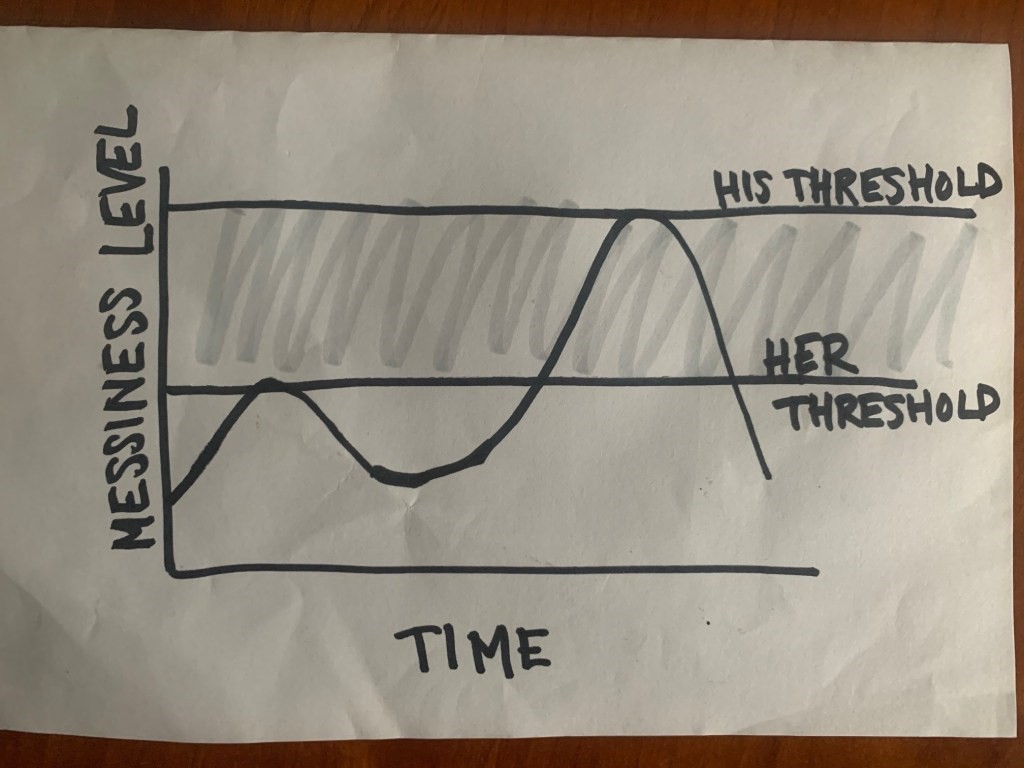
Since I am six years younger and wasn’t married at the time he told me, I thought he was imparting some great wisdom about marriage. It wasn’t til later that I realized that his diagram depicted a way of looking at all our relationships.
Because our thresholds on any number of subjects will likely vary in a great number of areas from those around us: what qualifies as noise, when do we experience hunger, pain tolerance, ability to withstand uncertainty, desire to take risks, and our willingness to express ourselves or seek relief when we are exhausted, overwhelmed and sad to name just a few. So how do we live with others in the gray area between our tolerance level and theirs?
Believe Them
My years as a parent of young kids have taught me that it goes better when I believe them when they tell me how they feel. In that way, we don’t end up debating the truth of the feeling but instead can move to finding out what to do about it.
There are times they’ll tell me they are sad, frustrated, disappointed and I might say, “It’ll be okay” if we need to move on. But I try not to argue that they should be feeling something else like grateful, happy or blessed because it compounds the feeling. They stay stuck trying to prove what they are feeling instead of transitioning to the next phase of how to make it better.
Try to Laugh About It
The other day my 7-year-old daughter was goofing around before bed. Despite my numerous admonitions that she was too tired to keep safely doing cartwheels and should instead try to quiet her body, she kept throwing herself around the room until she ended up hurting her arm pit and her crotch. At that moment, I had the choice of being irritated that she didn’t listen or making a joke about those being two very unlikely body parts to get hurt at the same time. We ended up laughing all the way to bed about how that happened.
On a recent Unlocking Us podcast with Brené Brown, Drs. John and Julie Gottman were talking about their latest book, The Love Prescription: Seven Days to More Intimacy, Connection and Joy. They made the distinction between turning toward a bid of attention (responding or engaging when your partner says something like “look at that blue jay out the window”), turning away (ignoring) and turning against (responding with something like “why are you interrupting me?”).
In happy relationships, people turn toward their partner’s bids for attention 86% of the time, couples who were not successful only turn toward each other 33% of the time. John Gottman explained the result, “Couples who increase their turning toward wind up having more of a sense of humor about themselves when they are disagreeing with one another, when they are in conflict.”
As Brené Brown summarized “Turning toward gives us a sense of confidence about our togetherness.” From there, it’s easier to find what’s funny about this daily existence.
Live Directly
In his book, The Book of Awakening, Mark Nepo gives an example of being at an ice cream shop with a friend and eating their cones when the table next to them became boisterous. As he became more irritated, he asked if she wanted to go. But his friend was fine and in saying so, she noticed the look on his face and asked, “Do you want to go?”
He laughed as he realized he was couching his needs into some form of thoughtfulness instead of owning his own feelings. Relationships are so much easier when we claim our own stuff and live directly.
Navigating the Gray Area
My brother’s marriage from his 20’s, the source of the threshold theory, didn’t work out. Turns out his wife had a different standard for telling the truth about significant things. I suppose there needs to be another line on the chart for boundaries. Regardless, I learned a lot vicariously about living in the gray area with others. The longer I live, the more gray it gets but also easier to navigate if I believe others, laugh about it and own my own stuff.
I’ve written a companion piece to this one on the Wise & Shine blog about WordPress relationships: Do You Like My Writing or Are We Just Friends?
(featured photo is mine – a heart of the week from Whidbey Island)









 Surprised By Joy