Touchstone

When it’s over, it’s the happy memories that hurt.” – unknown

This car is packed with memories,” Miss O said as we pulled into the lot of the company we were selling it to.

I’d aimed to sell the car earlier in the day. But it was so old that the title was in my married name. Even with the proper documentation, it took longer than I’d anticipated so I had to return with my kids to finalize the deal.

Miss O was right – the car was packed with memories from the 18 years I owned it. And about a thousand goldfish crackers stuck in the cracks. We’d tried to get all the goldfish out but probably missed at least a dozen.

This was the car I’d trepidatiously drove Miss O home from the hospital in almost ten years ago. And made that same trip with Mr. D about six years ago filled with awe and a little bit of overwhelm. Speaking of family members, it was the car we picked up Cooper the dog in as a puppy two years ago. Miss O sat with him in a box on our lap in the back seat and explained the world, “This is a freeway. That is an airplane. And you are my new best friend.”

It’s carried us, our well-worn hiking shoes, and our stuffies to school, our favorite vacation spots, and the best hiking trails.

The car was the last car of mine that my dad rode in and helped fix. I can still see him taping plastic over the rear window on the driver’s side when it stopped working on a stormy November day.

Along with the goldfish crackers, the car probably has two pounds of dog hair even after we vacuumed and vacuumed. It was the car that carried me to say good-bye to my beloved dog, Biscuit when it was time for him to cross the rainbow bridge at nearly 14 years of age in 2017.

Like all touchstones, the car is just a gateway for all the tender, tense, and touching moments my family has stored in our hearts. Funny how touchstones make feelings so accessible. The car feeling was that life is adventurous, rich, and full of beloved characters we love.

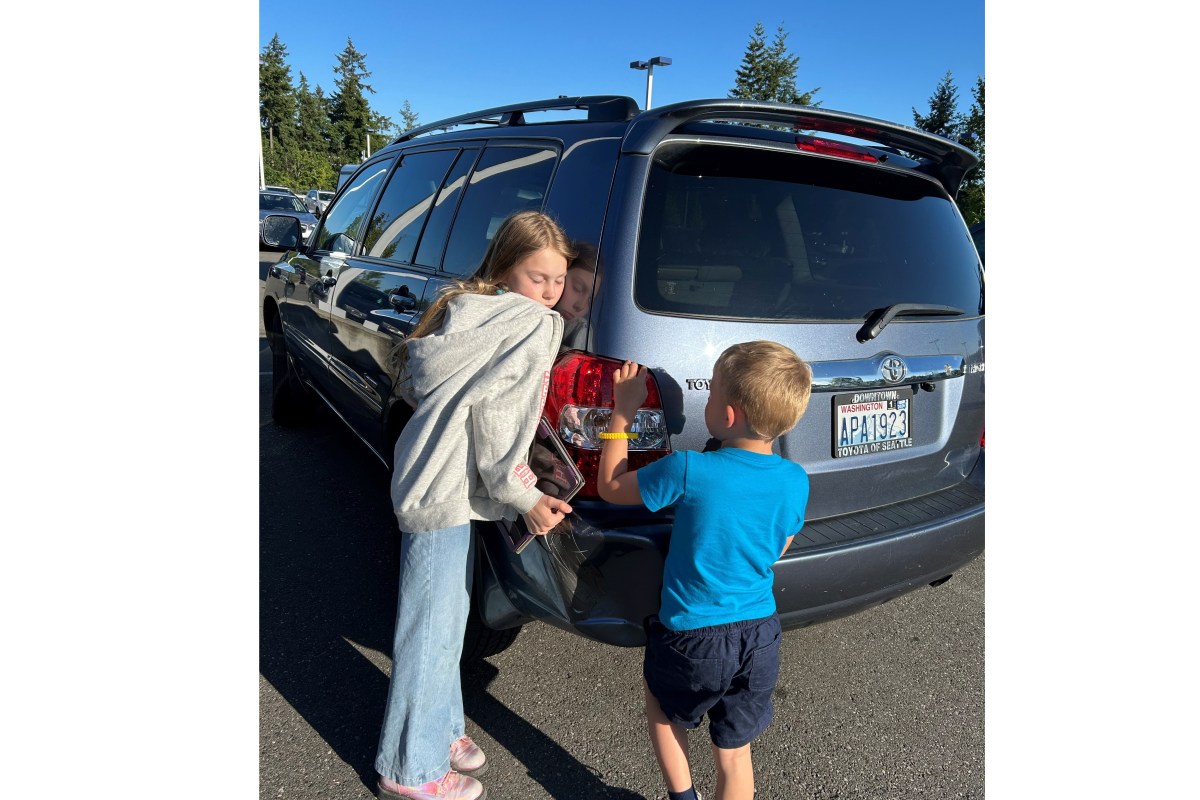
The kids and I hugged the car and walked into the building a little teary-eyed. We sold the car but we are keeping the memories.

(featured photo is of our parking lot car hug)

You can find me on LinkedIn: https://www.linkedin.com/in/wynneleon/ and Instagram @wynneleon

I host the How to Share podcast, a podcast about collaboration – in our families, friendships, at work and in the world.

I also co-host the Sharing the Heart of the Matter podcast, an author, creator and storytelling podcast with the amazing Vicki Atkinson.

How to Share Insight

We teach each other things. People take this for granted, but it’s actually unbelievable.” – Nicholas Christakis

Last weekend, my five-year-old son got two moon balls. They are cratered like the moon and bounce like they are going to leave this atmosphere. That bounce combined with my son’s determination to hit as if he’s aiming for the Green Monster at Fenway Park meant we lost both balls in pretty short order.

He was bummed when we lost the first… and really sad when we lost the second. I sat next to him on the steps and asked, “Do you want to know what I know about being sad.”

No,” he replied.

It’s all about timing, isn’t it? 🙂 It is one of the keys about sharing insight that I talk with customer experience strategist Karl Baisch about on the How to Share Podcast.

Nicholas Christakis, sociologist from Yale, has this really hopeful view of humans based on our ability to interact and cooperate with others. He says, “We teach each other things. People take this for granted, but it’s actually unbelievable.”

In this episode of ‘How to Share’, Karl and I explore the nuances of how we teach each other things and share insights effectively. We discuss the importance of asking the right questions, the challenges of navigating data, and the significance of context in delivering actionable insights. Our conversation also touches on parenting and how to instill curiosity and critical thinking in children, drawing parallels between data synthesis and everyday experiences.

Here are some takeaways from our conversation:

  • We teach each other things.
  • Real change happens when there’s enough curiosity.
  • Groups have to want an answer to hear it.
  • You gotta share your work product somewhere.
  • You want to avoid analysis paralysis.
  • How do you synthesize it into a story?
  • Insights should breathe new energy and life into anything.
  • You have to contextualize it.
  • You have to ask the right questions.

This is a great episode about the practice of creating insight. Join us as we dig into the who, what, when, where, how and of creating and sharing a-ha moments!

Here’s a short clip from our episode to give you a taste of the great conversation with the bright and engaging Karl Baisch:

Here are some ways you can listen and watch to the full episode:

Please listen, watch, provide feedback and subscribe.

Barbara Nickless on A Voice In The Dark, Online Gaming and The Power of Story The Life of Try: Personal growth, one try at a time.

In this episode of The Life of Try, host Wynne Leon talks with Wall Street Journal bestselling author Barbara Nickless about her new psychological suspense novel, A Voice in the Dark. Their conversation moves from the dark corners of online gaming and internet manipulation to the real-world vulnerabilities of teenagers, families, and people searching for belonging. Barbara shares how deep research, FBI consultants, and her own curiosity shape her fiction, especially as she writes about FBI profiler Helen Belle, criminal humanist Benedict Hoffman, addiction, trauma, and the question of what draws people toward danger.This thoughtful author interview explores how storytelling can help us understand complicated human experiences, including moral injury, PTSD, addiction, grief, law enforcement, cybercrime, and the healing power of writing. Barbara also reflects on teaching writing to military veterans and civilians, researching dangerous places and difficult subjects, and using narrative to “de-other” people we might otherwise misunderstand. Key Takeaways:→A Voice in the Dark explores the dangers young people can face in online communities, especially when vulnerable teens and young adults are targeted by manipulative influencers.→Storytelling can help us “de-other” people by taking us inside their motivations, histories, and struggles in ways that facts and news stories alone often cannot.→Curiosity is at the heart of Barbara Nickless’s writing process. Her research into online gaming, FBI investigations, addiction, trauma, and moral injury helps make her fiction vivid, compassionate, and grounded in real human experience.→Researching modern crime fiction requires balancing accuracy with readability, particularly when writing about cybercrime, AI, online manipulation, and evolving law enforcement tools.→The conversation highlights a core Life of Try theme: trying begins with curiosity, openness, and a willingness to enter unfamiliar worlds in order to understand ourselves and one another more deeply.If you love conversations about books, personal growth, curiosity, crime fiction, psychological thrillers, resilience, and what it means to keep trying, this episode offers a rich and compassionate look at the stories that help us make sense of ourselves and one another.📘 Order A Voice In the Dark: https://www.amazon.com/Voice-Benedict-Hoffman-Helen-Belle-ebook/dp/B0FTGGHSWL/🌐 Show notes and more inspiration: https://wynneleon.com🔔 Subscribe for more: Subscribe to The Life of Try for more conversations on: personal growth, creativity, reinvention, resilience, writing, and mindset.ABOUT MEHi, I’m Wynne Leon — host of The Life of Try, a personal growth and self-improvement podcast exploring resilience, reinvention, uncertainty, and the courage to keep trying.Through thoughtful interviews, reflective conversations, and real-life stories, I share insights to help you navigate change, get unstuck, and move forward with more intention.🌍 Website: https://wynneleon.com🎥 Watch Next➡️ Letting Go Of Outcomes: The Mindset That Keeps You Moving➡️ 48: How to Get Unstuck: Michael Yang on Saying Yes, Resilience and Coming Alive➡️ How to Finally Write That Book You've Been Dreaming About | Writing Motivation
  1. Barbara Nickless on A Voice In The Dark, Online Gaming and The Power of Story
  2. Embracing What Makes You Different | Kym Gordon Moore
  3. Motive + Means = Opportunity: A Life of Try Story
  4. How Writing Helps Us Survive Chronic Illness and Loss
  5. Near Death, Deep Faith, New Life | Liza Anderson’s Extraordinary Story

Links for this episode:

Karl Baisch on LinkedIn

How To Share

Everyone has a talent. What’s rare is to follow it to the dark places where it leads.” – Erica Jong

Do you have a solid idea of what you know? Not what your jobs have been or what roles you have played but the overarching talent, wisdom, and perspective that is uniquely you?

I ask because I’ve spent the last five months trying to figure out what I know. Believe me, I understand that seems like a long time to try to answer what is a seemingly straightforward question. But I found it to be harder than I expected.

Here’s why. I’m bound by a non-compete so that I can’t fall back to the technical expertise that I’ve cultivated for my career, at least not for a few more months. But that has been an incredible opportunity for me to figure out the bigger picture. Instead of just treading the same path I’ve been walking with Microsoft SharePoint, Teams, OneDrive, and the other technologies, I’ve had to examine what mountain I’ve been climbing the whole time.

Here’s what I discovered. In the 25 years I’ve been helping people with their collaboration software, I’ve learned a whole lot about how to share.

Not just what buttons to push to share a file, a photo or a calendar, but what makes groups do it well – and also do it poorly.

One of the more stark examples was a team that was so good at sharing not only files but also ideas, contacts, and worries about what could go wrong, they seemed to be able to nimbly handle challenges.

And then the leadership changed to someone who criticized that they talked too much, wanted people to focus on their own tasks instead of helping others, and berated team members for anything shared before it was polished. The leader thought they were “whipping the team into shape” but one of the side effects was that they were squelching vulnerability and sharing.

A couple of months into the new leadership, the team lost a key client. In the debriefing, it became clear that team members had picked up some little warning signs. If they’d shared them, it would have helped put together the big picture that the client was at risk.

While this example is in a professional context, it happens again and again in writing groups, schools, between friends, and more.

We have to share and it’s vulnerable. So we are continually evaluating who the audience is, what are the right permissions and how to identify the right time. That applies to files as well as personal stories, social media, wisdom, and more.

This period of introspection about what I know has pushed me to launch a new podcast, How to Share. It draws not only from my interest and experience but also applicable research and wisdom. My incredible and insightful first season guests will lend their expertise on how to share things such as credit and feedback, passwords, corporate communications, as well as how to receive when others share.

Here’s a short clip from the first episode, Why We Share:


Based on recent technology changes, we learned that embedding the full YouTube video reduces listens and views. Here are some ways you can listen and watch:

I’d be honored if you’d listen, watch, provide feedback and subscribe.

On the Sharing the Heart of the Matter podcast, Vicki and I also had a fascinating podcast conversation with author Mark Wukas about his incredible debut novel The Kiss of The Night. Please check out this fantastic author and hear how he cultivated his dream to write a book and this plot for almost 40 years!

Barbara Nickless on A Voice In The Dark, Online Gaming and The Power of Story The Life of Try: Personal growth, one try at a time.

In this episode of The Life of Try, host Wynne Leon talks with Wall Street Journal bestselling author Barbara Nickless about her new psychological suspense novel, A Voice in the Dark. Their conversation moves from the dark corners of online gaming and internet manipulation to the real-world vulnerabilities of teenagers, families, and people searching for belonging. Barbara shares how deep research, FBI consultants, and her own curiosity shape her fiction, especially as she writes about FBI profiler Helen Belle, criminal humanist Benedict Hoffman, addiction, trauma, and the question of what draws people toward danger.This thoughtful author interview explores how storytelling can help us understand complicated human experiences, including moral injury, PTSD, addiction, grief, law enforcement, cybercrime, and the healing power of writing. Barbara also reflects on teaching writing to military veterans and civilians, researching dangerous places and difficult subjects, and using narrative to “de-other” people we might otherwise misunderstand. Key Takeaways:→A Voice in the Dark explores the dangers young people can face in online communities, especially when vulnerable teens and young adults are targeted by manipulative influencers.→Storytelling can help us “de-other” people by taking us inside their motivations, histories, and struggles in ways that facts and news stories alone often cannot.→Curiosity is at the heart of Barbara Nickless’s writing process. Her research into online gaming, FBI investigations, addiction, trauma, and moral injury helps make her fiction vivid, compassionate, and grounded in real human experience.→Researching modern crime fiction requires balancing accuracy with readability, particularly when writing about cybercrime, AI, online manipulation, and evolving law enforcement tools.→The conversation highlights a core Life of Try theme: trying begins with curiosity, openness, and a willingness to enter unfamiliar worlds in order to understand ourselves and one another more deeply.If you love conversations about books, personal growth, curiosity, crime fiction, psychological thrillers, resilience, and what it means to keep trying, this episode offers a rich and compassionate look at the stories that help us make sense of ourselves and one another.📘 Order A Voice In the Dark: https://www.amazon.com/Voice-Benedict-Hoffman-Helen-Belle-ebook/dp/B0FTGGHSWL/🌐 Show notes and more inspiration: https://wynneleon.com🔔 Subscribe for more: Subscribe to The Life of Try for more conversations on: personal growth, creativity, reinvention, resilience, writing, and mindset.ABOUT MEHi, I’m Wynne Leon — host of The Life of Try, a personal growth and self-improvement podcast exploring resilience, reinvention, uncertainty, and the courage to keep trying.Through thoughtful interviews, reflective conversations, and real-life stories, I share insights to help you navigate change, get unstuck, and move forward with more intention.🌍 Website: https://wynneleon.com🎥 Watch Next➡️ Letting Go Of Outcomes: The Mindset That Keeps You Moving➡️ 48: How to Get Unstuck: Michael Yang on Saying Yes, Resilience and Coming Alive➡️ How to Finally Write That Book You've Been Dreaming About | Writing Motivation
  1. Barbara Nickless on A Voice In The Dark, Online Gaming and The Power of Story
  2. Embracing What Makes You Different | Kym Gordon Moore
  3. Motive + Means = Opportunity: A Life of Try Story
  4. How Writing Helps Us Survive Chronic Illness and Loss
  5. Near Death, Deep Faith, New Life | Liza Anderson’s Extraordinary Story