Depth and Breadth

The heart of man is very much like the sea, it has its storms, it has its tides and in its depths it has pearls too.” – Vincent Van Gogh

In my house when we have a fun announcement, we blow the imaginary trumpet in our hands and sing “Doot-doot-da-do!” So please, humor me and imagine a “doot-doot-da-do!

Because I’m really excited to announce a new shared blog space that Vicki Atkinson (from the Victoria Ponders blog) and I have created with a team of incredibly talented group of contributors and thinkers. It’s called The Heart of the Matter – https://sharingtheheartofthematter.com. It’s intended to be a blog that digs into the depth of how we find what matters to us and keep our eyes focused on that horizon as we are swimming through our days.

This topic of what matters I something I believe to be different for every person and different every day but with a lot of common elements of experience, learning and love. Which is why it’s important for us all to be collaborating on this topic and space so that as we figure it out, we are contributing to the journeys of others. It’s found in what DOESN’T matter as what does. The other things we plan on diving into are:

  • What is fueling us to figure out what’s important
  • Celebrating who is helping us discover our own keys
  • How we get stuck thinking it’s one thing long after that one thing has ceased to be vital.
  • Linking to resources that help uncover what’s real
  • Heartening each other to have the faith and confidence to pursue what matters
  • Healing what is broken so that we can uncover what’s essential

This shared blog space is for surfacing our stories that help us discern what matters so that others are inspired and it pulls us all along.

So please follow us there – but more than that join us there. As we figure out how to make this a collaborative and supportive space of contents, comments and topics, I hope to see all my dear blog friends in a rich space of discussion around the Heart of the Matter. My first post in that space is The Small Decisions that Matter.

Which doesn’t mean that I won’t be also blogging here on Surprised by Joy. As I see it, my personal blog covers the breadth of life in all its glory and surprises while The Heart of the Matter digs into the depth of authenticity, inspiration, values and love found in what really matters.
Keep Small Things Small

You wanna fly, you got to give up the shit that weighs you down.” – Toni Morrison

The other day Mr D was upset and Miss O shared the wisdom, “Keep small things small.” I was taken by the phrase and asked her to tell me more after we got past our speed bump.

It’s something Ms. Park says,” she elaborated providing the example that her second grade teacher, Ms. Park, said it the other day when there was a fly in the classroom. All the kids in the first row were trying to “attack it,” in Miss O’s words and Ms. Park wanted them to settle down. “Keep small things small.

I thought of the parking problem I had the other day when I was turning around to take the space and someone slid right in. I was on the verge of making it a bigger story about how tough life is when someone made me laugh and I let it go.

It also reminded me of when Mr. D punched his sister in the gut the other day as they were wrestling. She said it hurt and he said he was sorry and they moved on. If they continue to be able to do that, it seems less likely that they’ll create a pattern of feeling disrespected and hurt that has plagued my siblings’ relationship in adulthood.

Keeping small things small speaks to me of airing wounds before they fester, identifying patterns before they become bad habits, stopping the internal dialogue before it goes on a self-critical rampage. It helps nail me to the present before I pile on added layers of time and repetition until whatever it is that is bugging me becomes unrecognizable. It means don’t hurt myself trying to attack a fly, whatever the metaphorical fly may be.

So here’s a new note to self courtesy of classroom 219 and all our brilliant and dedicated teachers: “Keep small things small.

(featured photo from Pexels)

Democratizing the Theater

Gotta move different when you want different.” – unknown

My friend, award winning playwright, Jack Canfora has been working with his theater company, New Normal Rep to democratize theater. That is to say, they are trying to bring a dramatic theater experience to everyone, no matter where we live and at a cost that isn’t a whole paycheck.

So recently New Normal Rep produced a theatrical podcast of Jack’s play, Step 9 and released it on all podcast platforms for free. Doing it this way means a completely different marketing paradigm than brick and mortar theaters and they are relying on social media and word of mouth to spread the word about this really great play.

I was lucky enough to be able to interview Jack about Step 9, apologies and healing on the latest Wise and Shine podcast. For anyone who does podcasts and is interested in a great conversation, you can listen to the podcast on Spotify or via this link: Wise and Shine Podcast Episode 10: Jack Canfora on Step 9

And if you’d like to see the podcast show notes, I’ve posted them on Wise & Shine: Episode 10: On Step 9, Apologies and Healing

Finally, I highly recommend checking out the audio drama, Step 9. You can find it by searching New Normal Rep Step 9 wherever you podcast or going to: https://tinyurl.com/Step-9-NNR

Step 9: Five Stars

The idea is to write it so that people hear it and it slides through the brain and goes directly to the heart.” – Maya Angelou

I just finished listening to Step 9, a theatrical podcast based on a play written by Jack Canfora and produced by New Normal Rep. The description of the play includes these details,

“STEP 9 tells the story of Emily, a woman wrestling with the implications of prosecuting the man who raped her in college 30 years ago. Is she willing to relive the horror of that night in the pursuit of justice?”

I don’t think I’d normally select a drama where the description includes rape and prosecution but Step 9 is written by my friend Jack and I know from his other work that he deftly handles any topic with humor and insight.

And that is true with this theatrical drama, performed by an incredible group of actors. I’d say the two words I’d pick for this play (other than terrific and worthwhile) are resonant and healing. It speaks to our woundedness and with amazing dialogue walks us towards wholeness. A must listen.

 You can find Step 9 by searching New Normal Rep Step 9 wherever you podcast or go to: https://tinyurl.com/Step-9-NNR

Our Relationship With Pain

These pains you feel are messengers. Listen to them.” – Rumi

About 15 years ago I was climbing Mt. Whitney in the winter with my friend Jill and about 7 other climbers and 2 guides. Though Mt Whitney claims the prize as the tallest mountain in the lower 48 states at 14,505 feet, by reputation it isn’t a hard climb in the summer.

But in the winter, our approach was a couple of miles longer because the parking lot was snowed in, we had to carry heavy 55 pound packs with all the gear we needed and the route was deep with crappy snow so that even in snowshoes, we were regularly sinking in to our thighs.

I started out feeling fine but by the time we were at about 10,000 feet, my left ear was incredibly painful. I kept trudging along, not listening to the pain because I figured there wasn’t anything I could do about it. By the time we made camp at 12,000 feet I was in tears. Fortunately I didn’t impact the teams plans to climb because a storm with 60 mile per hour winds came through and we all had to go back down the next morning.

Mountaineering books are filled with stories about people who ignored their pain – usually with more dire consequences than my ear on Mt. Whitney. And of course this seems to be a universal human experience to not listen to the signals we are receiving. It’s the topic of my latest Wise and Shine (formerly Pointless Overthinking) blog post: Do You Listen To Your Pain?

(featured photo from Pexels)

Finding What Hurts

I can bear any pain as long as it has meaning.” – Haruki Murakami

Last week, 3-year-old Mr. D had a lot of objections as we were getting into the car to go to preschool. “I don’t like those boots.” And “I don’t want to watch that on my tablet.” And “This isn’t the arm I put into the seat belt.” And “It’s too sunny.”

As I responded to each of the objections, I finally got the a-ha – it wasn’t any of these things that was really wrong. It was that he didn’t want to go to school. He’d been having fun with his sister at home and didn’t want to stop.

It adds to my long list of how confusing it is to be human. First, it’s hard to pinpoint exactly what is going on with us. In Atlas of the Heart, Brené Brown cites a survey that she gave out in workshops asking people to list the emotions that they could name as they were having them. “Over the course of five years, we collected these surveys from more than seven thousand people. The average number of emotions named across the surveys was three. The emotions were happy, sad and angry.” Which is stunning that out of our nuanced ranged of emotions, we have trouble identifying many of them at the time we are having them. But I can affirm that it’s almost always on reflection after the fact that I have any emotional literacy.

Secondly, as friends, parents, partners, we try to respond to what our loved ones tell us that is wrong. And as I found with Mr. D, it’s an exercise in frustration as we solve problems that aren’t the problem. It’s like putting a band-aid on the knee that isn’t scraped – a little waste of resources that don’t stop the bleeding.

And finally, because accurately describing the wound is the key to healing, we have to keep unpacking the distractions and figure out what’s wrong. Only then can we hold ourselves and each other for what really hurts and matters. Only then can we find the meaning behind what is happening and as the quote for this post from writer Haruki Murakami suggests, it helps us to bear the pain.

So I left the boots off, turned off the tablet, got him settled in his car seat and we just talked on the way to school. About how sometimes we don’t feel like doing what we have to do and sometimes we just have to look forward to the next thing and it’ll carry us through. He wasn’t convinced but he wasn’t fussing. Then we were able to move forward into the day.

Sorry Your Head Hurts, Do You Want Something to Eat?

I am becoming water; I let everything rinse its grief in me and reflect as much light as I can.” – Mark Nepo

Last night we were having dinner on my brother’s World War II era tugboat. He has lovingly renovated it over more than 20 years so that it’s very comfortable for him and my sister-in-law to live on, but it still has a lot of steel edges to bump into. Which is what happened – my 2-year-old son was looking out a port hole, stood up quickly and bonked his head. My sister-in-law was standing there with me, saw him do it and as I picked him up, showered him with sympathy.

But 30 seconds later (maybe longer but not much), my sister-in-law said to my son, “What’s the matter, Buddy? Are you hungry?”

It struck me as a common thing we do as humans. It’s hard to witness someone else’s pain. So we express sympathy and then we are ready to move on. Three things strike me about this.

First, we often move to trying to solve the problem. I find this impulse, especially as a parent, to be so alluring.

Second, if things last longer than we expect, we try to conflate the pain with something else as my sister-in-law did. Is it not surprising that we grow up confused about what our feelings are if the grown-ups around us think that what is wrong is that we are hungry when really our head hurts?

Third, we compound the original pain with our discomfort at sitting with someone in pain. So that they often are moved to pretend the pain has stopped so that they don’t have to contend with both their own pain and the pain of the people who are witnessing it.

It’s hard but sometimes the best thing to do when someone is in pain, is just sit with them. As a mom, I want to reach for the ice pack, the bandage or the song but I’m working on just letting the tears fall onto my arms as I hold them. We have to clean our wounds before we bandage them and, in a way, letting the injured party cry for as long as necessary is the best first step.

The Deep Story

Our days are happier when we give people a bit of our heart, rather than a piece of our mind.” – unknown

I have a perception problem that caused a disagreement. I adore my brother. I see him as smart, likeable, responsible, resilient and industrious. I also know he has faults and avoids conflicts, will disengage instead of work things out or stand up for himself and has trouble being vulnerable.

We have another family member that sees him as manipulative, irresponsible, underhanded and arrogant.

Generally, we know the same history of my brother with the ups and downs of his life and interpret the story with our own lenses. I see him as the older brother I can always call and she seems him as the schmuck that dated her best friend in junior high.

In this On Being podcast, sociologist and Professor Emeritus Arlie Hochschild talks about the idea of a deep story which she defines as what you feel about a highly salient situation that’s very important to you. A story that explains how we can look at the same set of facts but come up with different conclusions because of the emotions that underlie the story. Her work has been primarily about our political divide – the deep stories of the red states and blue states.

But I see it at work in the stories of my family. It explains why we see things differently and have this perception problem that no amount of facts can solve. It points to the amount and type of work my brother and our family member would have to do in order to rewrite the deep story.

It also predicts that my brother and I will probably always be in accord through the rest of our lives. For me it makes some sense out of the unconditional love and adoration I have always felt and acted on through our many different phases of life.

Finally, it reminds me that the work of empathy for and listening to others is not only necessary for our relationships but also possibly the most transformative. Because even when we don’t agree on the facts, understanding someone else’s deep story at least brings the a-ha moment of understanding.

Are their deep stories in your family? Are there places where facts don’t seem to matter?

(featured photo from Pexels)

Life Banged Me On the Chin

Turn your wounds into wisdom.” – Oprah Winfrey

The other day my 6-year-old daughter and my mom were climbing into my car when my daughter said, “Mom, I hurt my chin.” I scanned the car to see how and she explained that she’d hit it the evening before when she was having an overnight with her aunt and uncle. Then they’d taken her to drama camp, my mom had picked her up so I hadn’t seen her all day and she was reporting something that had happened almost 24 hours prior.

It is unusual that we spend that long apart so of all the things she had to tell me from her many adventures that day, it’s funny that was the one she picked. She didn’t need any extra hug or even an after-the-fact ice pack, she just wanted me to know.

I’ve had to think about it for a couple of weeks to piece together why she told me. Then I happened upon a book about parenting I read a couple of years ago. The Whole-Brained Child by neuropsychiatrist Dr. Dan Siegel and Tina Payne Bryson, PhD. In it they explain the different parts of the brain – the logical left part of the brain, the emotional right part of the brain, the upstairs brain, which makes decisions and balances emotions and a downstairs brain that is in charge of automatic processes, innate reactions (fight or flight) and strong feelings (anger and fear).

They explain that the work of parenting is to help kids wire the parts of the brain together. By letting kids tell stories, they wire the words of the left brain to the emotions of the right. And by helping them calm the downstairs brain of fight or flight, we can then engage the upstairs brain to “think” about it.

But I don’t think this is just the work of parents. I think as friends, partners and bloggers, we are continually helping ourselves and others to make sense of experiences. We all need help interpreting, finding perspective, extracting the “lessons learned” from life.

I remember a particular friend in college whose long-time boyfriend had cheated on her and then broken up with her. She told the story over and over again to anyone that would listen. She was trying to figure out why it happened. It was a perfect example of this quote from The Whole-Brained Child, “The drive to understand why things happen to us is so strong that the brain will continue to try making sense of an experience until it succeeds. As parents, we can help this process along through storytelling.”

The reactions from our college-aged friends tended toward the sympathetic “What a jerk.” and “You were better than him anyways.” As momentarily comforting as those were, it wasn’t until someone pointed out that breaking up was always messy but she had faith in other parts of her life and she had to have faith about this too that my friend started to see the bigger picture and heal. Helping her see the mystery of life was just what she needed to become unstuck from the mire of life not being fair.

So we tell our stories to each other and the process hopefully helps us turn our wounds into wisdom. Because sometimes life bangs you on the chin and then you need to understand why it happened and what to learn.

(featured photo from Pexels)

Hot Mess

The good road and the road of difficulties, you have made me cross; and where they cross, the place is holy.” – Black Elk, Oglala Lakota Medicine Man

Yesterday morning I was feeling so optimistic about getting the kids out the door. It was a beautiful spring morning, I’d just had lovely quiet time meditating and writing. Then I got the kids up and I had my two-year-old son changed into his Superman costume for the day and breakfast on the table.

And then with 15 minutes to go we had a potty accident. Trying to recover from that, I didn’t give my 6-year-old daughter the 5 minute warning before she had to turn off her math game and get her shoes on. All of a sudden we were late, Mr. D was having a fit. I think it was mostly because he hadn’t eaten yet but probably a little because he had an accident and although I hadn’t said anything, he was attuned to my stress of being late. Miss O was upset because the pressure was on to get out the door. Our neighbor girl who carpools with us looked a little horrified as our hot mess unfolded.

I could find nothing to help my toddler calm down –  he didn’t want to sing or rock, he was resisting sitting in his car seat, screaming about going to school, there was no way to get him to eat and the pressure was on because we were going to make my daughter and her friend late to school if we didn’t leave NOW. All of a sudden, I went from my usual “it-will-all-work-out” state to being emotionally flooded.

I’ve seen different descriptions of the being flooded – but generally it seems to describe a feeling of strong emotions, release of adrenaline and cortisol in the body. For me it shows up as an inability to be creative and problem solve in the moment because the surge of emotion. I got the kids into the car – my daughter was fine after the initial grump that I was hurrying her – but I just couldn’t wait to drop my son at daycare because I was flummoxed.

After we dropped the girls at the elementary school, I still had no success in calming my son who was really upset. He didn’t want to listen to music or for me to talk. And while I still just wanted to drop him at daycare and make it someone else’s problem, this state was so unusual for my easy-going toddler I just couldn’t. In fact, I knew that not only he needed to calm down and heal from this moment – so did I.

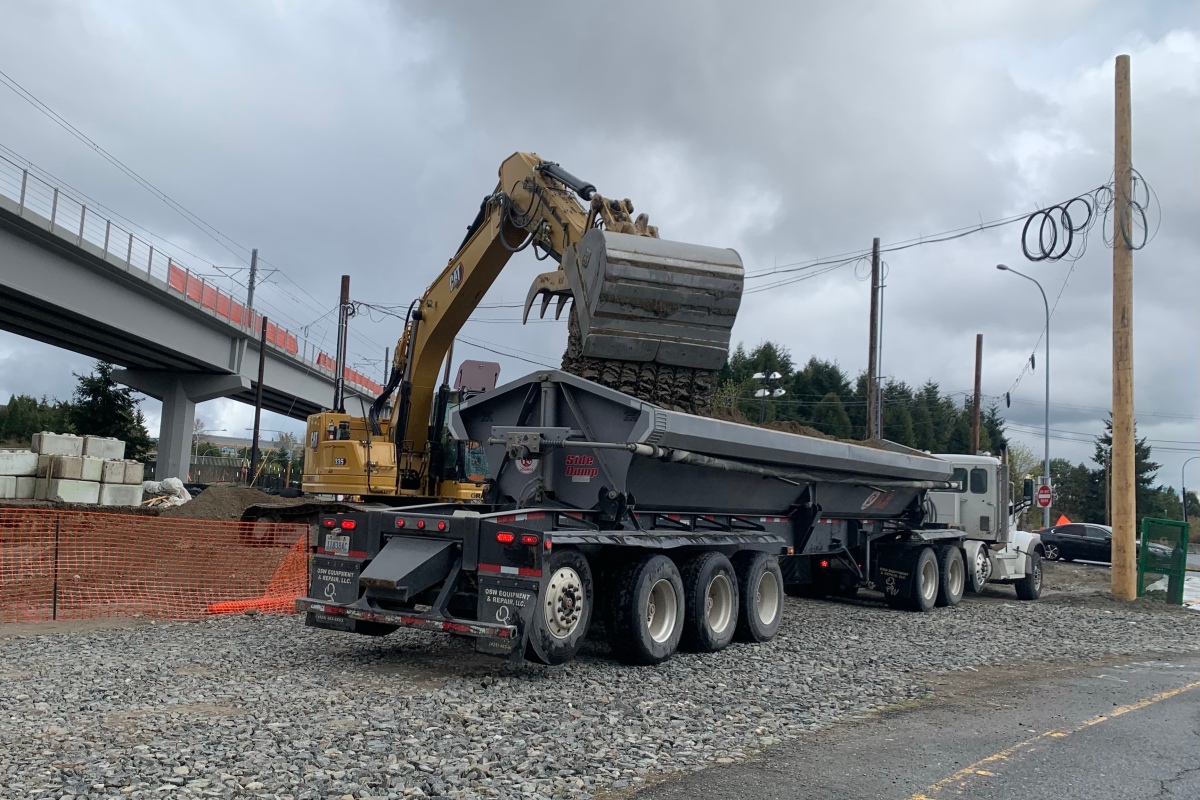
I found myself driving to Home Depot which thankfully had small excavators and backhoes for rent sitting in their parking lot. I parked where he directed me to, scrambled into the back seat to be next to him and his curiosity for the construction equipment took over. Once he started doing something else, I could get him to eat and everything settled from there. We ended up having a lovely time at Home Depot. The great thing about kids is how quickly they heal and move on.

It reminded me how in the moment where we are flooded, doing something else until we can restore our balance is the only thing that works. I’ve heard Drs Julie and John Gottman suggest doing a crossword or going for a walk – anything but continuing a conversation that can’t go anywhere.

I’d say 90+% of the time, my little family operates according to plan and we all do great. But it’s in messy 10% that we find our resilience and healing, figuring it out one Home Depot parking lot at a time.