Lost and Found People

The good road and the road of difficulties, you have made me cross; and where they cross, the place is holy.” – Black Elk, Oglala Lakota Medicine Man

The other day I was sitting at the kitchen table with Miss O. One of the 20-somethings in our lives had just shared with us that she was pregnant and Miss O was so excited.

She asked, “Mommy, how did you tell Nana [my mom] that you were pregnant with me?

I replied, “Well, it wasn’t that much of a surprise with IVF because she knew I went in to have an embryo implanted. Then 10 days later they did a blood test to determine whether I was pregnant. So I think I called her or I texted her.

Then she surprisingly asked, “And she was happy?”

Trying to figure out the phrasing, I raised an eyebrow and replied. “She was thrilled.”

And then Miss O revealed why she’d asked like that, “Even though Bumpa [my dad] had just died?

Oohhh, she was putting together the news with the story that she already knew which is that my dad died just as I was getting pregnant with her.

And then, my not quite 9-year-old daughter, replied, “We are the lost and found people.

Whoa.

I’ve often thought of those months when I was writing a book about my dad, his remarkable life, our connection, and the reward for being open with him when Miss O was in utero. It felt like a dance between birth and death. I was saying good-bye to having him present in life as I waited for Miss O to come. Such a sacred dance.

But Miss O’s comment about lost and found people made me think that maybe we all are. It seems like many new chapters are ushered in after we’ve given something up: a job, a partner, a story we believe about ourself.

And then, when we’ve given it up, we can proceed. Seems like the trick is not to get mired in the lost, so that we keep working towards the found.

We are the lost and found people. I couldn’t be more grateful to my beautiful daughter for pointing that out.

(featured photo is my dad and me when I was 2-years-old)

My book about my journey to find what fueled my dad’s indelible spark and twinkle can be found on Amazon: Finding My Father’s Faith.

Going to the Next Level

I am convinced all of humanity is born with more gifts than we know. Most are born geniuses and just get de-geniused rapidly.” – R. Buckminster Fuller

We are coming to the end of our school year. 28 more school days in third grade for Miss O. And 50 days until Mr. D graduates from his preschool program. Do you remember that feeling as a kid? Being not only ready for summer break but also ready to ascend to that next level?

It has me thinking of what milestones we have in our lives as grown-ups that celebrate our readiness to go on to the next level. There are some big ones like becoming an empty-nester or retirement. Or we have annual ones like birthdays, anniversaries, and New Years. But often, I find myself at those moments planning on what I’m going to do next instead of commemorating what I’ve learned.

Let me suggest that we take a moment to bring back that feeling of finishing a school year. To actually name something we’ve graduated from and celebrate it. I’ll start:

I’ve come to believe that I am enough. Or at least to understand that pretending to be someone else is ineffective. So if a situation or expectations make me feel otherwise, I try to slow enough to double-down on being me long enough to get through.

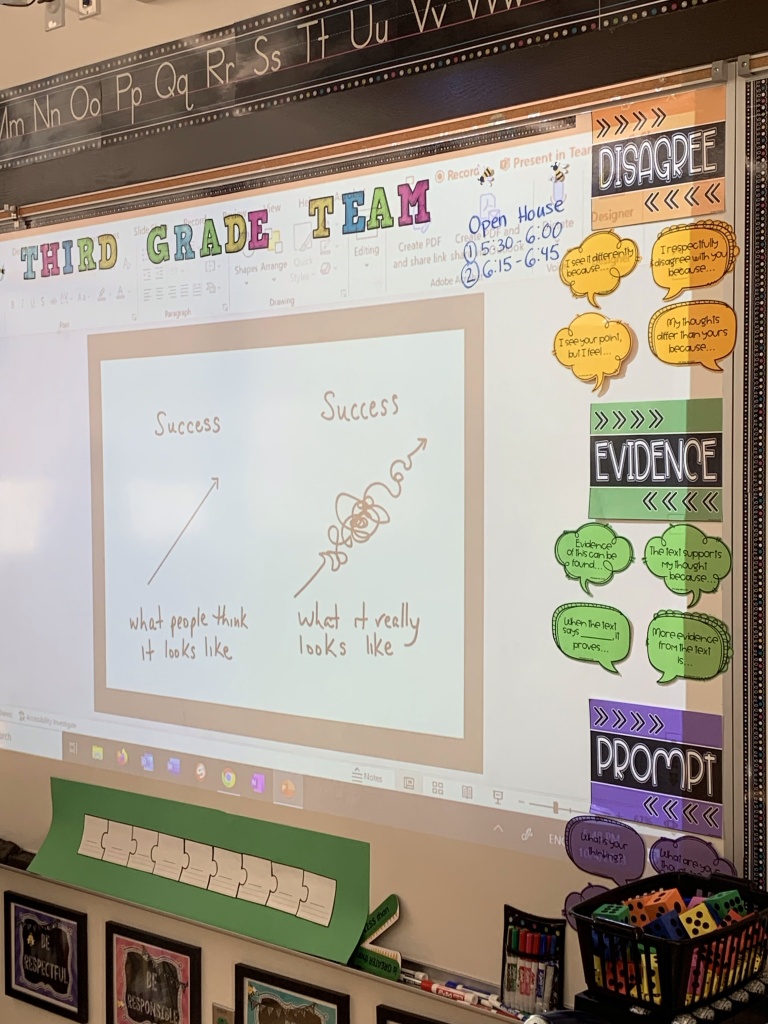
And by graduating, I don’t mean being done. It brings to mind another graphic from Miss O’s 3rd grade teacher:

It seems fitting on this last day of teacher appreciation week to honor our teachers by naming what we’ve learned. Are you with me? If you are stuck, maybe visit the list from Pick Three Affirmations to find a place to start.

(featured photo from Pexels)

For a story about the circle of life, please listen to our Sharing the Heart of the Matter podcast: Episode 66: The Power of Story with Wynne and Vicki.

We are changing our format starting with this episode. Vicki Atkinson and I are big believers in the power of story – to connect us, to create intergenerational healing, and to make meaning out of the events of our lives. To set the stage, we will be starting with someone telling a story in each episode.

To listen to the podcast, Search (and subscribe!) for Sharing the Heart of the Matter on Apple, Amazon, Spotify or Pocket Casts. Or subscribe to our YouTube channel to see a video clip of each story: @SharingtheHeartoftheMatter.

Finding the Rhythm

When anxious, uneasy and bad thoughts come, I go to the sea, and the sea drowns them out with its great wide sounds, cleanses me with its noise, and imposes a rhythm upon everything in me that is bewildered and confused.” – Rainier Maria Rilke

On my first mountain climbing attempt, a guided climb of Mt. Rainier in the summer of 1998, the lead guide introduced us to the poetry of Robert Service. Whether you or not you like his poetry, he delivers a cadence that I found helpful in keeping a climbing rhythm:

“There’s a race of man who won’t give in
A race that can’t stand still.
So they break the heart of kith and kin
And roam the world at will.”

The Men Who Don’t Fit In by Robert Service

Climbing depends on a steady pace. If you go too fast when roped to your teammates, you create too much slack ahead, and end up pulling the climber behind. If you go too slow, you create drag on someone else. When climbs would get tough, I’d recite the poems in my head and it would regulate my head, heart, and feet.

Thought I don’t climb any more, I still find evidence of pacing in all of the rest of my life. At work, knowing the cadence of team meetings helps to know when we can address issues. At home, rhythm is such a large part of how my little family stays stable. The waking up, eating breakfast, packing lunches, off to school rhythm is the cornerstone of our weekdays. When we get out of sync, it’s like a band that’s lost the beat.

Miss O recently learned to play Ode to Joy on the piano. When feeling like she wants to show off her mastery, she plays it somewhere between double and triple time. Played like that, it quickly becomes Ode to Indigestion.

I’m thinking of all these examples of rhythm and cadence because of an incredible podcast conversation that Vicki and I had with Edgerton award winning playwright, Jack Canfora. As a playwright and trained Shakespearean actor, he thinks a lot about cadence in writing. But for him, it extends beyond the theater. It applies to humor writing and essays as well.

Jack describes himself as a rhythmic writer. I’m thinking of You Make a Mean Salad as an example of his writing and humor. Or perhaps it’s best heard in a play. Step 9 is available as a theatrical podcast.

Thinking of my own writing as someone who tends to extended sentences, I have a lot to learn about calibrating sentences from Jack. Here’s a clip from our podcast where he talks about how Shakespeare balances sentences.

If you’re in the mood for a podcast, listen to this one. It’s got a great rhythm: Episode 56: Master Class In Creativity with Jack Canfora – Part II or search for Sharing the Heart of the Matter on Apple, Amazon Music, Spotify or Pocketcasts.

Links for this Podcast episode:

Jack’s website: Jack Canfora | Playwright | Podcaster | Writing Coach

Jack’s Online Theater Company: New Normal Rep

Jericho by Jack Canfora on Amazon

Jack Canfora on Instagram and Twitter: @jackcanfora

Other podcast episodes featuring Jack:

Episode 4: Why Theater Matters

Episode 55: Master Class in Creativity with Jack Canfora – Part I

From the hosts:

Vicki’s personal blog: Victoria Ponders

Wynne’s personal blog: Surprised by Joy

Vicki’s recently released book: Surviving Sue

Wynne’s book about her beloved father: Finding My Father’s Faith

(featured photo from Pexels)

Let’s Play

When one teaches, two learn.” – Robert Half

Last Saturday morning, four-year-old Mr. D wanted to drive his remote control car down the sidewalk. Since we were still in our pajamas, I tried to lobby for a back yard activity. But the sun was shining, the birds were singing, and Mr. D wanted to go out front, so I covered up with a coat and followed.

Funny thing – it’s hard to drive those remote control cars straight. We spent a fair amount of time just getting to two doors down, the side walk in front of my favorite neighbors. They are a retired couple in their 70’s. They’ve lived here for almost fifty years, I lived here for twenty and so we’ve got some history under our belt.

My neighbors are interesting, generous, and kind. We’ve shoveled five yards of delivered bark from the street to the yard together. I’ve gotten to know their kids and grandkids. My kids tell them all that’s top of mind every time they see them. They often rake my strip of grass between the sidewalk and curb in the fall. I bought them toilet paper at Costco during the pandemic.

When we got in front of their house, Mr. D said, “Let’s go ask them to play.” Some polite part of me thought we’d be pests asking them to do that on a Saturday morning. I said we shouldn’t. But Mr. D put his hand on his hip and said, “Follow my lead.

When we got up to the front door and they answered, Mr. D handed the remote control to them and said, “want to drive?” We had a lovely time standing on the porch and talking while Mr. D chased down the car any time it went astray. It was so enjoyable to chat with my neighbors that I don’t see nearly enough this time of year with short days and cozy couches inside.

My kids keep teaching me how important play is. For myself. And to keep inviting others to play. It connects us and relaxes us. And it’s fun. It isn’t an interruption – it’s what we need more of.

Be a Campfire, Not a Conflagration

Don’t set yourself on fire to keep others warm” – Rumi

We traveled this weekend to visit a friend in Eastern Washington. On Saturday morning, I crawled out of bed early for my sacred meditation time. After I meditated, I built a fire in the wood stove to take off the chill of the early morning in the woods.

The sequence made me realize the similarities between meditation and fire building.

We accumulate the debris from our lived days – the celebrations, the joys, the annoyances, the worries. It sits like stacked wood until we are ready to coax out the heat and the warmth. Somethings are easier to ignite than others while others need some tending to burn.

It requires a spark to convert it to something other than dead wood that we carry around. The spark can come from something like writing, introspection, or meditation. It can come from people around us or circumstances can set us off. But one way or another something is likely to light us up in good ways or in bad.

Some sort of ventilation is necessary in order for the process to work. We can talk it out, sweat it out, write it out, pray it out, cry it out, or some combo of it all.

Thinking about these parallels as I sat watching the fire in the stove, I found myself mesmerized by the beauty and warmth. But there are few things that scare me as much as when fire escapes its boundaries and roars out of control.

I came home from the weekend with a new motto: Be a campfire, not a conflagration.

Telling a Good Story

Just because they are a story doesn’t mean they’re not real.” – H.M. Bouwman

This is a repost of writing I posted on 7/13/22. Heads up – you may have already read this.


The other day my friend, Eric was over and started telling a story that had us all rapt, including my almost 7-year-old daughter and her friend who usually dismiss grown-up talk as boring. The story was about a summer job when he was in high school as a tennis instructor at a little neighborhood beach and tennis club.

One week they were short of lifeguards and asked him to fill in. He was neither certified nor a very good swimmer but this being the mid-1980’s, that was no problem because they just made him the shallow end specialist.

There was a group of 7-8 year old kids that showed up at the club in the mornings, had lunches their parents had packed and stayed all day. One sunny Seattle morning one of those kids, a 7-year-old boy announced he was going to catch a duck. Eric, as shallow end specialist of the week, said “No way, you are not going to catch a duck.” The boy proceeded to wade in to Lake Washington up to his neck and stand completely still for an hour.

Sure enough, the ducks got used to the boy and started swimming closer and closer until BAM, the boy caught one by the neck. Now Eric had both a boy and a duck, squawking in the shallow end and he was yelling, “Let go of the duck! Let go of the duck!” But the boy was conflicted because he’d spent an hour trying to catch the duck and now he didn’t know what to do.

At this point in the story, Eric had my daughter and her friend’s full attention and they were clamoring to know what the boy did with the duck. He let him go of course. But I was fascinated about what makes a good story.

According to journalist and author, Will Storr, there is a science to story-telling. As writers have worked to understand what captures an audience, psychologists have studied how our brains make sense of the world and both found the same elements. Stories have:

  • Change – good stories involve change because our brains are wired to identify change
  • Cause and effect – the wiring that makes the events understandable
  • Moral outrage – the motivation to act as seen in struggle between heroes and villains, the selfless versus the selfish
  • Effectance – humans like to be the causal effect on objects and the environment
  • Eudaemonic element – the happiness we get from pursuing goals that are meaningful to us but difficult
  • The God moment – how does the hero control the world?

These elements makes so much sense to me. We are all faced with change and we struggle mightily to define who we are in relation to it, what actions we take and how to be happy and ultimately control the world, or at least our perception of it. Stories are one of the tools we use to process our experience and follow the advice Maya Angelou gives, “If you don’t like something, change it. If you can’t change it, change your attitude.

I love watching how my kids have become pretty good listeners when a grown-up tells a story. I think it helps them try to understand the factors that go in to how the world works. They listen because they want a happy ending where they can control their world. Chances are, if among other things, they learn to tell themselves a good story filled with their responsibility and agency, they’ll probably have it. Chances are, that’s true for us grown-ups too.

My kids have been clamoring for me to tell them all the stories about real life that I can think of. I find it endearing and a little bit of an honor that they are interested, even at just 7-years-old and 3-years-old. This spate of stories brought up a memory of a friend who claimed to be clairvoyant and a cat lover. The combo didn’t work out so well for the cats. It’s the topic of my Wise & Shine post today: The Cat Conundrum

(featured photo from Pexels)