Snakes and Stories

Sometimes you have to let go of the picture of what you thought it would be like and learn to find joy in the story you are actually living.” – Rachel Marie Marten

This past weekend my kids and I went to the Reptile Expo. I know that might be the least appealing hook for a Monday but stick with me.

It was an experience gift that my niece gave us for Christmas. The same delightful niece from whom we got the crested gecko. And guess what? My kids loved the idea. She and her husband made this great bingo card for the cards to help guide the experience.

My niece had given us an extra ticket so I extended the invitation to my friend, Eric. He asked if my niece was mad at me and then humorously declined. But he came over for dinner after we got back and had lots of questions.

And that’s where this got interesting to me. My kids loved the expo and so my off-the-cuff response was that we had a good time. But Eric is a great storyteller and pressed for the details. When he asked all about the show, it elicited stories and information I hadn’t really thought to mine.

Like he asked who went to reptile expos and it made me think of our reaction when we arrived. The show was about an hour south of Seattle and when we neared the fairgrounds, there was a huge line of people at the gate. We thought there must have been something else going on. Turns out the lines were for the reptile expo.” Two hundred people?” Eric prompted. More like two thousand.

And the type of people that attended were mostly families. In the bathroom, we saw a woman helping her grandsons wash their hands. And then she said, “Cmon, let’s go find grandpa and great-grandma.”

The first exhibit near the doors was snakes and the kids wanted to hold one. I stood back to watch until the gentleman that got one out for us explained that the protocol with kids is that he hands the snake to the adult and they supervise the kids holding them. Ugh.

Eric wanted to know whether the exhibitors were just people showing off their pets or if it was a money making opportunity. Most of the animals there were for sale. In one display, there was snake after snake after snake in what looked like cake displays. You know the topper you put on a cake plate? Let’s hope that these had latches to secure them. I didn’t get close enough to check.

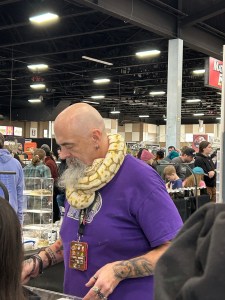
There was also a guy who was charging $5 for anyone who wanted to take a picture with his snake around their neck. We passed but I got a picture of him with the snake around his neck. Eric took a lot at that and laughed, “Not surprisingly, he’s got snake tattoos.

Man with snake wrapped around his neck

And there were also a couple of rescue organizations that had snakes, turtles, and geckos to adopt. I asked how most of their animals come to be in their care. It’s mostly when animal control calls them in. They even have a fostering system just like with dogs and cats.

One of these booths is where my kids got to pet a tortoise named Tate and hold a bearded dragon named Quibble. The volunteer that was helping us said she didn’t really enjoy geckos so I asked if it was bearded dragons she liked. “No,” she replied, “I like snakes.” When I asked, she listed the kind of snakes she had. I confess that I stopped actively listening after the fifth. Yikes.

People also sell the bugs that reptiles like to eat. Five-year-old Mr. D and I were looking into a container that had several geckos and Mr. D said, “Look, there’s a beetle.” And then a gecko noticed. It’s tongue was so fast that it was barely perceptible. It clearly enjoyed a crunchy snack.
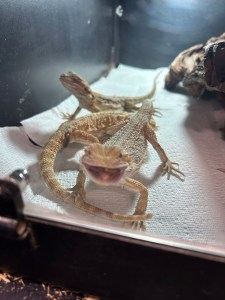
Gecko in an enclosure looking like he's smiling after eating a snack.

Which led me to the story about seeing a display with 10 gerbils for sale. There was only one left and I was unclear about whether people were buying them to be pets or…? Eric’s response, “Can you imagine the level of stress for a gerbil at a snake show?”

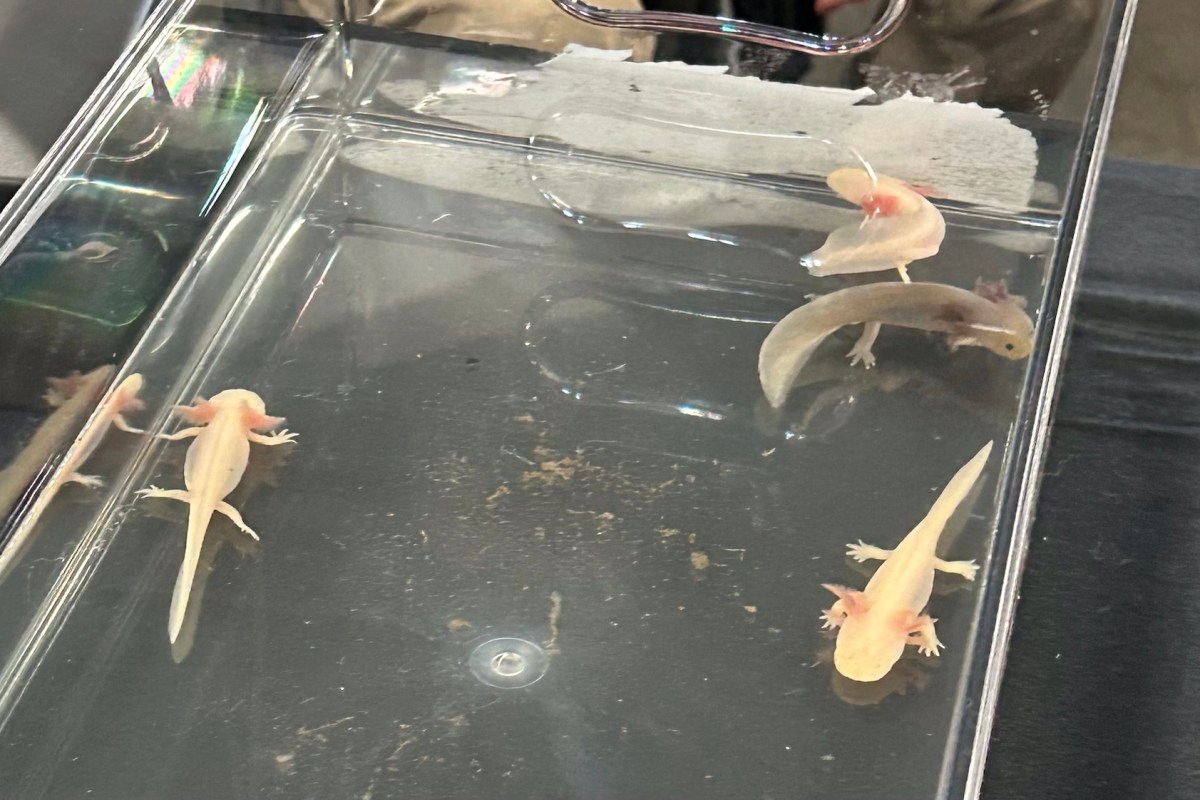
On the way out, my kids nearly fell over when we came across some axolotls (see featured photo).  These are the Mexican salamanders that are like the pickleball of elementary school kids. In the last few years, it seems like the increase in axolotl merch has been meteoric – stuffies, backpacks, keychains, and more. Eric confessed that until he saw our picture, he wasn’t sure that axolotls were real.

I’ll spare you the stories of the snake throwing up and the snake pooping. Suffice it to say, my kids had a great time at the reptile show. And I got some pretty good stories out of it – because Eric asked for the details.

It makes me wonder if an element of creativity…and life… is having people around us interested in asking. Last question from Eric was, “Did you check your car for snakes when you got home? No? That’s okay – you can just sell it.”

Do You Believe in Magic? Do You Write About it?

If we could see the world through the eyes of a child, we would see the magic in everything.” – Nancy Wait

I had to have the conversation with my eight-year-old daughter the other day. You know the one I mean? About Santa?

We were driving in the car and I broached the subject as “Do you want to talk about what your friend said the other day about Santa?”

Two days before I’d overheard her friend tell her that Santa wasn’t real. Then the friend took on the tooth fairy too when my daughter had asked, “Do you know your tooth fairy’s name?”

Her friend, a master of short, declarative sentences, replied with a snort, “Yeah, Mom and Dad.”

All of this led to my tentative query in the car. Quite honestly, I was feeling pretty shaky about it. It felt like blurting out something that we can never “unknow” even if we wish to. So, I’d come up with a spin that I got from a dubious parenting manual (and by that, I mean the Internet). I was going to talk about how we can all be part of the magic of the holiday season.

I find it difficult bordering on tortuous to write about and talk about magic. I think of some of my favorite South American authors like Gabriel Garcia Marquez and Juan Luis Borges, and their easy touch with things that can’t be explained.

Then I wonder if some American pragmatism blocks my flow when it comes to breaking away from the observable. Or perhaps it’s my engineering brain. But either way when I start trying to put words to experiences that can’t be rationally explained, I get very wordy. It’s like I need to insist that I really am anchored to reality and a lot of words are my lifeline.

So, when my daughter said she did want to talk about Santa, I started to roll out a lengthy explanation.

Well, you know that everyone has different beliefs and whether or not you believe in Santa, there’s a magic around Christmas time that comes from the spirit of generosity.”

She nodded and said, “Yes, no one really knows what Santa looks like, so we all see it differently.”

I pressed on, not realizing that she was still pretty attached to the Santa thing.

Before I could launch into more, she interjected, “Why don’t people want to believe in magic?”

Hmm, in my preparation for the talk, I hadn’t prepared a good answer to that one, so I asked about if she’d heard what her friend said about the tooth fairy.

Yes,” she said, “he said his Mom and Dad were the tooth fairy.” As I started to respond, my daughter continued, explaining something the tooth fairy had just done…”but my mom wouldn’t give [my brother] a two-dollar bill for nothing.”

I stopped. I was magically saved from having a conversation that I wasn’t ready for anyway.

2024 Note: Miss O is now 9-years-old but still believes…

(featured photo from Pexels)

The Archetypes of Story

Fairy tales are more than true: not because they tell us that dragons exist, but because they tell us dragons can be beaten.” – Neil Gaiman

This was originally published on 7/5/2023. Heads up – you may have already read this!


My kids have been clamoring for me to tell them stories at bedtime. They don’t want made up stories, they want real stories.

One of their favorite protagonists is Simon the Bad Cat. He was a character with a capital “C” – I adopted him from a neighbor when she moved. He proceeded to get into all sorts of trouble breaking into other people’s houses, picking on my dogs, and getting into cat fights. He lived a full life of 19 years and left behind a treasure trove of stories.

Telling these stories has made me think of the hypothesis that are a limited number of plot lines for our stories. I’ve heard this theory in several different ways from nine to twelve archetypal stories. But drawing from overview on Wikipedia of the work of Christopher Booker, The Seven Basic Plots: Why We Tell Stories here they are:

  • Overcoming the monster
  • Rags to riches
  • The quest
  • Voyage and return
  • Comedy
  • Tragedy
  • Rebirth

Can I fit the Simon stories into these categories? Here are our favorite bad cat stories:

Rebirth: Simon the cat got a claw stuck in between his shoulder blades while fighting another cat. It abscessed and made him so sick that I had to take him to the vet so they can drain the wound. Simon died on the operating table and they had to use kitty CPR to bring him back. Did the hero return home transformed as a wiser cat? Well, he did mend his fighting ways so that we never had to drain an abscess again.

Comedy: Five doors down was a neighbor named Steve who hated Simon because he was always getting into his stuff and messing it up. But it was a love/hate relationship because he noticed how smart Simon was as well. One day when Steve was showing some new tenants around the shared laundry room, he told them they must never leave the outside door open because there’s a bad cat that would get in. They pointed to a shelf right about Steve’s shoulder and asked, “Like that cat there?” and Steve turned around to see Simon smugly listening to his speech.

 Voyage and return: Simon the cat had a habit of breaking into houses and garages that he subsequently couldn’t get out of until someone opened a door. So I was used to him occasionally being gone for a night or two. But when he went missing for twelve days, I did all I could to find him: putting up posters, walking round the neighborhood calling for him, calling the pet shelter. Finally, I accepted that he was gone forever and gave away his food. On day 13, Simon nonchalantly walked up to the back door and demanded to be let in.

Overcoming the monster: I met Simon when I had a 150 pound dog, a gentle mastiff named Samantha. When we’d go out for a walk in the morning, Simon would hide in a bush, then jump out and smack Samantha on the rear. Then having “overcome the monster” (or at least scaring her half to death), he’d proceed to join us for our 12 block walk through the neighborhood.

Telling these stories to my children, I wonder if it is just a silly ritual. But I believe it helps them at a deeper level to make meaning out of their lives and days. Maybe one day when they are struggling with a monster or experiencing the rebirth and renewal that sometimes comes with life, there will be a niggling of a Simon story that reminds them they aren’t alone on their journey.

Perhaps it’ll even help them understand my story of the quest and how that led me to have them as a single parent. Even if it just creates a basis for loving stories, I believe it will help them to live fuller and more imaginative lives.

Don’t you still love a good story?

Stories Matter

I began to realize how important it was to be an enthusiast in life. Embrace it with both arms, hug it, love it and above all become passionate about it. Lukewarm is no good. Hot is no good either. White hot and passionate is the only thing to be.” – Roald Dahl

This past Tuesday, eight-year-old, Miss O was working on a school project and announced “Volcanoes are boring.”

I harumphed thinking about all the beautiful, scenic, and climbable volcanoes in our vicinity. “I love volcanoes,” I said.

She shot back, “I bet you could make volcanoes interesting.

So at bedtime that night, I told her and four-year-old Mr. D. about when I was 11-years-old and living in Spokane, Washington. We were driving home from church on a Sunday afternoon in May, 1980. We stopped to talk with a neighbor who told us that Mt. St. Helens had erupted. Mt. St. Helens was on the opposite side of the state from us. The eruption blew the top 1,300 feet and the north side of the mountain off. We nodded with interest and went about our day as usual thinking it had no bearing on us.

As we drove home from a playdate four hours later, the sunny May sky turned gun metal gray and ash started falling. We carefully drove home with our windshield wipers pushing the dusty pile off our windshield.

In Spokane where it snows usually from October through March, school is never canceled because of weather. But after Mt. St. Helens blew, they told us to stay indoors, and school was canceled for a week. Everyone tried to figure out what to do with Mt. St. Helens ash. We collected it to polish silverware. Others used it to make ceramics. My friend, Jiffy and I used it to build sand (ash?) castles. When we drove across the state on vacation that summer, we stopped on several occasions to watch impressive ash dust devils form in fields across the state.

Then I told my kids about how, in the year 2000, twenty years after it erupted it, I climbed Mt. St. Helens for the first time. It’s hard to get permits to climb in the summer. The park service limits traffic to help the flora to grow back. [And here I may have embellished a little side story imagining how excited the scientists were when they discovered the first flow to grow back after the eruption. “Look, look, the first tiny flower has come back to St. Helens!!”]

In order to bypass the permit lottery process my friend, Jill, and I climbed in the late spring when the traffic is low so it’s easy to get a permit. We climbed up 6,000 feet on a sunny April Saturday to look over the rim. Even though it wasn’t very high (any more) was a long one-day climb.

The view over the rim of Mt. St. Helens to the little pot-belly lava dome in the top center.

And the rim? Well, it was fascinating to look over the edge into gaping hole below with a little pot-belly lava dome in the middle. And then to have a sense of surreal shock that nothing was below us.

The rim of Mt. St. Helens 20 years after the top and half the mountain blew off.

For as exhilarating as it is to stand on a mountain top, it’s a little dizzying to stand on only half of one.

This bedtime story session was on Tuesday night. By Wednesday afternoon, Miss O was telling me facts about volcanoes. “Mom, did you know there are three types of volcanoes?

I didn’t even try to hide my glee.

This theme shows up for me again and again. When we share our stories – it matters. Our authentic voice telling our experiences are more than just a bedtime story. It’s the passing on of energy, passion, and warmth.

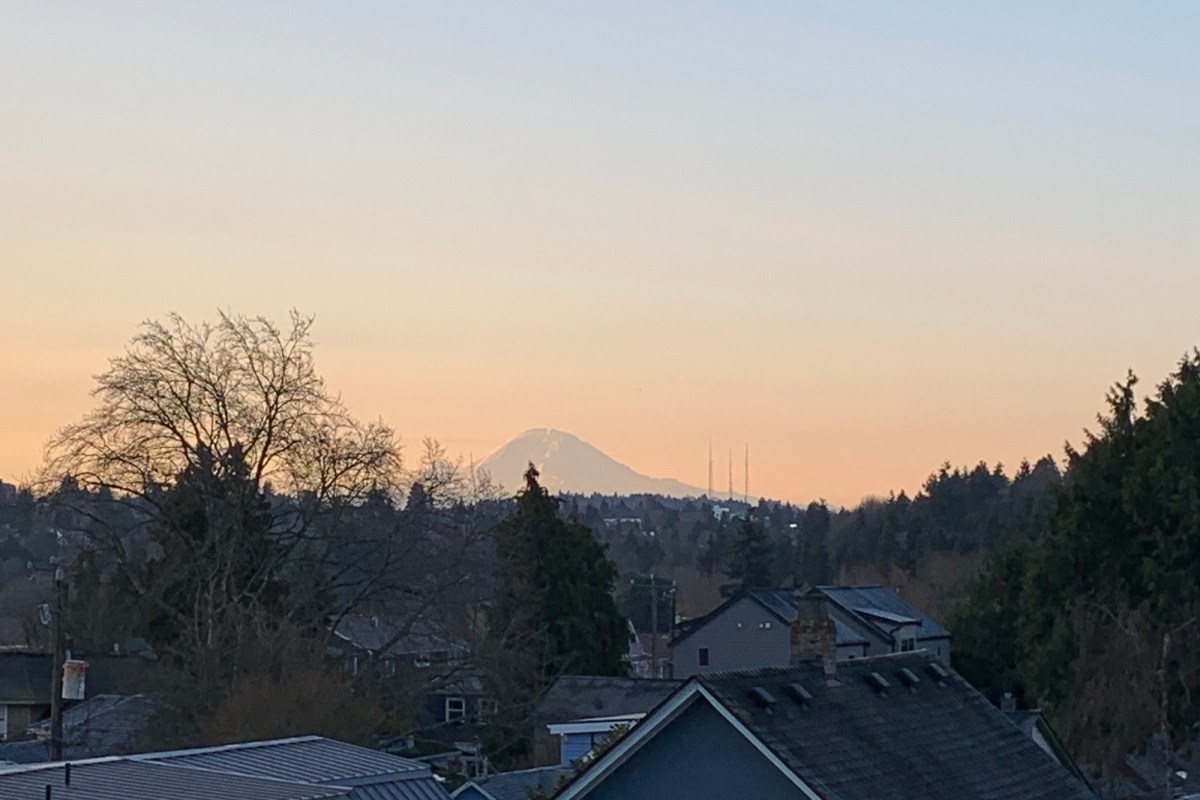
(photos in this post are mine – the featured photo is my favorite volcano, Mt. Rainier)

And speaking of authentic stories, Vicki and I talk with writer and blogger, Cheryl Oreglia on our podcast today about her experience at the San Francisco Writer’s conference. She sells us the idea that not only are we the only one to tell our stories – we might be obligated to. It’s such a great episode. Please tune in by searching for (and subscribing to) Sharing the Heart of the Matter on Apple, Amazon, Spotify or Pocketcasts

Or click through to the show notes Episode 61: The Writers Conference with Cheryl Oreglia for the link to listen on Anchor on whatever device you are using.

Food Associations

You are the sum total of everything you’ve ever seen, heard, eaten, smelled, been told, forgot – it’s all there.” – Maya Angelou

My mention of our trip to New Orleans brought a lot of comments about trying the beignets there. Which reminded me that in addition to my favorite word associations, I also have food and drink associations for cities. Here are some:

Bagels in New York City

Pizza in Chicago

Baked beans in Boston

Rocky Mountain oysters in Denver

Irish coffee in San Francisco

Key lime pie in Key West

Arroz con pollo in Quito

Coca tea in Cusco

Momos in Kathmandu

Fish and chips in London

Prosecco in Venice

I’m curious if these match yours or what other ones you have. Tell me what’s good in the places you frequent!

P.S. for Mark from Mark My Words, I know I should put Cheese in Wisconsin – but I’ve never been to Wisconsin…yet).

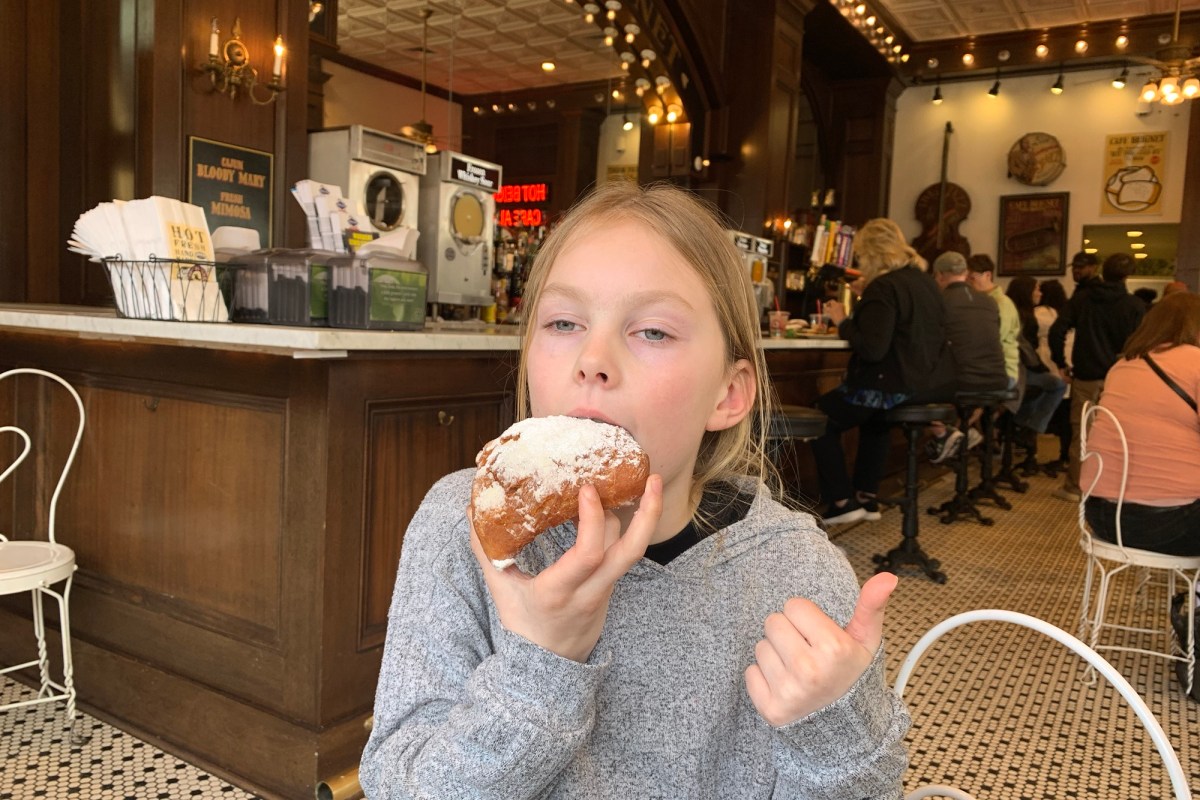
(featured photo is of Miss O enjoying a beignet)

Finding the Rhythm

When anxious, uneasy and bad thoughts come, I go to the sea, and the sea drowns them out with its great wide sounds, cleanses me with its noise, and imposes a rhythm upon everything in me that is bewildered and confused.” – Rainier Maria Rilke

On my first mountain climbing attempt, a guided climb of Mt. Rainier in the summer of 1998, the lead guide introduced us to the poetry of Robert Service. Whether you or not you like his poetry, he delivers a cadence that I found helpful in keeping a climbing rhythm:

“There’s a race of man who won’t give in
A race that can’t stand still.
So they break the heart of kith and kin
And roam the world at will.”

The Men Who Don’t Fit In by Robert Service

Climbing depends on a steady pace. If you go too fast when roped to your teammates, you create too much slack ahead, and end up pulling the climber behind. If you go too slow, you create drag on someone else. When climbs would get tough, I’d recite the poems in my head and it would regulate my head, heart, and feet.

Thought I don’t climb any more, I still find evidence of pacing in all of the rest of my life. At work, knowing the cadence of team meetings helps to know when we can address issues. At home, rhythm is such a large part of how my little family stays stable. The waking up, eating breakfast, packing lunches, off to school rhythm is the cornerstone of our weekdays. When we get out of sync, it’s like a band that’s lost the beat.

Miss O recently learned to play Ode to Joy on the piano. When feeling like she wants to show off her mastery, she plays it somewhere between double and triple time. Played like that, it quickly becomes Ode to Indigestion.

I’m thinking of all these examples of rhythm and cadence because of an incredible podcast conversation that Vicki and I had with Edgerton award winning playwright, Jack Canfora. As a playwright and trained Shakespearean actor, he thinks a lot about cadence in writing. But for him, it extends beyond the theater. It applies to humor writing and essays as well.

Jack describes himself as a rhythmic writer. I’m thinking of You Make a Mean Salad as an example of his writing and humor. Or perhaps it’s best heard in a play. Step 9 is available as a theatrical podcast.

Thinking of my own writing as someone who tends to extended sentences, I have a lot to learn about calibrating sentences from Jack. Here’s a clip from our podcast where he talks about how Shakespeare balances sentences.

If you’re in the mood for a podcast, listen to this one. It’s got a great rhythm: Episode 56: Master Class In Creativity with Jack Canfora – Part II or search for Sharing the Heart of the Matter on Apple, Amazon Music, Spotify or Pocketcasts.

Links for this Podcast episode:

Jack’s website: Jack Canfora | Playwright | Podcaster | Writing Coach

Jack’s Online Theater Company: New Normal Rep

Jericho by Jack Canfora on Amazon

Jack Canfora on Instagram and Twitter: @jackcanfora

Other podcast episodes featuring Jack:

Episode 4: Why Theater Matters

Episode 55: Master Class in Creativity with Jack Canfora – Part I

From the hosts:

Vicki’s personal blog: Victoria Ponders

Wynne’s personal blog: Surprised by Joy

Vicki’s recently released book: Surviving Sue

Wynne’s book about her beloved father: Finding My Father’s Faith

(featured photo from Pexels)

The Feeling of Community

The deep irony, in order to be social, we first have to be individual.” – Nicholas Christakis

This was originally published on 2/16/2022. Heads up – you may have already read this.


When I was climbing mountains, I’d regularly sign up for a guided climbing trips, sometimes with a friend and sometimes by myself. It was a great way to travel and also get to climb a mountain or two. Typically we’d all converge in a meeting place and do the initial meet and greet and then go from there.

The groups of people that would come together were always interesting. I’m thinking about a particular climb of two volcanoes in Mexico. We all flew to Mexico City where we met our guides and fellow climbers before riding in a van to the base of Mt. Ixtacchuatl for our first climb.

The group was mostly Americans but otherwise there wasn’t an easily defined demographic, not gender, education level, personality type other than love of mountains.  On this particular trip, there were very outgoing people like my friend, Jill, and man named Trent who loved to talk and help anyone with anything. Most of the group was like Paul from Greenfield, NY who was really nice to talk to but more reserved about initiating conversations. There was our guide, Phil, who like to just spit out wisdom or quips in one line but not talk endlessly (e.g. “Watch out Jill, that guy has more moves than an earthquake.”)

As we went around doing introductions, one man named John stated very clearly, “I don’t like people. I’m just here to climb the mountains.”  Which was fine because that’s what we were there to do.

We summitted the first mountain, Mt Ixtacchuatl (17,338 feet) on October 31 and then headed down to celebrate the Day of the Dead in Puebla. After a day of rest, we started up our second mountain, Mt. Orizaba (18,491 feet).

After being dropped by trucks on the mountain, we spent the evening in a hut. At this point, we’d been together as a group for about 5 days and we were having a great time and working together pretty well as a team. The guy that didn’t like people was a very good climber and mostly stayed to himself, grabbing his share of dinner and finding a quiet place to eat it.

Around midnight, we got up from the few hours of rest we’d gotten and started preparing for our summit attempt in the dark using the light of our headlamps. We climbed steadily in the dark for about 6 hours until we reached an exposed couloir. We paused as the guides tried to get some ice screws deep enough into the fractious ice to secure our trip across the steep gully. Eventually we realized that the conditions wouldn’t allow us to cross safely over that part of the mountain and our summit bid had ended.

As we sat on the mountain watching the sun come up in no hurry to get anywhere, John, the climber who didn’t like people, pulled off his boot and found a Payday bar. He’d put the candy bar in his boot while preparing in the dark and then forgotten to take out. After being climbed on for 6 hours, it was shaped like an orthodic. He pulled it out, showed it around and we all had a good laugh alongside him as we imagined the journey of that candy bar. Even John enjoyed for that moment being part of a group that understood the crazy things that happen on a climb.

That particular event created an idea of community for me. One where we don’t have to all be best friends or come out of our comfort zones but can still enjoy the camaraderie of a shared experience focused on a common interest.

(featured photo is mine of the group leaving the top of Mt. Ixtacchuatl)

About Me

The two most important days in your life are the day you are born and the day you find out why.” – Mark Twain

The other day I clicked through to the blog of someone that had commented and read their latest post. It was interesting and well-written but I wasn’t sure how to take it. Was it intended to be a little humorous or totally serious? It reminded me of the importance of the about me section of blogs and how we can maybe do better job of filling them out so that readers can more easily sense of who we are.

Here’s what I usually include as a bio. “Wynne Leon is an optimist, an enthusiast of endurance sports and a woman intent in charting her own path. Which is a combination that has led to an unconventional life. When she was younger a life of adventure meant climbing mountains, traveling the world and being an entrepreneur. More recently, it’s been starting a family as a single parent at age 46, having another child at age 50 and adopting a highly-strung kitten, even though she really is a dog person. Her writing projects include technical computer manuals, articles about meditation and parenting, and Finding My Father’s Faith, a memoir about spirituality, solace and her relationship with her beloved father.

I am a member of the Chicago Writer’s Association. For speaking engagements on creativity and AI through the CWA Speaker’s Bureau, please see the 2025 Program Menu.

I wrote it and then a friend of mine in marketing edited it. It’s more cutesy after that (the bit about the cat while I’m really a dog person) and less factual (who needed to know I have a degree in electrical engineering). It’s okay for when I need a short bio.

But I think we can do a better job of grounding people in our work. So for whoever wants the long version, here it is.

About Me

If I was a dog, I’d be a golden retriever: exuberantly joyful, family-friendly and always up for a walk. But I’ve done a lot of training so I don’t bowl people over with my enthusiasm and optimism. Especially myself. And that’s the key part of my story – that through meditation I’ve learned not to believe everything I think and I return to that every morning when I get up and meditate and then I do it all again.

kids meditating

I write about my kids a lot because I choose to become a single-parent and age 46 and again at 50, but I’m not a writer about parenting. Instead I’m aiming to capture the depth and meaning of life that I get to experience because my kids show me what it is like to be so Close the Source and unapologetically human. I write about what I learn when I look closely and see how they develop as people, as siblings, as my children and as a family. Wrapped in all of that is a core of pure love that I want to enjoy more deeply by sharing.

Spending the last seven years raising kids without a significant other has taught me self-compassion in a way that no relationship or practice ever has. It has also made me so appreciative of the blogging community because this exchange of creativity and companionship is so rich. Especially through the isolation of Covid, I am so grateful for the deep and abiding relationships that I’ve been able to make on this journey of self-discovery.

I’ve listened to my inner God voice for three significant decisions. First to start climbing mountains when I was in my late 20’s. Second to interview and record my dad’s stories which eventually became a book I wrote after he died suddenly in a bike accident and to figure out what made him such a joyful person. And third to have kids as a single person in my mid-forties instead of rushing into a relationship that wasn’t right. In all three, that deep conviction that I was doing what I was meant to do has carried me through the tough moments.

ice at Everest base camp

I am an endurance person. I can dig deep to take small steps with heavy loads on a regular basis. I’ve accepted that I’m not a high-speed athlete. But I have learned that I don’t always have to carry everything with me but instead lean in to what is weighing me down to unpack it and lighten the load.

The Back Story

I’m the youngest of three kids in a family with a dad who was a Presbyterian pastor and a mom who was incredibly smart and might be a CIA spy (now retired). Would there be a better cover for a spy than a pastor’s wife?

My brother is oldest. I adored him growing up and still do. My older sister hated me growing up –resented might be a better word. The lessons I learned from that adverse relationship are so powerful, especially as I parent my children to care for each other. In many ways, my sister was my first teacher about how instructive our wounds can be when we do the work to heal from them.  When my dad suddenly died in a bike accident in 2014, it felt like all her complaints over all the years growing up, bubbled out. We’ve never managed to put it back together.

I’ve been divorced longer (10 years) than I was married (8 years) so it doesn’t feel like much of my story any longer except for two things for which I am so thankful:

  1. Going through divorce, or maybe more specifically the unhappy years of my marriage, drove me to meditation
  2. When I decided that I wanted to have kids post-divorce and I was in my mid-40’s, I didn’t want to rush into a relationship in order to have them. So I choose to have them as a single person instead. I still enthusiastically believe in love and that I’ll one day find the perfectly imperfect man when the time is right.
me with my kids

But because I don’t think often about my marriage, divorce and coming to choose single parenthood, I’ve gathered from some common questions that I get from people I’ve met later in life that I fail to give some proper background. So here are the answers to the questions I get:

  • I got divorced when my husband’s best friend told me about his infidelities. In the aftermath, all my husband wanted to talk about was how his friend betrayed him. And I couldn’t sustain enough outrage to insist we talk about how my husband betrayed me because he could always outdo any dramatic fervor.
  • That was the story I believed until I started meditating. Then in emptying the pockets of grief I realized that I needed to own how badly I wanted out of that marriage that both starved and suffocated me. Starved because my husband needed all the attention and suffocated because he needed all my attention. But in meditation, I discovered how freeing it was to own my part in the end of the marriage – and also a way to practice focusing my mind on the right stories and questions.
  • I had my kids at age 46 and again at age 50 through invitro fertilization. I choose the sperm donor from a bank that provided more complete information that I’ve ever had for anyone that I have dated. Maybe even more than I know for my lifelong friends.

You can find me on Instagram and Twitter: @wynneleon

The Arc of the Moral Universe

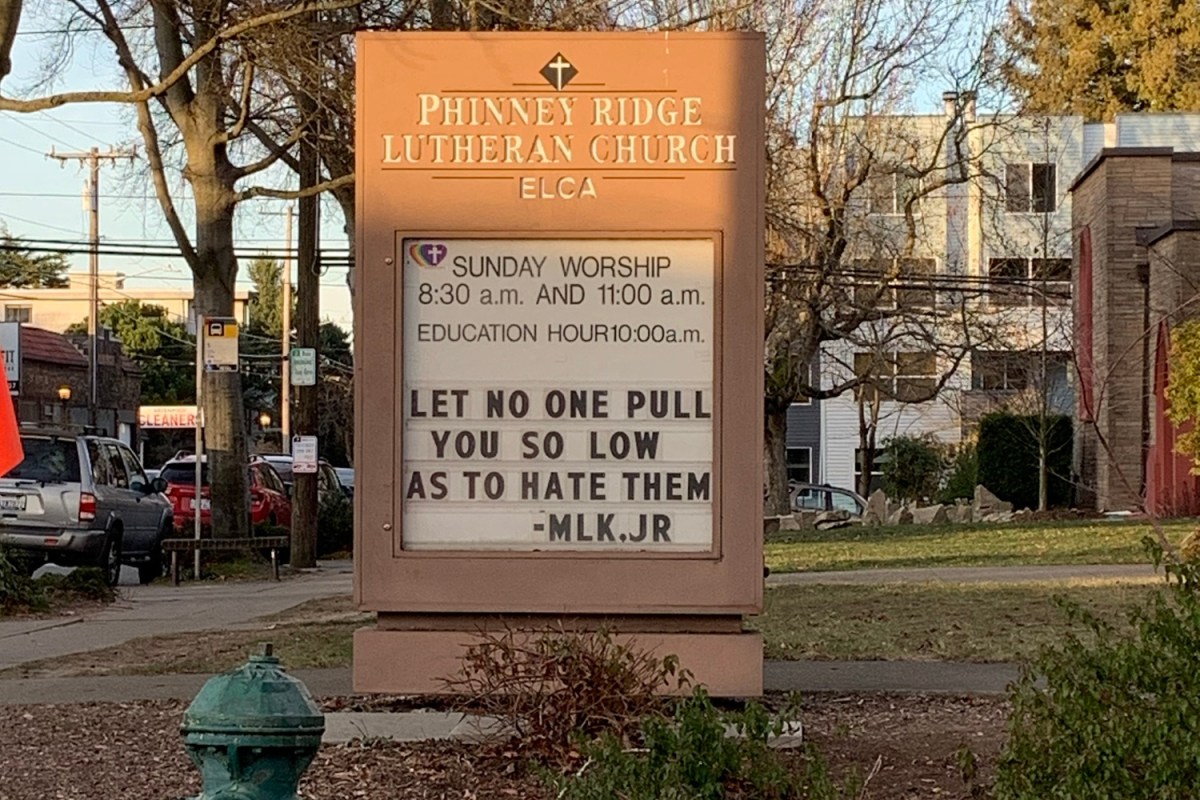
There is some good in the worst of us and some evil in the best of us. When we discover this, we are less prone to hate our enemies.” – Martin Luther King, Jr.

I think it’s notable when you start learning from your kids. I’m talking about facts and figures, that is. I’ve been learning what it’s like to be human from them all along.

Eight-year-old Miss O loves Martin Luther King, Jr.. She’s been coming home with tidbits about him all this past week. “Did you know that Martin Luther King skipped 9th and 12th grade?” she asked.

Or that he was 39 when he died? That he hadn’t actually written the I have a dream speech? It was a response to a question from someone in the crowd.

But one day she came home this week and said, “It’s so sad what happened to him when he marched.

I prompted, “What do you mean?

And she continued, “When he marched, they sprayed them with fire hoses. And some people died because they had dogs attack them.

Oh,” I affirmed, “that was awful.

Miss O was about 4 1/2 years old when Black Lives Matter signs appeared in our neighborhood. She asked me what they were about. When I simplistically explained that black people had been treated unfairly by white people, she paused for a moment and said, “I’m glad I’m peach.

And now almost four years later, she and her classmates marched three miles in 17 degree weather (and believe me, Seattlites are not prepared for 17 degrees) carrying Black Lives Matters sign. Miss O said they got 172 honks.

I’m not wise enough to know what all of this adds up to. But I believe MLK was right all those many years ago when he said, “The arc of the moral universe is long, but it bends toward justice.”  

Editing That Six-Word Story

The other day we were holding a family meeting where eight-year-old Miss O and I where hotly debating the next thing to do and I asked four-year-old Mr. D if he had an opinion.

“No, I’m not a good talker,” he replied.

Whoa, there’s a six-word story!

I’m sure with his very verbal older sister and his mom that is fascinated by words, it feels like he can’t get a word in edgewise. Funny thing is that he is interested in following along. I notice that the more we talk, the more still he gets. And then when we least expect it, he pops off with a perfectly positioned sentence like on January 1st when he said, “I told you last year not to step on lava.”

It feels like helping these young people write and change their stories as they grow is one of my biggest responsibilities and honors. In this case, I’m hoping to convince Mr. D that his six-word story is better said as, “I’m not a good talker…yet.”

And for more about six-word stories, please tune in to my podcast with Dr. Victoria Atkinson. We know and love her as our blogging, writing, and podcasting friend. But in this case, she brings all her experience as a therapist, professor, college dean, and author to bear to teach us how potent these little stories can be.

Search for Sharing the Heart of the Matter on Apple podcasts, Amazon Music, Spotify, and Pocket casts. And please subscribe! Or click here for the show notes and link to listen to the podcast on Anchor.

(featured photo is mine. I offer these six words as a caption: Despite our care, another worm died)