Simple and Direct

The problem of distinguishing what we are and what we are not responsible for in this life is one of the greatest problems of human existence.” – Dr. Scott Peck

We were at a community swimming pool the other day when we walked by a grown-up forcefully saying to a boy who looked about 12 years-old, “Stop talking. All I hear from you is blaming others, saying how they made you do what you do instead of taking responsibility. Stop talking.”

It was easy to have great sympathy for both of them. The grown-up who also had 3 other children younger than the boy with her and the boy who looked stunned to have a grown-up yelling in his face.

Thinking about it, it reminds me of the quote for this post, a great line from psychiatrist and author, Dr. Scott Peck, “The problem of distinguishing what we are and what we are not responsible for in this life is one of the greatest problems of human existence.

We all personalize or project. When we personalize, we think that everything happens has to do with us. If the boy at the swimming pool personalized, perhaps he thought that the grown-up’s mood was his fault. And when we project, we take our feelings and color everything around us.  In the swimming pool scenario, the grown-up could have been tired and frustrated after the effort to get four children dried off and changed after swimming so she projected that frustration onto the boy.

Dr. Peck wrote that we all exist on a continuum between neurotic and character disordered. When we are neurotic, as I tend to be, we take too much responsibility for things and when we are character disordered, we take too little. We see it all through our lens and then it’s a struggle to find a way to just own our part.

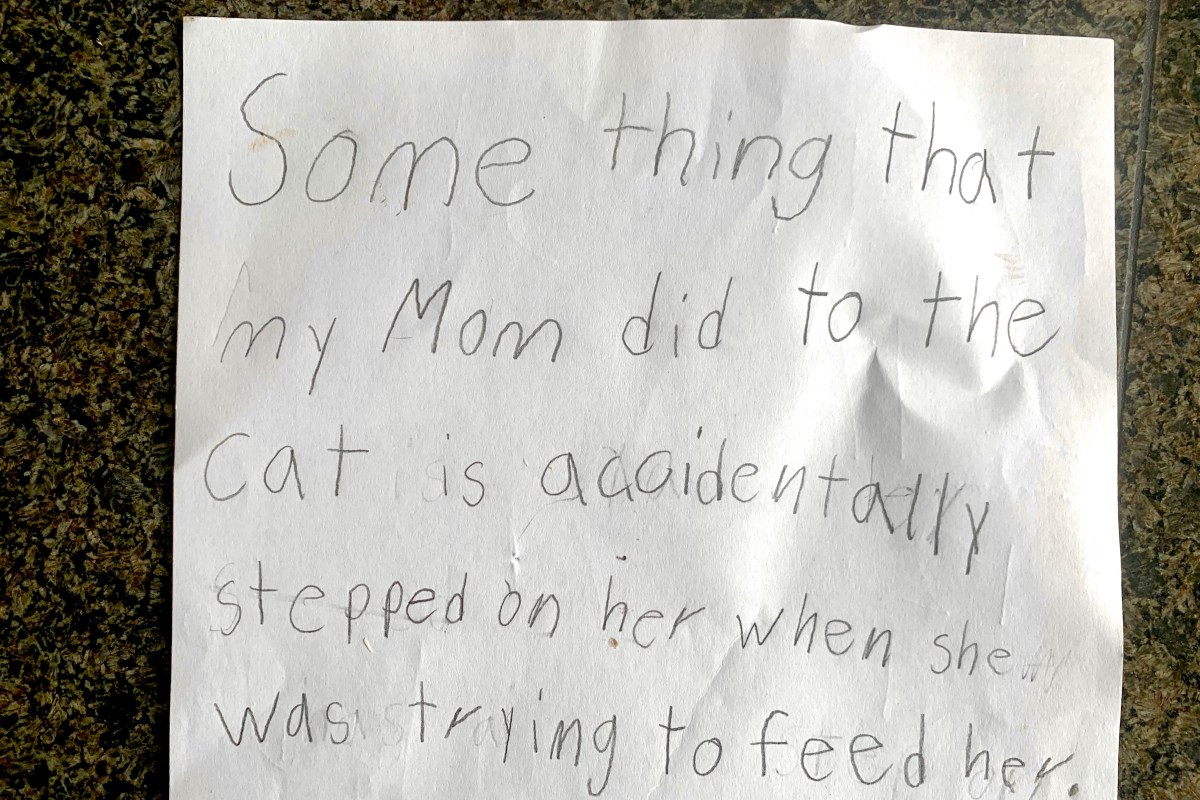
It’s a hard thing to teach to my kids since I’m still working it out myself. But I’ve been practicing just being direct – not embellishing either why it happened or owning too much or the scenario. When I step on the cat’s paw when she is winding her way around my ankles as I feed her, I try to model just saying “I’m sorry I stepped on your paw” instead of “I’m so sorry, it’s all my fault” or “you made me do it, you shouldn’t have been underfoot.”

At the swimming pool, I walked by the intense scene and then went out the double doors just past them. I’ll never know if the boy was able to say, “I’m sorry I did that” and the woman to say, “I’m sorry I took my frustration out on you” but I hope so.


Milestone Moment

The difference between winning and losing is most often not quitting.” – Walt Disney

I’m celebrating today. I’ve published a post every day for a year. And since late October of last year, I’ve also written a weekly post on the Pointless Overthinking blog as well. That’s about 400 posts total.

Looking back on the experience, I realize that what happened to me over the year was a far different thing than what I thought going into it.

Write What You Need to Read

I was reminded of this adage somewhere in the middle of this year of posts and connected it to what I’m doing here. I’ve been writing what I need to process and remember this precious time that is so busy it could go by without notice. The posts that I imagined I would write – clean, full of poignant phrases, powerfully evocative – are not at all what came out. But what came out was something like little snapshots of learning, appreciating and searching for the depth and richness of life as it is right now.

Themes

I imagined that I would write a lot more about faith and God because this was going to be my meditation journal for parenting. But it turns out that I can’t easily find the words to describe this core but non-denominational factor in my life. I suspect that because my beloved dad had such a definite view of God through Presbyterianism that I imbibed that deep belief but have trouble intellectualizing the faith, hope, and optimism that keep me going.

Instead I find myself writing about friendship, learning, trying, failing, confidence, feelings, the precious lessons I see unfold in my kids, meditation and breathing, imperfection, healing. And though they are all colored by my faith, hope, and optimism, they reflect life as I process it in all its messiness.

Community

I expected that writing posts would help me practice to become a better writer. But I had no idea I was joining a community. In many ways, the beauty of this experience had very little to do with the keyboard and everything to do with finding a network of interesting, inspiring and invested people. Writing blog posts has helped me remember this year of my life – but commenting on them and other people’s post filled a need I didn’t know I had for daily interaction with grown-ups that I wasn’t getting from my professional or family life.

As an example, in the beginning, I had my Gravitar website pointing to an outdated URL. Fortunately, Ab pointed that out to me, I fixed it and we connected. He has commented on every single post of mine since which deserves its own medal. Thank you for that gift, Ab!

That experience multiplied by many including Alegria, Ally, Art, Ashley, Betsy, Caitlyn, Chaya, Claudette, Cristiana, Deb, David, Dr. Stein, Dutch, Endless Weekend, Fred, Gary, Grace, Jane, Julia, Kathy, LaShelle, Mark, Michael, Michelle, Nancy, Natalie, Rebecca, Rosaliene, Susan, Tamara, and so many more is a treasure trove of goodness for which I’m so grateful. Thank you all!

I’m going to go celebrate. See you tomorrow – because even though my experiment is over, somehow I still have more to say… 😊  

(featured photo is of my kids celebrating a few years back)

The Choices We Have

Life is the sum of all your choices.” – Camus

I was talking with my friend, Betsy of the ParentingisFunny blog (possibly going to be renamed the Chex and Balances blog) but a delightful and fun blog about life, Jui Jitsu and the Universe at any name. We were discussing the idea of choices that behavioral economist Dan Ariely discusses in his book Predictably Irrational. He gives so many great examples of how our brain works to make choices based on the options presented. Like if we are looking to be a house and are comparing two ranch style homes, one that needs work and another that doesn’t, and a colonial, our brain will make the choice based on the price/work of the two ranch homes because they are similar. And even if it isn’t a totally rational choice if you really figured in the third option (the colonial), it’s repeatable because of way the brains anchors the choice by comparison.

Betsy said something lovely about admiring my ability to read and listen to interesting stuff. I replied that being single gives me more free time in which I fill with listening to content. And maybe it even fulfills a need for this intellectual stimulation since I’m not getting that from a partner at this point in life.

Which isn’t to say that I’m recommending being single, it just is a little amazing how much time being in a partnership can take. Choosing to do fun stuff, watch tv or even make dinner together – wonderful things to enjoy in a relationship but it fills time in a way that is hopefully fulfilling but might not leave time for reading behavioral economists. Or it could be deemed rude to put a podcast in at night when folding laundry or working out.

So I have the great pleasure of having time to listen and read great content. And then I have so much life in my house and little ones that I get great joy in processing the ideas and trying them out on them. Like with choices, if I think my little one should wear sneakers instead of rain boots, it works marvelously well to give him the choice of two pairs of sneakers and the rain boots. Just like the houses, it works!

Then Betsy generously added, “Your brain is being so enriched. And then you share your newfound knowledge with others. What a service! Especially when you share the highlights to those of us who don’t have time to learn things ourselves.” Which was a delightful thing to hear but also explained by behavioral economics.

In Predictably Irrational, Dan Ariely describes an experiment they did at a college campus. They had pictures of two attractive people – Student A and Student B. They created a triptych of pictures with student A, Student B and a third picture where they altered student A to be less symmetrical and therefore less attractive.

When students were given the choice of who they found to be most attractive, the majority picked Student A. The third picture, the altered student A gave them something to compare against that steered them towards student A. They did this with several pictures to make sure it wasn’t specific to Student A.

Applying that to life, the choices are

  1. Being single with a rich blogging/writing life
  2. Being in a partnership with a great intellectual conversation
  3. Being single but feeling isolated because I’m not discussing the ideas that have inspired me.

Since option B isn’t really viable right now, it’s a no brainer that I happily choose to listen, write and share since it enriches the option that I have.

(featured photo from Pexels)

Beautiful Questions

Be patient toward all that is unsolved in your heart and try to love the questions themselves, like locked rooms and like books that are now written in a very foreign tongue…And the point is to live everything. Live the questions.” – Rainier Maria Rilke

I needed a break from the minutiae of data that I was dealing with at work yesterday so I took a few minutes to listen to Krista Tippet’s conversation with poet and philosopher David Whyte on the On Being podcast. The conversation turned to the human experience and how we face life. Referencing the poet, John O’Donohue, David Whyte posed the practice of asking beautiful questions:

John used to talk about how you shaped a more beautiful mind; that it’s an actual discipline, no matter what circumstances you’re in. The way I interpreted it was the discipline of asking beautiful questions and that a beautiful question shapes a beautiful mind. And so the ability to ask beautiful questions — often in very un-beautiful moments — is one of the great disciplines of a human life. And a beautiful question starts to shape your identity as much by asking it as it does by having it answered. And you don’t have to do anything about it, you just have to keep asking. And before you know it, you will find yourself actually shaping a different life, meeting different people, finding conversations that are leading you in those directions that you wouldn’t even have seen before.

David Whyte

This sent me on a search to find out more about John O’Donohue’s idea of a beautiful mind and found this passage in an excerpt from John’s unpublished work:

Your mind is your greatest treasure. We become so taken up with the world, with having and doing more and more, we come to ignore who we are and forget what we see the world with. The most powerful way to change your life is to change your mind.

When you beautify your mind, you beautify your world. You learn to see differently. In what seemed like dead situations, secret possibilities and invitations begin to open before you. In old suffering that held you long paralyzed, you find new keys. When your mind awakens, your life comes alive and the creative adventure of your soul takes off. Passion and compassion become your new companions.

John O’Donohue

Inspired by both of these Irish poets, I started trying to think of beautiful questions.

What is the softest touch I can apply in this situation? (to myself, to the Earth, to others)

What is there to see right here and now with compassionate curiosity?

And this one I heard from my 8-year-old next door neighbor as I was ferrying the girls home from school, “Why would we not?”

Indeed, why not?

In the interview with Krista Tippett summed up David’s musing on beautiful questions with “That’s what Rilke called ‘living the question.‘”

What beautiful questions come to your mind?

(featured photo from Pexels)

Certitude

You can’t connect the dots looking forward; you can only connect them looking backwards. So you have to trust that the dots will somehow connect in your future. You have to trust in something – your gut, destiny, life, karma, whatever. This approach has never let me down, and it has made all the difference in my life.” – Steve Jobs

You know that feeling when you start to wobble? It could be riding a bike or stand up paddleboarding or going down the stairs too fast with your hands full but there’s a moment when it all starts vibrating and you think, “Oh no, I’m going to fall!” but you haven’t fallen yet. That’s how my family feels right now.

It started with my two-year-old’s root canal – his fever spiked, the dentist worked on the tooth and then put him on antibiotics. Just as that pain was starting to heal, my 6-year-old daughter came down with a head cold. Right as she started to kick that, my son’s fever spiked again so it was back to the dentist who finished working on the tooth and continued the antibiotics. Then his body signaled it was done with antibiotics by breaking out in a rash all over his body. Right as that began to clear, I caught my daughter’s head cold.

It was hard to put my finger on why all this feels difficult. It’s more than the aches and pains, although they aren’t very fun and different than the fear that I won’t be able to get my work done.

But I put a name to what I was grappling with when I listened again to an Unlocking Us podcast where Brené Brown talked with Father Richard Rohr, a Franciscan priest and prolific author. CERTITUDE

“People who’ve had any genuine spiritual experience, always know that they don’t know. They are utterly humbled before mystery, they are in awe before the abyss of it all, in wonder at eternity and depth, and a love which is incomprehensible to the mind.”

Our ancestors were more easily able to hold on to mystery in general and God in particular. Whereas we worship workability, predictability and answers. We like answers! It’s not good to think that way. It takes away a natural humility.

We created an artificial world in which we create circumstances in which WE KNOW.

You have to get away from Western over-developed countries to meet a different kind of human being who isn’t that way. Who don’t think they have a right to certitude.

Father Richard Rohr

Uncertainty is a great word to describe what I’ve been feeling as my family wobbles. I lose my ability to predict what the next day is going to look like, more or less, and I feel a little bereft without that. I start casting about trying to think of when this is end so I can get back to knowing.

And then I think of one of my favorite quotes from Mark Nepo, “When we stop struggling we float.”  I imagine just leaning back into this time of uncertainty, having faith that a dots will connect as Steve Jobs says in the quote for this post.

When life roughs me up I often find that it gives me a little bit of texture to hang out to. Almost as if when things are going too smoothly, time glides too easily through my fingers and I “routine” my life away. Difficulty keeps us close for a moment and life becomes more of an adventure.

There was a COVID case in my son’s classroom last week. Will his COVID test come back negative this morning so that he can go to school and I can go to my 11:30 meeting? It’s a mystery – and I’m so grateful I woke up this morning so that I will be able to solve it and go on to the next.

(featured photo from Pexels)

Digging Deep vs Leaning In

I don’t promise you it will be easy. I do promise you it will be worthwhile.” – Art Williams

My 6-year-old daughter mentioned that she wasn’t excited to go to school yesterday because she had “reading rotation.” I don’t exactly understand why she doesn’t like it but it’s something about being with her group and having to move through the different stations of school work. So we counted the number of days she has of reading rotation left in the school year – nine. She decided nine was more than doable.

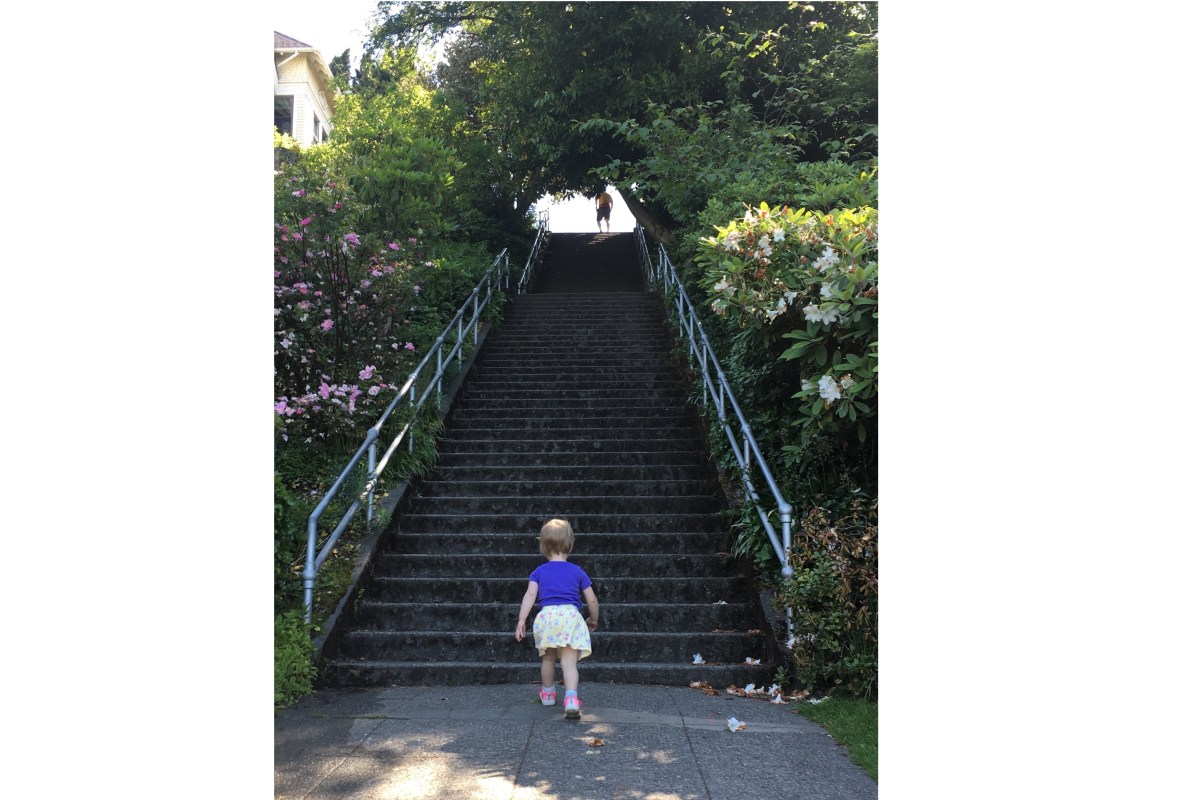
But I was left thinking about “counting the days.” It made me think of the difference between digging deep and leaning in. I remember when I started working out to climb my first mountain and I was working out on these set of stairs on Capitol Hill in Seattle where there are 13 flights for a total of 290 steps. As I did these the first time I thought, “I can do anything for 20 minutes.” This became my mantra for digging deep to get through short-term pain.

Then it came time to climb and I thought “I can do anything for two days.” And adopting that attitude got me through a great deal of repetitive tasks and tough conditions.

When I had first had kids and the sleepless nights were getting to me, I remember thinking to myself, “I can do anything for two years.” Well, I’m not sure I could have done sleep deprivation for that long and fortunately didn’t have to find out but saying that mantra helped get me through.

I can do anything for x amount of time is my mantra for digging deep. It works – it helps me push through a perceived limit by tricking my brain. But there is a point where digging deep becomes a habit to not only push through challenges but also to bear down and push through life. At that point digging deep becomes a liability.

By contrast, the biggest gift I received from the rich healing days when I first started meditating after my divorce was learning how to lean in. It was a lesson I got from Pema Chödrön’s book When Things Fall Apart. It was my awakening that it doesn’t work to avoid things – we need to lean in to them instead and take the power away.

I’ve heard this likened to the martial art of Aikido – that by leaning in to a punch, you take away its power. You get it closer to the source so it doesn’t have a chance to build up steam and turn into something bigger.

You lean in to the things that make you uncomfortable to find out why. You lean in to the arguments you have with your partner to find the root cause of what isn’t being said. You lean in to the fear of what you don’t want to do to find out what associations can be untangled.

For me, it’s a subtle difference between digging deep and leaning in. Digging deep is for when I have to grind things out. Leaning in is for when I can stop things from blossoming into something that has to be endured.

We close enough to the end of the year that I’m sure my daughter can dig deep to get through her remaining reading rotations. But perhaps next time we should practice the art of leaning in so we find out what is making an activity hard and disarm it.

(featured photo is my daughter on the Capitol Hill stairs in 2017)

How to Become Your Own Best Friend

I like lists. They are neat and ordered and have the magic of being able to encapsulate something. So when Dr. Gerald Stein published this list of 30 ways to become your own best friend, I was captivated. His long and distinguished career as a psychologist and keen enthusiast of life shines through in this wonderful post.

Dr. Stein’s comments on my blogs always make me think and laugh – as does this list with items like #3 Mistakes are inevitable. Master them. Please take steps to skip over their repetition. And #13 Allow love and kindness to emanate from your being. Live with both intelligence and an open heart. Those different from you also find existence challenging.

Without further ado, here is Dr. Stein’s post How to Become Your Best friend

drgeraldstein's avatarDr. Gerald Stein

Who is the person closest to you?

You see him every day, talk to him and about him, sleep with him, clean him up, applaud his successes and analyze his defeats.This individual knows more about you than you will ever know.

Maybe it’s time to make yourself into your own best friend, given all that intimacy.

I’ve listed 30 suggestions to get you started.

  1. Be entertaining company on your own.Inspect your personality and how you view the world compared to others.Seek new ideas, and pass the unaccompanied time with enjoyment.Go places and do things beyond your usual comfort zone, including solo explorations.Perhaps concerts, movies, parks, museums, and tours.  Don’t sit alone in quiet desperation.
  2. Be kind to who you are.Your life emerged without a display case from which to choose the attributes you wanted.You began with raw and imperfect materials of external…

View original post 1,094 more words

Open Up, Buttercup

Self-pity in its early stages is as snug as a feather mattress. Only when it hardens does it become uncomfortable.” – Maya Angelou

The other day on the carpool home from school, my daughter teed off when her friend said something about being called on in class. “I never get called on in class!” and “I never get to say my ideas!”

Self-pity is the emotion that I have the most trouble with. I think the idea that we should never feel or express self-pity was inculcated in me from an early age. My memory is that it was communicated in statements like “You can join us again when you are feeling more positive.” Or “Can I join the pity party?” or “Toughen up, Buttercup.”

So I think I came by my intolerance of self-pity in myself or others honestly from probably generations of family habits. But a little self-reflection shows me that the complete shutdown in my ability to listen and feel when self-pity appears is neither the person or parent I want to be.

I was mulling this over when I heard a Ten Percent Happier podcast with therapist Dr. Jacob Ham that helped clarify the underlying question. In the course of the conversation the topic of whether you have to love yourself to love another came up. Dr. Ham’s answer was it depends – “It depends if your fear is so great that it inhibits connection to yourself or another.”

While my natural inclination is not to name the feeling as fear, it gets at the heart of the question of solving things in ourselves so they don’t hinder our connection to others. I still have trouble thinking of self-pity as anything useful – but I also know my resistance tells me that it’s inhibiting the Flow of life somewhere and it’s worth a look.

In the car when I was listening to my daughter’s complaints, I could relate that I often see a skewed version of events when I’m tired or not feeling well. In my daughter’s case, I think she was both tired and hungry so I asked if we could come back to it after we filled her tank.

She said it was frustrating not to feel seen at times but after acknowledging that, we made a list of things she wants to do so that she can speak up about her ideas like raising her hand more enthusiastically. We’ll see if it works but I’m just grateful that I held on long enough to participate in the conversation.

(featured photo from Pexels)

Tent Associations

And into the forest I go, to lose my mind and find my soul.” – John Muir

When my daughter told my mom’s 83-year-old gentleman friend that we were going to camp out in the backyard this weekend, he turned to me and said, “After I got out of the army, I told myself I’d never spend another night in a tent.” It seemed like a reasonable vow for him.

My friend, Phil, who was the first American to climb the north side of Everest quips that bivouac is French for mistake. It isn’t – it’s derived from a French word that means “by guard” according to Merriam Webster but since Phil had to once bivouac high up on Everest, he’s earned the right to that joke.

My association with tents comes from the first time I spent an extended amount of time in them. It was 5-week trip through Ecuador I did in college with a group. We lugged the tents up there in our backpacks and then huddled in them to stave off the cold of the Andes. I remember one of my tentmates, Ted, retelling the entire movie of Dead Calm with no interruption since we had nothing else to do. Then we sweltered in the humidity of the Amazon jungle in tents where we squished ants and spiders and talked about our dreams of what we’d be when we were full-fledged adults. I can still replay my tentmate, Lisa, talking at length of how great an ice cube would feel sliding over her forehead. We’d take to our tents every afternoon on a beach near the Galapagos that had no shade and told stories about things we’d seen on the trip.

So for me, tents are not only a base for adventure but also a safe place to lie on your back and just listen. Listen to your tentmates, listen to the wind and the rain on the nylon, listen to your heart beat in a new place where nothing is familiar.  To me they smell like hard work, feel like closeness, look like a kaleidoscope view of the world outside them, taste like crappy food that you are just so grateful to be eating and sound like everything you can’t hear when you are too close to life as usual.

No wonder I’m excited about back yard camping with my little ones even though the ground feels a little harder than when I was young. It was hard to go to sleep with all the excitement and the steady rain on the tent and we only made it til 4:20am and the birds woke us up. And maybe they’ll need their own adventures before we’ll really know but I can’t wait to find out what they associate a tent with!

How about you – how do you feel about tents?

Transforming to Just Being

Nothing has a stronger influence on their children than the unlived lives of their parents.” – Carl Jung

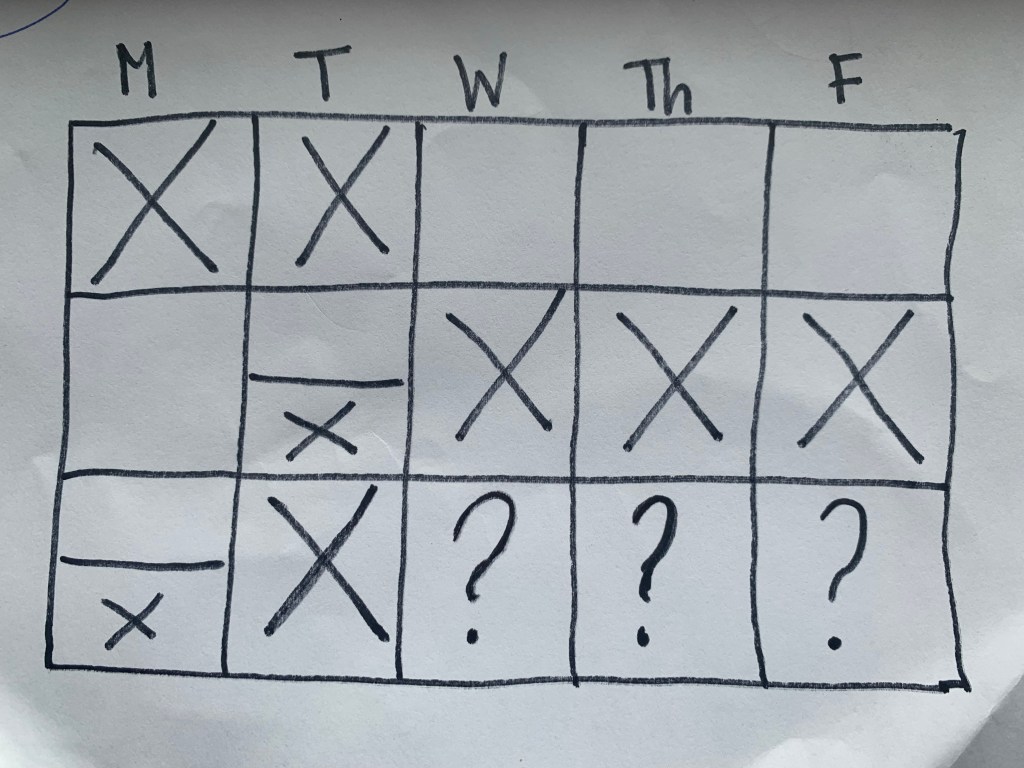
My 2-year-old cried in the car all the way to daycare yesterday. I cried all the way back. At issue for him was that after spending 3 ½ days out of school last week and then having to have a root canal to solve the problem, it’s hard to get back to the routine. Especially because his 6-year-old sister is now staying home from school with a sore throat.  At issue for me is this is the way the last three weeks of work days have gone – X’s denote a day that one of my two kids was home (placeholders for today, tomorrow and Friday because I haven’t woken the kids up yet):

Because I’m self-employed, there are many things I’m so lucky to be able to swing because I don’t have any corporate meetings, I don’t commute and my boss understands the situation. With all that said, here’s my question – does any parent with primary parenting responsibility actually get any work done? And has any parent gotten work done since the pandemic started?

It seems from my informal small survey of two kids, that the non-Covid illnesses are way more prevalent in these days of getting back to group activities. If that’s the case, I’d suspect that this will even out over time. But I’m not sure that I will even out after two+ years of feeling like the fulcrum on which I’ve tried to create balance in my kid’s lives no matter what’s happening in the world. Here’s how that feels:

Of course this is a little tongue in cheek and you must forgive the crude artwork. But with that said, the problem is that it is sometimes hard to get some perspective from down there. It brings to mind the quote for this post from Carl Jung, “Nothing has a stronger influence on their children than the unlived lives of their parents.

Which I take to mean that when we sacrifice any aspect of ourselves – whether for our children, our parents, our partner or anyone else in our lives, that part haunts the remaining parts of our lives if we don’t make peace with it.  In my current situation, I’m having a hard time being successful at work. And aside from the monetary ramifications, it also impacts my ability to commit to things. Who am I if I’m not someone who can set deadlines?

In this process, I’m finding out that what’s getting squashed out is my self-conception. I’m becoming someone better at just being instead of being measured by my doing. I’ve said this before so I know I’m repeating myself but this is a process of transformation, so it’s taking some time. I still like to be reliable and productive. But I’m better at rescheduling something on my work calendar if I have to without it impacting my sense of who I am.

Dr. Gerald Stein quipped in a blog comment the other day, “”I wish I would have worked more’ said no one ever on their death bed.” But there is a wide crevasse to cross to understand how to put that into practice when we are in this middle part of our lives where we are responsible. I suspect parenting is one of the bridges that might help us get a leg over.

Has your conception of work changed during the pandemic or over time? Did parenting change it?