“Spend time with people who are good for your mental health.” – unknown
This week I was up on a ladder trying to hang some extra Christmas lights when eight-year-old Miss O walked in the room and said with a laugh, “I don’t like this lip gloss. It’s all over my teeth. Want to come down and see?”
I launched into a laundry list of things on my to-do list that precluding me pausing to see lip gloss on teeth. She laughed again and repeated something I told her the other day when she was frustrated with her Xmas gift making. “You’re a Leon. We expect to get things done. We experience stress when that doesn’t happen as quickly as we’d like.”
Then she brought me a hand strengthener and a stress ball to take my frustrations out on.
Isn’t it funny that we need other people to repeat our own observations back to us? My on-going battle is that my ideas of what I can accomplish, and the time I have available, are forever mismatched. I’m aware of it and yet I’m still like a fly against the window, bumping against it over and over again. Every once in a while, I’ll have a miraculous day where I feel like I accomplished what I set out to do.
But mostly, I just spend a lot of time practicing letting go of the list to be present. My kids help me do that. A lot.
“I cannot do all the good that the world needs, but the world needs all the good that I can do.” – Jana Stanfield
I met a friend when I was in my 20’s who summed up his dad’s advice to him:
Always buy the best tires you can afford
Never buy a cheap garden hose
Buy tools with a lifetime guarantee
I marveled upon hearing that about how straightforward that fatherly advice was. Because my dad’s advice was a lot more ephemeral – not surprising given his profession as a Presbyterian pastor.
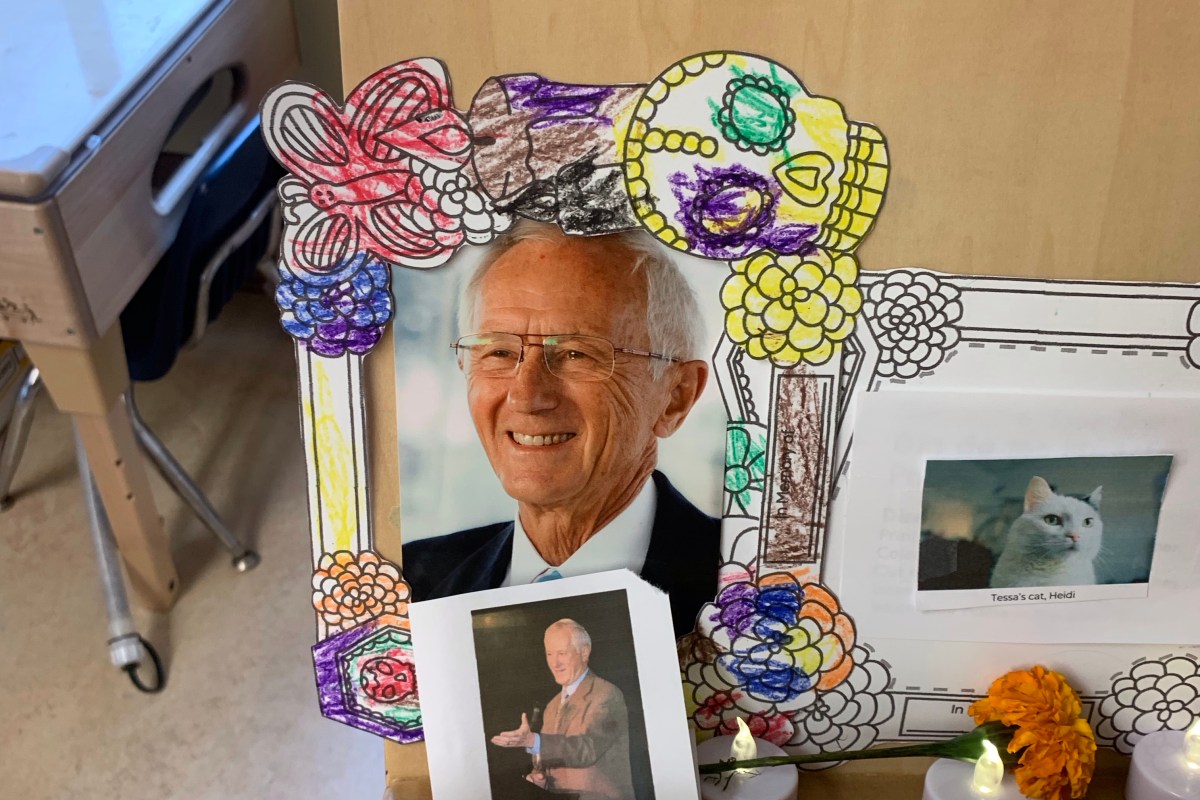
Our exchange reminded me of three pieces of advice from my dad, Dick Leon:
Do the next right thing: This is a continual instruction, not a one time thing. Do the right things to make this planet a better place to live in whatever way that you can and according to your passions. Stand up for those that have been treated unfairly. Be kind. Take action on the social issues that are meaningful. Do all that you can to work, support, and encourage a better planet.
The Dick Leon approach was not to play it safe either. Over the years he worked for Civil Rights, on behalf of Russian citizens during the Cold War, and at the end of his life he was working on land rights for peaceful Palestinian Christians in the West Bank. Most of those issues got him in trouble with some factions of his congregations and his life.
Be cheerful about it: My dad often said that doing the right thing often means doing the hard thing. He recognized that it wasn’t/isn’t easy. So his instruction to be cheerful was two-fold. First, do what you can, and be happy about it. Because if you’re gritting your teeth every step of the way, it’s not sustainable.
The second part is that when you are in the groove of doing what you can cheerfully, you attract other people to the cause. Even if they don’t agree, others are more likely to engage in conversation with someone who appears not to already be irritated. Hence how my dad managed controversial topics within a church congregation of varying viewpoints.
Cheerfulness is not synonymous with toxic positivity. Some of the issues my dad advocated didn’t work out. Others took a long time. My dad’s definition of cheerfulness was what one can do with a happy heart.
When you’ve done all that you can, give up the rest to God: Or a higher power or whatever thing bigger than yourself that you believe in. This was my dad’s way of not worrying about the stuff that was outside of his control. Less energy spent on anxiety equals more energy for doing the next right thing.
I envied my friend from my 20’s for the simplicity of a list of dad advice. But now that I’m middle-aged, appreciate my father’s wisdom more. I believe his list is the reason that I’m still paraphrasing him almost a decade after he died. I’m not sure my dad had any awareness of his impact beyond his lifetime. But I think his advice guaranteed that he did have impact because it was the way he created legacy with his actions every day.
It’s harder to check off things from my dad’s list. But when I follow it, I find great comfort. And cheerfulness, of course!
(featured photo is mine: Dick Leon, on a Dia de los Muertos ofrenda)
For another great list, please listen to Dr. Gerald Stein on the Sharing the Heart of the Matter podcast talk about Being Your Own Best Friend. Dr. Stein comes through with such wisdom and warmth as he provides some great tips for living our best lives.
“Life is an echo. What you send out — comes back.” – unknown
A couple of weeks ago, my son, four-year-old Mr D, got a new boxing toy, a small punching bag anchored on a vertical stick. We were home alone together when we assembled it and then went a couple of rounds with it.
We took a break in the yard to cool off and play with our dog, Cooper. As we were throwing the ball, I was coaching Mr. D on what he’d say when his eight-year-old sister came home and asked to play with his toy.
“What are you going to say when Miss O asks to box with your toy?” I started.
“Well, ummm, uhhh.” Mr. D stalled
“Say, ‘yes.’” I whispered.
And we went a couple of rounds practicing that which was every bit as hard as actually boxing.
Then Mr. D asked where his shovel was. As I looked in one hidey-hole and then another, he asked, “Want to go find some worms with me?”
“Uhhh,” I stalled.
“Say, ‘yes.’” he whispered.
And I did.
If we ever need a reminder that what we put out in the world comes back to us, just spend time with children.
“Be teachable. Be open. You’re not always right.” – unknown
This was originally published on 11/2/2022. Heads up – you may have already read this.
When American actor James Caan died in July of this year, I heard that his least favorite words were “I don’t care.”
Obviously, I can’t ask him to elaborate on that. But if I’m trying to take his point, I’m guessing he was aiming for “I don’t care” – as in, it is of no consequence to me. I don’t care – as in, it will fail to penetrate my reality one way or the other. I don’t care – as in, it or you are not worth getting worked up about.
But sometimes I think we take caring too far. As if we should have an opinion about everything from what kind of brands are okay to wear, the exact specifications for the type of liquor we’ll drink and whether we can only shop at boutique and artsy stores.
When I’ve mistakenly worn my opinions as some armor of sophistication, I’ve found that it’s closed me off from life. It becomes a barrier between me and experience so that I have to surmount my own expectations before I can taste curiosity.
My dad had a mantra that he used for golf, “You need to care less without being careless.” And I think it works for more than just that silly sport (sorry golf lovers). It speaks to a balance that we can create between being involved in the world without gripping too tight.
We can have opinions, beliefs and wisdom while still holding space for not knowing. It means that sometimes we can embrace our lack of control and be entirely open to what comes next. And it suggests that we can maintain a curiosity even when we think we are right.
There is one more way that I believe caring can get in our way, especially when trying to find our authentic voice. We can care too much about the opinion of others, especially in our social media age. And then what we say and what we write becomes performative instead of real. This brings to mind a quote from Mark Nepo, one of my favorite poets:
This is at once the clearest of spiritual intents and yet the hardest to stay true to: how to stay open to what others feel and not what they think.
The Book of Awakening by Mark Nepo
So, I applaud James Caan for having a phrase that he said often enough to make it repeatable. But I have to admit, I don’t care for it.
I written about some of the ways we use language on the Wise & Shine blog today: Use Your Words
“The bad news is time flies. The good news is you’re the pilot.” – Michael Althsuler
This post was previously posted on 7/20/2022. Heads up – you may have already read this.
Last week I was driving in my car with my almost 7-year-old daughter at 8:29am when she said “Darn, I’m always a minute late for my favorite time.” She likes palindromic times – in this case 8:28.
It made me think about what I’ve been working on lately. Life feels hectic – summertime means different routines for each week, forms to fill out for camps, people to coordinate carpools with, a lot of additional details in addition to working my full-time job, taking care of kids and trying to maintain a social life.
In the midst of this, my goal is not to be in a hurry even while living a busy life.
That is to say, to try to be intentional and savor the things I’m doing. For example, I had on my to-do list an item to fix the fence where it had come apart at a post. That activity in and of itself doesn’t really have a high enjoyment value. But the other day when I stepped out to assess the task, I felt the summer sun on my back and saw the green of all the grass and trees around. The flowers of the garden are really flourishing and it’s an incredibly vibrant scene right now.
The task might not be much to talk about – but the scenario is gorgeous. When I hurry, I miss all of that. So I’m trying to take an extra breath or two, how long can that take – 11 seconds if I’m optimizing the length according to the Unified Theory of Breathing? Just a couple breaths add a dimension that makes me think of the quote from Auguste Rodin, “Nothing is a waste of time if you use the opportunity wisely.“
There are two different Greek words that speak to this divide: chronos and kairos. Chronos is clock time so when my daughter is saying that she’s a minute late for her favorite time, it’s chronos we’re talking about. Kairos is translated as the “right time” as in now is the right time to step in, speak up or enjoy what I’m doing. I might have to be somewhere at a particular time, as in chronos, but kairos calls me to be mindful of the trip.
I usually manage to arrive on time, chronos speaking, but I frequently mess up the quality of the time, kairos, in order to do so. In fact, I did that just yesterday when I was hurrying the kids to the car so we’d be on time for our carpool. My almost 3-year-old son wanted to hold the door for his sister and in my desire for efficiency, I didn’t listen to him and missed the right time to enjoy the spark of what he was doing. A small moment that is neither here nor there in the big picture, unless all the small moments are rushed like that.
What I’ve learned is when I manage not to be in a hurry even while life is busy, it prevents me from feeling like I’m a minute late for my favorite time.
How do you approach the quantity versus quality of time? Any tricks to slow yourself down when you are hurrying?
If you aren’t short of chronos, I’ve also posted a related post on the Wise & Shine blog: Speed Reading
“Ancora Imparo. I’m still learning.” – Michaelangelo
Okay, not everything but a few key things. Cooper has started puppy kindergarten and has been kind enough to take us along with him. Here are some of the things I learned.
It takes training to become best friends.
We listen better when treats are involved.
Gifted dog people are not necessarily people people or business people If you’re good enough at what you do, the people who love their dogs will pay you anyway.
Enthusiasm can’t be fenced in.
We come in all shapes and sizes, colors and combinations.
There are some breeds that will be judged harshly based on their appearance. The people that love them feel that they have to train them to be perfect to overcome bias.
We can learn things through positive reinforcement, but it takes a plan and a lot of practice.
Learning is exhausting. Set aside time to nap afterwards.
Our attention goes where the treats are; this can be used to great effect.
It’s great to practice for emergency situations. But preparing for it all the time is counter-productive.
Be consistent and those around you will benefit from knowing your cues.
Use your words. Even non-verbal beings can’t tell what you want without words.
Tell people to take their sh!t home with them.
Suggesting what we SHOULD do is more effective than just telling others what NOT to do.
Our natural desire to please and be social will drive a lot of behavior, good and bad.
Loyalty is a two-way street. When you find a creature that will turn to you upon hearing their name, treasure it.
“It’s not the mountain we conquer, but ourselves.” – Edmund Hillary
My math brain likes to discern patterns. If you call me out of the blue at 4pm on Monday and then do it more than once, I’ll jump to wondering what you are doing Mondays at 3pm that makes you think of me.
The patterns that interest me most are the ones that take me a long time to pick up on. Here’s one.
I have a sweet tooth. Like a big sweet tooth. More than one – actually, a whole mouthful. I’ve frequently argued with it, sometimes ignored it, but very rarely analyzed it.
My dad had a big sweet tooth as well. Are these kinds of things inherited?
But recently I was describing my sweet tooth to someone as something that starts with Halloween, carries through the holidays, and best case, abates sometime around Memorial Day.
When I started stashing those mini candy bars in my pantry again, I chalked it up to the pre-Halloween availability of those bite size snacks. Besides, I’m especially busy, so it’s just part of keeping up the quick energy to get everything done, right?
And then my recent description of my sweet tooth jiggled something loose. The memory that last year my reason was that it was because I was traveling for work. And the year before that? I don’t know – probably post-pandemic back to in-person school or something.
The point being – I have a new reason every year. If I look at the pattern, it starts with fall. I start feeling like sleeping more with the earlier sunsets and crisper evenings. And it’s a little harder to get up at 5am in these cold, dark mornings. I’m looking for the natural summer productivity that I get here in Seattle with the 16 hours days, to be all year round. When my body tries to pick up the seasonal cues to slow down, I jack it up on sugar.
You know what? I bet my dad did that to a degree too. He also had a problem slowing down, being anything less than on-the-go. So is it inherited? Well, maybe it is. The go-go pattern not the sweet tooth. Not that I’m ruling that out either.
Now that I see it, I wonder if this is a pattern I want to pass on. Isn’t that a funny thing about families? Sometimes it’s hardest to see the patterns closest to us.
For a related post about change in energy, please see my Heart of the Matter post Department of Low Energy.
“That is what learning is. You suddenly understand something you’ve understood all your life, but in a new way.” – Doris Lessing
The other day I went to help four-year-old Mr. D with his shoes, and he said, “I can do it. I’m an es-pert!”
It reminded me of a story I had just re-read in Mark Nepo’s Book of Awakening. He credits it to Leroy Little Bear:
“Two scientists traveled halfway round the world to ask a Hindu sage what he thought about their theories. When they arrived, he kindly brought them into his garden and poured them tea. Though the two small cups were full, the sage kept pouring.
Tea kept overflowing and the scientists politely but awkwardly said, ‘Your holiness, the cups can hold no more.’
The sage stopped pouring and said, ‘Your minds are like the cups. You know too much. Empty your minds and come back. Then we’ll talk.’”
Leroy Little Bear
This is my invitation when I think I know something, to stop, empty my mind, and fill my heart.
I went to the memorial service of the father of one of my childhood friends this weekend. He was a psychologist by vocation and long before I knew what that was, I understood that he had a healing presence.
One of the phrases that stuck out to me in the eulogies was one from his grandson. He said that this man “led by listening.” Ah yes, that’s it exactly.
Which brings me back to my four-year-old es-pert at shoes. I am so grateful for his help with the routine by getting his own shoes on. But anytime I’m feeling expert at anything, I remember that most of the time Mr. D, the es-pert, wears his shoes on the wrong feet. There’s always room for more listening and more learning.
“Love is a feeling, marriage is a contract, and relationships are work.” – Lori Gordon
This is a repost of something I posted on 11/30/2022. Heads up, you may have already read this.
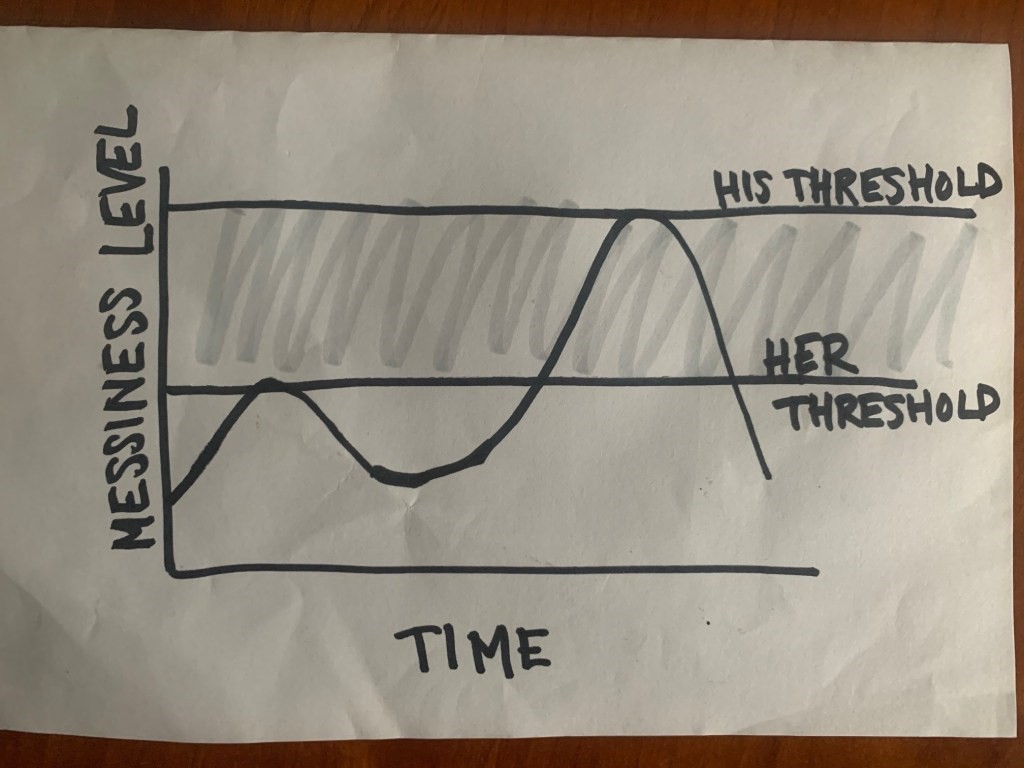
When my brother was in his twenties and a couple of years into marriage, he explained to me his theory about the cleanliness threshold. He drew out a chart where he illustrated the state of the household mess and that when it increased, it hit his wife’s threshold for a messy house long before it hit his. Therefore, she was always cleaning it and he never thought it was messy. The diagram looked something like this with the gray area as the space between her threshold and his:
Since I am six years younger and wasn’t married at the time he told me, I thought he was imparting some great wisdom about marriage. It wasn’t til later that I realized that his diagram depicted a way of looking at all our relationships.
Because our thresholds on any number of subjects will likely vary in a great number of areas from those around us: what qualifies as noise, when do we experience hunger, pain tolerance, ability to withstand uncertainty, desire to take risks, and our willingness to express ourselves or seek relief when we are exhausted, overwhelmed and sad to name just a few. So how do we live with others in the gray area between our tolerance level and theirs?
Believe Them
My years as a parent of young kids have taught me that it goes better when I believe them when they tell me how they feel. In that way, we don’t end up debating the truth of the feeling but instead can move to finding out what to do about it.
There are times they’ll tell me they are sad, frustrated, disappointed and I might say, “It’ll be okay” if we need to move on. But I try not to argue that they should be feeling something else like grateful, happy or blessed because it compounds the feeling. They stay stuck trying to prove what they are feeling instead of transitioning to the next phase of how to make it better.
Try to Laugh About It
The other day my 7-year-old daughter was goofing around before bed. Despite my numerous admonitions that she was too tired to keep safely doing cartwheels and should instead try to quiet her body, she kept throwing herself around the room until she ended up hurting her arm pit and her crotch. At that moment, I had the choice of being irritated that she didn’t listen or making a joke about those being two very unlikely body parts to get hurt at the same time. We ended up laughing all the way to bed about how that happened.
On a recent Unlocking Us podcast with Brené Brown, Drs. John and Julie Gottman were talking about their latest book, The Love Prescription: Seven Days to More Intimacy, Connection and Joy. They made the distinction between turning toward a bid of attention (responding or engaging when your partner says something like “look at that blue jay out the window”), turning away (ignoring) and turning against (responding with something like “why are you interrupting me?”).
In happy relationships, people turn toward their partner’s bids for attention 86% of the time, couples who were not successful only turn toward each other 33% of the time. John Gottman explained the result, “Couples who increase their turning toward wind up having more of a sense of humor about themselves when they are disagreeing with one another, when they are in conflict.”
As Brené Brown summarized “Turning toward gives us a sense of confidence about our togetherness.” From there, it’s easier to find what’s funny about this daily existence.
Live Directly
In his book, The Book of Awakening, Mark Nepo gives an example of being at an ice cream shop with a friend and eating their cones when the table next to them became boisterous. As he became more irritated, he asked if she wanted to go. But his friend was fine and in saying so, she noticed the look on his face and asked, “Do you want to go?”
He laughed as he realized he was couching his needs into some form of thoughtfulness instead of owning his own feelings. Relationships are so much easier when we claim our own stuff and live directly.
Navigating the Gray Area
My brother’s marriage from his 20’s, the source of the threshold theory, didn’t work out. Turns out his wife had a different standard for telling the truth about significant things. I suppose there needs to be another line on the chart for boundaries. Regardless, I learned a lot vicariously about living in the gray area with others. The longer I live, the more gray it gets but also easier to navigate if I believe others, laugh about it and own my own stuff.
“Pushing through your fear. If there’s something you want, it usually worth the risk. I’ve found that on the side of fear is rebirth.” – Paula Whaley
One of the guides that I climbed mountains with, Phil, taught the skill of weighing objective risks versus subjective risks. Objective risks in the mountains include avalanche danger, weather forecast, rock fall areas, and navigating around crevasses. It is because of objective risk that we’d often leave for the summit in the middle of the night, when things like big blocks of rocks and ice are still frozen to the mountain. That way we reduced the risk of climbing in the heat of midday when the sun warms things up and they pop off to crush you.
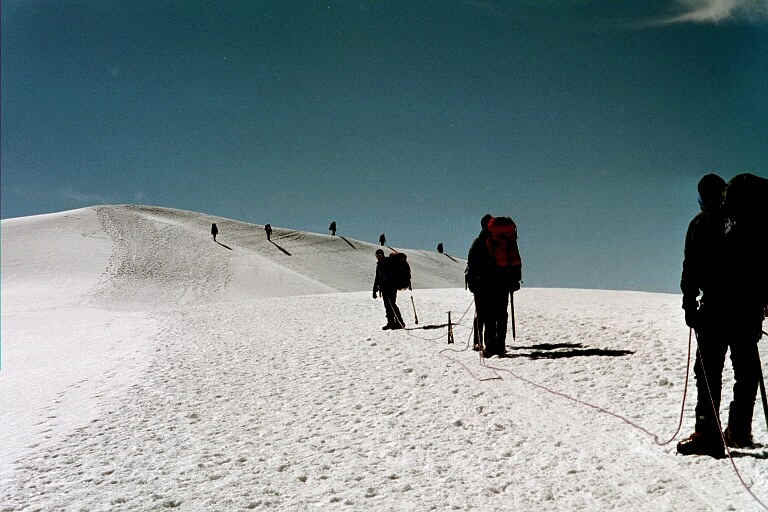
As an aside, I found climbing at night to be one of the most beautiful things to do. While it was exceedingly painful to leave a warm sleeping bag, the intimacy of my steps enveloped only in the circle of my headlamp was a way to be both big and small. In a huge arena but only focused on a small area. Groups ahead look like a caravan crossing through the desert because the landscape could be anything. And, crossing things like ladders laid horizontally over crevasses is way more doable when you can’t see the gaping hole below.
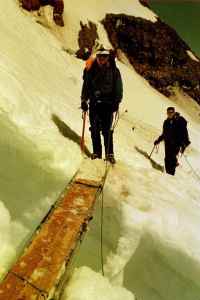
A friend ready to cross a crevasse on Mt. Rainier (image mine)
But subjective risk, as I understood it from Phil, is what we internally sense and measure. How do I feel? Does this seem doable today? Subjective risk is more personal, trickier to plan for, and different for everyone.
But this is a post about life, not climbing
I’d argue that in my life now, I have very little objective risk. Perhaps the most hazardous thing I do is forget to wear eye protection when I’m using the weed whacker.
But the subjective risks I’ve found in middle age to be plentiful. Daring to be vulnerable, trying to learn something new, opening to new friendships, asking to be seen, and offering grace instead of judgment – all those things lay bare my heart in a way that can be terrifying and precarious.
I think meditating and writing both are huge subjective risks to my perceived well-being. Hazarding a look inside at the goopy mix of who I am, taking on attempts to change myself, the conditions for my children, and generational patterns of my family. Geez, that’s harder stuff than I ever faced in the mountains.
And yet, I find when I try these things that are subjectively risky, they get me somewhere. Not always, and I haven’t kept track but I think it’s safe to say not usually, where I intend to go but with a receptiveness that moves me forward.
It’s a round-trip sport
As my guide friend, Phil, says, “Climbing is a round-trip sport.” It’s both the up and the down. And the risks are often greater on the down when I’m exhausted from the climb. And now have to cross the crevasse on a ladder in the daylight when I can see the gaping hole beneath me. It’s the same in life for me, taking the risk to extend myself in vulnerability and openness is hardest when I’m tired and depleted but it’s often necessary to lead me home.
I don’t think you have to have climbed to imagine how life can be a slog, both uphill and downhill. But whatever the slope looks like, thinking about it this way has helped me to take the steps to evaluate and take on subjective risks in order to get to my best and highest place.
There is no way to get to the summit, whatever our personal summit may be, without exposing ourselves to risk. But the view from the top and the learning from the trip change us forever.
View from Mt. Adams (image mine)
What do you think about risk? Any tips for how you face risk?
(featured photo is mine from Ixtacchuatl a 17,160ft mountain in Mexico)






 Surprised By Joy