At the Core

Whether you think you can, or you think you can’t — you’re right.” – Henry Ford

Last weekend we drove about 15 minutes down to Shilshole Bay on Puget Sound to see a dock where sea lions like to congregate. It was packed with sea lions – usually a dozen on the dock and I counted a least a dozen more swimming in the water.

Every once in a while, a sea lion would launch itself out of the water in an attempt to land on the dock. The new weight would make the dock roll one way or the other causing all the sea lions to bark. But there was one sea lion in the center who was doing most of the work to keep the dock level. It would lift its head high and shift its weight this way or that to stabilize the dock again.

It made me think of how impactful what is at the center is. As I was pondering what was at my core, Life, in that beautiful way that sometimes happens, delivered the answers to the question I’d just uncovered. In this case it was through the latest the Unlocking Us podcast about living into our values. In it, Brené Brown had an exercise to determine our core values.

Her research shows that when in a tight spot, most people call on their one or two go-to values. So on her site, there is a pdf of about 120 values. Her recommended approach was to circle the ones that called to you and then distill them to the two values that encompass what is central for you. It may change over time but this exercise was to identify what is key for right now.

Doing the exercise, I came up with faith and usefulness. Faith, which for me encapsulates confidence, courage, adventure, integrity, spirituality, openness, love, optimism and gratitude. Usefulness I thought did a good job of rolling up my other values of reliability, learning, kindness, growth, family, and independence,.

Over the years I’ve done a lot of work to strengthen my physical core. It has enabled me to carry heavy loads up mountains and I feel it most now when I hoist my toddler onto my shoulders. But thinking about my core values, faith and usefulness, I realize that they are what I go to again and again to power me when I have to dig deep. Like with the sea lions, when I am living into my values, they are the center that brings me back to level when the world is rocking.


Taking the Crust Off

I have no special talents. I am only passionately curious.” – Albert Einstein

Around Christmas, my mom was helping my 6-year-old daughter with some Legos. Frustrated by something she tried many times, my mom turned to me and said, “Do they sometimes forget to put pieces in these kits?”

I laughed because I’ve thought that many times. When the instructions don’t work and everything seems to almost but not quite fit and I want to blame the instructions. But from my experience, it has never been the instructions that have been faulty. I’ve usually found an error in previous steps that once reversed, it works fine.

Life has taught me that this just doesn’t happen with Legos. That when life feels blocked, often we spend a lot of energy trying to problem solve where we are at before realizing we go back a few steps to fix what is fundamentally causing the issue. It may be a wound we try to cover over instead of heal or a belief about ourselves, others or life that we never revisit to test if it is true.

Recently I was listening to an On Being podcast where writer Katherine May interviewed author Michael Pollan. He was talking about his research into using psychedelic drugs for therapeutic purposes. One of the benefits he said was “Recovering the profundity that we already know. Like ‘love is everything.’ We spend a lot of time encrusting these fundamental ideas about life and reality with irony and all these protective rhetorical devices to keep them at bay. And suddenly that crust comes off.”

While the chances of me doing a psychedelic trip are about zero, I was struck by the notion of uncovering what we already know. Or in Michael Pollan’s words, taking off the crust. Going back a few steps, in Lego speak.

Praying, meditating, writing, therapy, honest dialogue, vision journaling – all these tools remind me of a mediation retreat but I think they are our ways of discerning where in the directions we went wrong. To somehow reveal that thing that keeps bugging us but we can’t quite put a finger on.

In the On Being interview, Michael Pollan described why insightful experiences, however we come about them, have such power to create long term change in us. He brought up the work of William James who was talking about mystical experiences 100 years ago. Michael Pollan explained, “One of the characteristics of that [mystical experience] besides ego dissolution and transcendence of time and space was the Noetic quality. That is the quality that what you learned, the insights you had were not merely opinions but revealed truth. They have a stickiness and power that I think is central to people being able to change. The difference between knowing in your head and knowing in your heart and whole being.”

When my mom was having trouble with the Legos, I sat down with her (my daughter having wandered off long before) and we looked at the directions, the picture and our pieces. Then my eyes, new to the project, were able to spot the tiny extra red piece that made all the difference. I wouldn’t call it a mystical experience but we whooped with delight at fixing something. When we take off the crust and look inside, especially together, it’s fun to discover how it all works and put it together better.

(featured photo from Pexels)

Swimming In the Deep

The inner life of any great thing will be incomprehensible to me until I develop and deepen an inner life of my own.” – Parker J. Palmer

This weekend my friend Eric told me a story about a course that he took in college. He went to one of the Claremont Colleges in the mid-1980’s and this sounds like something that might have only been possible in that place and time.

The course was called Mind, Culture and Sports and it was held at the professor’s house, usually with drinks served and the professor encouraged everyone to take it pass/fail. The course content varied greatly – one week it might be a study of how hard it was to hit a baseball and the next week it was about meditation.

One weekend their field trip for this class was to spend a night at a Buddhist monastery. With great interest I asked how that went and Eric replied that he was terrible at mediation. Apparently the monk kept coming by to (gently) correct his posture. But, Eric brightened considerably when he reported that he was great at “sweep the path,” the chore he was assigned at the monastery.

It made me reflect on what we get out of our experiences. I’d have probably missed the whole point of a meditation retreat when I was 19 years old as well. But in contrast, can I name what I get out of meditation now?

If I didn’t meditate, I’d spend the day operating from my to-do list and getting a great deal done but swimming on the surface of the lake where the conditions of the weather affect the choppiness of the water a great deal.

By meditating, it feels like I spend at least a few minutes submerged in the deep. It’s where the quiet allows me both to read about and hear the bigger forces at work – the thread of the Divine in my life, find the echo of Love and Beauty in what I’m doing and touch the feeling of Peace that pervades regardless of the surface conditions.

I was also in college and about 19 years old, the same age as Eric when he took his college course, when someone who was trying to recruit students for the Church of Scientology stopped me on University Avenue and asked me “What about your life do you not want anyone to know?” At age 19, I was still blissfully naïve, untroubled and pretty uncomplicated. Perplexed by the question, I replied, “Nothing?”

Now, 33 years later, I’d answer a lot more assuredly “Nothing. Because after all those years I spent thrashing about on the surface, I’m finally submerged in the deep.”

(featured photo by Pexels)

Rebranding Exercise

Sometimes it’s okay if the only thing you remembered to do today was breathe.” – Unknown

Somewhere in the middle of yesterday morning, I realized that, although I was in the middle of a scenario that I dreaded, I was doing fine, in fact better than fine. The scenario: quarantined alone with two kids for days on end, no other grown-ups allowed in for help or distraction, not able to go outside which is both my and my kids’ happy place, feeling sick and trying to work.

It made me wonder – how much energy is wasted imagining dreaded scenarios? They may or may not happen. And this one has taught me, that even when they happen, they don’t feel like I feared they would. In fact, I felt so emboldened by the fact I was facing this nightmare down that I skipped through the rest of the morning.

This sparked a tidbit that I learned many years ago from someone who was researching how we RSVP events that are 1 month or 6 months out. They found that our minds have an image of who we’ll be and how we’ll feel in the future that isn’t accurate. When we respond based on that image, we often don’t predict well whether we’ll want to go. The trick, the research said, was to RSVP as if the event was tomorrow or next weekend. Because we just don’t know how we are going to feel about an event until we are facing it.

Also in my dread, I couldn’t imagine the beautiful difference that how other people would react would make. My friends, neighbors and colleagues have been so supportive and offered to drop off groceries, dinners and things for the kids. And in my imagining, I couldn’t factor in the great community of grown-ups that I’ve found in blogging. Reading other people’s blogs and writing through this has kept me in touch with the big picture reality in such a delightful way (thank you so much!). And finally, my kids have done pretty darn well in this break from normality. They’ve bickered and gotten grumpy but also taken it in stride.

And finally, the fear of the unknown made the idea of the quarantine much scarier than it is. When I fear things, it adds a patina to the image that doesn’t appear in the reality. Dealing with and dreading are two different things. Of course, that is also thankfully because our cases are mild, it gets better and more known each day and now the end is in sight.

The more often I face something I dread, the more I learn to return from that feeling. I think we all leave the present for someone imagined scenario but like just like blinking, we have the chance to clear our vision and return. No need to spend any time in the future – because how I think I will feel when I have to have a tooth drilled, hold a child that is hurt or face disappointment is not how I will actually feel.

And building on the other things I’ve learned this week, I sat my kids down to do a meditation last night after dinner. It worked wonderfully to settle us all into a fun evening routine. They loved it and my 6-year-old especially thought it was great.

So I’m rebranding this quarantine as a meditation retreat.

A Meditation on Evenings or Evening Meditation

Wear your ego like a loose fitting garment.” – Buddha

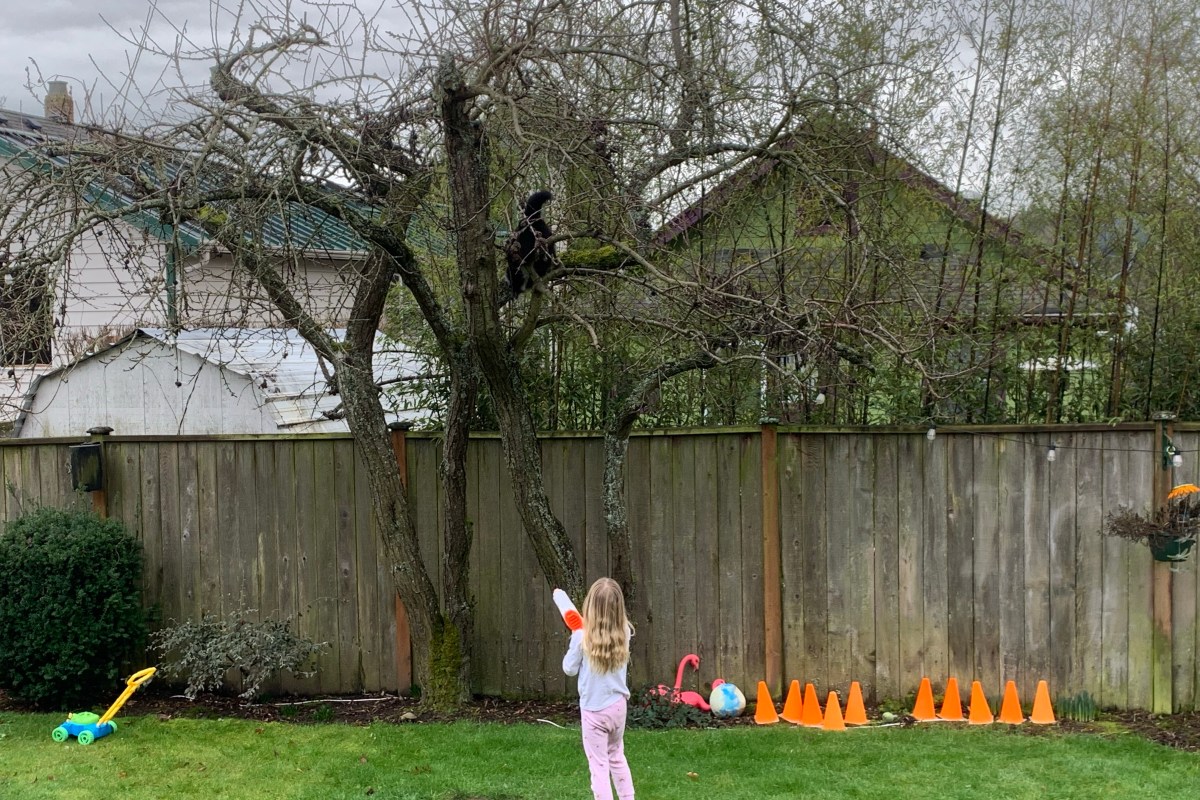
We all have Covid (mild, thankfully) and are on day 99 (feels like) of quarantine. The one household member that doesn’t have Covid, the cat, is on a diet because a recent trip to the vet for her check-up revealed that she’d gained a lot of weight under all that fluffy fur. On top of that, she has to put up with us all home and as you can see in featured photo, my daughter trying to shoot her with a water gun. So, I think it’s fair to say that we’re all a little grumpy.

In the midst of this, I’ve noticed something interesting. We do pretty well until right around 6pm. Then it turns into a scrum unless I can find a way to redirect the energy.

What I find fascinating is that corresponds with about the same time of day that the voice in my head turns self-critical. The other night I was getting ready for bed and thinking about a proposal that I needed to do the next day when my inner narrator popped up with “There’s no value you can add for them that they can’t already do themselves.”

What?? The voice was talking about what I have done for 20 years that I do day in and day out and I know based on my track record of doing it for happy clients that keep me employed that I do it very well.

This reminds me of the preface to Dan Harris’ book 10 Percent Happier in which he said the working title for his book was “The Voice in My Head is an Asshole.” My voice doesn’t usually stoop to that level until after about 6pm. And then it is always a JERK!

I am a congenital optimist. For example, when I gain weight, it usually makes me think, “Well, at least I don’t have one of those hard-to-detect cases on cancer where the primary symptom is unexpected weight loss.” There is nothing I have knowingly done to foster this optimism but life has largely worked out for me – or maybe it hasn’t and I just think it has because I’m an optimist?

That’s the problem with the voices in our heads, right? They are completely subjective, often influenced by food and sleep and given how much they change in a day, totally unreliable. But I like my optimistic voice, just not the self-critical voice that kicks in for the evenings.

This is where meditation has saved me by creating an awareness that these voices are not me. That if I sit with ideas, actions and my path for a little while, a way that rises above the fickle swings presents itself. As the quote from Buddha above suggests, wearing the ego like a loose fitting garment helps remove it more easily. Just a moment’s space between thought and speaking or action can allow peace to prevail.

This gives me an idea for the rest of our quarantine. Maybe tonight I’ll try to get the kids to sit and meditate with me after dinner and we’ll have a completely peaceful and cooperative transition to bed. As you can probably tell, I’m writing this in the morning when my optimist voice is strong…. 🙂

Underneath the Urgency

Either you run the day or the day runs you.” – Jim Rohn

I woke up this morning at 5:30am – a little later than usual. In the dark of a morning in January, I rolled out of bed thinking that I didn’t have enough time to do yoga in addition to meditate, write and read before I need to get my kids up.

I frequently feel like I don’t have enough time. I feel it on weekdays when I know I have a hard deadline to wrap things up with work so that I can go pick up my kids. I feel it on weekends when I’m immersed in kid chaos and can’t get personal to-do items done.

The more that I think about it, the more urgent it feels. Gripped by that feeling, I flail and get less done. It’s like a secret of physics that noticing the speed of time makes time go faster.

I think it’s fair to say that I’ve never enjoyed a moment in which I was gripped by scarcity. And the majority of the mistakes I make are done when I rush.

And sometimes I can sense that it’s not a feeling of not have time (lower-case t) as in just that day but Time (upper-case T) as in before I die. Recently a 63-year-old friend died of complications of cancer treatment and I have another friend who is experiencing some progressive cognitive diminishments in her mid 60’s.

When I think about these friends, not only do I feel grief for them and their families but also a little frantic. Because having kids as an older parent means I will be 68-years-old when my youngest graduates from high school. I want to be fully present for my kids all they celebrate all their growing-up milestones. And beyond.

When feeling that urgency, the only thing I’ve found to do is to slow down. It’s a sense of reaching underneath the urgency to grab the fabric of life that’s just under the surface. Gripped by that ache of not enough time, I force myself again and again to return to this moment.

This moment, the one right here where I’m quietly sitting and writing these words is full of abundance. It’s a rich moment of quiet and calm. It’s a celebration that I haven’t yet run out of time because I woke up this morning.

Sure, I have to make choices about what I can get done today and prioritize. But making those choices when in the throes of scarcity usually means I make the short-sighted one. When I’m plugged in to the power of now, I can choose more wisely. And the other secret is that most of the time, the wisest choice is opting not to clean. 🙂

Secrets

Put your ear down close to your soul and listen hard.” – Anne Sexton

This week when we are returning from holiday breaks always reminds me of one of the wackiest stories from when I was in business with two partners and we had almost 20 employees. On the Monday after New Years Day in 2008, I was in the office when the office manager came in to say that we hadn’t heard from our program manager, JE, since the Christmas party two weeks prior.

JE didn’t work for me but in a small company, I certainly knew him. I liked him too. He was smart, quiet and diligent about getting his work done. He’d left Microsoft six months before to come work for us and except for one scheduled break in late October, he’d always shown up. It wasn’t unusual for our folks to work from home, especially over the holidays but not answering emails and phone calls was definitely odd.

Since my two business partners to whom JE did report were in Mexico on a hang gliding trip, I jumped in to help. Thinking that maybe we could find his girlfriend’s name and call her to check in, I googled his name. The top result was a memo from the United Stated Department of Justice dated in October of the previous year (the same days of his scheduled absence) that read something like this:

“<JE’s full name>, 27, of <city>, WA was sentenced to six month in prison for his role as the leader of a software pirating group. He will be reporting to <low security prison> on January 1, 2008.”

Well, that explained why we couldn’t get ahold of him! When we finally talked with his girlfriend, she said that JE would be disappointed to know we’d found out because he didn’t want to let us down.

Of course, had he quit before he went to prison, we would have never looked for him!! Granted he had bigger things to worry about in the 8 weeks between sentencing and reporting to the facility but as a logical young man, it seemed obvious that if you don’t want people to look for you, you need to break up with them first.

I think of this often when someone is carrying a secret. It is an immense burden that sometimes precludes thinking and acting rationally. And often the secret itself prevents the carrier from finding the tools to heal – because developing any depth is dangerous, lest it unearth the core of what they are carrying. The secret has a life of its own that requires it to stay buried and drains a lot of energy to support itself.

At the time of my life when this happened, I had a secret too. I was unhappy in my marriage and way of life and I was diligently trying to keep that a secret, mostly from myself. I drank too much wine and then smoked cigarettes when I drank as a way to numb myself from feeling what was really going on.

Thinking back now, I realize that I was forcing myself daily to keep walking down a path that didn’t feel right. I was in a relationship that wasn’t supportive of me, I was in a business partnership with a charismatic that was making me crazy and I had developed no spiritual depth with which I could heal these wounds. All these secrets were a prison in their own way.

As it turned out, I kept my misery under wraps for another year after JE went to prison. Then the charismatic business partner told me of my husband’s infidelities and it all blew apart – the business and my marriage. Finally, no one had any secrets left and I could begin to heal. With nothing left buried, it was finally safe to develop some spiritual depth that carried me out of my prison. I can only hope that JE was able to heal once his secret was out as well.

(featured image from Pexels)

Pushing Our Limits

Only those who risk going too far can possibly find out how far one can go.” – T.S. Eliot

I just took care of my kids for 11 days without a break. Turns out that was two days too long. It was fine -we had lots of fun activities with our family and friends, new Christmas toys to play with and even two nights away at a cabin on the water. But without taking some intentional time to myself to take an hour’s walk alone or just sit on a bench and listen to sounds around me that wasn’t my kids’ voices, I hit my limit of tolerating chaos, my patience was thin and I didn’t have any of my usual zest for the experience.

Being pushed to the limit makes me think of the judgment calls mountain guides have to make on a climb. The ones that I’ve climbed with are very good at assessing an individual’s physical and mental state and making that call whether to push through or turn back.

On a five-day expedition climb of Mt. Rainier that I once did, there was a team member who when we did the group introduction said that he’d come from St. Louis, hadn’t worked out in preparation and was there for the most painful experience of his life. Then he disappeared for a few minutes while we were all packing up and returned with a chili dog. Just the thought of a chili dog in my gut as I cinched down the waist belt on my pack made me a little queasy.

When we left the lodge at 5,400 feet altitude for a five-hour climb to our camp for the night, the climber from St. Louis fell behind right away. A guide stayed with him and started the process of understanding his limits as I’ve seen practiced in the mountains several times.

Guides start by asking how you are doing to gauge a sense of your mental state and attitude. In between the lines of answers like “I just got a stitch in my side”, “I didn’t sleep well last night” or “I just can’t seem to get it together” are clues about how the climber is feeling about the journey.

Then they slow the pace down for the climber or take an extra break to see if that will help restore the equilibrium. I’ve often wondered why they don’t just turn people around right away if it seems to be a problem. But sometimes just a few minutes of rest can change the attitude from “I can’t” to “I can.”

And then, if someone is still struggling, the guide will walk the climber to the base. I’m know this is a safety thing to not leave people wandering around a mountain trying to get back but it’s always struck me as a beautiful act of kindness to walk someone home when they are done.

The climber from St. Louis hit his limit pretty early on that first day of climbing and turned back about three hours in. I never saw him again so I don’t know whether it was the chili dog or approaching the trip as the most painful experience ever that did him in.

As we face this new week, new month and new year, I think about the guides’ formula for understanding our limits: talking through how we feel, slowing down and take a rest and if necessary, having someone walk us safely back to the base when we have reached our limit so that we can climb again another day. It gives me inspiration for not only knowing when I’ve had enough but guiding others through theirs.

Sometimes we have to carry on in spite of our limits – like I had to my kids because the unusual Seattle snow hampered the breaks that I had planned. It worked out fine but I learned once again to respect the balance of life, pushing my limits and also finding a way back to home base when I’ve reached them.

Other People’s Writing: Dec 29th

I don’t know where I got this book, The Faith of a Writer by Joyce Carol Oates nor can I even say that I’ve read her work extensively. But this author of 58 novels who was first published at age 26 and taught at Princeton for 36 years certainly has so many great stories to tell about writing with sections on inspiration, self-criticism, memory and more. But it’s the description of her process that caught my attention and charmed me.

The Writer’s Studio

It’s a room much longer than it is wide, extending from the courtyard of our partly glass-walled house in suburban/rural Hopewell Township, New Jersey (approximately three miles from Princeton) into an area of pine trees, holly bushes, and Korean dogwood through which deer, singly, or does-with-fawns, or small herds, are always drifting. Like the rest of the house my study has a good deal of glass: my immediate study area, where my desk is located, is brightly lighted during the day by seven windows and a skylight.

All the desks of my life have faced windows and except for an overwrought two-year period in the late 1980’s when I worked on a word processor, I have always spent most of my time staring out the window, noting what is there, daydreaming, or brooding. Most of the so-called imaginative life is encompassed by these three activities that blend so seamlessly together, not unlike reading the dictionary, as I often do as well, entire mornings can slip by, in a blissful daze of preoccupation. It’s bizarre to me that people think that I am “prolific” and that I must use every spare minute of my time when in fact, as my intimates have always known, I spent most of my time looking out the window. (I recommend it.)

The Faith of a Writer by Joyce Carol Oates

And as a bonus selection – here’s a small part of her reflection on inspiration.

Inspiration

Yes, it exists. Somehow.

To be inspired: we know what it means, even how it sometimes feels, but what is it, exactly? Filled suddenly and often helplessly with renewed life and energy, a sense of excitement that can barely be contained; but why somethings – a word, a glance, a scene glimpsed from a window, a random memory, a fragrance, a conversational anecdote, a fragment of music, or of a dream – have the power to stimulate us to intense creativity while most others do not, we are unable to say. We all know what it was like to have been inspired, in the past; yet we can’t have faith that we will be inspired in the future. Most writers apply themselves doggedly to their work, hoping that inspiration will return. It can be like striking a damp match again, again, again: hoping a small flame with leap out, before the match breaks.

The Faith of a Writer by Joyce Carol Oates

(featured photo from Pexels)

Other People’s Writing: Dec 27th

I’m dedicating this dark and quiet week before the New Year begins to posting writing that has inspired me this year. To start, this meditation by Frederick Buechner who was a writer before he became an ordained Presbyterian pastor.

In addition to being an author and pastor, he has taught both religion and writing at a number of places including Exeter, a boarding school in New Hampshire. One of his students was John Irving, who included a quote of Frederick Buechner in A Prayer for Owen Meany. His meditations often strike me often as a writing lesson as much as spiritual guidance.

Silence of the Holy Place

What deadens us most to God’s presence within us, I think, is the inner dialogue that we are continuously engaged in with ourselves, the endless chatter of human thought. I suspect that there is nothing more crucial to true spiritual comfort, as the huge monk in cloth of gold put it, than being able from time to time to stop that chatter including the chatter of spoken prayer. If we choose to seek the silence of the holy place, or to open ourselves to its seeking, I think there is no surer way than by keeping silent.

God knows I am no good at it, but I keep trying, and once or twice I have been lucky, graced. I have been conscious but not conscious of anything, not even of myself. I have been surrounded by the whiteness of snow. I have heard a stillness that encloses all sounds stilled the way whiteness encloses all colors stilled, the way wordlessness encloses all words stilled. I have sensed the presence of a presence. I have felt a promise promised.

I like to believe that once or twice, at times like those, I have bumbled my way into at least the outermost suburbs of the Truth that can never be told but only come upon, that can never be proved by only lived for and loved.

Listening to Your Life by Frederick Buechner

(featured photo from Pexels)