Today

When you realize how perfect everything is, you will tilt your head back and laugh at the sky.” – Buddha

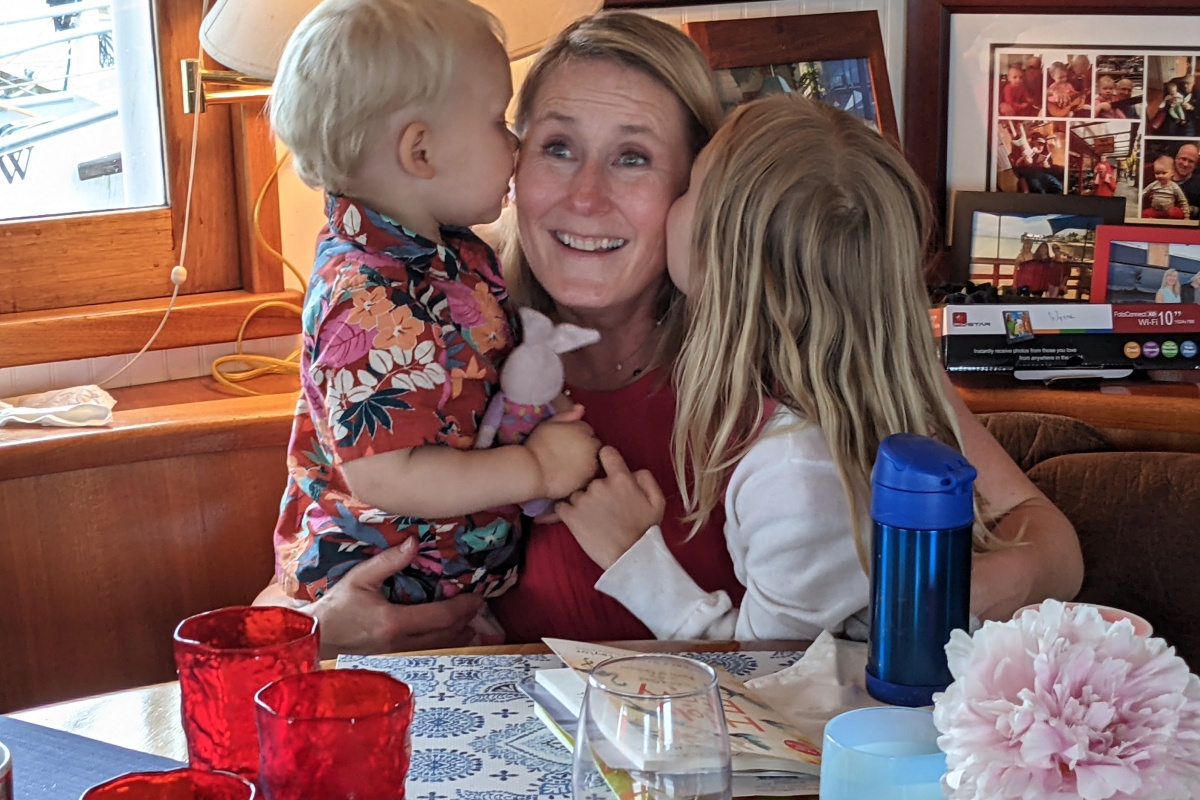
Potty training is really getting my goat. A month in and we mostly have successes but the failures are memorable! It’s unpredictable, impossible for me to control (which seems to be most of the battle) and creates a lot of laundry.

I catch myself thinking, “Pretty soon we are going to be through this and then life will be great.”

Which I think will be true. Especially if I remember how to savor today.

Because I think is how we wish our lives away and as a parent, how I could wish my kids’ childhood away. Waiting for the thing we don’t like to stop and THEN we’ll be good. Or waiting to lose 10 pounds, reach a milestone or be better at meditating – anything I reflexively put between myself and my experience.

Returning to today – we still laugh and learn every day, and I still love my kids to pieces every day. Yep, every time I leave, I just need to come back from my visit to the future and love today. And also I need to buy more laundry detergent.

Woof

You are never too old to set another goal or to dream a new dream.” C.S. Lewis

A couple of 82-year-olds that I know just got a puppy. Why is that so surprising?

Before I continue, let me dispense with the practicalities here. This couple has been married for 60 years, and are two of the most responsible and grounded people I know. They are the type of people who not only have a backup-plan but a backup-plan for the backup-plan. Also, they are surrounded by family that love them and will take the dog if the need arises.

With that said – why it surprising? As I know from training the puppies I’ve had in my life, a puppy is an investment. I think of my beloved golden retriever who passed away 5 years ago at almost 14-years old and I remember him as the amazing companion he was to me through my divorce and the start of my little family. But training him to be that companion took a lot of initial energy.

I think that we have a story that tells us that when we get to age X, we are supposed to stop investing. It might not be a conscious story but one that affects our choices nonetheless. We may or may not have adjusted that age upward based on the increasing longevity of humans but regardless, there is a time limit on when we are supposed to stop doing new things.

But, if we can be assured of the practicalities, why not get a puppy? At a time in life when one has a lot of free time, wouldn’t it be wonderful to have some young energy to keep you moving? And when your friends may be losing their hearing, isn’t there an upside to a companion that will listen to every word?

More than that, shouldn’t we be willing to keep trying as long as we are on this side of death’s door? It seems that we should at least consider whether the only thing stopping us is a story in our head that tells us there is an age where we shouldn’t love something new, try something different or take on a project just in case we won’t finish.

The couple that got the puppy are the parents of my very dear friend. When I was a senior in high school, my dad took a job in a church across the state and gave me a choice whether to move or not. This family took me in so I could finish out high school where I started. From me, their one-time wayward puppy to this new puppy, all I have to say is, “You’ve got a good home, Lady!”

(featured photo is my beloved dog, Biscuit)

Crossing the Chasm

Beautiful days do not come to you, you must walk towards them.” – Rumi

Yesterday was the first day that my daughter could be in school without a mask on. I found it to be a trepidatious experience. As a single, working parent, one of my biggest concerns is for school to be able to continue in-person. If I had to send my child in a full haz-mat suit, I would happily comply.

But broader than that, now that our state mask mandate has ended, is the question of whether I would continue to wear a mask when going into a store or resume activities like an in-person meditation class now that we seem to be transitioning to endemic mode from pandemic mode.

I’m not an epidemiologist so I don’t have an authoritative answer on mask wearing so I’m happy to follow their advice. But some of this return to normalcy feels like taking a big step to cross over the chasm.

Crossing over the chasm makes me think of some of the scariest things I’ve had to jump over or traverse when I was climbing mountains – like crevasses on Mt. Rainier. In most cases, I was lucky enough to have traversed them the first time going up the mountain in the dark. That way I couldn’t see the pit we were walking over on horizontal ladders with some plywood on them while wearing crampons our on boots which made the balance on top of metal spikes feel even more precarious. (See featured photo of my friend preparing to do this).

When I saw the full scale of what we had to do to cross back over in the light of day, that ladder was between me and the parking lot. That I had something to get back to was big motivation to conquer the fear and discomfort of crossing over.

Looking for the lure to other side of going back to pre-COVID practices and it reminds me of a Ten Percent Happier podcast that I heard with Professor Barbara Frederickson about positivity resonance. Our bodies and minds benefit greatly every time we experience a positive emotion in concert with another human. It could be as simple as a smile exchanged at the grocery store or being interested in the same topic with another person.

The more of these positive resonance interactions we have, the more we are buoyed by them and the benefits extend to our creativity, openness, willingness to get out of bed in the morning and on and on. Her two caveats for these to be possible – we have to feel safe and we have to be face-to-face. (She did say we can get somewhat of a boost on screen or over the phone but it’s harder).

There is a boy in my daughter’s class that she is particularly fond of. In Kindergarten, he was one of the two and a half boyfriends she’d told everyone about. (The half boyfriend talked too much to be a full one). Miss O was so excited yesterday to go to school to see his face which she has only really seen fully at his birthday party without a mask on. That in and of itself helped me get over my fear of this new phase of our public school lives.

May we all reap the benefits of more positive resonance.

The Ripple Effect

I’ve learned that people will forget what you said, people will forget what you did, but people will never forget how you made them feel.” – Maya Angelou

My dad once made a comment that when he focused on a topic for a sermon, there was a noticeable effect on his life. If he was preaching about parenthood, he’d be a better parent for that week. Likewise about being a better husband, friend or citizen as he focused on those topics.

As I was writing my post for Pointless Overthinking this week, The Art of Apology, I found the same ripple effect in my life. Reading through Dr. Harriet Lerner’s book Why Won’t You Apologize gave me so many great talking points for how to sincerely apologize and it also reminded me of the practice of accepting apologies, especially from kids.

Two points that really resonated with me. The first was not to brush off an apology with a “it’s no problem” when someone, especially a child, has worked up the courage to offer one.

And the second was not to use an apology as a springboard to a lecture. Responding to an apology with something like “Well, I’m glad to hear you apologize for hitting your brother because we don’t do that in this family” is the best way to make kids regret ever offering one.

When we apologize, we help heal the wound however slight for someone else. When we accept an apology, we affirm the courage of someone else to voice their mistakes.

As Dr. Lerner says “We take turns at being the offender and the offended until our very last breath. It’s reassuring to know that we have the possibility to set things, right, or at least know that we have brought our best selves to the task at hand, however the other person responds.”

The other day my 6-year-old daughter was making sticker art for people in her life. One mermaid that she made lost an itty-bitty piece of her tail and my daughter said, “I’m going to give this one to Nana. Because even though I lost the sticker, she’s a great forgiver.”

Isn’t that a great way to be known?

Asset-Framing

A small degree of hope is sufficient to cause the birth of love.” – Stendal

My mom came over yesterday with a newspaper for me because she had an extra copy. It’s been a long time since I’ve beheld an entire printed newspaper. As much as I like the news, skimming the headlines about Ukranian refugees, discord in the state legislature, the approach of 6 million deaths worldwide from COVID reminded me of something I’d heard researcher Brené Brown say. She said her therapist once told her something like, “Brené, in the time we have together each week I can’t undo the damage you do to yourself listening to the news.”

It also reminded me of an On Being podcast I heard recently where Krista Tippett interviewed CEO and Visionary Trabien Shorters. Trabien has identified our need to redefine the way we look at the world. Instead of continuing our habit of seeing problems and defining people in need in terms of their problems, a worldview he calls deficit-framing, he calls us to practice asset-framing. As Krista said in the podcast, “it works with both cutting-edge understandings of the brain and an age-old understanding of the real-world power of the words we use, the stories we tell, the way we name things and people. “

And in Trabian’s own words, he says asset-framing is “It is defining people by their aspirations and contributions, before you get to their challenges. So whatever is going on in someone’s life, you don’t ignore it, but you don’t define them by the worst moment or the worst experience or the worst potential; none of that. You have to look past their faults, to see who they really are. 

And specific to the news, Trabian and Krista talked us through an example of how the news leads us to deficit frame, to see things and particularly marginalized communities by the problems. In the original lede of the story, there isn’t anything very hopeful:

“The Latinx community in the United States has always been, for the most part, on the bottom half on income, in the American society. The struggle to have access to health and mental care is part of the history; however, the COVID-19 pandemic has come to intensify the problems.”

But the revised lede that Trabian and his team helped write started like this:

“Since 2014, Latinx people have constituted the largest ethnic group in the nation’s largest state. They now represent 39 percent of the California population.” And then it goes on to talk about “in recent years Latinx residents have made advances in economic well-being measured by metrics like reduced poverty rates, growth in business ownership.” And then after a couple of sentences like that, people elected to school boards, local offices. “Despite this impressive social and economic progress, Latinx residents have lagged behind other Californians in achieving important goals like home ownership and income growth, and we can now add to that list the disproportionate harm visited on the community by the COVID-19 pandemic.”

Listening to that example, I realize how much how the news is presented matters to our perception. It also makes me appreciate this Word Press Community even more because as the war in Ukraine has ramped up, I’ve seen so many posts that highlight the hope of how to get through it like Jane Fritz did with her post on Robby Robin’s journey yesterday.

A couple of weeks ago my 6-year-old daughter look at the news on the tv and said, “The Queen is dead.” And I had her read the banner again which said, “The Queen has tested positive for Covid-19.” The news is important, but a lot of it is how we read it!

(featured photo from Pexels)

The Outer View

To see what is in front of one’s nose needs a constant struggle.” – George Orwell

I sent this picture to my mom. She wrote back that it looked like something that could be on the cover of the Saturday Evening Post. I laughed because I snapped it to capture one sweet moment that was somewhat unusual in the typical the after-dinner chaos.

Life always looks easier from the outside, doesn’t it?

I think of a picture I took of a friend at a beach on a school field trip (back a few years ago when we could do those). She was sitting on a log with her two children nestled in her arms and I texted the picture to her adding that she looked like the quintessential mom. Her reality was probably that she was struggling to keep her children warm on a cold June day and to feed them without dropping anything into the sand.

Which is right? The inner view or the outer view?

The more I meditate, the more that I’ve come to believe that the outer view holds great promise. When meditation helps me drop the dialogue in my head that is always taking me out of the moment by planning for the next thing I need to do or recovering from the last thing that went wrong, I can see the outer view. Like in the case of the picture, I was still recalibrating after getting my kids to stop vying for a turn on the piano and also calculating how long til we started our bedtime routines.

It seems like there is a healthy and an unhealthy way to think of the outer view of our lives. The unhealthy way is to work hard to make everything appear in a certain way and then use other people’s perceptions to check to see if we are meeting up.

The healthy way is to get a glimpse every once in a while of what a trusted person sees in order to be reminded of what is so delightful about this moment.

So here’s a moment of my picture perfect life. There are other moments that aren’t as sweet but I bet when I look back on this time, this is how I’ll remember it.

Twenty-Five Words or Less

Every great dream begins with a dreamer. Always remember, you have within you the strength, the patience, and the passion to reach for the stars to change the world.” – Harriet Tubman

I was intrigued by a question in one of my meditation books, Listening to Your Life by Frederick Buechner. “If you had only one last message to leave to the handful of people who are most important to you, what would it be in twenty-five words or less?”

I came up with two versions.

Life is a never-ending raffle. Curiosity buys you tickets. Love enables you to turn them in. And, most importantly — you have to be present to win.

OR

Thank you. You have shown up, laughed with me, made me think, kept me company when it was dark. But that’s not why I love you. I love you because you are amazing.

What would you say?

Wordle as a Metaphor for Life?

You can’t win a game 7 without losing three games first. Keep going.” – Shea Serrano

As I having trouble solving Wordle the other day, I realized that I have been unusually focused on the word I used to start the puzzle. I’ve asked my friends that also play it what word they use. I’ve tried a few different ones myself, often using S-T-E-R-N since it represents some of the letters used most frequently used in English.

[For anyone who hasn’t tried to play this game that was recently bought by the NY Times, Wordle is a game where you have six tries to guess a common five letter word. You are not given any information to start with but when you enter a guess, you are told if you have any right letters and they are green if correct in the right spot and yellow if they are used on the word but in the wrong spot. Letters can be repeated. There is one word a day and everyone gets the same word so rest assured, this post doesn’t reveal today’s wordle.]

But as I typed in my word and got the result that the answer had none of those letters, I realized that knowing what isn’t in the word is equally as important.

The absence of a positive result is also informative.

It makes me think of a story about Thomas Edison. As he was trying to invent the light bulb, he tried more than a hundred different types of materials to use for the filament. Someone asked if he got discouraged and he said that he didn’t because each failure told him one more thing that didn’t work.

So Wordle is just the latest reminder that life is best met by continuing attempts to try. Every failure is just another opportunity to see what doesn’t fit. When I feel great resistance to something I’m doing in work or parenting, it presents an opportunity to think about whether I should push harder or try another tactic.

Some of life’s lessons are the hardest because we learn what not to do. But they are also some of the most valuable lessons, especially when we are able to distill the information and heal the trauma.

I did finally get the Wordle on the sixth try – phew! Because there weren’t very many letters left to combine into a common word (letters in dark gray on the keyboard indicate they have been tried and are not used in the word). It reminded me yet again, failure is an excellent source of information. Here it is in case you want to guess.

Wired to Learn

“Sharp people learn from their mistakes. But the real sharp ones learn from the mistakes of others.” – Brandon Mull

I got a new client this week. She was introduced to me by a mutual contact that told her I could help. She is clearly very bright and has done a lot of research but given the huge amount of documentation on the technology choices she has to make, she just needed someone to weigh in on what would work best because she doesn’t have time to try out every option herself.

After only a 30 minute phone call in which we talked through her options, she was ready to go with what I recommended. Of course, the technology we were talking about is my specialty and has been for 20 years but what struck me was how openly she was able to learn.

According to Nicholas Christakis, a sociologist from Yale, this is the hallmark of the human species. Christakis’ work in the field of sociology is about the long view of human history. He’s deeply optimistic about our ability to cooperate, teach others and love because we are one of the only species that does that outside of the family structure. In his book, Blueprint, Christakis lays out the case that “natural selection has given us a suite of beneficial social features including our capacity for love, friendship, cooperation and learning.”

Of course one of the places this is easiest to see has been with my kids over the last few years as they’ve learned to talk. When my son was one and just starting to talk he called water, “Mamu.” He and my brother’s wife, who was nannying for me, use to have a funny verbal game they’d play. He’d said, “mamu”, she’d say “water” and it would go on for a minute until they both broke out in laughter. And then eventually he accepted that it was water, just like he’s learned all the other hundreds of words he can say, because he trusts the caretakers in his life.

Which reminds me of my ex-husband. He had good reasons to believe his parents weren’t reliable sources of information. His dad used to say to me, “I knew my boy was smart when I came in to beat him with a belt and he asked for me to beat him with the wooden spoon instead.” And it was in his senior year of high school when he was living with his dad and step-mom and they moved in the middle of a night to a different state to avoid a tax debt without telling him (or bringing him) so he had to find a place to live on his own.

I think they were one of the reasons that he couldn’t learn from other people (or maybe the primary reason he couldn’t). And that was behind my reluctance to have kids with him was because I couldn’t bear the thought of having him experiment on children as the only way to learn the best way to parent.

So I understand that we all have different levels of openness to learning and that it might vary within a person by topic. But it gives me great hope when I witness the human ability to trust and learn like I did with my client this week. Because it resonates with what I’ve gleaned from Nicholas Christakis’ work – that we have come this far because we are wired to cooperate and learn. Coupled with Arthur Brook’s concept of crystallized intelligence that I wrote about last week, the idea that as we age we develop intelligence more suited to synthesize, tell stories and teach, it seems we have the right ingredients to pass on goodness to the next generation and beyond.

(featured photo is of my dad teaching a class)

Efficiency

“It’s not the heavy load that breaks you, it’s the way you carry it.” – Lena Horne

I needed to go downstairs to empty out the recycling bin. While I was down there, I thought I’d bring up some sodas from the store room. Then I remembered that my friend Eric was coming for dinner and I grabbed cans of the seltzer water he likes too. Before I even got to the door of the storage room, I dropped one of the cans. I picked it up, dropped it again and this time when I picked it up, it had been punctured. Nevertheless, I still continued to carry it upstairs, balancing 6 cans and a recycle bin dripping seltzer water the whole way.

<Sigh> The things I do for efficiency. 😊

This seems to be a lesson that I have to learn again and again. I think it’s a tangible reminder when I’m carrying too much.

When I slow down and do things well, I feel the simple joy of completing each task well. When I overload myself, all I feel is the sensation of juggling balance.

And then I drop one thing and instead of noticing it as a cue to empty my hands, I focus on just the thing I dropped.

Finally when I’ve persisted in bumbling my way through, I see the ridiculousness of it all and start to laugh. Humor makes sopping up seltzer water more bearable as I shake my head in wonder at my stubbornness.

I know it’s a human affliction to believe that we can contort ourselves in all sorts of shapes in order to juggle it all. And then we are reminded to put the load down, ask for help, or not do it all at once. If we listen, we are rewarded with the pleasure of doing one thing well. If we don’t, we get to laugh at our humanity while we clean up the mess.

(featured photo from Pexels)