Unlearning My Way Back

A child can teach an adult three things: To be happy for no reason, To always be busy with something, and To know how to demand with all his might that which he desires.” – Paulo Coehlo

My sister-in-law recounted a conversation she had this week with my daughter, 7-year-old Miss O while holding hands and walking through an outdoor shopping center near our house.

Miss O said, “I love this place. Fun stores, good food, no BS”

My sister-in-law paused for a beat, wondering if she should ask, hoping Miss O didn’t know what it meant, and then asked, “Do you know what BS is?”

Miss O replied brightly, “Of course! Bad Service!”

After I stopped laughing, I wondered why it is that we think it’s bad for 7-year-olds to know swear words. Other than the fact that their executive brain function isn’t fully developed and they might deploy them inappropriately, indiscriminately or both. I landed on the fact that it feels like a loss of innocence.

I heard an interview once with singer and songwriter Billy Bragg where he posited that the opposite of faith isn’t doubt – but cynicism. If I think of Miss O using bad language, it feels cynical as if some beliefs of childhood would have had to have suffer in the process.

At their age, Miss O and Mr D believe that:

They are loved beyond measure and worthy of love

If you pray, those prayers will be answered

There is magic in the air so that sometimes fortunes found in fortune cookies will reveal the next fun thing

Potential new friends are everywhere

If you cry and show your vulnerability, you will be taken care of

Looking through this list I’ve typed, I think that I need to unlearn my way back to those beliefs. Because my cynical self might have been feeding me a lot of BS instead – and by that I mean bad service, of course. 😉

Thanksgiving Prep

Everyone is my teacher. Some I seek. Some I subconsciously attract. Often, I learn simply by observing others. Some may be completely unaware that I am learning from them, yet I bow deeply in gratitude.” – Eric Allen

In this week leading up to Thanksgiving, Miss O has taken on the extra job of cleaning all the art supplies and projects off the dining room table before our seven guests show up tomorrow. As I help her, it makes me think of all the Thanksgivings we’ve celebrated there – the years when my kids were tiny babies and we passed them around the table from person to person, the years that my nieces were young and we ended up doing exercise contests before and after dinner. Then there’s the year where it was the first holiday after my dad died and we felt his absence so powerfully.

But one of the most infamous Thanksgivings in this house was the one right after my husband and I separated and I invited him to dinner anyway. It’s the subject of my Wise & Shine post this week: Guess Who’s Coming to Dinner?

I hope you read it. But more than that, I hope if you are celebrating Thanksgiving this week, you feel my gratitude for you as part of this wonderful WordPress and blogging community. I’m grateful for you. Just to be clear, I hope you feel that gratitude even if you don’t celebrate Thanksgiving.

High Expectations

Things are always in transition. Nothing ever sums itself up the way we dream about.” – Pema Chodron

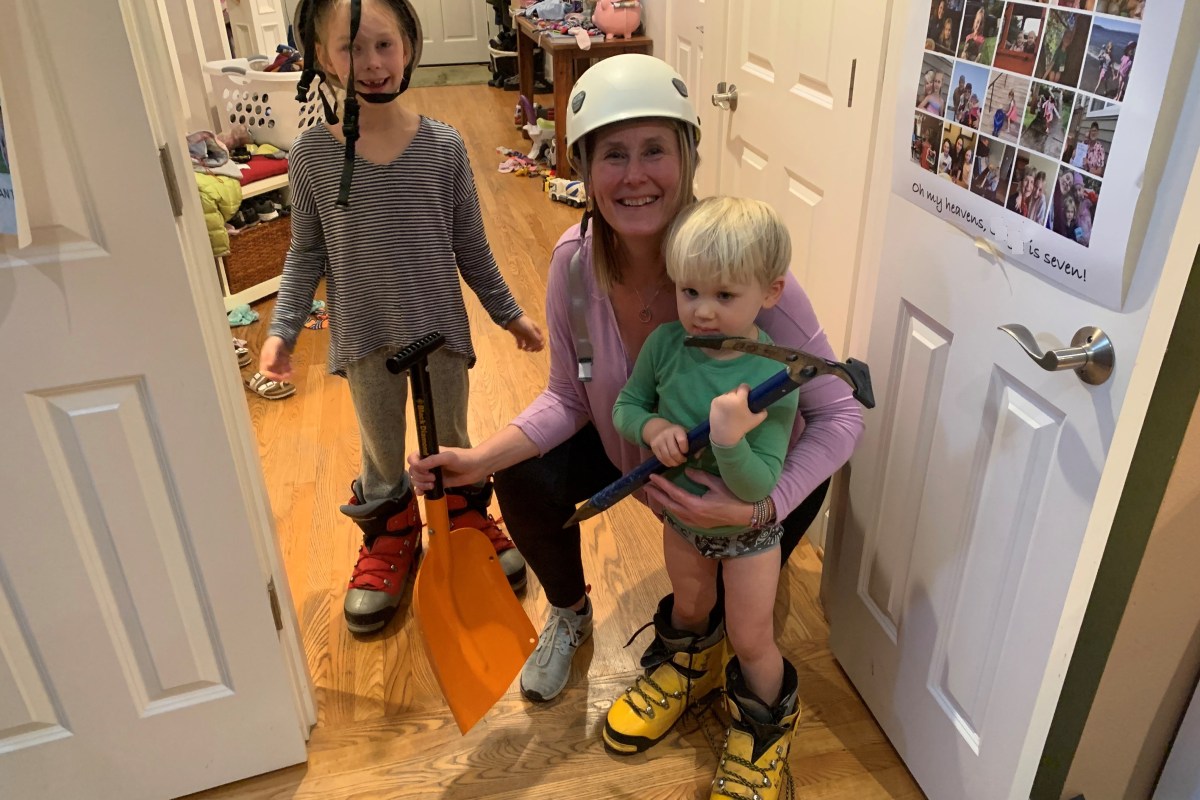
Yesterday I delivered a presentation on mountain climbing to Miss O’s class at school. My friend, Doug, who I’ve done a lot of my climbing adventures with, joined me and we had a talk filled with pictures, a lot of equipment, and stories. We also had the most enthusiastic audience of second graders (Natalie, Chaya, Belle and all the other teachers out there, hats off to you for years of being teachers to these young and energetic minds).

Miss O had been so excited all week. She’d told me and her teacher that she’d written “best week ever” over her mood meter assignment. And then when Doug came to stay the night before the presentation and we started packing our climbing gear, she extended that to this was going to make 2nd grade the best grade ever!

So it surprised me when Miss O had to step out of the room to collect herself in the middle of the presentation. Through teary eyes, she told me that she felt that Doug was bypassing her when he handed out all the equipment. Which might have been true to some degree since she’d handled all the stuff the night before.

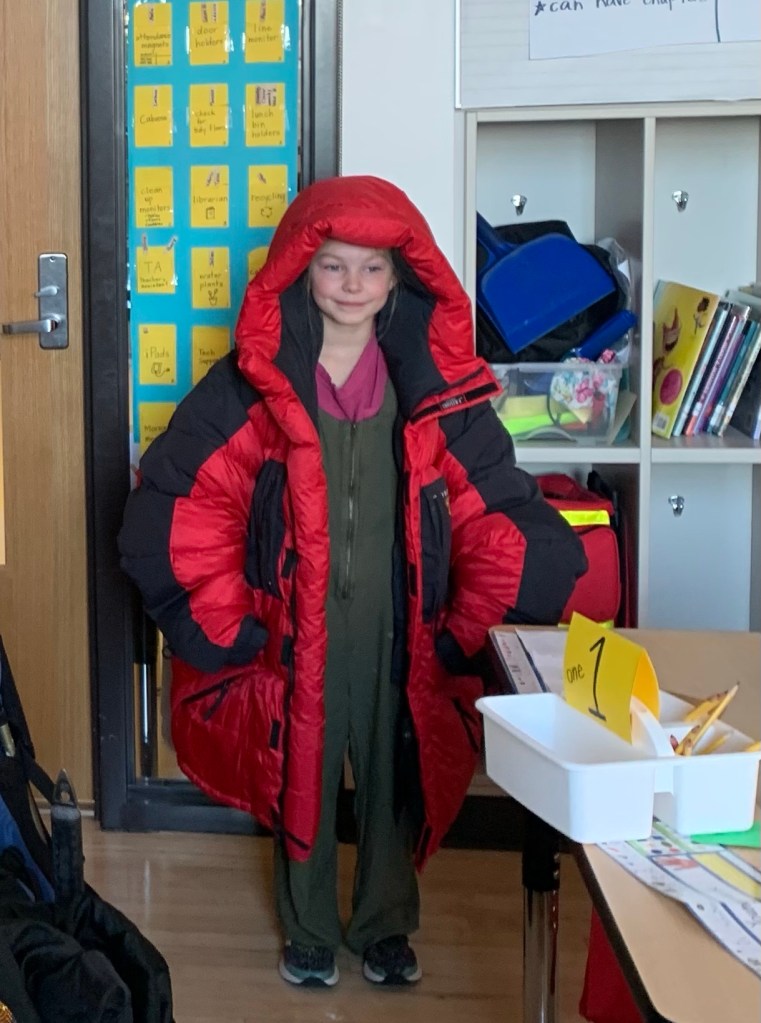
But I think it was more that her expectations were SO high. And I think she had a picture for a part that she’d play in the presentation or how it would reflect on her that didn’t quite match to reality. She modeled my climbing parka but mostly she was a participant.

This reminded me of every big occasion in my life – parties, birthdays, holidays, presentations – I’ve always felt a let down when they passed and I was still the same person afterwards. All that looking forward to something and then I’m still me with my same life when its done.

I’m projecting here because these aren’t the words Miss O used when we talked about it later but I think it’s a fairly common experience after we look forward to something. As Pema Chodron says in the quote for this post, “Nothing ever sums itself up the way we dream about.” There’s a mismatch between how we imagine in and how we experience it, and more than that, there’s an exhale after its done and before we find the next thing to look forward to.

At the end of the presentation, I told the story of friendship brownies. It was the climb that Doug and I were doing and we were climbing on Doug’s birthday. His wife asked him to carry some brownies to celebrate and he said “no” because he’s vigilant about only carrying what’s necessary. So she asked me and I said, “Sure” because we sometimes carry weight for our friends when they can’t or won’t do it themselves.

Miss O passed out the friendship brownies to the class and so it all ended well. Then she asked me to tell the story of the guy who was dancing with his toilet paper and I think those 2nd graders might have liked that one the most! Hard to tell whether ending with potty stories meant we ended on a high note or low one but the audience, including my delightful daughter, was pleased.

Meaningful Interaction

Many people will walk in and out of your life, but only true friends will leave footprints in your heart.” – Eleanor Roosevelt

I was reading an article written by a single mom with kids who was bemoaning her situation in life. And there were many things I could relate to even though her kids are a lot older than mine (maybe in their 20’s). Because it’s hard to live in a house where you are loved dearly but not really cared for.

But there was a lonely note in her writing that I couldn’t place. So I looked up loneliness in Brené Brown’s Atlas of the Heart. Brené includes the definition of loneliness as defined by social neuroscientist, John Cacioppo and his colleague William Patrick as “perceived social isolation.” And Brené expands on this with “At the heart of loneliness is the absence of meaningful social interaction – an intimate relationship, friendships, family gatherings, or even community or work group connections.”

It brings to mind two times in recent years that I’ve felt lonely and had to adjust my social interactions to make them meaningful. The first was when I first became a mother. I remember one night I courageously left my daughter with a babysitter and went to a restaurant to drink wine and watch a Seahawks game with a good friend. I had fun – but the next morning got up and felt empty because what used to be fun for me longer met my needs. I longed for more meaningful interaction.

And the second was when the pandemic started. All of a sudden my meaningful interactions with other parents were eliminated or reduced to online. I had to find another way — and that eventually led me to blogging.

Thinking about Brené’s comment – it isn’t about how many friends we have or whether we are in a partnership, it’s about whether we are meeting our needs for depth. In fact, I think the loneliest place I’ve ever been is inside a committed relationship. I send a wish to the author of that article and for us all to have the focus on cultivating friendships where we are seen.

What makes you feel less lonely? What counts as meaningful interaction for you?

(featured photo from Pexels)

Lying or Telling the Truth?

We are here to live out loud.” – Balzac

I remember reading a parenting book that stated that by age 4, kids lied on average about once every 2 hours and by age 6, every 90 minutes. I’ve never seen a statistic about how much grown-ups lie, it’s probably not even measurable.

But I generally believe most things people, including my children, tell me. I think what is truly dangerous aren’t lies but instead when we forget to tell our truth. It’s the subject of my latest post on Pointless Overthinking: Conditions of Truth.

(featured photo from Pexels)

Patience To Stay Open

Fear wants us to act too soon. But patience, hard as it is, helps us outlast our preconceptions. This is how tired soldiers, all out of ammo, can discover through their inescapable waiting that they have no reason to hurt each other. In is the same with tired lovers and with hurtful and tiresome friends. Given enough time, most of our enemies cease to be enemies, because waiting allows us to see ourselves in them.” – Mark Nepo

I have a friendship that is in trouble. When I ask my friend questions about herself, she doesn’t answer but instead redirects the question. This is change in our 10+ year friendship. I’m not sure the cause but I’ve supported my friend and her husband through some difficult issues so my suspicion is that it’s more important to her to have a seemingly friendly relationship where I remain “on her side” rather than an authentic one where she has to tell me what’s bothering her or what I’ve done.

Just writing about this makes me a little light-headed. Because it touches on the divide between barely living and living barely. That is to say, I spent too many years barely living when I pretended that life was great and I buried all suffering deep down. Then I discovered that living barely, trying to keep the thinnest possible covering between my heart and the world actually lets more things in and more importantly, more things out.

But just because I want to try to live without pretense doesn’t mean my friend can right now. And what I understand from my tentative attempts to open a space between us to speak is that she isn’t ready to talk.

So I’m trying not to break things in my impatience. To declare the friendship over because I can’t stand the uncertainty or to insert a defensiveness because I don’t understand. Or to assume or imagine anything.

My dad told me of a group of olive farmers he met who owned a prime piece of land in a contested part of the world. Even though they had a deed of property they were regularly hassled by local soldiers. They developed a motto, “We refuse to become enemies.

That phrase has stuck with me of a reminder that no matter what the other side is doing, we can keep open the channel of our hearts. The motto tells me that we can be in conflict without stirring up that fear within.

When something reminds me of my friend, I’ve found that instead of ruminating on the problem with all the dark alleyways of anxiety I can say a quick loving-kindness chant: “May I be happy, may you be happy; May I be at peace, may you be at peace; May I be loved, may you be loved.” It helps keep me from closing down.

What do you do when things aren’t going well with a friend?

(featured photo from Pexels)

Both And

Well, you can’t make old friends.” – Zadie Smith

The other day, my mom asked my daughter how her best friend, the little girl that lives next door, was feeling about having to move 1200 miles away in a month. My daughter replied that her friend was excited. And then she added, “And that makes me feel sad.”

The conversation moved on so thankfully I didn’t have to follow-up on that one right away because I find that subject to be tricky. How to be happy for others even when it means a loss for ourselves.

Years ago when I had a corporate job, I hired a former colleague to come work for me. He worked for me for about a year and I had given him some great opportunities and he had done a fantastic job. Then he announced that he’d gotten a job at Microsoft and was quitting and I felt hurt and betrayed. I don’t think I could talk to him at length for a week. Down deep I was happy for him and eventually I got there so I was happier for him up top as well, but I definitely felt the challenge of summoning my best self.

Listening to a Ten Percent Happier podcast with cognitive scientist Maya Shankar gave me some insight on why it’s so hard. She said “We don’t like change because it almost definitionally involves a loss of identity and that’s very destabilizing. I think as humans we often attach ourselves to specific identities as we move through the world because it gives us a sense of security.”

When I use that lens to apply to my work situation with my colleague, I can spot the identity I was inhabiting easily. The man that I hired was also someone I had championed previously when he was switching into the field of technology from his career in the military. I had spent a lot of time and energy helping him adjust to the change of culture and expectations and hopefully imparted some technical knowledge as well. When he quit, it challenged my sense of being a mentor.

In return, he had done the job beautifully and when I got over myself, I could appreciate that. It required me to disconnect from that specific identity to a more general sense which is that I draw a lot of satisfaction from helping other people.

In a quiet moment at the end of the day my daughter made that comment about her friend, I asked her some more questions and we talked about how she could be both/and. That is to say both sad that her friend was leaving and hopeful that her friend has an exciting new adventure when she moves. And that neither takes away from the friendship they have today.

(featured photo from Pexels)

It’s in the Comments

To listen with an open heart and ask questions to better help us understand the other person is a spiritual exercise, in the truest sense of the word.” – Harriet Lerner

Yesterday I re-blogged a post about sliding glass door moments, the moments where you see the life you could have on the other side and choose whether to open the door and cross that threshold. Deb commented on it and mentioned that solid door moments, those times when we have no real sense of what’s ahead yet we know we need something in our life to change, might take even more courage to pass through.

Wow, did that make me think. It is just one example of the very many where a comment has expanded the envelope of my thinking. Which is the wonderful effect of comments. They often drive me to a deeper understanding of myself or the topic, sometimes both.

But when I first started blogging, I found commenting hard. Did I know the author well enough that a typed comment would be relevant? Was I interpreting the material correctly and would I be on point?

Maybe first time comments are like tiny solid doors – we often have no real idea who’s on the other side and whether our typed message which is often a bid for friendship will be accepted or even acknowledged. But you have to open it to find out whether or not the person on the other side wants to sit around your coffee table, to use my analogy of blogging from last week, or just speak from the podium.

What do you think about comments? How about the experience of commenting?

Holding Space

True friends are those who lift you up when no one else has noticed you’ve fallen.” – unknown

The other night I was reading books with my two-year-old and he whispered in my ear, “You are the best girl.” It was such a sweet and tender moment that gave me the shiver of recognition of what happens when we hold space for one another.

In the Disney Cars movie, Lightning McQueen starts out as the hot shot rookie that only cares about himself until he discovers the feeling of community and values in Radiator Springs and then finally emerges as the worthwhile competitor that knows that there is more to life than winning.

It’s actually in the third installment, Cars 3, that they use the line that Doc Hudson, Lightning’s gruff mentor (voiced by Paul Newman), “Saw something in you that you couldn’t see in yourself.” It’s a wonderful statement about hope and potential.

When we hold space for others, we store the image of their highest, purest selves so that when they are in the messy middle of anything, we can reflect it back to them. This reminds me of friend who became disoriented and demoralized while trying to reach a goal and we sat on a bench overlooking Puget Sound and unraveled why it was she started.

When we hold space for others, we capture the essence of who they are they are in the squishy, vulnerable core underneath any job or external validation so that if they get lost in work or a relationship, we can huddle with them and tell them we still see them.

This brings to me the moment when my friend Doug called to ask if I would climb Mt. Adams with him and his son this summer. He knows I am knee deep in raising these two kids, have been distracted by all that entails and I’ve not been a very present friend, but his offer stirred me deep within and I was so grateful he remembered me.

When we hold space for others as they age, we become the safety line back to the boat of their life, even when they don’t remember themselves. When my great-aunt Wilma was suffering from Alzheimers and nearing the end of her life, her son arrived on his weekly visit to talk with her and bring her favorite treats. She sweetly said to him, “You are so nice. You remind me so much of my beloved son Gary.”

When my son uttered, “You are the best girl.” he was just parroting back what he’s heard said. But he also reminded me that there’s a purity in the simple way he sees me that has everything to do with our relationship and nothing to do with what I accomplish. It made me think that relationships, parenting and families, when they are functional, can be repositories for our essential selves. We hold space for each other for the moments we need to come “home” and recharge.

What does the phrase holding space mean to you? Do you have a good holding space story?
Here and Now

How simple it is to see that we can only be happy now, and there will never be a time when it is not now.” Gerald Jampolsky

Last weekend as I was planting some new strawberry plants in a planter next to some well-established ones, the 8-year-old girl from next door reached out to gently finger the leaves. “I am going to move before these strawberries come” she said a little wistfully but not too sadly.

As I wrote about in the post The Long Good-bye, our neighbors and my daughter’s best friend are moving to a city 1,200 miles away in 3 months. Every time I see the girl, she says something about moving.

“I want to ride bikes to school again before we move.”

“I think we are going to start packing soon.”

“Eighty-seven days until we move.”

I asked my daughter how her friend feels about moving she says disappointed to be leaving but excited to have a bigger house. Watching this happy and social child talk about her family’s plans, I recall that before this move came to be, the farthest forward time I ever heard her mention was dinner that night.

I know leaving now to imagine what the future might be like is pointless. More than that, every time I give in to worry over the specifics of how it might come to be I feel the drain of energy and faith that pulls at me.

But there is nothing like watching a child leave right now to visit some fuzzy future to illustrate the point. I see her eyes get a little unfocused as she tries to imagine what her days will hold in this vision she has no control over. Then she gives an almost imperceptible shake and returns.

This little girl calls my daughter her soul sister and me her soul mother. Trying not to mother too much, I mentioned that we don’t even know if the strawberries will bear fruit this year but there were some inside right then if they wanted to taste the present.