Writing a Good Ending

The discipline of creation, be it to paint, compose, write, is an effort towards wholeness.” – Madeleine L’Engle

At this point 30 years into my career as a computer consultant, I’m always surprised when I go through periods of not knowing. When I was younger, I thought that I’d surely know it all – if not by 30, then by 40, and for certain by 50!

But now here I am in my 50’s and I still face periods when what I’m doing is a little fuzzy, as has been the case the last few weeks. Of course, it rarely has to do with the technology even though the tech is always changing, but often has to do with the people. In this case, I’ve been working with a new client on a lot of projects and fitting into their team and especially their process has left me feeling tentative and kinda stupid.

Here’s the secret that I have to rediscover every time I face certainty like this. When feeling out of sorts, I just need to stay open. When I do, I’m able to ask more questions, and to listen better. My instinct, however, is to retreat. To say something like, “I’m not sure this is a good fit” and run for the safety of my familiar clients and projects.

And yet sooner or later, I find myself back on mostly solid footing. Yesterday, after weeks of feeling low-grade dread, I woke up, and I knew what my next step on two of my new projects with this client were. Yay! I suspect I wouldn’t have always surfed these waves in my past, preferring to feel like I know what I’m doing, and by being spoiled by usually knowing how.

Here’s the thing that I think has helped me, especially this time. Writing. Yes, because it’s self-care and therapy. But also because I’ve grown used to not knowing where I’m going when I sit down to write. I often start with an idea, but then have to type my way there. Sometimes, it’s getting two sentences on the page, erasing one, and inching forward in that fashion. Other times it flows more naturally. Either way, I’m often surprised at the progress I make just by dedicating myself to sitting down, and letting it flow.

As is the case with this new team and project. I found myself reluctant to sit down every day and engage with them, especially with one chap who admits to getting a “little cranky as he gets older.” [A little???] I felt as unsure as I did when I was just starting out 30 years ago. Okay, maybe it wasn’t that bad but still.

So I’d sit on my meditation cushion every morning with the image of breathing out the anxiety, dread, and self-doubt, and breathing in fresh inspiration and renewal from God, the Universe, my guides – any Power bigger than me. The image was all the dingy-gray clutter leaving via my feet on the out breath, and yellow, white, gold inspiration streaming into the top of my head with the in breath.

Now as I type this, I’m a little surprised at the ending – of this piece, of the period of uncertainty, of the week. I’m glad that I don’t know it all – the a-ha moments and surprise are always better than I could have imagined.

(featured photo from Pexels)

Healthspan

Aging is an extraordinary process where you become the person you should have always been.” – David Bowie

Listening to a recent Ten Percent Happier podcast, The Science of Longevity, with Dan Harris and his guest, Dr. Peter Attia introduced me to a new word: healthspan. Dr. Attia specializes in longevity and he was talking about his recently published book Outlive: The Science and the Art of Longevity

“There is this other component that if really I think push people will acknowledge is more important to them and that is healthspan. Which is harder to understand and define because it’s not binary but it’s an indication of quality of life. The medical definition of healthspan is the period of time from which you are free of disability and disease. I think some definition of healthspan needs to touch on physical robustness, cognitive robustness, and emotional resilience and health.”

Dr. Peter Attia, Ten Percent Happier Podcast

As I celebrate another birthday, this seems like a topic worth digging into. After all, when I grow up, I want to be just like our blogger friend, Julia Preston, who published a fantastic book at age 83, Voices: Who’s In Charge of the Committee in My Head?, and who regularly sprinkles this blogging community with delight, joy, and encouragement.

So how do we do it? Dr. Attia had five main areas: exercise, nutrition, sleep, pharmaceutical tools, and emotional health.

Exercise is the tool that turns out that it impacts lifespan (and healthspan) the most. The more exercise the better – he describes it as “the most potent longevity drug in our arsenal.” I found his breakdown on what we need to be very interesting – of the time we spend exercising, he gave the rough rule of thumb as half aerobic and half strength training. And of the aerobic half, 80% low intensity, 20% high intensity. For the strength half – 80% strength and 20% stability.

His comment on what we should do was more nebulous. It turns out that measuring our VO2 max is the best predictor of longevity, which matches what I remember when writing The Unified Theory of Breathing drawing from James Nestor’s book Breath. So the exercise we choose should ultimately improve our VO2 max because it is the best “predictor of length of life.”

Strength they measure by grip strength. Dr. Attia threw out this comparison: “If you compared the top 10% of grip strength to the bottom 10% – there is a 70% reduction in both incidence and mortality from dementia.” He followed that up with that it isn’t that they believe a strong grip protects the brain, but it works as an indicator.

The other bucket that really interested me was emotional health. Dr. Attia made the point that this one is different because it’s not age dependent but it affects the quality of life throughout. If we don’t have emotional health, we can make life more difficult for ourselves and those around us. Which makes me think of one of my favorite Oscar Wilde quotes, “Some cause happiness wherever they go; others whenever they go.

For me, my emotional health toolkit contains faith, meditation, writing, and love. When I start the day with meditation, faith, and writing, I have a better chance of facing the challenges of the day with openness and less worry. These tools help me put down the stuff I don’t need to carry and keep so that I can face the day, and my loved ones, with open arms.

Growing up with two parents who made emotional health look easy, I didn’t develop my toolkit until life tossed me around a bit. I thought enthusiasm and optimism could cover everything over. Maybe we all have maladaptive ways of doing things we have to relearn but don’t have the opportunity until life gives us something to practice. It makes me think of all the tools I carried when climbing to help in the case of falling into a crevasse or needing to rescue someone else. Thank goodness I never had to use them – because all I knew was the theory of what I should do, not the adrenaline packed reality of facing the tough situations.

But now that I’ve had plenty of opportunities to find out just how important emotional health is in the quality of life, I’ve found that doing my work, just like exercise, truly makes such a difference. There might not be the statistics to compare what happens when we do or do not do our work as it relates to emotional health, but I know for me, it is the key to enjoying each day that I’m lucky enough to walk on this green earth. And for each of these days I have in my life span, I’m so grateful. So thank you all for being part of my tool kit!

Speaking of someone who has done her work, I was lucky enough to have a wonderful podcast conversation with Vicki Atkinson about her book, Surviving Sue. As we talked through the themes in the book, she told me about doing the work to turn her well-deserved anger at her mother into compassion and positive regard. Episode 22: Themes in Surviving Sue with Vicki Atkinson

It’s a great episode, please give it a listen and subscribe! Search for Sharing the Heart of the Matter on Apple Podcasts, Amazon Music, Spotify, or PocketCasts or click on the link above.
Having Lunch with God

Everyone’s life is a fairy tale, written by God’s fingers.” – Hans Christian Anderson

The other day I read the suggestion in a meditation book that we could talk to God, whatever our idea of a Higher Power might be, as if God was our friend. I’ve been pondering it ever since because chattering away to the Universe about the latest cute thing my kids have said, relating the story about spilling water on my pizza, or who I have a crush on doesn’t match with my idea of prayer.

But it has me thinking about faith, prayer, and God in a slightly new way. That is, the one phrase that I hear said to me by my friends, the one that is consistent whether they be new or old friends, male or female, is “you don’t ask for help.

As is often the case with new angles, it’s led to an a-ha moment — that would likely be the same thing that God would say to me. I’ve long known that I tend towards doing instead of being and am impatient. The result is that I’d prefer to take things into my own hands instead of waiting for the Universe to work its magic.

If there’s a consistent trend that I notice looking back at my life so far, it’s that it’s only after I’ve mucked around trying to make things happen my way, only then do I sit back on my heels and try vulnerability, faith and patience.

This makes me think of Brené Brown’s recap of Joseph Campbell’s The Hero’s Journey. The protagonist tries everything they can to complete their quest, ruling everything else out, until they finally concede the only way through is to be vulnerable.

If God were a friend, I imagine I’d show up for our lunch date a little harried by life and then after a warm hug, sit down to change gears, and breathe deeply. I’d pick up the menu, only to put it down immediately so I could focus on the presence before me, and remember how good it is to sit in the company of my friend.

Ah yes, God and I would have a good laugh about my proclivity to engineer life and to try work above my pay grade. But then I’d thank God for all the wonderful ways God has delivered amazing miracles and results in my life, even when I couldn’t see it at the time. And then maybe we could work out a signal of when I’m supposed to stand down and ask for help.

If God were a friend, I’d ask questions about climate change and gun violence because I imagine God could provide a bigger picture view that would help inspire and motivate my efforts in the right direction. I would have the opportunity to ask, “How can I help?”

I’d unload the things the things that feel burdensome and heavy, share my recent mistakes that I haven’t quite forgiven myself for, and I’d glean a little insight about myself from how my friend responds.

I’d tell stories about Miss O answering why she got dressed on a weekend morning before she had to, “I want to be ready for the future.” I’d tell about the other night when Mr. D was fitful because he didn’t want to be back from our mini vacation, and in the middle of the night he sat up in my bed and said, “Mama?” And when I tiredly answered “yes”, he sighed and laid back and said, “Nothing.”

I’d remember to turn and ask, “I don’t have a map. Can you help me get to wherever I’m supposed to be going?” And I’d walk away a little bit lighter because of the time spent in the company who lets me know I’m loved, understood, and supported.

Maybe God has been a friend this whole time.

I also publish posts on the Heart of the Matter blog on Mondays. The Journey to Wholeness talks about writing about life from the understanding that comes from the second half of life.

(featured photo from Pexels)

Sunday Funnies: May 14

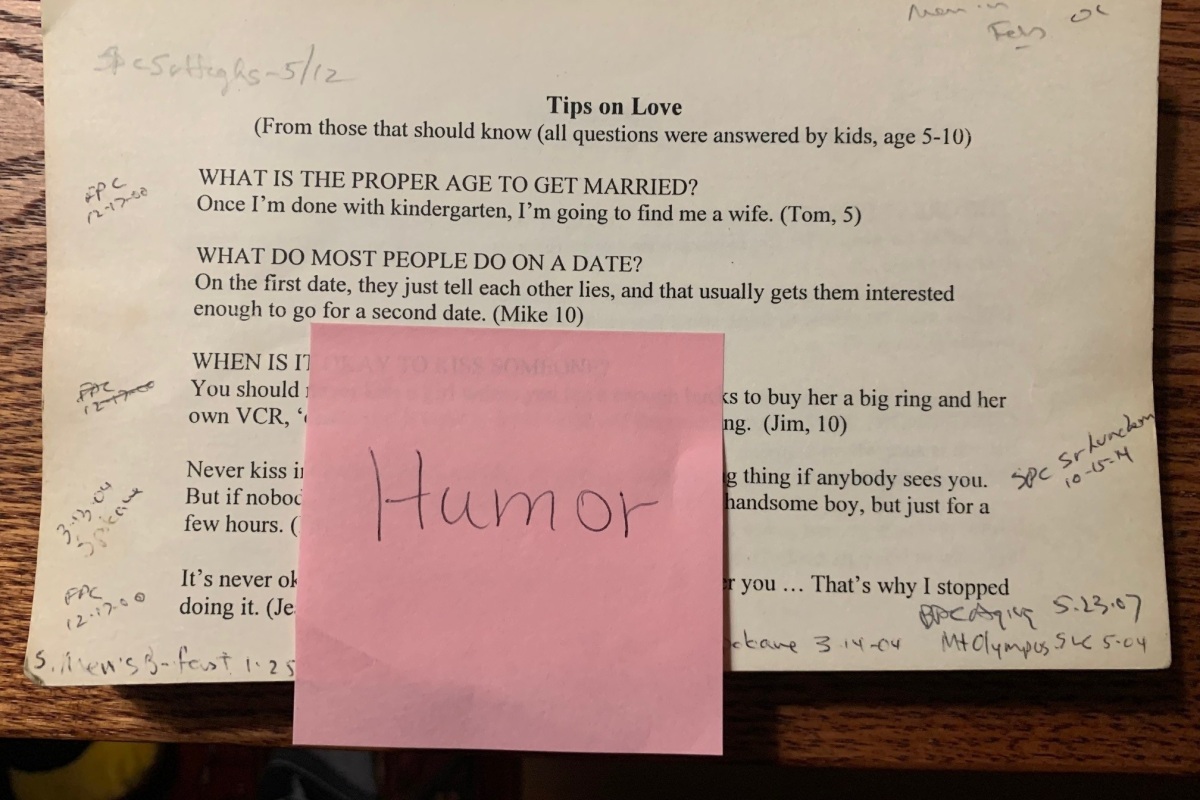
A re-run of my dad’s humor cards. They make me chuckle all over again – so I hope you enjoy them whether it’s the first time or second (first posted on 3/27/22).

The backstory: My dad was a Presbyterian pastor for 40 years. He kept a well curated stack of humor cards – little stories he heard, found or saw and then typed onto 5×7 cards. Then he wrote in the margins when he used that particular item. His humor was often an easy way to settle in to something deeper – by laughing and thinking about the buried truth in these little nuggets, it paved the way to an open heart.

Potty Talk

A woman in England runs out of petrol. She can’t find anything to carry gas in – until she spies her child’s portable potty. She walks 3 km, gets the gas and returns to the car. She is pouring it from the potty into the tank when a Cadillac pulls up beside her.

The window rolls down to reveal four men from Saudi Arabia looking at her with astonishment. They finally say, “Ma’am, we don’t share your religion, but we want you to know we admire your faith.

Looking in Through the Sliding Glass Door

May your choices reflect your hopes, not your fears.” – Nelson Mandela

The other night, I was standing at the kitchen sink putting the final dishes for the day in the dishwasher when my kids walked into the kitchen after bedtime. I caught sight of them – seven-year-old Miss O in the lead hugging her stuffy close and three-year-old Mr. D seeking a little comfort by standing in the shadow of his sister and wearing his little dinosaur shorty pajamas. I had to turn back to the sink for a moment to try to put my game face on. It was a clear violation of bedtime rules and I needed to try to assemble some sort of serious countenance because seeing them quietly standing there had totally melted my heart.

It was like I caught a vision of the reverse of Brené Brown’s sliding glass door moments. She describes those as the small glimpses where you see the life you could have on the other side and have to decide whether or not to cross the threshold.

In this case, it was like I was on the outside looking back in at the life that I created for myself when I made the choice to have kids. I had a fleeting flash of what walking through that sliding glass door into this life has delivered.

I saw my life has been redefined to drop most standards of cleanliness and order, and all attempts at perfection. Instead it has become a continuous re-sorting of my priorities so that I’m trying to do what is important in the moment. And in the shuffling, I’ve come to discover that I can repeatedly choose my kids, myself, and family instead of arbitrary external markers of success.

The glimpse let me see that I’ve gotten better at “being” instead of “doing.” My kids are a lot of work and in a strange paradox they have taught my how to let work go – to relax and slow down. I get so much less done – but I laugh so much more while I do it. And when I don’t laugh, when I’m all bound up and tight – these two are my sanity check to reground myself in why.

I glimpsed how the power of believing this all is my choice has carried me through some really tough times of sickness, sleeplessness, and carrying too much weight. Simply knowing that I chose this has given me strength I didn’t know I had before.

I saw my transformation to believe in miracles – because I’m living with two. And my kids continue to be miracles long after they were born because they’ve become my teachers. I thought I would be the teacher and they would be the learners – only to find out that I’m the one learning about how to have a meaningful and authentic life. Those lessons come from the myriad of interactions that we have had to crouch and look at bugs, stuff our pockets full of rocks, snuggle together to talk about feelings, quietly draw and color together, run excitedly to the beach on vacation, fold into each other while reading books, lash out in anger at boundaries, fear, and discomfort, and heal together holding hands when we’ve talk/acted/laughed it out.

By becoming their lightening rod for big emotions, I have learn to cultivate my own emotional intelligence about the weather inside me. They’ve taught me to choose joy. Not happiness, but joy!

In that moment, I caught a sense of how everything that transpired before I had kids has come together to help – my love of outdoors, my family, my gaining a sense of going with the flow, the endurance training. And most of all, my faith, and that has the goodness of my dad all wrapped up in it too.

I saw that “me” had been completely replaced with “we.” That I have given up the ability to make unilateral decisions and in return have been gifted with a life filled with heart.

From all of this, I was left with a heart melting feeling. Seeing my kids both as the precious, earnest, and delightful little ones that they are and the courageous, free, and integrated people they are becoming. And seeing myself as the same.

After being gifted with this glimpse of things, I finally turned to my kids to hear them out as to why they were out of bed. They’d been fighting and needed a referee. My little flash of perspective helped me choose not to be irritated or impatient but instead just listen. I told them I loved them and sent them back to bed.

My post on Wise & Shine today is about my mom’s choices: The Choices We Make: My Mom the Spy

Leaning in To Letting Go

The only way to make sense out of change is to plunge into it, move with it, and join the dance.” – Alan Watts

It seems like for every lesson I’ve learned in my life, I can trace it back to a particular story. Is that a sign of middle age? In this case, I’m thinking of the lesson of learning to let go and a consulting project I did for Microsoft about 25 years ago.

My colleague, Bill, and I were assigned by the consulting firm for whom we worked to write a white paper for a client at Microsoft. It was the late 90’s and Microsoft was in that phase where it was growing so fast that there wasn’t a lot of process but instead a lot of hard-working but perhaps egomaniacal cowboys.

Our assignment was to write this paper about how a group of these cowboys rolled out a new email software at Microsoft. Bill and I were experienced at deploying that software and had published a book about it so theoretically, this project should have been a snap.

After interviewing the key players, we drafted the paper. They hated it. We revised it. They still hated it. They would call us to meetings to tell us in detail how much they hated it. The problem wasn’t the technology – it was that we didn’t get the tone right. We didn’t think they were as cool as they thought they were so we missed the mark over and over again.

I can’t remember how many versions of that paper we wrote. Maybe five? But after torturing us for a while, they finally fired us and wrote it themselves. It hurt. I felt like I’d been at a rodeo and had hung on way too long.

I went on to learn that lesson about letting go in many ways as a consultant. I’ve found out that no matter what kind of a job that you are doing, if the person that hired you is replaced by someone else, you will most likely get replaced too.

I’ve hung on too long in those cases as well – trying to pretend it’s not going to happen. I’ve been sure I can make the new person pick me, and like a puppy at the pound, try to do any number of tricks to prove I’m likeable and reliable.

I’ve also done the opposite and just walked away when the staffing changes happen. Finally, I’ve figured out that when the changing of the guard happens, I say, “Here’s what I’m working on. I will continue to support it in whatever way works and if you prefer to have someone else do it, I will facilitate that in the smoothest way possible.”

It’s so natural to want to cling when things are coming to an end. Sometimes, it really hurts and is scary. I’ve found that acknowledging that, feeling it all the way through, helps. Because projects, groups, and companies, like life, have a cycle. I’ve come to learn that to stay loose is the best way to ride the current. That way, I’m ready to lean in to the next thing that comes to fill the opening. Because that happens too.

Leaning in is just one of the things I’ve learned to do the easier way. For a mountain climbing story that taught me the difference between doing things the easy way versus the hard way, check out my piece on The Heart of the Matter: Doing It The Hard Way Or the Easy Way

(featured photo from Pexels)

Just Beyond the Veil

Death is just a door that only love can come and go through.” T.L. Moffitt

Last week when I was walking in to Costco, the man in front of me turned and for an instant I was sure it was my dad. Next to me, Miss O was startled by the unexpected break in my fast stride and turned to look at me. I put my hand on my heart and said, “that man looks just like Bumpa.” Wide-eyed, she nodded – she’s only seen pictures but she recognized him too.

Then later last week, I was doing a technical training at the church that my dad used to be senior pastor of and was surprised by someone in the audience who asked me to say a few words about him. It wasn’t my prepared topic but since my dad is one of my favorite subjects, it was fairly easy to ramble on about him as a few errant tears rolled down my cheek.

All of this to say, my dad feels very near in recent days. He would talk about this phenomenon as someone being “just beyond the veil.” The way I’ve come to see it, I don’t exactly where he is but somehow he comes near, and then I feel the brush of his touch.

I know I’m not alone in this as I’ve heard so many great stories that give me that spine tingle of mystical knowing. Someone who picks up their voice mail and there’s an old message from a departed loved one. Or someone thinking of their loved one who has passed, and they cross paths with their loved one’s favorite animal in a completely unexpected place. Or a gift that arrives just after praying to our dearly departeds for help.

Why do I think my dad is near right now? He didn’t often tell me what to do when he was alive so I doubt he’s doing it now. I think he’s sending his love — a love that’s even more meaningful to me because we did the work to make our relationship closer in the years before his death. So that even though he died unexpectedly, he still left me with words that mean so much to me. That is what my post on W&S is this morning: Writing Last Lines That Count

(Featured photo is from my book about my dear dad, Finding My Father’s Faith.)

Sunday Funnies: April 16

A re-run of my dad’s humor cards. They make me chuckle all over again – so I hope you enjoy them whether it’s the first time or second (first posted on 3/6/22).

The backstory: My dad was a Presbyterian pastor for 40 years. He kept a well curated stack of humor cards – little stories he heard, found or saw and then typed onto 5×7 cards. Then he wrote in the margins when he used that particular item. His humor was often an easy way to settle in to something deeper – by laughing and thinking about the buried truth in these little nuggets, it paved the way to an open heart.

Children’s Letters to God

“Dear God, how do you feel about people who don’t believe in you. Somebody else wants to know. A friend, Neil.”

“Dear God, Are you real? Some people don’t believe in you. If you are, you better do something quick. Harriet Ann.”

“Dear God, count me in. Your friend, Herbie.”

And once again I have a late addition to my dad’s list. The other evening, I was pushing both my kids in a stroller up a steep Seattle hill. We were making steady but slow progress because the combined weight of the kids and the stroller is 100+ pounds, when I heard my daughter say:

“Hi God, It’s me, O, with my mom and brother. We love you. Thanks for helping us with our lives. A little help goes a long way. Please help my mom with the hill. She needs it.”

B-E-L-I-E-V-E

Believe with all of your heart that you will do what you were made to do.” – Orison Swett Marden

The other night Mr. D came up and asked me for the rock in my pocket. It’s a small rock that has “believe” etched into it. As a little man of patterns, he wanted to put it with the others in the collection – a beautiful group of rocks selected for me by a friend. The other ones say things like “love,” “leap,” “hope,” and “grateful.”

I can’t really explain why I carry a rock in my pocket. There are times in life, now being one of them, when things are just a little bit more of a grind. I get a little bit of flow when I reach in and feel the etching with my fingertips. It’s moments and months like I’m going through now where I’m scrambling to get all that’s on my plate done, a little too busy and discombobulated to discern direction so I need a little extra “belief.” And there are periods when I feel a little disconnected from my faith so I’m missing the extra charge for my spirit and I make up for it with a little physical memento.

On my third round of IVF, I got pregnant with Mr. D. At the 10-week ultrasound, the milestone in which I miscarried a baby a year earlier, the fertility clinic gave me a stone in which “BELIEVE” was etched. I thought it was an odd gift for a medical/science based institution but because I was so nervous given my previous miscarriage, I was delightfully reassured. The stone from the clinic was a little too big for my pocket but I put it under my pillow for the duration of my pregnancy so I could feel the coolness on the nights I was uncomfortable or worried.

One of the benefits I’ve gleaned from yoga and meditation is a feel for the body-mind-spirit connection. When I can’t find quiet in my mind, I can still my body instead, and the sooner or later my mind receives the benefit. In the moments when my spirit needs more foundation, rubbing my finger along an etching shores it up in an indescribable way.

So I’ve stopped worrying if it’s silly and just drop the “believe” rock into my pocket on days I need extra “umpf.” Mr. D is right though – when I’m in balance, it does belong with the group of other words that all work together to hold the goodness of life.

For more of my woo-woo words and a bit of humor, check out my post on the Heart of the Matter, It’s In The Cards

Without Leaving Where He Was

At some point, you have to realize that some people can stay in your heart but not in your life.” – Sandi Lynn

I’ve written so much about my dad that it’s surprising that I still have something more to say about him. Except that even eight years after his death he’s still teaching me things.

There’s a phrase that my brother used for my father at his funeral, “He met you where you were without leaving where he was.” When Vicki graciously interviewed me about the book I wrote about my dad on this week’s Sharing the Heart of the Matter podcast, she asked me about it. In the same way that my Presbyterian pastor dad said that every time he wrote a sermon about a topic it made him more focused on that topic, her asking me about it has made me so much more aware of what an awesome trait it is.

I’ve been thinking about the part of the phrase “without leaving where he was.” Because it’s a lesson that I am learning all the time. I get around my climbing friends and have an enormous urge to work out, my emotive friends and I want to prove I can match their disclosure, or spend time with my children and my creativity explodes. I think that urge to blend in to our current environment is strong for humans – or at least for me.

Here are some of the things I noticed about how my dad, who was also a people pleaser handled this. I’ve spent some time reverse engineering it and come up with five examples:

If he was around someone grieving or sad, he’d definitely dial his energy down. If they were secular, he wouldn’t say anything particularly faith based to them. But he still radiated his love that was based on the belief there was something bigger than this moment, this life, and this pain. He never left his faith behind even when he wasn’t talking about it.

If he was on the golf course with foul-mouthed partners, he didn’t start swearing. But neither did he seem to mind if someone else did. He knew what his values were and was confident in them that he didn’t trade them to fit in. But he was certain enough of who he was so that he seem to understand that others’ behavior didn’t diminish him and therefore freed him from judgment.

If my dad walked into a room or you crossed paths with him in the store, on a hiking trail, waiting for a table at a restaurant, or anywhere else, his presence was palpable. He exuded well-intended welcoming. It wasn’t about him, as it can be sometimes when someone charismatic enters the room, but instead was about a curiosity and interest in others. He didn’t need to tell you who he was but instead was excited to find out who you were.

In that same way, he assumed a lot about the capabilities of others. He was the quintessential “I see things in you that you don’t see in yourself” guy. He would extend himself to help get others to the starting line – but had faith that you could continue on from there. He could help on an effort without needing to own it or control it.

My dad worried over relationships and conflict. It was palpable when something worried him – but then he’d move to do whatever he felt would restore his part of the balance. He definitely followed the advice of one of his favorite quips, “If you have to eat crow, eat it early while its tender.” Then he seemed to be able to let it go so that time and faith could do their parts.

When I break down that phrase that my brother used for my dad, I realize how much magic there was in not leaving where he was. It’s one of the reasons he accomplished so much in his life – because he didn’t waste any time or energy being someone else.

If you are a podcast person, I’d love for you to listen to the Sharing the Heart of the Matter podcast (and subscribe). It’s now on Spotify, Apple podcasts, Amazon podcasts, and Pocket Casts as Sharing the Heart of the Matter. And here’s a link to the shownotes to this episode about Finding My Father’s Faith.