Marking the Trail

The softest things in the world overcome the hardest things in the world.” – Lao Tzu

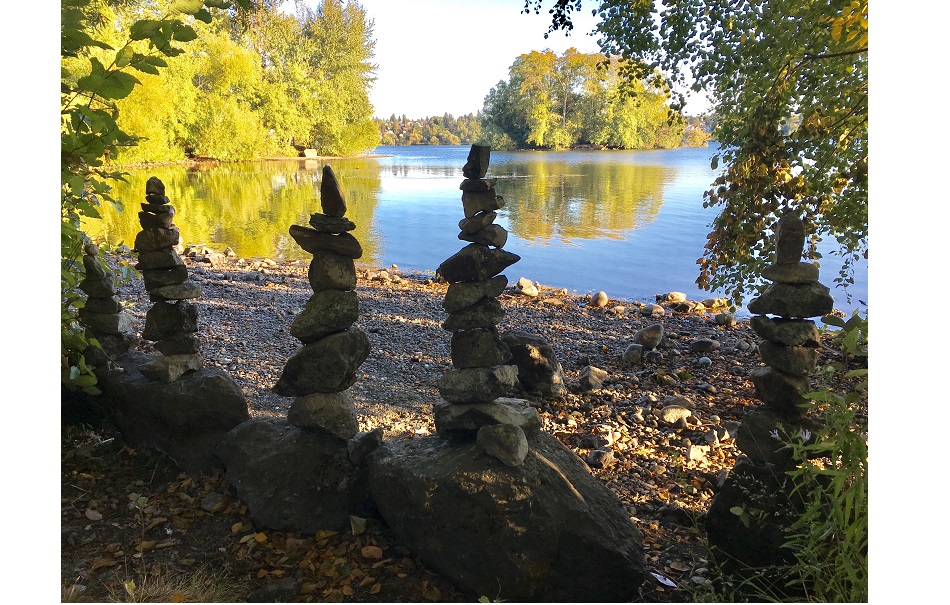
Almost 4 years ago I was out walking on the day after the mass shooting in Las Vegas and came across these beautiful rock cairns on the shore of a little local lake. It was a calm and quiet morning with the chill of October in the air and I just stopped in my tracks, wanting to spend a sacred moment in the presence of this inspired creation.

I imagined that in the wake of something so horribly violent, someone needed to make themselves feel calmer by creating something beautiful. Of course I’ll never know if it worked for them but I do know that just looking at this impromptu art installation worked to soothe that raw and exposed grief I was feeling.

When I think about whether anything I do, say or write has any meta-effect on the world at large, I think of those rock cairns. I might be working out my own grief, demons, cares and worries but if I do it in a peaceful and creative way, I have a small chance that it will express empathy and understanding for others walking a similar path.

Most of the rock cairns I’ve come across are on hiking paths marking the way to go. They are minimally invasive ways to communicate that the trail continues here. They are ways that one human tells another that they’ve walked this same way and don’t want anyone else to feel unsure or to be lost. May we all continue to be rock cairns for one another, marking the trail with peace.  

The Other Side

Resolve to be tender with the young, compassionate with the aged, sympathetic with the striving, and tolerant with the weak and wrong. Sometime in your life, you will have been all of these.” – Buddha

Last weekend I took my kids to a swimming beach in a very wealthy suburb of Seattle. It was beautiful – the grounds perfectly maintained, a recently built dock of all the latest materials so no one would get a splinter, a cabin as beautiful as you would hope for a restful lakeshore vacation for the lifeguards to use when they were off rotation and a play structure with no graffiti. It felt like an idyllic break from the signs of homelessness, addiction and lawlessness that are so evident in Seattle these days.

Within 10 minutes of peeling off our top layers and getting into the water I heard a father chastise his son, who looked about 10-years-old, “You are just a dumb kid.” And because I’ve read so much about how shame doesn’t work, especially in parenting, I felt shocked because I can’t recall hearing someone shame their kids in the six years I’ve been a parent. I’m in no way claiming that it doesn’t happen in the big city but just that I haven’t heard it.

We moved on to the play structure which was almost deserted except for two other kids. My daughter breathlessly ran over to where I was standing told me that a little boy who was about a year older than my toddler was punching my son in the stomach. The child’s mom was about 50 feet away, completely uninterested, so I walked over and the child had taken a lap around the structure and was now pushing my son. As I carried my son away from the child, I thought again how odd that was both to have kids touching each other these days and to have parents totally tuned out. These little incidents reminded me of the adage that money doesn’t solve everything.

My dear dad spent fifteen years as a senior pastor in a Presbyterian church in a very wealthy community before he retired. I remember the gist of many sermons he delivered to the very generous and lovely congregation was that quite often the problem with money is that it makes us think we don’t need faith. Whew, that at least is one problem that I don’t have. 😊

As I drove back to my middle-class neighborhood, I was thinking about our universal humanity. That I with my kids, the homeless heroin addict on the street and the wealthy patrons at the park on the other side of the lake all have hearts that ache for love, lungs that long for clean air, and backs that get tired when they carry too much. Maybe we only differ in how far we think we are from suffering. It made me remember again that there is no way to drive away from suffering but instead I just have to meet it, in me and in others, with as much faith and empathy as I can muster.

Difficult Compassion

It’s not how much we give but how much love we put into giving.” – Mother Teresa

Recently my kids and I have had a couple of encounters with apparently homeless people that along with the proliferation of tents in the parks that came with COVID have my almost 6-year-old daughter asking a lot of questions. In one encounter, a man with a belt still tying off his arm for shooting up was hollering and trying to take off his pants and another man was threatening him with a baseball bat to emphasize that he should keep his pants on. In another, a man was crawling down the busy street near where we live with a look of sheer agony on his face and one arm outstretched.

I often am confused about how to talk with my daughter about these matters. She may only be going in to first grade but she talks like she is a 9-year-old, is very observant and asks a lot of good questions. To top it off, the homeless problem is so apparent and pervasive that I certainly don’t have any great ideas about how we are going to fix it. But we came up with an idea that she could draw something and we could make some care packages for people that we see.

Yesterday she wrote this note without any help from me:

We nowe you are homeless but we care. Sorry you are homles.

Do not smoc. Do not take drugs becus they make you feel bedder for a few minets but wen it goes a way it makes you feel wurs.

My daughter – age 5.9 years

She then started taping on extra pieces of paper so that she could continue. In addition to being fascinated about what content she’s taken in from our many discussions, I noticed how hard it is to stay in empathy before moving to advice or judgment.

The other day my friend, Doug, asked if I could remember the name of a guy we used to work with. He said something like, “You know, the guy who’s wife left him, house burned down and his dog died?” “Oh my goodness,” that’s terrible I thought and still had no idea who he was talking about. But it wasn’t long before the thought crossed my mind that this poor man really must have pissed off God.

So I know first-hand how hard it is to stay in empathy. I start moving to judgment or advice because it feels like having an explanation of why bad things happen makes me feel safer that they won’t happen to me. Understanding that tendency has helped me practice a better kind of compassion, one that tries not to presume to know the journey another person has walked but is willing to help. It haven’t gotten any less confused about how to talk about these huge problems with my kids but I think it has helped me to have more open-ended conversations with them where we can recognize the humanity of others and be curious about how we can help.

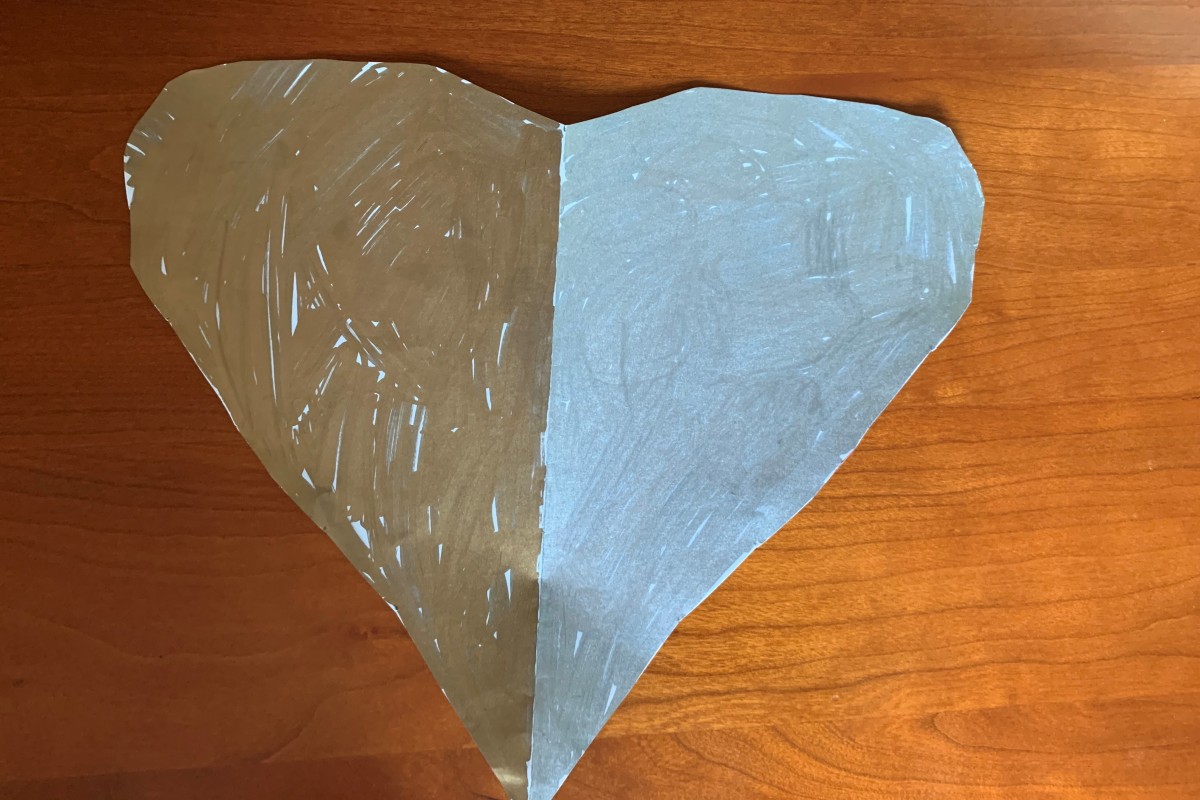
In that spirit, my daughter and I settled on just drawing hearts that say “we care” on the back. I don’t think they will solve homelessness but I do hope that they bring a moment of being seen.

Strong Back, Soft Front

“Do small things with great love.” – Mother Teresa

Last night we returned from a small outdoor party right at my son’s bedtime. I went to take off his shoes and socks and start to get him ready for bed and he was lying on the couch, head on the pillows, looking very much like a little grown man taking a load off after a long day. When I told him it was time to get his jammies on and stooped to pick him up he said, “No tank ooo.” At 23 months “no thank you” is his most powerful phrase and although I’d never claim that he fully understands the politeness of it, it’s still quite effective.

It makes me think of a phrase I first heard used by Brene Brown, “strong back, soft front” but I believe was originated by Roshi Joan Halifax, a Buddhist teacher. Strong back, as I think it relates to parenting, is all the things I try to hold the line on to raise healthy, happy and kind children. Bedtimes, self-care, routines, boundaries with each other, politeness. They are all the things that I feel like I repeat over and over again until I hope they pick them up for themselves.

And while I’m doing that, my soft front is so often moved by the sweet little things they do, their cries when life gets too much, and the moments of pride when they show they are learning something I’ve said. It’s my soft heart that gets opened over and over again by the bravery, dignity and earnestness of little people.

The thing I’ve noticed about parenting with a strong back, soft front is that dichotomy keeps me upright in those moments when I’m out of my depth. Either I’m too tired or too confounded by a situation that is challenging me, I can hold both ideas to create a balance that will see me through. I can be overwhelmed by my love and empathy AND still have the wherewithal to get my kids to bed.

Which is what I did last night. I stopped and talked with my toddler for a minute about the day, I listened to his “no tank ooo’s” and then I scooped him up to go upstairs and read.

NOTE: For anyone interested in a great description of strong back, soft front, I found this post by Bev Janisch that includes content from Brene Brown and a guided meditation.

Hey, Listen

“Please remember, it is what you are that heals, not what you know.” – Carl Jung

My kids and I were driving in the car the other day. My toddler kept saying “Mama?” and I kept answering, “Yes?” and because he still has a limited vocabulary, the conversation would stop there until he said, “Mama?” again a moment later with the same call and response. And then my five-year-old said, “I think he likes it when you answer him. It makes him feel like you are listening to him.” Awww.

But this post isn’t a victory lap celebrating great listening because I can just as readily not listen well. One rainy weekend during a coronavirus era lockdown, it felt as if my five-year-old hadn’t stopped talking, singing or asking something for the entire day. I asked her if we could be silent for 10 minutes and she thought about it and asked, “Why?”

When I listen well, it’s listening from the heart. It feels like a catcher’s mitt that is worn, old and ready to receive. I can listen to hurts, opinions and worries from my kids or friends and gently accept them. In that mode, I can even accept what my inner voice is telling me without struggle.

And when I’m listening from the head, it feels more like a tennis racket. I bounce things back without holding them. When it’s an owie, physical or otherwise, it seems to make them last longer. As if the teller has to dig in to convince me of the wound by describing the size, shape and depth which in the telling makes it larger.

When my kids get hurt, I want to solve what they were doing that caused the injury so they don’t do it again. Or, I want to downplay what I saw as such a minor scrape that couldn’t hurt so much. Even worse, when my daughter apologizes, I tend to use it as an entrée to a lecture on why she shouldn’t have done whatever it is that she did instead of simply saying “thank you, I appreciate that.”

And it’s not just kids, I have the same patterns with friends. Someone apologizes and I jump to say, “It’s no problem.” Or if listening to a hurt, I can rush to put one of my one on the table to somehow try to validate them or maybe prove that I have the right to be there.

I also find it difficult to listen to myself, to listen to my inner voice, that small, insistent voice that tells me I need to get up an hour earlier to mediate, do yoga and write. Or tells me to extend myself to a friend when I’m in a rush. A voice that I’ve come to recognize as part of my Divine path because I will inevitably end up having to listen to it, I just get to choose to do it when it’s a gentle whisper or wait until it’s an insistent bellow.

So, I’ve tried hard to learn to listen with my heart. Sure, there are times I need to engage the head to engage in critical thinking when safety and sanity are at stake but when it comes to hurts, apologies and accomplishments, I find the heart does best. Because it’s great to feel heard and it’s even better to feel heard and held!