Step 9: Five Stars

The idea is to write it so that people hear it and it slides through the brain and goes directly to the heart.” – Maya Angelou

I just finished listening to Step 9, a theatrical podcast based on a play written by Jack Canfora and produced by New Normal Rep. The description of the play includes these details,

“STEP 9 tells the story of Emily, a woman wrestling with the implications of prosecuting the man who raped her in college 30 years ago. Is she willing to relive the horror of that night in the pursuit of justice?”

I don’t think I’d normally select a drama where the description includes rape and prosecution but Step 9 is written by my friend Jack and I know from his other work that he deftly handles any topic with humor and insight.

And that is true with this theatrical drama, performed by an incredible group of actors. I’d say the two words I’d pick for this play (other than terrific and worthwhile) are resonant and healing. It speaks to our woundedness and with amazing dialogue walks us towards wholeness. A must listen.

 You can find Step 9 by searching New Normal Rep Step 9 wherever you podcast or go to: https://tinyurl.com/Step-9-NNR

Editing the Page

All life is an experiment. The more experiments you make, the better.” – Ralph Waldo Emerson

Looking at the stats for my blog, I can see that the most visited page is the About page. Which makes sense because I don’t have a lot of other pages. However, it makes me want to go back and re-do that page of information about me because I think I’ve changed since I’ve written it. I also often leave out the background info so as not to repeat myself so I think some links are in order. I took at stab at a rewrite and published it as my Wise & Shine post this week: About Me.

Podcasting

Your first podcast will be awful. Your first video will be awful. Your first article will be awful. Your first art will be awful. Your first photo will be awful. But you can’t make your 50th without making your first. So get it over with and make it.” – unknown

I was recently interviewed by Troy Headrick on the Wise and Shine podcast about my creative process. It was my first time and if I haven’t set your expectations too low with the quote above 🙂 and you are interested in listening, here’s a link to the podcast: Wynne Leon On Writing and the Creative Process Or you can search on Spotify for Wise and Shine and find it there (and subscribe).

After we were done, Troy asked why podcasts are so popular since there are at least 2 million out there (more if you could episodes). So I’m throwing that out as a question. Anyone have any theories?

List of Lists

Love is patient, love is kind. It does not envy, it does not boast, it is not proud. It does not dishonor others, it is not self-seeking, it is not easily angered, it keeps no record of wrongs. Love does not delight in evil but rejoices with the truth. It always protects, always trusts, always, hopes, always perseveres.” – 1 Corinthians 13:4-7

My engineering brain like lists to create order. But I think that lists can also be used in the creative process as a powerful writing tool. The quote for this post is 1 Corinthians 13 which must be one of the most often quoted verses and lists of what love is and is not.

Lists are the topic of my Wise & Shine post today: Give Me a List

More Lists

And as a bonus, here’s a list of some of my favorite WordPress lists:

Endless Weekend’s Top 5 Halloween Theme Comedy Shows:

Staying with the Halloween theme, Todd Fulginiti has a list of his Halloween Hall o’ Fame

One of my all time favorite lists is one Jack Canfora did when he turned 53 maybe because it made me feel more prepared to turn 53 in two months hence: Things I Think I’ve Learned so Far

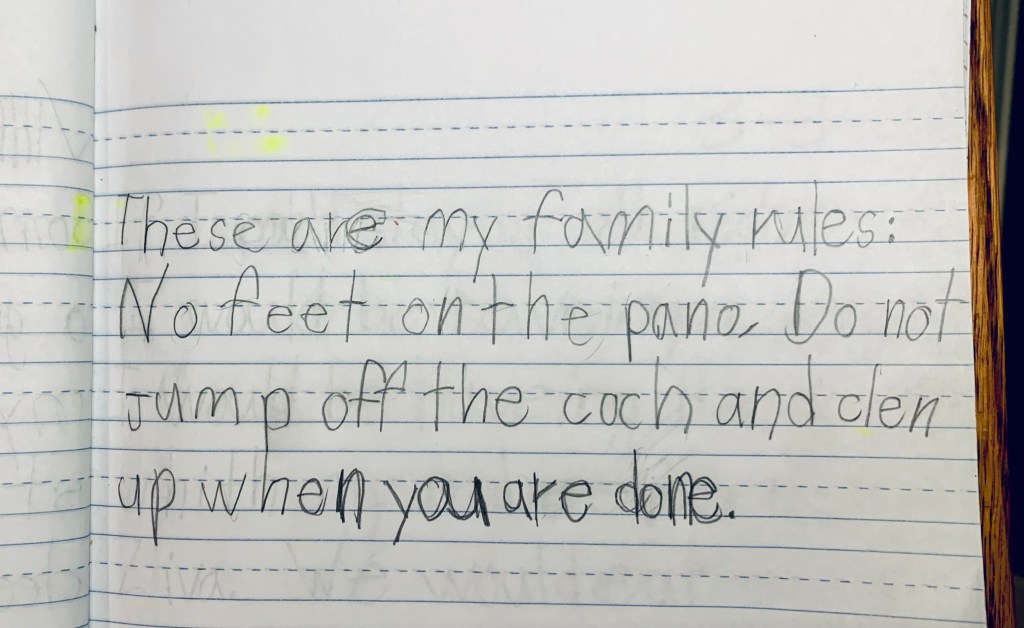
And my last list is one I published from Miss O from her first grade journal on this blog with her permission:


And to bring the list full-circle to a conclusion, there are more links to lists in my post today on Wise & Shine: Give Me a List

The Story of Life

Just because they are a story doesn’t mean they’re not real.” – H. M. Bouwman

I was listening to Brené Brown’s podcast, Dare to Lead last night and the first question she asked her guest was, “Tell us your story.”

It is probably an offshoot of my dad – who loved parables more than directives and could tell a great story – but I love stories. Hearing them, telling them and the way they stick with you. Like yesterday, I read Ally Bean’s story of the self-scan mishap and then when I went to the grocery store, I chuckled all the way through check out.

So stories are the topic of my post this week for Wise & Shine: The Power of Story.

(featured photo from Pexels)
Discernment

It usually takes me two or three days to prepare an impromptu speech.” – Mark Twain

One of my favorite words these days is discernment, especially when it applies to my own actions. That is to say, when I take the time to discern to what I should or should not be doing.

Oxford Dictionaries defines discernment as “the ability to judge well.” I think of it more broadly as taking the time to choose how I apply my energy and time. Also, to notice when I’m trading routine for quality.

Lately I’ve been writing my blog posts on the morning of the post instead of what I’d done most of the year, which is to draft something the day before and finish it the morning I post it. Putting a little time between when my fingers hit the keyboard and when I hit “publish” served to give me space for reflection and hopefully be a little more thoughtful.

Discernment tells me I need to stop publishing every day so that I have more time to think about things. So that I can do a better job. Maybe three thoughtful pieces a week instead of five slapdash ones. And now I’m laughing because of the post I wrote about Interrupting the Pattern earlier this week – it’s hard to break a habit.

What role does discernment play in your life?

(featured photo from Pexels)
The Blog Tour

Vision without action is merely a dream. Action without vision just passes the time. Vision with action can change the world.” – Joel Barker

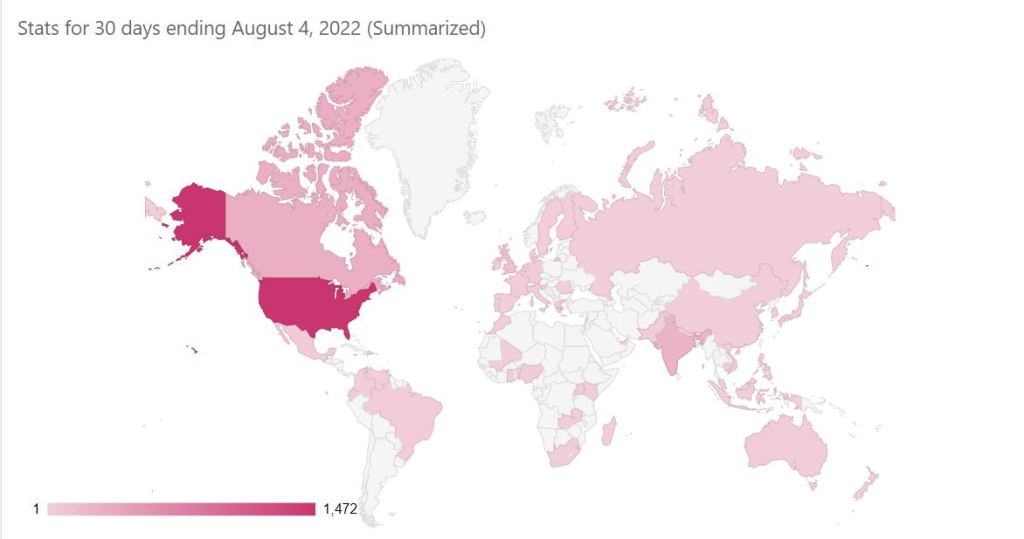
I glanced at the maps on the stats page of my WordPress blog yesterday and was delighted the sight of this map:

There’s a fantasy I have in my mind of taking a blog tour. Loading my kids up in a RV and driving to see my blog friends. The WordPress stats don’t show me any detail within a country so going off the top of my head from where I think people live –  down the West coast, Oregon, California, Arizona, Texas, up through South Dakota, over to Colorado and then to the West coast of Canada and then Alaska, over to Chicago, Wisconsin, Philadelphia, New York, up to the East Coast of Canada, then back down to New York, Maryland, North Carolina, Tennessee, Georgia.

Then hitting other countries – UK, Ireland, Belgium, Finland, Romania, Germany, France, Italy, Portugal, Malta, Lebanon, Nepal, Pakistan, India, Nigeria, Kenya, South Africa, Madagascar, Philippines, Japan, Malaysia, Australia, New Zealand. Then back through South America – Brazil, Ecuador then through Trinidad & Tobago, Jamaica, Mexico to home.

Who’s in for a blog tour? And though the physical thing would take a lot of resources, it is so amazing that this is where I get to travel each time I read something someone has written. This blogging thing is amazing!

(featured photo from Pexels)

Categories

Life is full of surprises and serendipity. Being open to unexpected turns in the road is an important part of success. If you try to plan every step, you may miss those wonderful twists and turns. Just find your next adventure-do it well, enjoy it-and then, not now, think about what comes next.” – Condoleeza Rice

When I first started using WordPress, I wasn’t blogging as much as just using it as a place to store a series of posts I was doing on social media as a response to the ugliness of the 2016 election cycle. I put all those posts in a category called antidotetomeanness and didn’t put any thought into categories overall.

Then when I started blogging in earnest, I still didn’t put much thought into categories and generally dumped them in a category called meditation, thinking that would cover almost any pondering on life.

Which is a little shame on me moment because I create information architectures for companies for a living – that is, I help them design the ways to store information that is structured, findable and meaningful for those who need to find it. Of course a lot of people, especially the younger generation, just use search to find things but if things are tagged appropriately we can also create effective navigation to guide people to things we think are most relevant.

But to be fair, I wasn’t sure what I was going to be writing about and wanted to be findable. Now that I have some experience under my belt, I wanted to put some thought into categories and maybe update my navigate to point to things I post about regularly – like my dad’s humor cards and the confidence series I’ve been working on.

I had a few questions:

  1. If I updated a post to change how it’s categorized would it email all my followers to notify them and create an email storm? The answer is thankfully, no.
  2. If I create a parent category like “archive” could I make a menu item for the navigation that would automatically include all the posts that I rearranged to be sub-topics?

Yes! When I created the parent topic, it had 0 posts in the top-level category but still if I navigate to the page for the category, it shows me all the posts that make up the subcategories and I can also add it to the navigation menu if I want to.

3. I wanted to create a menu header for my regularly used topics so that it provided a place for a drop-down menus of my two most common categories: humor and confidence. I ended up created a page for “topics” and then used that to anchor the sub-menu items for my categories:

Once I started to get comfortable with the answers, I had a lot of fun playing around with categories and how they can be useful. It’s opened a whole new level about how I can make things fun and findable on my home page.

Do you use categories? Do you plan them out or just add them as needed?

(featured photo from Pexels)

Confessions of a Digital Hoarder

The best time to plant a tree was 20 years ago. The second best time is now.” – Chinese Proverb

There is a house in my neighborhood that I think of as the hoarder’s house. In the 20+ years I’ve walked by this house, it has been filling up with stacks of boxes which I can see through the dining room window that is near the sidewalk. And once the boxes hit the ceiling in that room, they started to spill out onto the front and back porches.

I think I’m fascinated by this house because what I’ve noticed in my computer consulting business, is that we are becoming digital hoarders.

When I started in the business, IT departments largely operated the nuts and bolts of company software on servers in one or more data centers. When a server failed, ran out of disk space or software had to be upgraded, there was a very real cost of having to buy and insert some new hardware and plan software upgrades. Because of that, companies made hard choices limiting the amount of data to be stored.

Now a great deal of the companies I work with have their operations to the cloud. Email, collaboration software and more are all run by a 3rd party who provides all the hardware and software management. All companies have to do is sign up for a plan and it usually comes with a large amount of data storage with an upgrade to more space just a click away.

The result is that companies don’t have limits that encourage people to throw away digital assets. Often times, deleted items go to a deleted folder that essentially becomes another filing system.

On the unseen side are the huge datacenters that house all the hardware and software. These datacenters often sit in locations where electricity is cheap and the data center can be cooled. For instance, there’s an enormous Microsoft datacenter that sits by the Columbia River in Washington State because of its proximity to cheap hydroelectric power and water. (To be fair, Microsoft has pledged to be water positive, replenishing more water than they consume by 2030 so I’m thankful for that corporate conscientiousness.)

This goes for the personal software we use as well. Companies that store our data run redundant data centers which we appreciate when we want to access a file, picture or song at any time of day or night. But these data centers require a massive amount of electricity, cooling systems and hardware. A 2015 article in The Atlantic quotes a 2013 Facebook sustainability report in which Facebook reported that its data centers used 986 million kilowatt hours of electricity that year. The article points out that is the same amount used by entire country of Burkina Faso in 2012.

Thinking of all the places I store data – iCloud, Amazon (books, movies and music), Shutterfly (photos), Dropbox, OneDrive, Google Docs, WordPress, Facebook and Instagram to name just a few, many are free or charge a small amount to increase storage limits. For a picture that I like, it sits on my phone, is backed up to iCloud, I might post it to Instagram, upload to one a site to make a calendar for my mom, another site to make my yearly photo album and use it in a WordPress post. That’s 6 copies of one picture and I’m rarely incentivized to remove any data and so I don’t. I’m a digital hoarder.

Yesterday when I walked by the hoarder house, I saw a young woman sitting on the front porch taking what looked like a much needed break in the sunshine. There was debris all around her that made me think she was cleaning out the house and sure enough, there were no boxes visible in the dining room window any longer. Many of us don’t want to leave that kind of physical job to our friends and family when we die – but we need to consider doing the clean up of our digital assets as well.

Do you delete digital files? I know Ashley just posted that she consolidated and removed old posts that weren’t getting any views – but does anyone else do that?

(featured photo from Pexels)