Discernment

It usually takes me two or three days to prepare an impromptu speech.” – Mark Twain

One of my favorite words these days is discernment, especially when it applies to my own actions. That is to say, when I take the time to discern to what I should or should not be doing.

Oxford Dictionaries defines discernment as “the ability to judge well.” I think of it more broadly as taking the time to choose how I apply my energy and time. Also, to notice when I’m trading routine for quality.

Lately I’ve been writing my blog posts on the morning of the post instead of what I’d done most of the year, which is to draft something the day before and finish it the morning I post it. Putting a little time between when my fingers hit the keyboard and when I hit “publish” served to give me space for reflection and hopefully be a little more thoughtful.

Discernment tells me I need to stop publishing every day so that I have more time to think about things. So that I can do a better job. Maybe three thoughtful pieces a week instead of five slapdash ones. And now I’m laughing because of the post I wrote about Interrupting the Pattern earlier this week – it’s hard to break a habit.

What role does discernment play in your life?

(featured photo from Pexels)

The Blog Tour

Vision without action is merely a dream. Action without vision just passes the time. Vision with action can change the world.” – Joel Barker

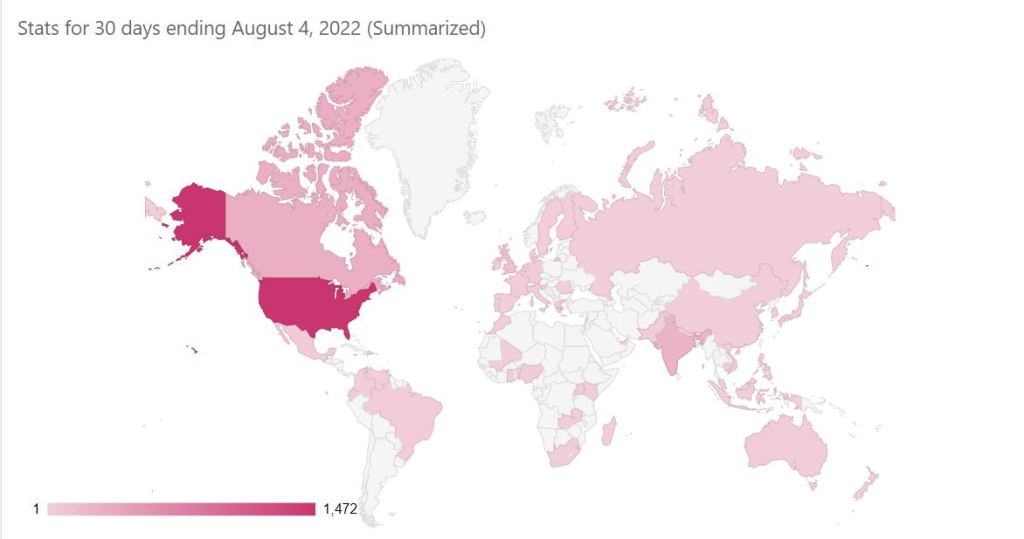
I glanced at the maps on the stats page of my WordPress blog yesterday and was delighted the sight of this map:

There’s a fantasy I have in my mind of taking a blog tour. Loading my kids up in a RV and driving to see my blog friends. The WordPress stats don’t show me any detail within a country so going off the top of my head from where I think people live –  down the West coast, Oregon, California, Arizona, Texas, up through South Dakota, over to Colorado and then to the West coast of Canada and then Alaska, over to Chicago, Wisconsin, Philadelphia, New York, up to the East Coast of Canada, then back down to New York, Maryland, North Carolina, Tennessee, Georgia.

Then hitting other countries – UK, Ireland, Belgium, Finland, Romania, Germany, France, Italy, Portugal, Malta, Lebanon, Nepal, Pakistan, India, Nigeria, Kenya, South Africa, Madagascar, Philippines, Japan, Malaysia, Australia, New Zealand. Then back through South America – Brazil, Ecuador then through Trinidad & Tobago, Jamaica, Mexico to home.

Who’s in for a blog tour? And though the physical thing would take a lot of resources, it is so amazing that this is where I get to travel each time I read something someone has written. This blogging thing is amazing!

(featured photo from Pexels)

Categories

Life is full of surprises and serendipity. Being open to unexpected turns in the road is an important part of success. If you try to plan every step, you may miss those wonderful twists and turns. Just find your next adventure-do it well, enjoy it-and then, not now, think about what comes next.” – Condoleeza Rice

When I first started using WordPress, I wasn’t blogging as much as just using it as a place to store a series of posts I was doing on social media as a response to the ugliness of the 2016 election cycle. I put all those posts in a category called antidotetomeanness and didn’t put any thought into categories overall.

Then when I started blogging in earnest, I still didn’t put much thought into categories and generally dumped them in a category called meditation, thinking that would cover almost any pondering on life.

Which is a little shame on me moment because I create information architectures for companies for a living – that is, I help them design the ways to store information that is structured, findable and meaningful for those who need to find it. Of course a lot of people, especially the younger generation, just use search to find things but if things are tagged appropriately we can also create effective navigation to guide people to things we think are most relevant.

But to be fair, I wasn’t sure what I was going to be writing about and wanted to be findable. Now that I have some experience under my belt, I wanted to put some thought into categories and maybe update my navigate to point to things I post about regularly – like my dad’s humor cards and the confidence series I’ve been working on.

I had a few questions:

  1. If I updated a post to change how it’s categorized would it email all my followers to notify them and create an email storm? The answer is thankfully, no.
  2. If I create a parent category like “archive” could I make a menu item for the navigation that would automatically include all the posts that I rearranged to be sub-topics?

Yes! When I created the parent topic, it had 0 posts in the top-level category but still if I navigate to the page for the category, it shows me all the posts that make up the subcategories and I can also add it to the navigation menu if I want to.

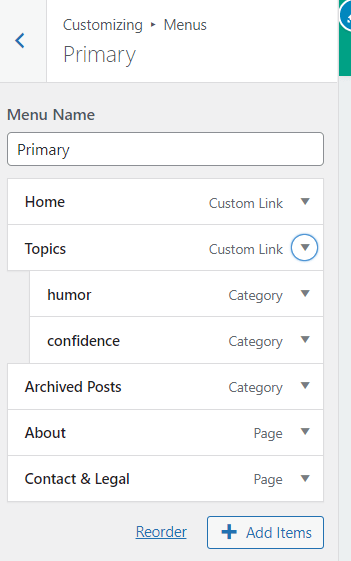
3. I wanted to create a menu header for my regularly used topics so that it provided a place for a drop-down menus of my two most common categories: humor and confidence. I ended up created a page for “topics” and then used that to anchor the sub-menu items for my categories:

Once I started to get comfortable with the answers, I had a lot of fun playing around with categories and how they can be useful. It’s opened a whole new level about how I can make things fun and findable on my home page.

Do you use categories? Do you plan them out or just add them as needed?

(featured photo from Pexels)

Confessions of a Digital Hoarder

The best time to plant a tree was 20 years ago. The second best time is now.” – Chinese Proverb

There is a house in my neighborhood that I think of as the hoarder’s house. In the 20+ years I’ve walked by this house, it has been filling up with stacks of boxes which I can see through the dining room window that is near the sidewalk. And once the boxes hit the ceiling in that room, they started to spill out onto the front and back porches.

I think I’m fascinated by this house because what I’ve noticed in my computer consulting business, is that we are becoming digital hoarders.

When I started in the business, IT departments largely operated the nuts and bolts of company software on servers in one or more data centers. When a server failed, ran out of disk space or software had to be upgraded, there was a very real cost of having to buy and insert some new hardware and plan software upgrades. Because of that, companies made hard choices limiting the amount of data to be stored.

Now a great deal of the companies I work with have their operations to the cloud. Email, collaboration software and more are all run by a 3rd party who provides all the hardware and software management. All companies have to do is sign up for a plan and it usually comes with a large amount of data storage with an upgrade to more space just a click away.

The result is that companies don’t have limits that encourage people to throw away digital assets. Often times, deleted items go to a deleted folder that essentially becomes another filing system.

On the unseen side are the huge datacenters that house all the hardware and software. These datacenters often sit in locations where electricity is cheap and the data center can be cooled. For instance, there’s an enormous Microsoft datacenter that sits by the Columbia River in Washington State because of its proximity to cheap hydroelectric power and water. (To be fair, Microsoft has pledged to be water positive, replenishing more water than they consume by 2030 so I’m thankful for that corporate conscientiousness.)

This goes for the personal software we use as well. Companies that store our data run redundant data centers which we appreciate when we want to access a file, picture or song at any time of day or night. But these data centers require a massive amount of electricity, cooling systems and hardware. A 2015 article in The Atlantic quotes a 2013 Facebook sustainability report in which Facebook reported that its data centers used 986 million kilowatt hours of electricity that year. The article points out that is the same amount used by entire country of Burkina Faso in 2012.

Thinking of all the places I store data – iCloud, Amazon (books, movies and music), Shutterfly (photos), Dropbox, OneDrive, Google Docs, WordPress, Facebook and Instagram to name just a few, many are free or charge a small amount to increase storage limits. For a picture that I like, it sits on my phone, is backed up to iCloud, I might post it to Instagram, upload to one a site to make a calendar for my mom, another site to make my yearly photo album and use it in a WordPress post. That’s 6 copies of one picture and I’m rarely incentivized to remove any data and so I don’t. I’m a digital hoarder.

Yesterday when I walked by the hoarder house, I saw a young woman sitting on the front porch taking what looked like a much needed break in the sunshine. There was debris all around her that made me think she was cleaning out the house and sure enough, there were no boxes visible in the dining room window any longer. Many of us don’t want to leave that kind of physical job to our friends and family when we die – but we need to consider doing the clean up of our digital assets as well.

Do you delete digital files? I know Ashley just posted that she consolidated and removed old posts that weren’t getting any views – but does anyone else do that?

(featured photo from Pexels)

Coming Together

When I despair, I remember that all through history the way of truth and love have always won. There have been tyrants and murderers, and for a time, they can seem invincible, but in the end, they always fall. Think of it–always.” – Gandhi

This weekend my kids and I went to a wedding. As we were going through the receiving line, the bride squatted down so that she could be closer to my 2-year-old son’s level. And when she squatted, he squatted.

As I laughed, I thought about how we mirror the people around us. Neuroscientist David Eagleman, says that who were are is shaped by the five people that we spend the most time with.

But lately the grown-up people I’m spending time with seem to mostly be feeling a general sense of despair about the US and the world. I feel like I’ve hit my saturation point of not being able to take in more bad news.

Then I stumbled on this paragraph from poet Mark Nepo, “I realize that, when things fall apart, they make a lot of noise. When things come together, they do so quietly and slowly. And so, we often miss them. Our culture is obsessed with how things fall apart. The news reports only the noise of things breaking down. The weather is even called Storm Watch. Yet things are constantly coming together, though we have forgotten how to hear them.

That is when I turn to the WordPress community because unlike the news, I find people writing stories of things coming together all the time. Here are 5 posts that recently gave me joy and delight.

A touching story of kindness from Stuart Perkins of the Storyshucker blog: A Nugget of Kindness | Storyshucker

A researcher joke from the Candid Cerebrations blog: I stole this… – Candid Cerebrations

A beautiful walk through a garden with Rebecca from the Fake Flamenco blog: 5 Local July Flowers ‹ Fake Flamenco

A photographic trip to Venice from Natalie on The Hot Goddess blog – Silent Saturday Solo Sojourn – The Hot Goddess

Camping and Canada Fireworks from the view of a child from Ab and the My Life with T blog – Ignite the Night and Let It Shine – My Life With T

And those are just a few of all the wonderful and creative posts that make me laugh and inspire me.

Thank goodness for all you amazing bloggers that are writing posts about how life comes together. This is what I want to mirror and reflect.

What’s inspiring you this week?

It’s in the Comments

To listen with an open heart and ask questions to better help us understand the other person is a spiritual exercise, in the truest sense of the word.” – Harriet Lerner

Yesterday I re-blogged a post about sliding glass door moments, the moments where you see the life you could have on the other side and choose whether to open the door and cross that threshold. Deb commented on it and mentioned that solid door moments, those times when we have no real sense of what’s ahead yet we know we need something in our life to change, might take even more courage to pass through.

Wow, did that make me think. It is just one example of the very many where a comment has expanded the envelope of my thinking. Which is the wonderful effect of comments. They often drive me to a deeper understanding of myself or the topic, sometimes both.

But when I first started blogging, I found commenting hard. Did I know the author well enough that a typed comment would be relevant? Was I interpreting the material correctly and would I be on point?

Maybe first time comments are like tiny solid doors – we often have no real idea who’s on the other side and whether our typed message which is often a bid for friendship will be accepted or even acknowledged. But you have to open it to find out whether or not the person on the other side wants to sit around your coffee table, to use my analogy of blogging from last week, or just speak from the podium.

What do you think about comments? How about the experience of commenting?

Blogging Around the Coffee Table

Fill the paper with the breathings of your heart.” – William Wordsworth

I have a feeling when I blog – both reading and writing – that it’s like having coffee with a group of friends. I get to talk about what is holding my interest these days and I get to hear about what’s going on for other people. The topics are wide-ranging but the lovely part is that there’s space for everyone to share.

My experience differs based on whether I show up to share with my head or my heart.

When I write from my head, it feels as if I’m tussling with my inner critic. I find myself more restless and wanting to rely too heavily on other people’s ideas and words. It feels as if my fingers are encased in bubble-wrap and I have a harder time getting the message across. If I were to name someone I write for when I’m in my head, it’s my mom who is incredibly smart, very literal and a stickler for a solid argument and perfect English grammar.

When I write from my heart, it feels like being in the flow of the stream. I can produce faster when I get out of my own way. It’s not that my head isn’t present – it just has accepted its position to be subordinate to the heart. In that way, I get to the point more quickly, as to the “heart” of the matter. When I’m writing from my heart, I write as if for my dad, the person who is incredibly generous in their desire to understand the point of what I’m saying even if I miss a couple of steps in my argument.

Where do you go, metaphorically speaking, when you write? Do you have a specific person or image that you write for? What does the blogging experience feel like for you?

(featured photo from Pexels)

WordPress Help

Serenity comes when you trade expectations for acceptance.” – Buddha

Last week when I was writing about WordPress data, I couldn’t find the answer to why emails of posts from my blog include a “like” link at the bottom but emails from other blogs like the posts I write for the Pointless Overthinking blog for don’t have the “like” link – just the “comment” link.

I did my due diligence trying to find the answer by googling the question and by searching the WordPress FAQs and knowledge base but there was nothing there that I could find. So I used the contact us function provided by WordPress.

It took a back and forth but they answered my question:

Thanks for sharing the screenshots!

It seems that this is a known bug, however, the reason why it affects pointlessoverthinking.com and not your other one is that it only occurs on sites with the Business, Pro, and eCommerce plans.

Our developers are already aware of this but are backed up with other areas requiring their urgent attention. I will mention your case to them but we cannot guarantee a fix for this anytime soon.

So, I have an answer. It makes me rethink wanting to upgrade to a plan other than my free one. I’m glad they are working on urgent issues but this has been happening for at least 3-4 months, possibly more so I hope it’s working its way up the queue.

But it was a good lesson that WordPress does respond to its users on questions that you can’t find the answer to anywhere else!

(featured photo from Pexels)

Data With a Grain of Salt

Not everything that can be counted counts, and not everything that counts can be counted.” – Albert Einstein

Talking with some blogging friends the other day, the topic of blog views came up. We were discussing all the different reasons that view numbers could be less this year than last year: people’s attention spans getting shorter, maybe viewers read more when the pandemic shut down other activities and now they are reading less, etc..

I’m too new to blogging to have enough historical data of significance, but I’ve studied similar data in my professional life to know that numbers aren’t as concrete as we think. So I did some digging and thought I’d share the results of my research specific to WordPress.

First of all – what is a view?

According to the WordPress stats and insights page it is:

“The two main units of traffic measurement are views and visitors:

  • view is counted when a visitor loads or reloads a page.
  • visitor is counted when we see a user or browser for the first time in a selected time frame.

visitor is an individual looking at your site. A visitor can view many different pages of your site or view the same page multiple times. Therefore, the views number is typically higher than the visitors number.”

With those definitions in mind. Here are some things that impact the numbers.

  • If a viewer reads your content in the body of email notification and never clicks on any links within the email, it doesn’t count as a view.
  • If a viewer reads and/or likes your content in the WordPress viewer but does not click through to the full post, it does not count as a view.

One of the blogs that I write for has changed in the last few months so that when posts are emailed out, they no longer have a “like” link at the bottom, just the “comment” link. However posts that come from my blog still have both “like” and “comment” links at the bottom. Some posts are emailed out with just the summary and then something like “click here to read the full post.” For people who are reading blog posts in email like I do, those three differences are going to impact the number of views.

There are some things that WordPress makes a point not to count as a view – search engines and views from anyone that has logged in and who has authoring permissions. Generally speaking, there are trying to report how many views of the content by readers as accurately as they can.

The technology is constantly changing so things like a change in the format of the notifications by email or even how well the WP Reader performs on a mobile device can impact things like view numbers. Numbers as reported within a week are probably pretty accurate in relation to each other because the functionality is consistent. There are likely seasonal differences with dips in summer and holidays. Year over year numbers, comparing the same month this year to the same month last year, is very interesting data but needs to taken with a grain of salt.

If a blog has a drop in views, it’s possible that it’s because the author(s) has alienated the viewers or our collective attention span has gone to seed. But since the trend over time for active bloggers is towards more followers and views, it also might be worth considering these technical factors as well.

For those of you who are interested in more information on the many way people read blog posts from two incredibly talented writers and experienced bloggers, both Ashley and Claudette have covered the topics in depth and by survey here:

Ashley Peterson’s post on How Do You Read Blog Posts? on her Mental Health @ Home blog.

Claudette Labriola’s survey results of How Do You Read Blogs on her Writer of Words, Etc blog

(featured photo from Pexels)

Confession of a Writer

What you are afraid to do is a clear indication of the next thing you need to do.” – Ralph Waldo Emerson

In the year before my dad’s sudden death in a bicycle accident, I had a soul whisper that I needed to get to know my dad on his terms. He was such an enthusiastic supporter of so many people that it was hard to get him to talk about himself. But I sat him down and asked questions and recorded his stories. It was one of the most inspired things I ever did. His death catapulted me into an ambition to write a book about him.  In those months as I was pregnant with my daughter and writing about my dad, spinning between death and birth, I met Sheila, my writing coach.

With her help, I finished and published the book, and after my daughter was born, I found more to write about. When I contacted Sheila again, she asked, “Do you remember the first thing that you said to me?” I didn’t so she reminded me that I had told her I wasn’t a writer, I just wanted to write a book about my dad. But as we worked together, she told me along the way that I would have more to write about.

I think back to how I was so quick to disavow any greater aspirations to be a writer and it showed how much I feared admitting what was calling to me. I didn’t want to presume that I had anything valuable to say (or write) and it wasn’t what I went to school for. In fact, when I was finishing my BS in Electrical Engineering, the last course I needed to complete was a technical writing course, and it took me until after I walked through ceremonies and had a real job to complete those credits and finish my degree.

Sitting down to write and publish blogging posts every morning has been my practice to walk what my inner self already knows is true. That I’m driven to write about this one wild and precious life of mine, to quote Mary Oliver, and that it’s not presumptuous to own that.

I like to think of writing as the last gift that my dad gave me before he departed this planet. And as such it’s the one that helps me integrate him with the life I have now with these two beautiful children. It’s the gift that has brought me depth and wonderful relationships with you all in the WordPress community. To not own that I love writing is a betrayal of all that so I guess I need to call Sheila back up and tell her I’m a writer.

How about you – do you admit that you are a writer?

(featured photo from Pexels)