Maniacs

Faith gives flight to the imagination.” – Lailah Gifty Akita

The other day Cooper (the dog) had a play date with a neighbor’s puppy, Ziggy. Four-year-old Mr D. heard me say to the pups, “What are you two maniacs up to?

And Mr. D fell in love – with the word “maniac.

We were at the store a short while later and he yelled from the other end of an aisle, “Mom, call me a maniac!

And he sometimes greets me, “Hi Mom. You maniac!

It’s a rule in our house that we don’t call each other names but maniac seems like a term of affection to me. At least, I was saying it affectionately when I used it on the dogs.

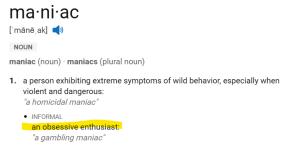
So I looked it up in the dictionary and found that the informal definition matched my liking: An obsessive enthusiast (from Oxford Languages).

As I mentioned in My Love Affair with Words post, the word enthusiastic or enthusiast always reminds me of my dad since it comes from the root, en-Theos or “with God.” I’m at my best when I leave my logical nature and go with the flow of God, life, and the Universe.

So, yes, call me a maniac. On fun days, I have a whole houseful of them!

The Gift of Hard Things

Experience is the hardest kind of teacher; it gives you the test first and the lesson afterward.” – Oscar Wilde

Summer is winding down in the Northern Hemisphere. I can feel all the tell-tale signs, the nights that are chilly before we go to bed, and have that cool calm when I get up at 5:30am. The relenting brightness of the sun starts to give away to the softer light of fall. And, we are getting ready for the start back to school.

Last week, my eight-year-old daughter was giving me the breakdown of the third grade teachers that she might get for this next year in school. One yells a lot, one is neutral, and one is nice. As she was talking about who she hopes to get for this year to come, I felt an upwelling of tension surge through my spine. Putting my finger to it, I’d say it’s because of that protective desire for her to get the nice teacher.

But that’s at odds with what I know about life. My lived experience tells me that everything doesn’t always work out the way we want, that sometimes we have to wade through the year(s) of muck to get to the side of clarity, and that sometimes we get the crusty teacher.

For all the resilience I’ve learned about life, I find that my children challenge my worldview. That is to say, my desire to give them a life that was better than my own sets up a tension with the reality of how life unfolds. There is about zero chance that I can root for my daughter to get the mean teacher even though she may learn a lot more about uncovering the gem in the rough if she does.

It reminds me of a letter my dad, who was a Presbyterian pastor, gave me when I was going through my divorce about 12 years ago. It was tucked in the page of a book he was giving me: Know Doubt by John Ortberg. The letter said in part.

I have seen so many people in my ministry going through times of deep change in their lives and it seems that those are also times of deep thought and reflection that have been creative and good for them. You are in the middle of a lot of change these days. There must be some serious disappointment that your marriage has not worked out as you had dreamed and intended. Your life has been the story of one big success after another and you don’t have many things in your life that don’t work out well and so this time must be unsettling. So just maybe this time of change is also a time when you are questioning and thinking about big stuff like faith and doubt and your life-view. If so, I really think this little book might be a good read for you.

Dick Leon

He acknowledges the unsettling nature of life – but that unsettling times of life also lead to creativity and good. Did my dad wish for me to have hard times? Absolutely not. But did he think that goodness was going to come out of it? Definitely.

I wonder if my tension about not wanting my kids, or any of my loved ones, to go through hard times comes across. Maybe as anxiety? It’s way harder to watch others face uncertainty than to go through it myself.

In another sign that summer is coming to an end, my daughter just celebrated her birthday. At the end of the day, she pulled me in tight and whispered in my ear that she didn’t want the day and her birthday to end.  I thought “Ah yes, my dear, but finding the magic in all the other days of the year when we aren’t front and center creates the sweet spot of life.” The lessons are harder to find on the days we get everything we want.

I find I can reduce my anxiety about the hard days my kids will have by remembering, as my dad did, that creativity and deep understanding comes on those days, not on birthdays.

Check out my Heart of the Matter post today for a lesson I’m learning about taking a new job in my 50’s: Going with My Gut

(featured photo from Pexels)

The Bookkeeper

I’ve often kidded folks that when you start working with people, the first rule that you live with is, ‘People are weird.’ We are all weird, we are all funny combinations of funny stuff. So, what’s that mean for us? How do you love people that are different in a weird sort of way? Well, you just try to help them, wherever they are.” – Dick Leon

Since I am on a business trip to the East Coast of the US this week, I thought I’d make my writing really easy and publish a sermon from my father. Mary from the beautiful Awakening Wonders blog puzzled over how he used his humor in sermons. So, for all of you who love my dad’s Sunday Funnies, here’s a sermon he delivered about 10 years after he retired about forgiveness that is one of my (and his) favorites.

It’s long (about 2,800 words) but it starts with some children sermons humor, wanders through some American Idol (I had no idea my dad even knew about that show) and ends with what my dad called his weekly theological journal – Sports Illustrated. I can hear his voice delivering it as I read it – and the delight and enthusiasm he brought to everything he did. Perhaps you can too.


Death of the Bookkeeper

By Richard H. Leon

Delivered 6/20/2010 at Bellevue Presbyterian Church

Thank you, too, for your thoughtful questions about how Carolyn and I are doing these days.  We are getting older every day, as you’ve observed already, but we are getting on very well anyway, thank you.  I was a bit shaken this week, however, when I got a letter promoting a “pre-paid cremation!”  I guess they didn’t trust that the bill would be paid afterwards!!  It added, “Hurry, before it’s too late” also!  You can add that to your list of “You know you are getting old whens …”

Scott has asked that I begin this series on “Encounters with Jesus;”  what happens when we meet him and open our lives to him?  So, I’d like to talk with you about God.   That should be no surprise!  It is like the children’s sermon that started out with a question to the kids, “What is grey and furry and has a long bushy tail and runs around the back yard?”  Johnny raised his hand and said, “Jesus.”    The pastor asked him how he came to that answer and he said, “I know you’ve described a squirrel but sooner or later you are going to get to Jesus!”  So, sooner or later I’m going to get to God this morning, so let’s get to it.

Specifically, I want to test you on what your basic image of God is like.  Is it a great grandfather in the sky?  Is it a cloudy nebulous in the universe?  Is it a black woman as the book, THE SHACK, portrays?  Maybe is it a stern judge holding us all accountable for our follies?  Or a straight talking judge like Judge Judy?  I think, bottom line, many of us still hold a view that God is like a bookkeeper in heaven who is keeping track of all our thoughts and deeds for the day of final accounting. 

Well, whatever it is, Jesus has another teaching for us.  Let’s see what scripture says.  Here, by the way, is a good way to read your Bible.  I have found that almost all scripture carries a point of TENSION and a point of SURPRISE.  Think of it.  The Bible is God’s word to us; it comes to us from beyond, outside our way of thinking and knowing.  Therefore, it should produce some tension when we look at ourselves, and it should also produce a surprise when it tells us about God

Our text today falls into a neat little three-act drama, one long act and then two little ones.

Act I ~ The Bookkeeper Dies

Our text begins with Peter asking Jesus a question about forgiveness.  He wonders how many times should we forgive those in the church!  On the one hand, we might want to give Peter a small cheer because he is beginning to get it.  He suggests maybe we should forgive someone 7 times, and then that’s it.  No more. In the Old Testament we read from Amos that we should forgive someone three times.  So Peter has doubled that and added one more for good measure.  Not bad!  But,not good enough.  Jesus tells him it should be 77 times!  Wow!  77 times, who can count that high?  Aha, just the point!!   Don’t count like a bookkeeper!  I like this bookkeeping image and want to credit an Anglican author, Robert Capon, for using it first. 

So, to make this more clear and to give the reason for this dramatic shift in the way we relate with others, Jesus tells the story of a king who was playing bookkeeper with his accounts and came upon a slave who owed him so much he could never ever pay it all back.  Notice: Jesus tells us that this is what the kingdom of heaven is like!  One talent equaled 15 years wages for a slave.  10,000 talents … well, you do the math, it is beyond my math skills!!  Jesus is clearly exaggerating for a reason.  This is a huge debt for anyone, let alone a slave.   The king, quite justly please note, ordered him to prison.

Here is the major TENSION of the text for you and me.  If we are going to identify with anyone in the story, it must be this slave.  And so Jesus is telling us all: we owe God more than we could ever pay!

Do you believe that?  Really?  Are we all that bad off?  This is not a happy thought!  I think we resist this idea with all our energies.  Besides, we live in a society that makes this hard to believe.  The title of a recent book called The Narcissism Epidemic says it all.  The authors document how our culture feeds excessive self-love and self-centeredness.  One of the ways we do this is with our excessive praise of what others do.  I am as guilty of this as the rest of you.  I want my kids and grandkids to feel good about themselves and to have good self-esteem, but I wonder if we have gone too far and have fostered excessive self-love.  The authors describe where narcissism comes from and their first chapter is called “Parenting: Raising Royalty.”  The authors comment on this over-praising by saying, “Thinking you are great when you actually stink is a recipe for narcissism!”

Reality TV is a good example of this cultural encouragement to excessive self-love. 

Such as,  American Idol which tells all these thousands of people they are “awesome” and could be the next Idol?  Friends and family must encourage people with little or no talent into thinking they are really good.  And then they run into the reality-therapy of Simon Cowell and that is the end of their run!

I think the tension between Jesus’ words here and our own self-appraisal rests on what we are using as our measure.  If we measure our marital fidelity by the standards of Tiger Woods, hey, we are doing quite well!  At least I hope so!!  There are a lot more bad people out there that we read about every day in the news who make our little foibles look like no account at all!  We aren’t bombing wedding parties or burning schools for girls like the Taliban, we aren’t killing cops, we aren’t running Ponzi schemes, we didn’t spill all that oil!  Besides, we are looking pretty cool this morning and we are actually in church.  Doesn’t that count for something?  Can’t we be judged on the curve?

But, when we use the measure that Jesus used, we might come up with a different answer.  His answer to the rich young ruler was to keep the Commandments of God.  Jesus wants to bring the transcendent relationship with God, not just the relative comparison with others.  We all know the Commandments, I’m sure.  There are only 10 of them, right?  Four point God-ward and you can probably tell me what they are.  No other gods, no idols, don’t abuse his name and keep the Sabbath as a day of rest?  Anyone pass on all of these?  Anyone pass on any of these?

The next six don’t make it any easier.  Honor your parents, don’t commit adultery, don’t lie, don’t steal, don’t bear false witness and don’t covet your neighbor’s Lexus!  How are you doing?  I actually thought I was doing pretty well on a couple of these … like adultery and murder … until I saw what Jesus did with these.  He gets to the spirit behind them, so for adultery he asks if we ever look at another with lust, and for murder he asks if we ever harbor hate towards someone?  Whoops!  The spirit of the Commandments put us all in jeopardy.  John’s first letter pretty well sums it up for us: “If you say you have no sin, you only deceive yourself and the truth is not in you.”  

Our problem is we want to be measured on the curve, on the horizontal, and we feel pretty good because we can find a lot of people who are doing a lot worse!  God sees it differently. The great Russian author, Dostoyevsky, in his classic work, The Brothers Karamazov, puts it most succinctly several times throughout the book.  This may be his main point, or at least one of them, and it is a quote Carolyn and I have posted in our house:  “When transcendence disappears, everything is permissible.”

As a side note here, if you are feeling some tension between what Jesus is saying and what our culture teaches us to think about ourselves, how do you think I feel telling you this?  I am constitutionally structured to want people to like me.  When I graduated from High School all the seniors put their life goal in the yearbook; mine was “to have no enemies!”  And now I’m saying what none of us want to hear: that we owe God more than we can ever pay!  Is that a good idea?  It is even funnier than that.  I have a muscle condition that is being treated with prednisone and one of the side effects of prednisone is thin skin.  So we have a people-pleasing preacher with thin skin telling all of you exactly what you don’t want to hear!!

Nevertheless, as uncomfortable as this makes me feel, I think I need to say it here because this is what Jesus’ parable teaches us.   The church’s first job is to speak the truth about us and about God.  I do believe anything less than this brutal assessment of ourselves is simply a wishful fantasy.  Jesus gives us “Christian Realism.”  Actually, the good news about God that follows is only good when we know that the bad news about ourselves is real!

Here comes the central SURPRISE of the text. The story continues with the slave making an impassioned plea and in it I think gives us a clue to one of the puzzles of this whole parable.  “Have patience, he pleads, and I will pay you back in full!”  Really?  In full?  The size of the debt amounts to more than he could count let alone pay!  Now, listen to the king’s response.

Surprise: the king forgives him for everything!  This guy asked for patience and he got mercy!  Deep debt is met by deeper grace.  This is huge in any day, but it was more huge in that day when primitive justice called for revenge.  Revenge was the strong virtue of the day.  When anyone did you harm, you made sure you harmed them back!  Sadly, we have many “primitives” with us today who call for raw justice and revenge when any offense occurs!

Remember, Jesus is talking about the kingdom of heaven and he tells us that this is a king of a different kind whose world order is run on mercy not revenge.  Here is the Great Gospel Claim: The Bookkeeper king is dead, and a new grace-giving, mercy-giving King is now in charge. 

This is no fairy tale or movie fantasy.  We all know that this is rooted in the historical event of the cross.  Jesus died there to tell us bookkeeping is dead and to proclaim even more loudly and clearly to the world that the God who made us has come, not to condemn u,s but to save us because he loves us! 

A number of years ago I put together a little saying that I think helps us to remember this remarkable and surprising truth about God.  It goes like this:

Thank God, God’s Not, Just Just!

If God were only just, we would all be toast.  But the good news of the gospel needs to rise above all other views of God that might be working in our heads: he is not the stern judge, or the straight-shooting Judge Judy, he is the gracious king.  He is not a bookkeeper counting all our failings or holding our huge debt up against us; he is the merciful one who says to us: you are forgiven because my son’s death ended my bookkeeping and his resurrection announces to the world that grace now abounds and will persevere to the end of time and beyond! 

That ends the first act.  Even though we might think this is the whole gospel, Jesus has something more for us.  It is the start of God’s work in us, but not the end.

Act II ~ The Debtor Remains a Bookkeeper

This next act is a bit puzzling.  Having been forgiven so much, our debtor goes out and holds someone who owed him but a pittance to the full penalty of the law.  This is not good.  And if we are to identify with this debtor who has been forgiven, we may need to look at ourselves to see if this fits too.

This guy is a real jerk and deserves heckling, trash talking, and a huge round of hissing and booing.  How do we understand this strange behavior?  Well, here is my theory:  I don’t think he ever got it.  I don’t think he ever realized the enormity of his debt to the king.  Didn’t he say he would pay it all back?  How could he, it was more than he could ever pay.  He never got it that he owed more than he could pay!

If I’m right, then this is the crucial lesson: We forgive best when we know the enormity of our being forgiven!  Bookkeeping does die hard in us, doesn’t it!  But, if I’m right here, the very thing we don’t want to hear or believe (the size of our debt) is the very thing that helps us stop being bookkeepers in our life!  This may be a second surprise of this text: that the truth about ourselves we all avoid is the truth that sets us free to be forgiving people just as God is a forgiving God!  It is not simply a “nice thing” to follow the wisdom of Psalm 103: “Forget not all his benefits, who forgives all your iniquity …”  it is life changing! 

Act III ~ Bookkeeping Must Die Too

This opens the third act.  Nothing is secret in the villages of Jesus’ day.  The crowd knew the slave had been forgiven big time and they expected something big from him.  Then they see how he treated  another slave who owed him a couple of bucks.  So they tell the king what happened and the king calls him in and sends him away.  Notice what the king now calls his slave: “wicked.”  He was not wicked for amassing the debt or for pleading for patience, but he is wicked for still being a bookkeeper!

Jesus gives us the theology of why we should forgive those who owe us anything: “Should not you have had mercy on your fellow slave as I have had mercy on you?”  Our forgiving others is not a condition for God forgiving us, but is surely should be a consequence.  This is always the gospel sequence ~ first God touches us with his mercy and then we become merciful people.  

There is a bonus lesson in this story for us and I think it goes like this: “It is forgiveness that transforms us and our world.”  Keeping score of others’ debts to us, holding others accountable, paying them back with equal pain, taking revenge on our enemies, all those tactics in life only perpetuate the troubles of the world or the troubles in our lives. 

If there were time I could name how nations have been changed by the powerful use of forgiveness for past injustices: Australia’s apology to Aboriginals, England’s apology just this week for Bloody Sunday in Ireland, the Pope’s apology to Jews for not standing up to Nazi camps,  Canada’s apology for the Lost Children of Native Americans, America’s apology in 1988 for the Japanese internment camps and, the most powerful of all, what Nelson Mandela did in South Africa.   God, the once-Bookkeeper and the now-Grace-giver has shown us the way.  Forgiveness transforms history as well as our personal lives!

I was reading my weekly theological journal the other day, Sports Illustrated, and it carried the great story about James Joyce, not the author but the baseball umpire who stole Galaragga’s perfect game by blowing the call at first base for what should have been the last out of the game!  But here is the best part of the story.  Joyce looked at the tape, saw he was wrong, apologized and asked to be forgiven!  Have you ever known an umpire or referee to do that?  So the next night when he walked on the field for the next game, he was given a standing ovation by the home fans in Detroit and Galaragga himself came up to give him the lineup at home plate as a public gesture of his forgiveness! 

Friends, here are two transforming lessons that emerge when we encounter Jesus:

~ the great Bookkeeper in heaven is Dead, the grace-giving God is Alive and he forgives us,    so if you have not accepted his forgiving grace yet,  Iinviteyouto do it today!

~ when we understand the enormity of our debt that is forgiven, then we are able to let our Bookkeeping die too, so if you are still playing the bookkeeper with others, I urge you to stop it now!   Amen.


For anyone who’s interested in more about my dad, check out my book, Finding My Father’s Faith. It sounds like a religious book but really it is about getting to know my kind and gentle father as an adult. We talked and accepted that while we had religious differences, there was no reason not to talk about the deep and meaningful subjects in life, bringing us even closer.


Writing a Good Ending

The discipline of creation, be it to paint, compose, write, is an effort towards wholeness.” – Madeleine L’Engle

At this point 30 years into my career as a computer consultant, I’m always surprised when I go through periods of not knowing. When I was younger, I thought that I’d surely know it all – if not by 30, then by 40, and for certain by 50!

But now here I am in my 50’s and I still face periods when what I’m doing is a little fuzzy, as has been the case the last few weeks. Of course, it rarely has to do with the technology even though the tech is always changing, but often has to do with the people. In this case, I’ve been working with a new client on a lot of projects and fitting into their team and especially their process has left me feeling tentative and kinda stupid.

Here’s the secret that I have to rediscover every time I face certainty like this. When feeling out of sorts, I just need to stay open. When I do, I’m able to ask more questions, and to listen better. My instinct, however, is to retreat. To say something like, “I’m not sure this is a good fit” and run for the safety of my familiar clients and projects.

And yet sooner or later, I find myself back on mostly solid footing. Yesterday, after weeks of feeling low-grade dread, I woke up, and I knew what my next step on two of my new projects with this client were. Yay! I suspect I wouldn’t have always surfed these waves in my past, preferring to feel like I know what I’m doing, and by being spoiled by usually knowing how.

Here’s the thing that I think has helped me, especially this time. Writing. Yes, because it’s self-care and therapy. But also because I’ve grown used to not knowing where I’m going when I sit down to write. I often start with an idea, but then have to type my way there. Sometimes, it’s getting two sentences on the page, erasing one, and inching forward in that fashion. Other times it flows more naturally. Either way, I’m often surprised at the progress I make just by dedicating myself to sitting down, and letting it flow.

As is the case with this new team and project. I found myself reluctant to sit down every day and engage with them, especially with one chap who admits to getting a “little cranky as he gets older.” [A little???] I felt as unsure as I did when I was just starting out 30 years ago. Okay, maybe it wasn’t that bad but still.

So I’d sit on my meditation cushion every morning with the image of breathing out the anxiety, dread, and self-doubt, and breathing in fresh inspiration and renewal from God, the Universe, my guides – any Power bigger than me. The image was all the dingy-gray clutter leaving via my feet on the out breath, and yellow, white, gold inspiration streaming into the top of my head with the in breath.

Now as I type this, I’m a little surprised at the ending – of this piece, of the period of uncertainty, of the week. I’m glad that I don’t know it all – the a-ha moments and surprise are always better than I could have imagined.

(featured photo from Pexels)

Having Lunch with God

Everyone’s life is a fairy tale, written by God’s fingers.” – Hans Christian Anderson

The other day I read the suggestion in a meditation book that we could talk to God, whatever our idea of a Higher Power might be, as if God was our friend. I’ve been pondering it ever since because chattering away to the Universe about the latest cute thing my kids have said, relating the story about spilling water on my pizza, or who I have a crush on doesn’t match with my idea of prayer.

But it has me thinking about faith, prayer, and God in a slightly new way. That is, the one phrase that I hear said to me by my friends, the one that is consistent whether they be new or old friends, male or female, is “you don’t ask for help.

As is often the case with new angles, it’s led to an a-ha moment — that would likely be the same thing that God would say to me. I’ve long known that I tend towards doing instead of being and am impatient. The result is that I’d prefer to take things into my own hands instead of waiting for the Universe to work its magic.

If there’s a consistent trend that I notice looking back at my life so far, it’s that it’s only after I’ve mucked around trying to make things happen my way, only then do I sit back on my heels and try vulnerability, faith and patience.

This makes me think of Brené Brown’s recap of Joseph Campbell’s The Hero’s Journey. The protagonist tries everything they can to complete their quest, ruling everything else out, until they finally concede the only way through is to be vulnerable.

If God were a friend, I imagine I’d show up for our lunch date a little harried by life and then after a warm hug, sit down to change gears, and breathe deeply. I’d pick up the menu, only to put it down immediately so I could focus on the presence before me, and remember how good it is to sit in the company of my friend.

Ah yes, God and I would have a good laugh about my proclivity to engineer life and to try work above my pay grade. But then I’d thank God for all the wonderful ways God has delivered amazing miracles and results in my life, even when I couldn’t see it at the time. And then maybe we could work out a signal of when I’m supposed to stand down and ask for help.

If God were a friend, I’d ask questions about climate change and gun violence because I imagine God could provide a bigger picture view that would help inspire and motivate my efforts in the right direction. I would have the opportunity to ask, “How can I help?”

I’d unload the things the things that feel burdensome and heavy, share my recent mistakes that I haven’t quite forgiven myself for, and I’d glean a little insight about myself from how my friend responds.

I’d tell stories about Miss O answering why she got dressed on a weekend morning before she had to, “I want to be ready for the future.” I’d tell about the other night when Mr. D was fitful because he didn’t want to be back from our mini vacation, and in the middle of the night he sat up in my bed and said, “Mama?” And when I tiredly answered “yes”, he sighed and laid back and said, “Nothing.”

I’d remember to turn and ask, “I don’t have a map. Can you help me get to wherever I’m supposed to be going?” And I’d walk away a little bit lighter because of the time spent in the company who lets me know I’m loved, understood, and supported.

Maybe God has been a friend this whole time.

I also publish posts on the Heart of the Matter blog on Mondays. The Journey to Wholeness talks about writing about life from the understanding that comes from the second half of life.

(featured photo from Pexels)

B-E-L-I-E-V-E

Believe with all of your heart that you will do what you were made to do.” – Orison Swett Marden

The other night Mr. D came up and asked me for the rock in my pocket. It’s a small rock that has “believe” etched into it. As a little man of patterns, he wanted to put it with the others in the collection – a beautiful group of rocks selected for me by a friend. The other ones say things like “love,” “leap,” “hope,” and “grateful.”

I can’t really explain why I carry a rock in my pocket. There are times in life, now being one of them, when things are just a little bit more of a grind. I get a little bit of flow when I reach in and feel the etching with my fingertips. It’s moments and months like I’m going through now where I’m scrambling to get all that’s on my plate done, a little too busy and discombobulated to discern direction so I need a little extra “belief.” And there are periods when I feel a little disconnected from my faith so I’m missing the extra charge for my spirit and I make up for it with a little physical memento.

On my third round of IVF, I got pregnant with Mr. D. At the 10-week ultrasound, the milestone in which I miscarried a baby a year earlier, the fertility clinic gave me a stone in which “BELIEVE” was etched. I thought it was an odd gift for a medical/science based institution but because I was so nervous given my previous miscarriage, I was delightfully reassured. The stone from the clinic was a little too big for my pocket but I put it under my pillow for the duration of my pregnancy so I could feel the coolness on the nights I was uncomfortable or worried.

One of the benefits I’ve gleaned from yoga and meditation is a feel for the body-mind-spirit connection. When I can’t find quiet in my mind, I can still my body instead, and the sooner or later my mind receives the benefit. In the moments when my spirit needs more foundation, rubbing my finger along an etching shores it up in an indescribable way.

So I’ve stopped worrying if it’s silly and just drop the “believe” rock into my pocket on days I need extra “umpf.” Mr. D is right though – when I’m in balance, it does belong with the group of other words that all work together to hold the goodness of life.

For more of my woo-woo words and a bit of humor, check out my post on the Heart of the Matter, It’s In The Cards

Peace is Free

Peace is not something you wish for; It’s something you make, Something you do, Something you are, And something you give away.” – John Lennon

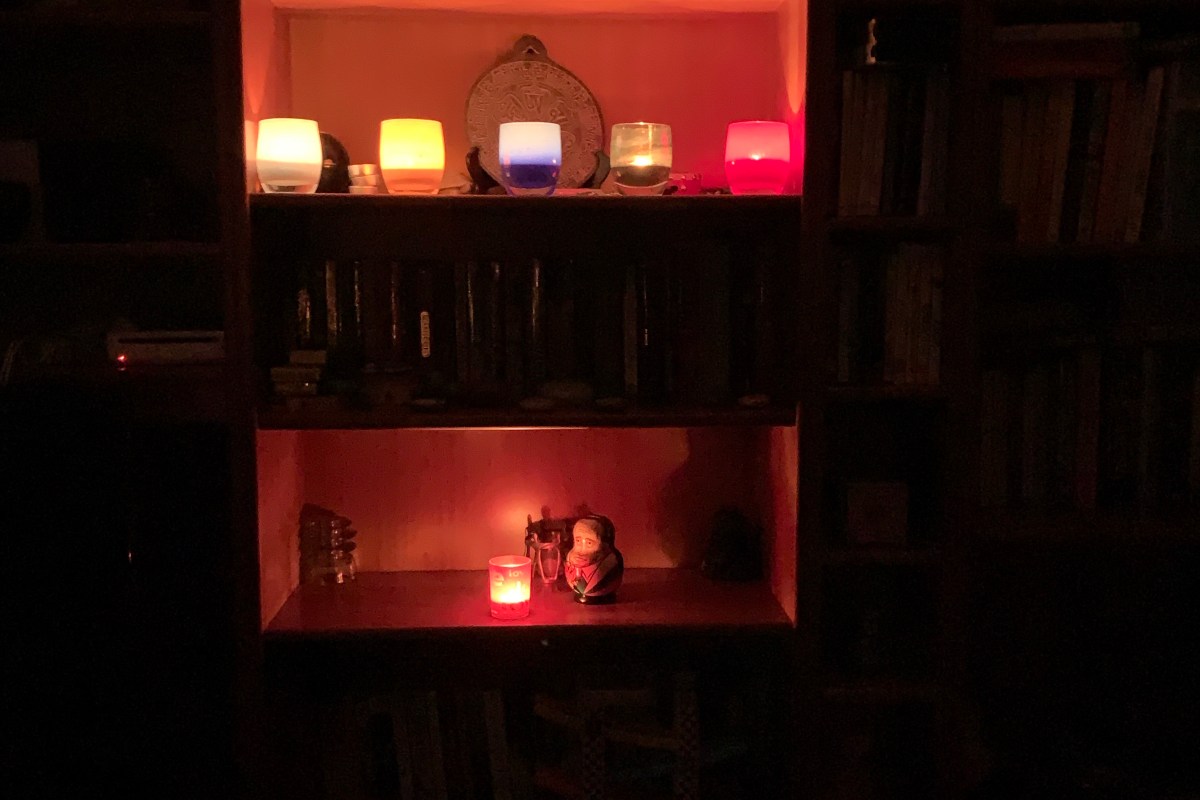
The other night I made the mistake of working on my taxes before bed. After a night of tossing a turning, mulling over finances, I blearily made my way down to the family room to meditate. As I lit the candles before settling down on the cushion, I thought “At least you have enough money to buy candles.

None of this is new – not the worrying about money in January which I’ve done every year for the more than 20 years I’ve been in business so I know from the pattern that it all works out but still worry anyway. And not the thought “At least you have enough money to buy candles.”

However, this was the first time I realized the fuller meaning of that phrase. I have always assumed that it was a reflex reminding me how much I have. But I marveled on the morning in question that what my inner voice was also telling me that my path to find peace, meaning and joy is free. It doesn’t cost me anything to stop and meditate at any or every moment.

And it was telling me that I can do that anywhere or everywhere. I can still find the calm within when the life circumstances are hard. As the quote from John Lennon reminds me, it isn’t just wishing that creates peace but it is powerful and transferable sense worth working for.

It brings to mind an Oprah Soul Sunday podcast I heard where she talked about whispers (here it is on a video of Oprah’s lifeclass). That she’s found that God, the Universe, a Higher Power talks to us in whispers. And it’s only when we don’t listen, the voice gets more insistent, a pebble upside the head and then a brick, in Oprah parlance.

So for twenty years I’ve been sweating through January as I handle the not-so-fun tasks of getting my customers to pay their invoices and to nail down commitments for the next year. This is the first where I really listened to that inner voice and was able to find my internal peace while doing so.

I’m hopeful that I’ll remember that the price of peace is free next year. And also, not to do my taxes before bedtime.

Unlearning My Way Back

A child can teach an adult three things: To be happy for no reason, To always be busy with something, and To know how to demand with all his might that which he desires.” – Paulo Coehlo

My sister-in-law recounted a conversation she had this week with my daughter, 7-year-old Miss O while holding hands and walking through an outdoor shopping center near our house.

Miss O said, “I love this place. Fun stores, good food, no BS”

My sister-in-law paused for a beat, wondering if she should ask, hoping Miss O didn’t know what it meant, and then asked, “Do you know what BS is?”

Miss O replied brightly, “Of course! Bad Service!”

After I stopped laughing, I wondered why it is that we think it’s bad for 7-year-olds to know swear words. Other than the fact that their executive brain function isn’t fully developed and they might deploy them inappropriately, indiscriminately or both. I landed on the fact that it feels like a loss of innocence.

I heard an interview once with singer and songwriter Billy Bragg where he posited that the opposite of faith isn’t doubt – but cynicism. If I think of Miss O using bad language, it feels cynical as if some beliefs of childhood would have had to have suffer in the process.

At their age, Miss O and Mr D believe that:

They are loved beyond measure and worthy of love

If you pray, those prayers will be answered

There is magic in the air so that sometimes fortunes found in fortune cookies will reveal the next fun thing

Potential new friends are everywhere

If you cry and show your vulnerability, you will be taken care of

Looking through this list I’ve typed, I think that I need to unlearn my way back to those beliefs. Because my cynical self might have been feeding me a lot of BS instead – and by that I mean bad service, of course. 😉

My Book Baby

The inner life of any great thing will be incomprehensible to me until I develop and deepen an inner life of my own.” – Parker J. Palmer

The death of my dad and the birth of my daughter are forever tied together in my mind. The day that I finished all the plans and paperwork to try to get pregnant via IVF, I sat at my desk and thought, “Wow, my world is about to change.” And the next day my dad suddenly died in a bike accident and I thought, “No, not like that!”

Then I spent 9 months taking the recordings I’d made of my dad and the effort I’d begun to write about his life and creating a book about him. On a night in August, at the end of the day I’d finished the very last line edits for the book, I went into labor with Miss O.

The birth of my baby right after I’d put my metaphorical book baby, Finding My Father’s Faith, to bed has meant that I haven’t thought much about the book in the last seven years. Until someone like the wonderful and insightful Vicki Atkinson of the Victoria Ponders blog comes along and reminds me of my book baby and I revisit the delight in the midst of grief of writing that for my dear dad.

Oops – I buried the lede – a podcast episode about my book

And I recently talked about the book, being a pastor’s daughter and the value of recording our loved ones with Troy Headrick in this Wise & Shine podcast. Here’s a link if you want to listen: Wynne Leon on Finding My Father’s Faith.

Pushing the Wrong Buttons

If what you believe in does not impact how you behave then what you believe in is not important.” – Shaykh Yassir Fazaga

My friend, Eric, told me that his 87-year-old mom has been leaving him really long voice mail messages. She records her message and then thinks she has hung up but the voice mail then records her going about her business.

So he was on the phone with her the other day and told her that she hasn’t been hanging up. “Well” she replied, “I hit the button.” After they finished talking, he stayed on the line and sure enough, heard her puttering around.

He got her attention by yelling her name into the phone and when she put it to her ear he asked, “WHAT button have you been pushing?” She replied something that made him realize she’d been pushing a volume button instead of the power button.

After we finished laughing about that, I mused about all the times I’ve pushed the wrong button. It reminded me of the old tech support joke when one tech asked another how he fixed the user’s problem, and the tech replied, “The On/Off selector was in the wrong position.”

I think of the time I was giving my friend, Jill, a compliment on her pants and said, “Those are so cute. My mom has a pair.” Turns out I offended her greatly because who wants to look like someone’s mom? Oops, wrong button.

But mostly it makes me think of all the times I’ve tried to do something without plugging into the Source and feeling the surge of power in my solar plexus. Like the tech joke, I have often tried things with the on/off selector in the wrong position, and without the power of belief, just relegated myself to futilely tapping at the keyboard with no results.

From rock climbs to bids for work in my professional field, there has been a huge difference between doing it with the power on or off, with my beliefs and values intact or lost somewhere in the dimness. Sometimes when I plug in to a Higher Power, I realize that I’m pursuing the wrong things but I find out the course correction is much easier with the power on.

Of course, like Eric’s mom, I continue to push the wrong buttons at times. Sooner or later, I find my way back to the small insistent God voice at my core asking, “WHAT button have you been pushing?”

(featured photo from Pexels)