At the Core

Whether you think you can, or you think you can’t — you’re right.” – Henry Ford

Last weekend we drove about 15 minutes down to Shilshole Bay on Puget Sound to see a dock where sea lions like to congregate. It was packed with sea lions – usually a dozen on the dock and I counted a least a dozen more swimming in the water.

Every once in a while, a sea lion would launch itself out of the water in an attempt to land on the dock. The new weight would make the dock roll one way or the other causing all the sea lions to bark. But there was one sea lion in the center who was doing most of the work to keep the dock level. It would lift its head high and shift its weight this way or that to stabilize the dock again.

It made me think of how impactful what is at the center is. As I was pondering what was at my core, Life, in that beautiful way that sometimes happens, delivered the answers to the question I’d just uncovered. In this case it was through the latest the Unlocking Us podcast about living into our values. In it, Brené Brown had an exercise to determine our core values.

Her research shows that when in a tight spot, most people call on their one or two go-to values. So on her site, there is a pdf of about 120 values. Her recommended approach was to circle the ones that called to you and then distill them to the two values that encompass what is central for you. It may change over time but this exercise was to identify what is key for right now.

Doing the exercise, I came up with faith and usefulness. Faith, which for me encapsulates confidence, courage, adventure, integrity, spirituality, openness, love, optimism and gratitude. Usefulness I thought did a good job of rolling up my other values of reliability, learning, kindness, growth, family, and independence,.

Over the years I’ve done a lot of work to strengthen my physical core. It has enabled me to carry heavy loads up mountains and I feel it most now when I hoist my toddler onto my shoulders. But thinking about my core values, faith and usefulness, I realize that they are what I go to again and again to power me when I have to dig deep. Like with the sea lions, when I am living into my values, they are the center that brings me back to level when the world is rocking.

Expectations

You can’t depend on your eyes when your imagination is out of focus.” – Mark Twain

On Friday, I was so excited to spend a morning with my toddler whose preschool was closed for a teacher in-service day. His sister had her last day of school before the holiday break so it would just be the two of us. I expected that he would soak up all the individual attention and enjoy all the fun we could cook up. I expected it would be a lot like spending time with my daughter when she was two-years-old and it was just the two of us.

What actually happened is that he spent the whole morning missing his sister and coming up with ideas like biking. I was happy to oblige only to find out the only route that he wanted to go was the one to his sister’s school so we could go get her. He wouldn’t listen to reason that it was too early to pick her up (after all, he is two-years-old) and my patience was frayed by not only his disappointment but also my own.

You know what they say – expectations are a bitch.

So I opened Dr. Brené Brown’s recently published book Atlas of the Heart to the section entitled “Places We Go When Things Don’t Go as Planned”

She does a beautiful job of defining disappointment – “Disappointment is unmet expectations. The most significant the expectation, the more significant the disappointment.”

And then she delves into expectations. The whole section is so illuminating but here is the part that caught my eye:

“When we develop expectations, we paint a picture in our head of how things are going to be and how they’re going to look. Sometimes we go so far as to imagine how they’re going to feel, taste and smell. That picture we paint in our minds holds great value for us. We set expectations based not only on how we fit in that picture, but also on what those around us are doing in that picture. This means that our expectations are often set on outcomes totally beyond our control, like what other people think, what they feel or how they’re going to react. The movie in our mind is wonderful, but no one else knows their parts, their lines, or what it means to us.”

Dr. Brené Brown – Atlas of the Heart

And the antidote to this disappointment? “Communicating our expectations is brave and vulnerable. And it builds meaningful connection and often leads to having a partner or friend who we can reality-check with.”

Reading over this, I thought of all the expectations that come with holidays – like that someone else will love the gift you got them or that loved ones will be able to perfectly see what you most desire and give that to you as a gift.  With little ones, I expect that they will treasure the gifts I spent time and money to get them – and not just the box that it came in!

While I couldn’t reality check my expectations about our morning together with my two-year-old, thinking through this process has helped me immensely to uncover my own hidden expectations. And then to recognize in turn how they lead to disappointment. It also made me see that my expectations that he will ever have moments of acting like a first child are completely silly. This helps me relax into the beautiful relationship that we do have so I can enjoy the time we have together for what it is, not what I imagine it should be.

Foreboding Joy

Wear gratitude like a cloak and it will feed every corner of your life.” – Rumi

Standing side by side yesterday with my 82-year-old mom as I made Thanksgiving dinner and she made the apple pie, I felt the physical presence of gratitude: the warm heart, the loving hands, the palpable sense of how many years we’ve been doing this. It, combined with the sounds of my kids playing in the other room with my friends, would have brought me to my knees in a prayer of thanks had my hands not been covered with turkey.

As I counted my many blessings in that moment, I couldn’t help but feel that pang of fear. What if something changes? It was the counter punch of foreboding joy.

It was such a relief when I started listening to the work of researcher, educator, author Brené Brown when she talked about the fact that we all stand over our babies at night or loved ones in a vulnerable moment and feel that seizure of heart that is “what if something happened to them?” And more so, her research that says giving in to the foreboding joy but trying not to enjoy it too much doesn’t work.

In fact, the only thing that works is to be grateful. Which in the midst of Thanksgiving seemed like a perfect full circle thing to remember.

So I’m grateful I know that other people feel this. And that it doesn’t mean that something bad is going to happen.

I’m grateful I know that I don’t need crisis to change. Because I associate the foreboding with my past when things fell apart so they could come together again. I’ve come to recognize that I can both keep evolving and handle things as they come.

I’m grateful that even the day after Thanksgiving, what I’m grateful for is still at the fore.

I’ve heard Brené give the example of a man who she interviewed as part of her research. He talked about losing his wife of 40 years after a car accident. He regretted holding back even a little bit of love so that he wouldn’t lose it all if something happened to her. Because when something did, all he thought was that he should have enjoyed it all more.

I’m carrying that story with me as we move into the Christmas season and all that’s good ahead.

Trust Me

Forget injuries, never forget kindnesses.” – Confucius

My toddler has learned to say, “Help me” when he needs assistance. He pronounces it with a soft “h” so it comes out “elp me” but it still is very effective at signaling when he wants help opening or moving something.

What’s fascinating to me is that even at 2 ¼ years of age, he is already learning some selectiveness of who he wants help from. He’s happy to let his older sister help him open pouches (those packets of apple sauce he can squeeze out and drink down) and fruit snacks because she doesn’t like those and never takes a cut off the top. But he does not want her to help him open candy or toys because she often takes a sample first.

Watching these two, it’s like they are illustrating the concepts of trust from the recently aired Brené Brown Dare to Lead podcast with author and leadership coach, Charles Feltman entitled Trust: Building, Maintaining and Restoring It.

Charles Feltman’s definition of trust is: “choosing to risk making something you value vulnerable to another person’s actions.” Wow – I had to listen to that one twice.

And when we choose to trust another person or company, we not only expect that they’ll take care of what we value but do it how and when we want. This makes me think not only of many examples from my career but also of the precious few clothes that I take to the dry cleaners and entrust them to take care of them, clean them and get them back to me on time.

Charles Feltman colors the definition in with several additional factors: sincerity (meaning what you say), reliability (meeting the commitments you make), competence (having the ability to do the job), care (having the other person’s best interests in mind).

The podcast had so many great examples at how we build and also destroy trust at work. Often overcommitting so that we can’t actually meet the deadline or pretending we have competence that we don’t are some of the ways we erode trust. Those descriptions brought back my first year of work after graduating college. I had been hired to build out the computer network for the local electric utility using Union labor from their Communications department. I overcommitted all the time and pretended I knew what I was doing again and again before I learned my lessons to check with the team before making promises.

But eventually my reliability and competence caught up with my care and sincerity and I was able to build and in some cases rebuild, trust. And then I moved on to manage people and experience the other side of the relationship.

All of this gives me great hope for my daughter who wants to be a big help to her brother but can get distracted by what she wants. My kids are learning to trust and to be trustworthy one interaction at a time. They don’t always get it right but they seem to learn a little bit every time they negotiate it as do the rest of us!

Comparative Suffering

Comparison is the thief of joy.” – Theodore Roosevelt

I’m old for a parent of a 2-year-old and a 6-year old. I had my son when I was 50 years old. Most of my long-time friends have kids in college which is great when I need babysitters. So part of my parenting journey has been to make new friends with people that have young children and have met many delightful ones.

But the other parents don’t complain to me. That isn’t to say that they don’t like me or include me, it’s just that generally they refrain from sharing their parenting woes. Every once in a while I’ll get a hint of why they don’t when a mom friend will say to me, “My husband was out of town for this week and wow, it’s so hard to get two kids to bed!” And they will often then add, “But I shouldn’t complain about that because you have to do it all the time.”

While I reassure them that it is totally fine to say that to me, I completely understand. More than that, I don’t feel bad that I do it by myself because I chose to. In fact, I often think about what would have happened if I’d had children when I was married and shake my head in relief that it’s only two kids that I have to get ready in the morning and not three if I was still married to my ex. 😊

But I finally have a term for why parents don’t complain to me because of a great Brené Brown Unlocking Us podcast episode with Esther Perel that I heard this week. Comparative suffering. When we start to complain about something and then cut ourselves off because others have it so much worse. I was recently talking with my friend Mindy about my dad’s death when I was 45-years-old and then stopped because her mom died when Mindy was only 23-years-old. I felt insensitive because I’d been able to have him in my life so much longer.

But I heard a heart-changing quote from Brené Brown on that podcast: “I had very little empathy for other people because I wasn’t open to my own pain.” When we stop to acknowledge that something hurts, sucks, is difficult — without comparing it to anyone else’s journey — we land ourselves back in reality. And from there, we can reach other people.

I frequently use “Comparison is the thief of joy” with my 6-year-old when she resorts to comparison with her friends. But now that I heard that wisdom I’m thinking of expanding it to “comparison is the thief of relationship.” We don’t have to compare any of our experience – good or bad. And when we do, we just have to acknowledge our own experience and theirs, and then continue to be real because that’s the glue of friendships, old and new.

(photo from Pexels)

Cultivating Play and Rest

Not everything that can be counted counts, and not everything that counts can be counted.” – Albert Einstein

Yesterday my sister-in-law took my daughter for the day and my son was in daycare, I had an entire day to myself. This is so rare, especially since COVID came and we have all been packed into the house on most days. I’ve had a few hours here and there but a whole day?? Of course I needed to work, the house was a mess and I had a to-do list as long as my arm so I was far from bored but the real question was, did I know what refills my cup?

Brené Brown has been doing this podcast series on The Gifts of Imperfection as it’s the 10 year anniversary of that book. And there is a particular guidepost in it “Cultivating Play and Rest – letting go of exhaustion as a status symbol and productivity as self-worth.” It was a reference that Brené made in a podcast to this guidepost and the work of Dr. Stuart Brown, psychiatrist, clinical researcher and founder of the National Institute for Play, that got me interested to read the Gifts of Imperfection in the first place. That to be whole-hearted, that is to say, fully awake and involved in life, we need to play.

My first thought when hearing about cultivating play was that I am a mother of young children, I should be all about play. My second thought was I have no idea what play is for me anymore. When I got my first night off from parenting when my daughter was about two years-old, I went out to drink wine with a friend. It was fine but I ended up feeling like I wasted that precious time. The second time I had an overnight break from parenting was when my daughter was three years-old and I went on a meditation retreat. It was so lovely to eat organic food, do yoga, meditate and cut out pictures for my vision journal. It really worked to refill my cup but isn’t very practical to do very often. The same goes for hiking which is my all-time go-to for refilling my cup but often takes too much time driving to do on these rare days off.

Here’s what I’m slowly realizing about cultivating play and rest for me. I know I’m still learning because I’m trying to be the most productive at rest. 🙂 But with that said, rest for me always involves some combination of reading, writing and exercise. Being quiet including turning off extraneous noise like the tv in the background is important. I never clean my house when my kids are gone unless it’s part of tackling a project that is fun for me. I try to reach out to at least one person that is key to my health and sanity. And when I’m very lucky, I go to a rarely visited neighborhood and find a place to eat lunch with a book.

Last night when my kids were returned to me, I listened to their reports from the day and we galivanted around the neighborhood and talked with neighbors, I felt like a new (renewed?) person. Someone who had a refilled cup to share with everyone else.

Five Pieces of Writing that Inspired Me: #2 Self-Compassion

Wisdom is oft-times nearer when we stoop than when we soar.” – William Wordsworth

I’m a master at slicing and dicing things so that I have to be perfect even as I cut everyone else slack. Most recently it’s that as a single parent, I better have things totally dialed otherwise people will think I expect help. Before that it was because I was the only female in a group of mountain climbers, I couldn’t forget anything or be the last to have my pack on to leave camp or the other climbers wouldn’t want to have a woman in their group again. And before that it was because I was the only blonde in an electrical engineering class, I better get a good grade or be a disgrace to all blondes.

Reading the work of Brené Brown has shown me that I’m better off at using my energy to practice self compassion than to keep believing that I’m the one person that can’t make mistakes.

We don’t claim shame. You can’t believe how many times I’ve heard that! I know shame is a daunting word. The problem is that when we don’t claim shame, it claims us. And one of the ways it sneaks into our lives is through perfectionism.

As a recovering perfectionist and an aspiring good-enoughist, I’ve found it extremely helpful to bust some of the myths about perfectionism so that we can develop a definition that accurately captures what it is and what it does to our lives.

  • Perfectionism is not the same thing as striving to be your best. Perfectionism is not about healthy achievement and growth. Perfectionism is the belief that if we live perfect look perfect, and act perfect, we can minimize or avoid the pain of blame, judgment and shame. It’s a shief. Perfectionism is a twenty-ton shield that we lug around thinking it will protect us when, in fact, it’s the thing that’s really preventing us from taking flight.
  • Perfectionism is not self-improvement. Perfectionism is, at its core about trying to earn approval and acceptance. Most perfectionists were raised being praised for achievement and performance (grades, manners, rule-following, people-pleasing, appearance, sports). Somewhere along the way we adopt this dangerous and debilitating belief system: I am what I accomplish and how well I accomplish it. Please. Perform. Perfect. Healthy striving is self-focused – How can I improve? Perfectionism is other-focused – What will they think?

Understanding the difference between healthy striving and perfectionism is critical to laying down the shield and picking up your life. Research shows that perfectionism hampers success. In fact, it’s often the path to depression, anxiety, addiction, and life-paralysis. Life-paralysis refers to all of the opportunities we miss because we’re too afraid to put anything out in the world that could be imperfect. It’s also all of the dreams that we don’t follow because of our deep fear of failing, making mistakes and disappointing others. It’s terrifying to risk when you’re a perfectionist; your self-worth is on the line.

The Gifts of Imperfection by Brene Brown

Whole-Hearted Joy

Hem your blessings with thankfulness so they don’t unravel.” – unknown

One of my friends has a beautiful ten-year-old golden doodle. They walk miles together every day and he’s constantly by her side. From nearly the moment she got him as a puppy, I’ve heard her say, “Oh, I’m going to miss you when you’re gone.” Foreboding joy. Trying to protect from feeling so much love by reminding ourselves it will end.

I remember hearing MSW and research professor Brené Brown talk about that feeling that steals over us when we go in to check on our kids at night. Standing over their beds watching them sleep, she said it’s nearly universal that we imagine the horror of losing them. I was so relieved. I thought it was just me. Foreboding joy. As Brené Brown says, “What we do in moments of joyfulness is, we try to beat vulnerability to the punch.”

It’s the reason I never want to have it all – happy marriage, beautiful family, good health. If things are going too well, I’m afraid that something will have to fall apart. Is it possible that the hidden underlying reason that I chose to become a single-parent is not wanting to have too good of a life? There are too many circumstantial things to go that far but there’s a nugget of truth that I feel in some twisted way less vulnerable when life is as much work as I’m putting in each of these days.

The antidote the Brené Brown has found through her research is gratitude. The people that Brené calls whole-hearted people from her studies are the ones who can embrace joy with open arms because they are so grateful. And practicing gratitude every day with a gratitude journal or a routine at dinner for everyone to name something they are grateful for is the way we lean in to it.

I wrote a post recently about my dad dying suddenly in a bike accident so I’ve been thinking a lot about what happens when the phone rings with terrible news. I know that gratitude has carried me through many of those tough moments – grateful that I was lucky enough to get him as a father, grateful that he didn’t suffer, grateful that we didn’t have to make tough choices about his care had it not been a sudden death, grateful that I have half of my lifetime of fun memories with him. None of the grief has been easy but the more I’ve celebrated who my dad was and the relationship we shared, the less I’ve suffered the ache of not having him.

So it seems like gratitude works on both ends – to keep us feeling the full joy of things as they happen and comfort us when the worst comes to pass. A worthwhile price to pay for whole-hearted joy!

Strong Back, Soft Front

“Do small things with great love.” – Mother Teresa

Last night we returned from a small outdoor party right at my son’s bedtime. I went to take off his shoes and socks and start to get him ready for bed and he was lying on the couch, head on the pillows, looking very much like a little grown man taking a load off after a long day. When I told him it was time to get his jammies on and stooped to pick him up he said, “No tank ooo.” At 23 months “no thank you” is his most powerful phrase and although I’d never claim that he fully understands the politeness of it, it’s still quite effective.

It makes me think of a phrase I first heard used by Brene Brown, “strong back, soft front” but I believe was originated by Roshi Joan Halifax, a Buddhist teacher. Strong back, as I think it relates to parenting, is all the things I try to hold the line on to raise healthy, happy and kind children. Bedtimes, self-care, routines, boundaries with each other, politeness. They are all the things that I feel like I repeat over and over again until I hope they pick them up for themselves.

And while I’m doing that, my soft front is so often moved by the sweet little things they do, their cries when life gets too much, and the moments of pride when they show they are learning something I’ve said. It’s my soft heart that gets opened over and over again by the bravery, dignity and earnestness of little people.

The thing I’ve noticed about parenting with a strong back, soft front is that dichotomy keeps me upright in those moments when I’m out of my depth. Either I’m too tired or too confounded by a situation that is challenging me, I can hold both ideas to create a balance that will see me through. I can be overwhelmed by my love and empathy AND still have the wherewithal to get my kids to bed.

Which is what I did last night. I stopped and talked with my toddler for a minute about the day, I listened to his “no tank ooo’s” and then I scooped him up to go upstairs and read.

NOTE: For anyone interested in a great description of strong back, soft front, I found this post by Bev Janisch that includes content from Brene Brown and a guided meditation.

The Power of Curiosity

“If you see the soul in every living being, you see truly.” – The Bhagavad Gita

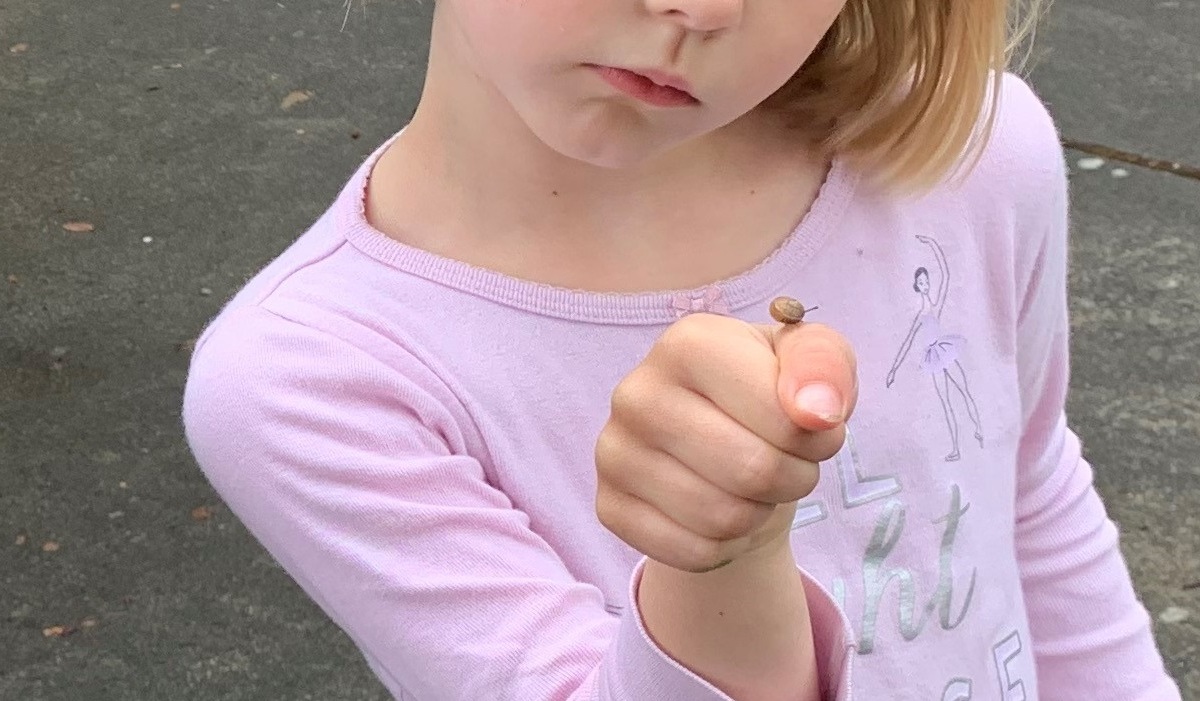
My five-year-old daughter kills snails. Let me pause here and say that it’s not a serial-killer-in-training kind of thing where she tortures and then decapitates them or something like that. It’s very well-intentioned interference in their life where she builds these very elaborate snail houses with pools and vegetation and then stocks them with snails. But then she’ll put them directly in the sun or forget to refill the water and oops, another snail is dead. One of my friends gave her a Bug Hotel terrarium and she put so many unfortunate snails in there that I started to call it the Bates Motel.

I have a friend who does a similar thing with humans (the help thing, not the killing thing). She doles out well-intentioned help to people that she believes need an upgrade in their circumstances. Unfortunately it sometimes backfires when people feel like they are projects and don’t absorb the help they are given.

I recently listened to this Dare to Lead podcast with Brene Brown and Michael Bungay Stanier that talked about the pitfalls of giving advice – the person with a problem may not accurately know what the problem is, any solution that you offer might not solve the root issue and even if you have the perfect solution, it can undercut their ownership of solving the problem themselves. Michael Stanier’s advice was to stay curious a little bit longer.

This seems to be a common theme in the content I’m listening to and reading these days – the power of curiosity. Asking open-ended questions like “how can I help?” and “what makes you think that?” and “say more” changes the nature of the conversation. Curiosity brings the power of mindfulness to an interaction and is a gateway for openness, an antidote to judgment. If we believe that we don’t have enough time to have these conversations, think about how much time it takes to solve problems again and again because we didn’t get it right the first time.

I’m finding curiosity a great tool for parenting because kids have so much of it. I could continue to slip out at night and free the snails or I can flat out tell her not to capture them but both of those solutions undermine her ability to see the soul in everything. Because of course this is not just about my daughter and snails, it’s about our agency in this world and learning not to destroy it. I’m hopeful as we research about whether snails grow out of their shells, what leaves they like best and how long they usually live that we can connect more deeply with compassion for others and retire the Bates Motel.