Editing That Six-Word Story

The other day we were holding a family meeting where eight-year-old Miss O and I where hotly debating the next thing to do and I asked four-year-old Mr. D if he had an opinion.

“No, I’m not a good talker,” he replied.

Whoa, there’s a six-word story!

I’m sure with his very verbal older sister and his mom that is fascinated by words, it feels like he can’t get a word in edgewise. Funny thing is that he is interested in following along. I notice that the more we talk, the more still he gets. And then when we least expect it, he pops off with a perfectly positioned sentence like on January 1st when he said, “I told you last year not to step on lava.”

It feels like helping these young people write and change their stories as they grow is one of my biggest responsibilities and honors. In this case, I’m hoping to convince Mr. D that his six-word story is better said as, “I’m not a good talker…yet.”

And for more about six-word stories, please tune in to my podcast with Dr. Victoria Atkinson. We know and love her as our blogging, writing, and podcasting friend. But in this case, she brings all her experience as a therapist, professor, college dean, and author to bear to teach us how potent these little stories can be.

Search for Sharing the Heart of the Matter on Apple podcasts, Amazon Music, Spotify, and Pocket casts. And please subscribe! Or click here for the show notes and link to listen to the podcast on Anchor.

(featured photo is mine. I offer these six words as a caption: Despite our care, another worm died)

My Love Affair With Words

“Be sure to taste your words before you spit them out.” – unknown

The other night I was fixing dinner while my seven-year-old daughter was in the family room working on her very first short story. “Momma, how do you spell persevere?” she asked. As I replied, I took in the really sweet scene and thought to myself “there’s another leaf that’s going to stick on my word associations tree.”

Because that’s how my brain likes to work — by creating associations to words. Like with smells or sights, words themselves conjure memories and the older I get, the more associations I have – or in my mental image, leaves on my word tree.

For example, enthusiasm – from en-Theos or with God – reminds me of my beloved father who was a Presbyterian pastor. There isn’t a word that describes his remarkable energy better and I can’t hear it without thinking of him.

Or plethora which is my best friend’s favorite word. And since we’ve been friends since we were seven-years-old, there are a plethora of memories that come to mind when I hear that word, especially of high school when life was abundant in opportunity, boys, and screw ups to learn from.

Then there’s the phrase “pit stop” that with the hard “t” and “p” sounds reminds me of my sister. She used the phrase in a letter she sent to the whole family when we were in 20’s when she was mad at my brother for not breaking off a relationship with one of her friends properly. In trying to smear him for using others as a “pit stop from himself,” she instead attached that phrase in my mind to my image of her, along with “misdirection” for her ability to distract from the work she needs to do.

Plenitude is a recent favorite that comes in accordance with meditation which almost always leaves me with the reminder that at that moment I have enough.

When I first started going to meditation class ten years ago as I was healing from my divorce, there was a bowl of inspirational words on a table to pick from. I kept getting “transformation” and I was so completely tired of it I just want to scream, “Haven’t I changed enough for a life time? Leave me alone.” And fortunately when I vented that thought, I was usually down on my knees in prayer pose and from there could bend to accept more renewal.

Because renewal has a friendly association for me. That means my cup is being refilled and hopefully my energy too. I’m friends with renewal in a way that I will never be with transformation.

“Calibrating sentences” is one of my recent favorites that comes from playwright and writer, Jack Canfora, on a podcast that he did bout the creative process. Isn’t that a beautiful way to measure the weight and balance the best utterances come with? And given that it comes from such a gifted writer, it gives me hope that if I work at it too, I might be able to calibrate a few great sentences in my lifetime.

Fledgling gained new attachment for me when I had kids. Never before had I been able to appreciate the delicate nature of holding newness in my arms combined with the potent desire to provide a platform strong enough to see them take flight.

Bivouac reminds me of my climbing friend, Phil, who is always joking that it’s French for mistake. It’s not, it means a temporary camp without cover according to Oxford languages, but since Phil bivouacked high on Mt. Everest during the climb when he became the first American to climb the North Side of Everest, it’s a well-earned attachment.

Say the word “authentic” and I think of my meditation teacher and friend, Deirdre. It’s the attribute that makes it so she can somehow manage to lead a yoga class and yell, without missing a beat, “Move on, Motherf*$)#^!” out the door at someone she thinks is casing her car.

The word I associate with me three-year-old son is observer. The other day I turned on some kitchen lights I don’t usually use for a house guest. When my son saw them, he took me by hand to show me where other lights of that same type were in the house. He sees the quarter moon and says, “The moon is missing a piece.” And most recently, in one of his most profound observations, we were watching a storm out the window and he said to his sister, “Sshh, I can’t see.”

There’s “constellation” and it reminds me of my brother and one of his favorite songs by the same name by Jack Johnson and Eddie Vedder. It also is attached because my brother is always seeing the patterns in things.

Love has so many associations that it has become cluttered. But dedication, commitment, intimacy, fun, play, expansiveness, laughter, loyalty, selflessness and desire each conjure a particular person or memory in my life so that all together, they jumble into a delicious mix of how love feels to me.

I can’t hear the word “condensation” without thinking of my very verbal daughter. As a four-year-old, someone was telling her he had water forming on the inside of his camper van on cold nights and she responded, “You mean condensation?”

My love of words has infected me so much that for almost any person in my life, I have a word association for them. It makes me wonder that if, by the time I’m really old, if I’m lucky enough that my body perseveres that long, every time I construct a sentence, there will be a memory and person hanging off of it.

Maybe that will be my tree of life and I’ll be able to enjoy each delightful word with the memory that comes with it.

(featured photo from Pexels)

Vulnerability

“To share your weakness is to make yourself vulnerable; to make yourself vulnerable is to show your strength.” – Criss Jami

This post was previously published on 2/2/2022. Heads up – you may have already read this.


The other day my friend, Doug called when I was working on a blog post. When I responded to his question to tell him what I was doing, he said, “Oh, that’s awesome. Send me the link to that blog.”

I did and then….<nothing.>

Did he not like my latest post? Did he not like any post? Maybe he didn’t read it? But he asked for it? <Gulp>

Vulnerability is hard.

When I applied to be a writer for the Pointless Overthinking blog (now Wise & Shine), I didn’t tell anyone in my in-person life. I was excited that I might have the opportunity to be a writer for a shared blog but telling someone seemed too scary — I didn’t have the guts to admit it out loud.

Six weeks went by. Because it was well within the window of expected response, I didn’t think about it much one way or the other.

Then from deep inside, my courage to follow-up won over the vulnerability of confessing that it mattered. I sent a follow-up email pointing out how well I can pointlessly overthink. And I got a response within the day.

This internal struggle reminds me how much I’ve learned about vulnerability in recent years, primarily from Dr. Brené Brown’s research. She defines vulnerability as “the emotion that we experience during times of uncertainty, risk and emotional exposure.” It is where we go when things matter and yet they are out of our control. Which I believe is the heart of life.

But she has researched extensively the connection between vulnerability and courage.  “In my most recent research on courage and leadership, the ability to embrace vulnerability emerged as the prerequisite for all of the daring leadership behavior.” Or said more succinctly in one of her most oft repeated quotes, “I believe that we have to walk through vulnerability to get to courage.”

Whether it is leadership, creativity or intimacy, we have to risk emotional exposure in order to show up. If something matters, it will hurt if not met with success, acclaim or acceptance. But I’ve learned that showing up always results in SOMETHING that keeps moving me forward on my journey. I’ll never be able to say that I don’t consider what the potential audience might think as I write this – but I get closer to knowing what it is that I think of my effort.

And what about what my friend Doug thinks? Something I read in a book published by blogger, Julia Preston’s “Voices: Who’s In Charge of the Committee In My Head?” about her life and blogging experience gave me insight into the reactions, or lack thereof, of my non-blogging friend.

“One of the most valuable lessons that I ever learned about vulnerability is that the more willing I am to tell the truth about myself to a trusted listener – someone who will not judge me for whatever heinous crime that I believe I may have committed, the more of me there is to love. The more others trust me enough to share from within the depths of their being, the more that I realize that we’re all struggling with the same human foibles.”

Voices: Who’s in Charge of the Committee In My Head? by Julia Preston

My mountain climbing friend and former IT work colleague, Doug, isn’t a blogger or writing in any format that I know of to share his authentic life. If I took up knitting, I certainly wouldn’t expect any insightful commentary from him on that pursuit. So why do I expect it about writing?

Because to speak to anyone else, writing has to be vulnerable and authentic. Sometimes opening that vein to pour onto the page takes a lot of guts but it’s the only way to reach to others who are willing to walk through vulnerability to get to courage.


I’ve written a related post on the Wise & Shine blog inspired by Miss O’s 3rd grade teacher about the reader’s experience: Writing Windows and Mirrors

(featured photo from Pexels and featured quote from Mitch Teemley: Be Humble. Or Be Humbled )
Give Me A List

“To meditate means to go home to yourself. Then you know how to take care of things that are happening inside of you, and you know how to take care of the things that happen around you.” – Thich Nhat Hanh

This post was originally published on 10/26/2022. Heads up – you may have already read this.


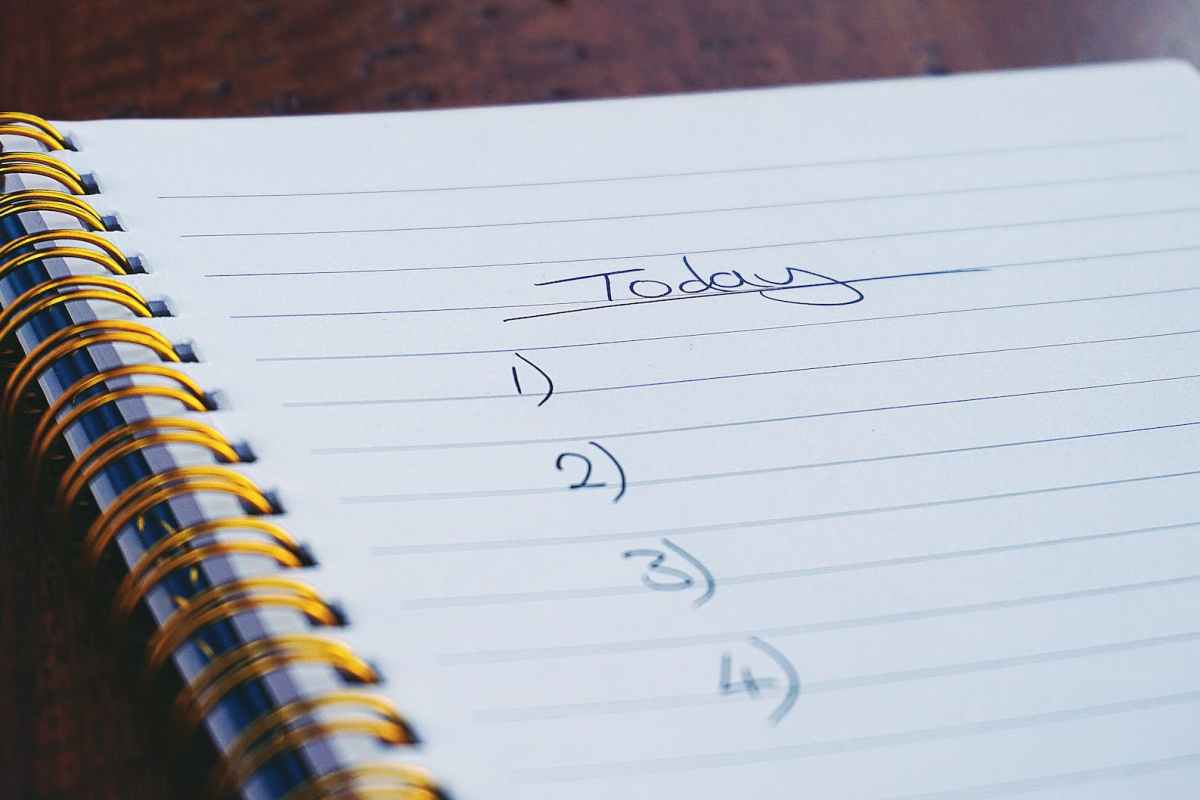
Have you thought about the effectiveness of lists in writing? Take a moment and think of the famous lists that come to mind like My Favorite Things from The Sound of Music or the Ten Commandments from the Bible. Even when we can’t name them all, I bet we can name a few or most.

Lists can help us as writers be concise, ordered and on topic. They also let the reader draw their own inferences. One of my favorite lists is Jack Canfora’s post, Dear Lord, Not Another Post on This Blog about Gratitude and I’m grateful it made me want to continue to write. AP2 polled the readers on the Wise & Shine blog and created 9 Pieces of Indispensable Life Advice From Your Future Self. And Dr. Gerald Stein’s list of How to Become Your Own Best Friend has so many nuggets of wisdom to mine. I can name those lists as impactful off the top of my head plus some items on them because at least I find lists are more memorable.

So, here’s a list I’ve written.

Why I Meditate

I meditate because it is the one thing that has improved the quality of my life the most.
The quality prior to meditation was only manageable if I drank a bottle of wine a day.

Meditation helps me live in my heart, not my head.
Because the voice in my head is an asshole.*
And I was sometimes an asshole when I listened to it.

Meditation has helped me to eat at the table of what IS and stopped begging at the table of what ISN’T.

I meditate to so that at least once I day I’m listening to the right things instead of the wrong things.
Right things include love, empathy, patience, wonder, awe, curiosity, grace, laughter.
Wrong things include judgment, self-flagellation, anxiety, comparison.

Meditation has helped me give up two key stories: that situations are win/lose and that choosiness leads to joy.

Instead I believe in bowing down to openness and creating porous boundaries where I try not to hang out to things as they come and go.

I meditate because it helps me exercise my grace muscle instead of my judgment reflex.

Sitting quietly in meditation has helped me to hear the heartbeat of life and trust in its timing and flow.
I almost always get this wrong and push ahead of the envelope but I’ve learned to respect it, especially in hindsight.

Meditation has helped me find internal quiet and be able to rest there.
When resting in that space, I can more easily find my way to others.

It takes repetition but meditation in five-fifteen minute daily increments has been the most gentle way of changing my life.
The other ways change has come to my life through loss, suffering and chaos have been a lot less fun.

And when I get all of the above wrong, which I do all the time, meditation helps me not judge myself too harshly, breathe and begin again.

How’s that for a list? Do you use lists in your writing? How about meditation?

*I give credit to former newsman Dan Harris, a self-described cynical but committed proponent of meditation and mindfulness for the phrase “the voice in my head is an asshole.” His podcast, Ten Percent Happier has great guests who discuss the science of mindfulness and it also has free, short 8-10 minute guided meditations. And for anyone looking for an app, Healthy Minds has 5-minute meditations. I am not affiliated with either.

** Update on 9/5: Another related post on meditation: Does Loving-Kindness Actually Matter?


Speaking of lists, I’ve compiled a list of favorite writer quotes submitted by bloggers in response to my poll of favorites on the Wise & Shine blog: Your Favorite Writer Quotes

(featured photo from Pexels)

When I Write

“The words you speak become the house you live in.” – Hafiz

This is a repost of writing I posted on 10/12/22 – heads up that you may have already read this.


The other day a friend was telling me how his dad, who was a professor in the business school at the University of Washington, wrote books. He’d shut himself in his home office and for two months would just sit there with a note pad nearby. Sometimes he’d watch a game or organize stacks of papers. When my friend would come in and ask his dad what he was doing, his dad would say, “I’m writing a book.” My friend would say, “Nah, you’re listening to your police scanner.“

And then in the third month, my friend’s dad would start typing and be done with the manuscript in a month.

After telling this story my friend turned to me and asked, “How do you write?”

I have a very specific time to write each day. It’s in the morning after I’ve gotten up at 5 or 5:30am to do yoga and meditate and before I get the kids up at 6:45 am. I tackle ideas that have been floating around my head because of things I’ve heard, read or have been struggling with.

That time of day for me is when I’m most hopeful, mystical, and quiet. I can hear the small whisper at my core and I have better access to my creative muse.

Then the day starts and its drop-offs, pick-ups, doing my day job. By the evening, my creative muse has been pounded into bits. It’s tired, critical and tells me I don’t have anything worth saying. I don’t look in the mirror at that time of day because I will find fault with what I see. I tend to be pretty quiet in the evenings because I’m as shallow as a muddy puddle and just as unclear.

So I almost always write from my renewed self and never include words from my salty self. As I laid this out to my friend, the downfall of my approach became apparent to me. It’s like cooking with only sugar and no salt. I write from a place from which I’ve shaken off the dust that collects during each day and even my suffering looks shinier.

I’m only covering about half (or less) of my human experience. Not the times that I say “sh!t, f*&k, d@mn under my breath when I step on a kids toy in the dark and definitely not when I very badly want to blame my kids for causing me pain. I don’t write in the times when it truly feels like nothing is going to work out. And certainly not the times when I feel like the life I’m leading is unrelentingly tough.

I can meditate later in the day and get back some equanimity. But there’s a Buddha quote that says, “Sleep is the best meditation.” Indeed it is my best way to remove the tarnish of life and reinvigorate my creative muse. But if I want to write about the fullness of life, I need to remember it’s the whole day experience.

My take is that my friend’s father wrote a book in one month because he had spent the time to gather himself and then could get it all down in one go. It’s a good reminder to me that I need to gather all of me to bring to the writing table lest I leave out all the spice.

I’ve also posted today about how my purpose for writing has changed at the Wise & Shine Blog: The Writer’s Mission Statement

(featured photo from Pexels)

A Post, A Podcast, and A Survey

“One ought, every day at least, to hear a little song, read a good poem, see a fine picture, and, if it were possible, to speak a few reasonable words.” – Johann Wolfgang von Goethe

Out of the 1,063 posts I’ve published on this site, the one that generated the most discussion was the one I did where I talked about podcasting and why people do and do not podcast. Which I find interesting on several levels.

First, because I think we all have opinions about how reading versus listening works for us. If I could summarize, some of the comments from that post, it is that they are two different experiences, and sometimes to switch between one and the other is more than we want to do.

Second, because there are so many choices of content that speak to us – words versus photos, prose versus poetry, story-telling versus informative and on and on. We come in to a platform like WordPress, or the blogosphere in general, and then have to sift our way towards it.

When I talk with my friend, Eric, about the podcasts I listen to, he usually rolls his eyes and says they are too much work. I like podcasts about finding meaning, and digging deeper into what parts of our brain and body are running the show, about meditation and mystery. He likes things that are more at the entertainment level. Fair enough – because we meet somewhere in the middle and have really good conversations.

All of this is a prelude to two things. One, Vicki (of the Victoria Ponders blog), Brian ( of the WritingfromtheheartwithBrian blog) and I talk about blogging on the latest episode of the Sharing the Heart of the Matter podcast. Episode 17: Building a Base with Brian Hannon if you want to listen on Anchor or search (and subscribe!) for Sharing the Heart of the Matter on Apple, Amazon, Spotify or Pocket Casts.

We explore the questions about whether numbers matter, how we can’t predict what will land with our audience, how Brian’s experience as a newspaper reporter early in his career applies to blogging, and what is meaningful about the blogging experience. If you are a blogger that likes podcasts, you’ll love this fun and interesting episode.

And number two, we’ve put together a short anonymous survey about podcasting to gather feedback about what you like. So, if you want to weigh in on what topics land for you and what you’d like to see more of – please spend 2 minutes to answer these 4 questions on the Sharing the Heart of the Matter Podcast Survey. Or put your thoughts in the comments below.

That’s a lot – a blog post, a podcast (Episode 17: Building a Base with Brian Hannon) and a survey (Sharing the Heart of the Matter Podcast Survey). Yeah, I know. But if you have a few minutes, I’d really appreciate it.

The Feeding and Nurturing of Life

“Love and compassion are necessities, not luxuries. Without them, humanity cannot survive.” – Dalai Lama

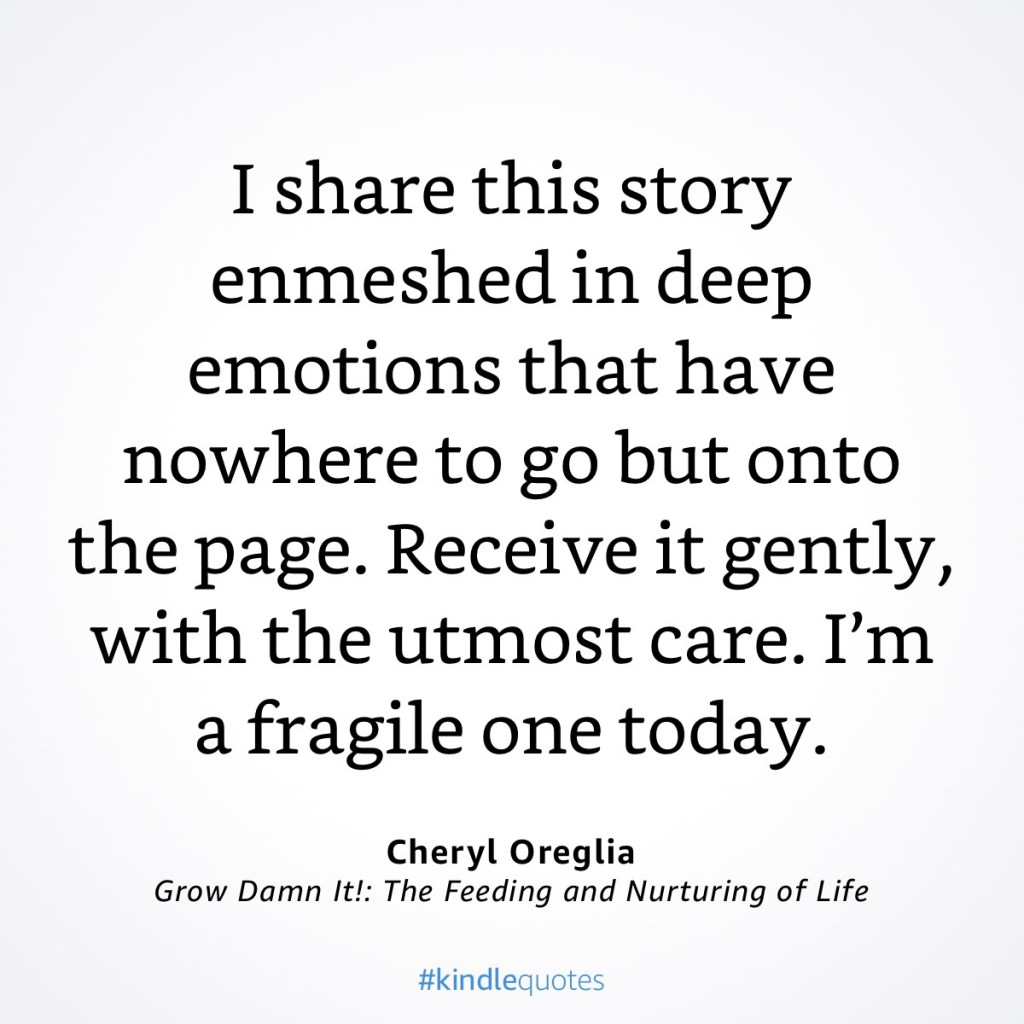
On Wednesday morning this week, I was driving the kids to school on the circuit around the lake and I felt softer and more patient. I appreciated the routine and the little people in my life more. I realized that it was because I’d just finished reading “Grow Damn It: The Feeding and Nurturing of Life” by author and blogger Cheryl Oreglia.

I clipped 23 quotes from my first reading of this book. And that was while trying to be mindful not to clip everything. Then I had the privilege of doing a Sharing the Heart of the Matter podcast with Cheryl to talk her journey and this book: Episode 7: Grow Damn It!

One of the stories Cheryl told me on the podcast was the one where she wrote a blog post and Krista Tippett of the On Being project (first aired on public radio, now as a podcast) tweeted about it. Cheryl laughingly said she assumed the technology was broken when she saw her stats after that.

In this great conversation, we got to talk about how the little stories make up the big picture, her journey to create this beautiful book, and asking people all the important questions before they go. I felt softened by reading the book and then I felt enriched after this beautiful conversation with Cheryl.

Cheryl said to me something like, “I know this book is not for everyone.” I agree – it’s only for people who want to feed and nurture their life – and laugh while doing it.

So if you do want to feed and nurture your life, please visit Cheryl’s blog, Living in the Gap, read the book, and listen to this podcast Episode 7: Grow Damn It (link opens the podcast to listen on Anchor). You can also find the podcast on Apple, Amazon, Spotify and Pocket Casts by searching for Sharing the Heart of the Matter.  Please subscribe!

Here’s link to the show notes on the HoTM site: Episode 7: Grow Damn It! show notes

Depth and Breadth

“The heart of man is very much like the sea, it has its storms, it has its tides and in its depths it has pearls too.” – Vincent Van Gogh

In my house when we have a fun announcement, we blow the imaginary trumpet in our hands and sing “Doot-doot-da-do!” So please, humor me and imagine a “doot-doot-da-do!”

Because I’m really excited to announce a new shared blog space that Vicki Atkinson (from the Victoria Ponders blog) and I have created with a team of incredibly talented group of contributors and thinkers. It’s called The Heart of the Matter – https://sharingtheheartofthematter.com. It’s intended to be a blog that digs into the depth of how we find what matters to us and keep our eyes focused on that horizon as we are swimming through our days.

This topic of what matters I something I believe to be different for every person and different every day but with a lot of common elements of experience, learning and love. Which is why it’s important for us all to be collaborating on this topic and space so that as we figure it out, we are contributing to the journeys of others. It’s found in what DOESN’T matter as what does. The other things we plan on diving into are:

  • What is fueling us to figure out what’s important
  • Celebrating who is helping us discover our own keys
  • How we get stuck thinking it’s one thing long after that one thing has ceased to be vital.
  • Linking to resources that help uncover what’s real
  • Heartening each other to have the faith and confidence to pursue what matters
  • Healing what is broken so that we can uncover what’s essential

This shared blog space is for surfacing our stories that help us discern what matters so that others are inspired and it pulls us all along.

So please follow us there – but more than that join us there. As we figure out how to make this a collaborative and supportive space of contents, comments and topics, I hope to see all my dear blog friends in a rich space of discussion around the Heart of the Matter. My first post in that space is The Small Decisions that Matter.

Which doesn’t mean that I won’t be also blogging here on Surprised by Joy. As I see it, my personal blog covers the breadth of life in all its glory and surprises while The Heart of the Matter digs into the depth of authenticity, inspiration, values and love found in what really matters.

Editing the Page

“All life is an experiment. The more experiments you make, the better.” – Ralph Waldo Emerson

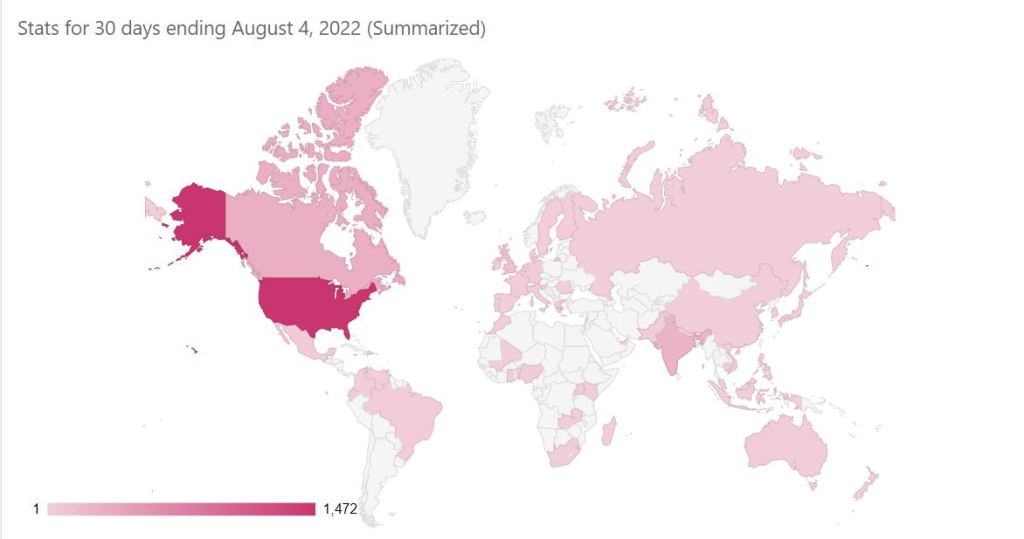
Looking at the stats for my blog, I can see that the most visited page is the About page. Which makes sense because I don’t have a lot of other pages. However, it makes me want to go back and re-do that page of information about me because I think I’ve changed since I’ve written it. I also often leave out the background info so as not to repeat myself so I think some links are in order. I took at stab at a rewrite and published it as my Wise & Shine post this week: About Me.

Discernment

“It usually takes me two or three days to prepare an impromptu speech.” – Mark Twain

One of my favorite words these days is discernment, especially when it applies to my own actions. That is to say, when I take the time to discern to what I should or should not be doing.

Oxford Dictionaries defines discernment as “the ability to judge well.” I think of it more broadly as taking the time to choose how I apply my energy and time. Also, to notice when I’m trading routine for quality.

Lately I’ve been writing my blog posts on the morning of the post instead of what I’d done most of the year, which is to draft something the day before and finish it the morning I post it. Putting a little time between when my fingers hit the keyboard and when I hit “publish” served to give me space for reflection and hopefully be a little more thoughtful.

Discernment tells me I need to stop publishing every day so that I have more time to think about things. So that I can do a better job. Maybe three thoughtful pieces a week instead of five slapdash ones. And now I’m laughing because of the post I wrote about Interrupting the Pattern earlier this week – it’s hard to break a habit.

What role does discernment play in your life?

(featured photo from Pexels)