The Four Habits of Happiness

It all comes to this: the simplest way to be happy is to do good.” – Helen Keller

I was listening to a 10 Percent Happier podcast that featured Arthur Brooks. A professor and social scientist, Arthur Brooks has recently published a book called From Strength to Strength: Finding Success Happiness and Deep Purpose in the Second Half of Life. He named a list from research of the 4 most important habits of happiest people:

  • Faith
  • Family
  • Friends
  • Work that serves others

But it made me wonder if everyone can fulfill that formula? First of all, faith means so many different things to different people. But perhaps it’s the trust in one of my favorite Steve Jobs quotes (which as Dr. Stein pointed out seems to build off Kierkegaard’s famous quote about living life forwards):

You can’t connect the dots looking forward; you can only connect them looking backwards. So you have to trust that the dots will somehow connect in your future. You have to trust in something – your gut, destiny, life, karma, whatever. This approach has never let me down, and it has made all the difference in my life.

Steve Jobs

But going down Brooks’ list, what about people who don’t have a lot of agency in their work? I recently heard an example of a hospital janitor. Instead of feeling like he didn’t have purpose in his work as he cleaned up vomit in the oncology ward, he’d framed it as an opportunity to make people feel a little bit better on what might be a low point in their lives.

And this made me think of my life. One of my least favorite activities about parenting is cleaning up spills. On a weekday when we are at work/school/daycare, it’s not so bad, but on any given weekend day, I clean up (or help my kids cleanup up) 6-10 spills a day. It feels like a waste of time to me, like I could be spending more time laughing and playing with my kids if we didn’t have spills.

But of course, despite my best precautions – kids, especially at age 3-years-old and age 7-years-old have accidents. They splash water out of the sink, they tip over the reservoir of paper they were using for a project, paint brushes fly out of little hands, and so on.

Reframing it, I see that I am not cleaning up spills. I’m teaching my kids how to react when things don’t go right. I’m helping them learn to pick up the pieces and continue when we have lost our mojo. And most importantly, I’m building up their belief that they can do it, even when it isn’t fun.

This big picture sentiment when it comes to caretaking is echoed by research professor Dr. Alison Gopnik “Taking care of children, like taking care of elders is frustrating, is tedious, and it’s difficult in all sorts of ways but it is also deep and profound and an important part of what makes us human.

In this way, maybe it is not only work that serves others but also quite possibly a habit of happiness.

What do you think about the four habits of happiness? Is there anything you do regularly that you’ve reframed as work to serve others?

(featured photo from Pexels)

Meaningful Interaction

Many people will walk in and out of your life, but only true friends will leave footprints in your heart.” – Eleanor Roosevelt

I was reading an article written by a single mom with kids who was bemoaning her situation in life. And there were many things I could relate to even though her kids are a lot older than mine (maybe in their 20’s). Because it’s hard to live in a house where you are loved dearly but not really cared for.

But there was a lonely note in her writing that I couldn’t place. So I looked up loneliness in Brené Brown’s Atlas of the Heart. Brené includes the definition of loneliness as defined by social neuroscientist, John Cacioppo and his colleague William Patrick as “perceived social isolation.” And Brené expands on this with “At the heart of loneliness is the absence of meaningful social interaction – an intimate relationship, friendships, family gatherings, or even community or work group connections.”

It brings to mind two times in recent years that I’ve felt lonely and had to adjust my social interactions to make them meaningful. The first was when I first became a mother. I remember one night I courageously left my daughter with a babysitter and went to a restaurant to drink wine and watch a Seahawks game with a good friend. I had fun – but the next morning got up and felt empty because what used to be fun for me longer met my needs. I longed for more meaningful interaction.

And the second was when the pandemic started. All of a sudden my meaningful interactions with other parents were eliminated or reduced to online. I had to find another way — and that eventually led me to blogging.

Thinking about Brené’s comment – it isn’t about how many friends we have or whether we are in a partnership, it’s about whether we are meeting our needs for depth. In fact, I think the loneliest place I’ve ever been is inside a committed relationship. I send a wish to the author of that article and for us all to have the focus on cultivating friendships where we are seen.

What makes you feel less lonely? What counts as meaningful interaction for you?

(featured photo from Pexels)

Growth and Comfort

In any given moment, we have two choices: step forward into growth or step backward into safety.” – Abraham Maslow

“How’d the paddle boarding go?” my friend Rachel asked Miss O who responded, “Good.”

Unfortunately that wasn’t the case. I’d planned a special outing for me and my almost 7-year-old to rent paddleboards and go out on the small lake near our house one afternoon after camp last week. Both of us were so excited to have the time together and to get out on the lake. Miss O has paddleboarded in a little inlet by my brother’s boat and seemed to get the hang of handling the board and the paddle so it was going to be a great expedition to be able to go together. We’d talked about the fact that it would be a little choppier and windier where we were going and made a plan if either of us fell in. Miss O said she was prepared.

But when we got out there, the wind pushed her around and at her light weight, she had trouble controlling the board. She got frustrated and it seemed like every sentence that she said out there started with “I can’t…” I offered to tow her and she didn’t want to do that because she wanted to do it herself. We talked about setting our sights on somewhere she could paddle to but she said she couldn’t do anything but circles. I asked her what she thought she could do and the answer was nothing.

I was flummoxed. I know Miss O can step it up to a level of toughness with teachers, coaches and other family members. She has been going to a different camp every week of the summer and when she’s nervous she takes a deep breath and says, “I can’t skip this first day because if I do, then tomorrow just becomes the first day” and then she squares her shoulders and walks inside.

But when I’m around, and this has happened in many different scenarios, she doesn’t show the same resolve and instead tends towards tears and hugs. In the choice Maslow presents in the quote for this post, she chooses to step backwards into safety more often than not when I’m present.

I asked her about paddleboarding in the quiet, calm time before bed that night and, she said it’s because she doesn’t want to cry for anyone else but she can with me.

It strikes me that this might reveal that support and education are mutually exclusive for most of us. That is to say, we can’t be in our comfortable spot and grow. I think about all the times that I’ve done business projects with more experienced colleagues or climbed mountains when someone else was leading the group. I know in those cases I relaxed in a way that made it harder for me to access mental toughness.

That is a beautiful part of being part of a group or family or partnership. But I’m starting to see that when I’ve grown the most, it’s when I’ve moved outside my comfort zone and in many cases, done things alone.

Which brings me to the heart of her answer to my friend, Rachel. Miss O knew that paddle boarding hadn’t gone well but has reached the age where she wanted to cover it over with a “good.” But that makes me very grateful that she, at least for now and maybe forever, can cry with me.  She’ll have plenty of other opportunities to learn from other people and experiences but even when growing, we all need a comfortable spot to come home to rest.       

Where Does The Spark Come From?

At the center of the being you have the answer; you know who you are and you know what you want.” – Lao Tzu

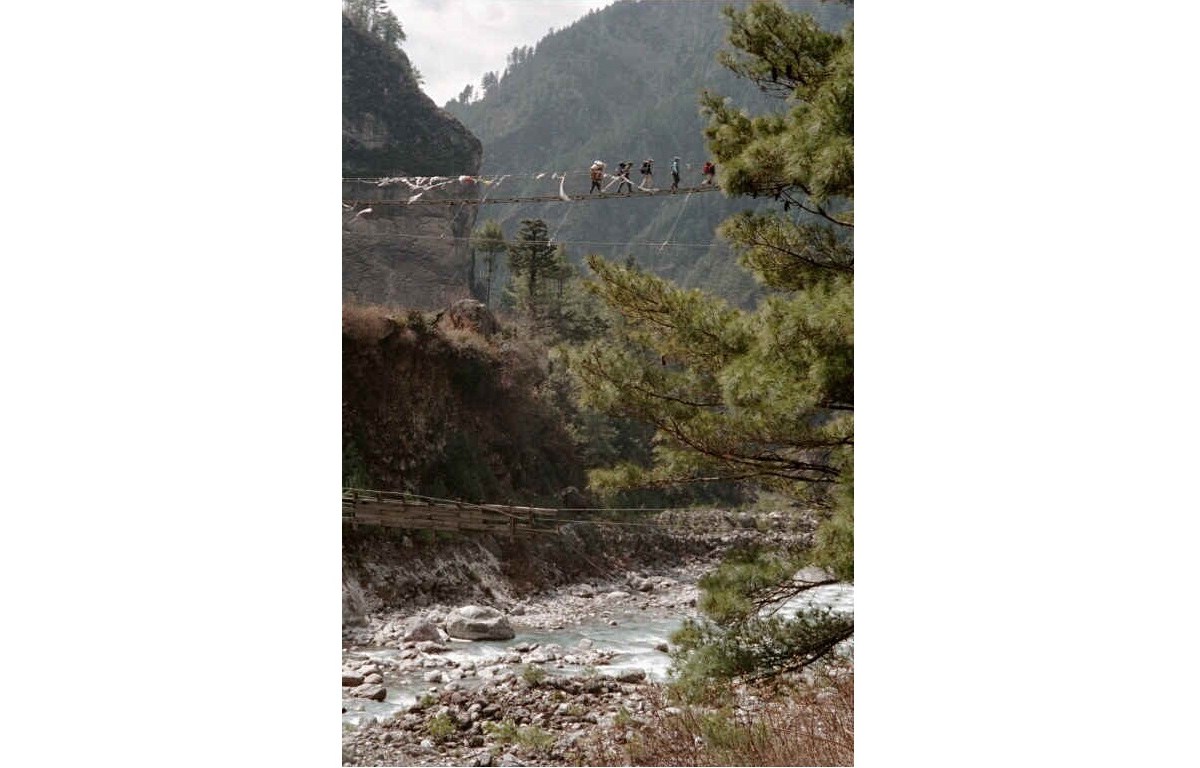
Cognitive and Computational Neurosience Professor Anil Seth related an experiment from about 50 years ago on a Ten Percent Happier podcast that caught my attention. In the study, participants, who were all male, had to either walk over a low, sturdy bridge or a high, rickety bridge over a raging torrent. On the other side of the bridge was a female researcher who asked them some questions and then gave them her phone number in case they had any follow-on questions. The outcome was that many more of the male participants who had walked over the rickety, precarious bridge phoned the researcher to ask for a date or talk to her after the fact.

Anil Seth summed it up as “The interpretation of this ethically very, very dubious experiment is that the creepy walk across the rickety bridge misinterpreted their physiological arousal caused by the scariness of the bridge as some kind of sexual chemistry with the female researcher.”

The point that Anil Seth was making is that our emotions, whether it is fear of a snake or chemistry with another person, often start in our body and then are interpreted by our brain instead of the other way around even though it appears that our brains are running the show. This matches the metaphor presented by psychologist Jonathan Haidt in his book The Happiness Hypothesis of the elephant and the rider. The rider is our conscious mind and the elephant is everything else – our sensations, subconscious motives, internal presuppositions. We think the rider is in charge but that’s only the case if the elephant agrees.

This reminds me of a recent conversation I had with a couple of friends about online dating. I tried online dating about 10 years ago after my divorce and before I decided to start a family on my own. I dutifully filled out the surveys that catalogued interests and personality preferences, wrote the essay and subsequently met a number of nice men. In fact, my friend Eric was someone who I met online and we became great friends after deciding that dating wasn’t right for us.

It seems to me that online dating asks us to essentially name what we want – and that we don’t know what we want. We can’t quantify the mystery or adrenaline or whatever else it is that causes us to feel attraction. Of course from there, a committed relationship is a decision as much or more than a feeling but for that initial emotion, it seems might come from the body as it did in the experiment that Anil Seth described.

Unfortunately, codes being what they are these days in Seattle, I can’t think of any rickety bridges either to cross or to stand on the other side of. 😊

What do you think of online dating? What about the idea that emotion starts in the body and is interpreted by the mind?

(featured photo was taken by me in Nepal on the trek to Everest base camp in 2001)