The Mysterious Case of the Barking Dog

In school we learn that mistakes are bad, and we are punished for making them. Yet, if you look at the way humans are designed to learn, we learn by making mistakes. We learn to walk by falling down. If we never fell down, we would never walk.” – Robert Kiyosaki

On a recent afternoon I was going through the mail in the mailbox and found an unsigned, handwritten note on a plain piece of paper that read (including word error),
“Please do not leave you dog out barking. It is unpleasant for neighbors.”

My ten-year-old daughter, Miss O, saw the look on my face as I tried to discern the message. She came to read over my elbow. Sensing a family meeting, six-year-old Mr. D wandered over and asked what we were doing. We read the note through one more time.

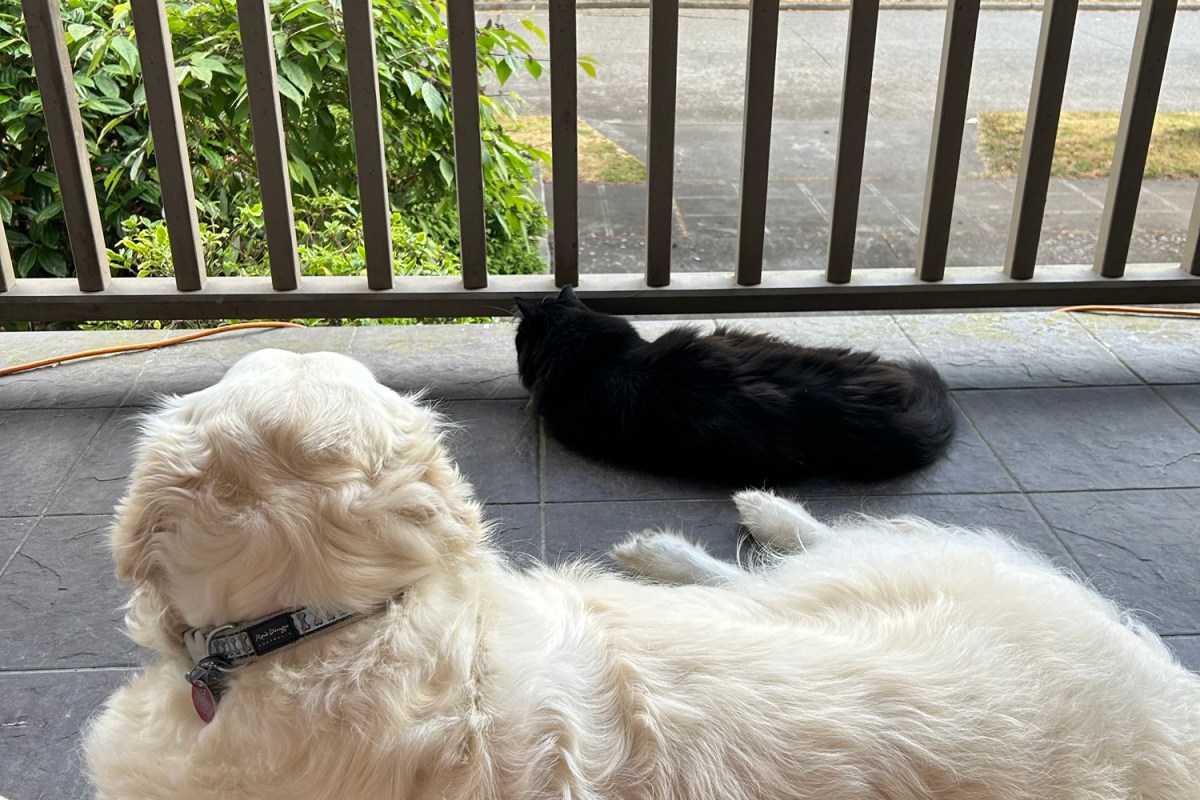
But Cooper doesn’t bark,” Mr. D said. And he’s right, Cooper isn’t a barker. He’ll steal your socks and your steak but he’s quiet about it.

And we don’t leave him outside,” Miss O added. Also true. Cooper is in the habit of lying on the front porch to watch the neighborhood but that’s when we’re home and the door is open.

Maybe they have us confused with someone else,” I mused.

We couldn’t figure out the note but we were united in our righteous indignation in defense of Cooper’s honor. Mr. D suggested he rip up the note and throw it as far as he could.

It wasn’t until the next morning in the shower that I connected the dots. One day the week before we were getting ready to leave the house so that I could drive the kids to camp. Cooper was out on the front porch. I called him in and locked the door.

But when I came home about 90 minutes later after dropping the kids and picking up supplies, Cooper was on the front porch and the door was unlocked. One of the kids must have opened the door to check the weather and Cooper snuck out. He wasn’t barking when I came home so I didn’t realize it right away. He must have barked when he realized he was trapped out there.

The funny thing was that I almost didn’t tell the kids once I figured it out. Our righteous indignation felt so comfortable that I kinda wanted to keep wearing it.

But I also know that it builds up over time. The vulnerability of confession doesn’t come naturally to me, but I’ve found owning my errors and frailty keeps my pipes clean. Everything flows better when I don’t let the grime build up. More than that, I feel everything more fully when I shake off the protective coat of righteous indignation or defensiveness.

And it creates space for learning. When I told the kids my solution to the mysterious case of the barking dog, they both nodded and went, “Ooohhh, right!” I bet we’ll remember that lesson.

(featured photo is mine)

You can find me on LinkedIn: https://www.linkedin.com/in/wynneleon/ and Instagram @wynneleon

I host the How to Share podcast, a podcast about collaboration – sharing leads to success.

I also co-host the Sharing the Heart of the Matter podcast, an author, creator and storytelling podcast with the amazing Vicki Atkinson.
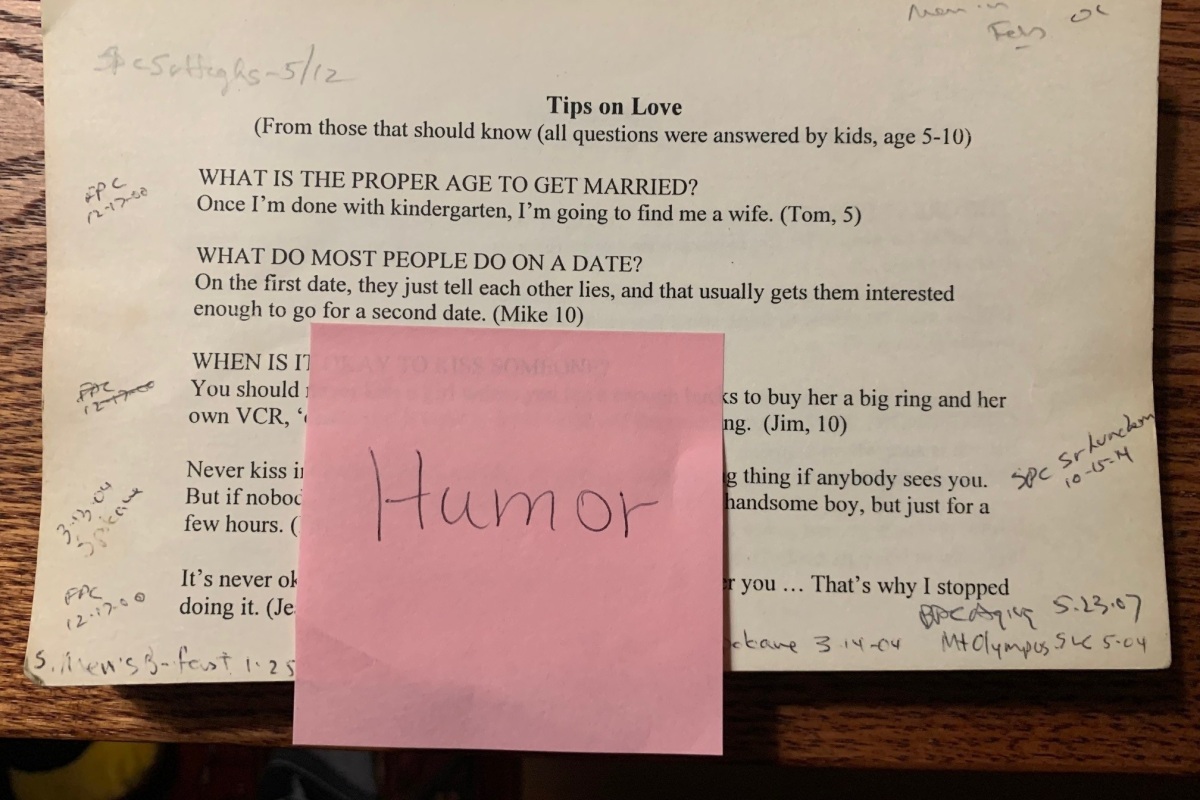
Sunday Funnies: March 5

A re-run of my dad’s humor cards. They make me chuckle all over again – so I hope you enjoy them whether it’s the first time or second (first posted on 1/23/22).

The backstory: My dad was a Presbyterian pastor for 40 years. He kept a well curated stack of humor cards – little stories he heard, found or saw and then typed onto 5×7 cards. Then he wrote in the margins when he used that particular item. His humor was often an easy way to settle in to something deeper – by laughing and thinking about the buried truth in these little nuggets, it paved the way to an open heart.

DEAR PASTORS

Dear Pastor, I know God loves everybody but He never met my sister. Yours sincerely, Arnold, Age 8, Nashville

Dear Pastor, Please say in your sermon that Peter Person has been a good boy all week. I am Peter Peterson. Sincerely, Pete, Age 9, Phoenix

Dear Pastor, My father should be a minister. Every day he gives us a sermon about something. Robert Anderson, age 11

Dear Pastor, I would like to go to heaven someday because I know my brother won’t be there. Stephen, Age 8, Chicago

Dear Pastor, I think a lot more people would come to your church if you moved it to Disneyland. Loreen, Age 9, Tacoma

Dear Pastor, I liked your sermon where you said that good health is more important than money, but I still want a raise in my allowance. Sincerely, Eleanor, Age 12 Sarasota

Dear Pastor, Please pray for all the airline pilots. I am flying to California tomorrow. Laurie, Age 10, New Year City

Dear Pastor, I hope to go to heaven some day but later than sooner. Love, Ellen, Age 9, Athens

Dear Pastor, Please say a prayer for our Little League team. We need God’s help or a new pitcher. Thank you, Alexander, Age 10, Raleigh

Dear Pastor, My father says I should learn the Ten Commandments. But I don’t think I want to because we have enough rules already in my house. Joshua. Age 10, South Pasadena

Dear Pastor, Are there any devils on earth? I think there may be one in my class. Carla. Age 10, Salina

Dear Pastor, I liked your sermon on Sunday, especially when it was finished. Ralph. Age 11, Akron

Dear Pastor, How does God know the good people from the bad people. Do you tell Him or does He read about it in the newspapers? Sincerely, Marie, Age 9, Lewiston

Do You Think I’m Stupid?

A friend accepts us as we are yet helps us be what we should.” – unknown

My best friend in college and I used to debate whether or not it meant that someone thought we were stupid if they lied to us. In those days of black and white, I definitely thought it to be a sign they thought I was stupid. Of course, the thing I feared most was being thought of as a dumb blonde so I probably was inclined to the position.

Now in these days of seeing the shades of gray in everything (and not just my hair) 🙂 I tend not to take umbrage if someone isn’t truthful. It’s the topic of my Wise & Shine post this week: Telling the Truth

(featured photo from Pexels)

Lying or Telling the Truth?

We are here to live out loud.” – Balzac

I remember reading a parenting book that stated that by age 4, kids lied on average about once every 2 hours and by age 6, every 90 minutes. I’ve never seen a statistic about how much grown-ups lie, it’s probably not even measurable.

But I generally believe most things people, including my children, tell me. I think what is truly dangerous aren’t lies but instead when we forget to tell our truth. It’s the subject of my latest post on Pointless Overthinking: Conditions of Truth.

(featured photo from Pexels)

Spiritual Leaders

Gaining knowledge is the first step to wisdom. Sharing it, is the first step to humanity.” – unknown

Several years ago I had a friend who was struggling to keep his marriage together after it was revealed that his wife was having a long-term affair. From time to time he’d recount some of the help and advice they were getting as they tried to heal – from therapists, friends and books. One of the most insightful pieces of advice he got was from his pastor who sagely counseled, “You are going to have to say ‘good-bye’ to that marriage. If you two are going to go forward, you will have to build a new marriage together.”

It takes a special role to be able to drop truth bombs and still be heard. Friends might be able to do it, but often have a vested interest in offering up advice. More often than not, they offer idiot compassion as therapist and author Lori Gottlieb calls it. “Idiot compassion is where you want to make somebody feel better, and so you don’t necessarily tell them the truth. And wise compassion is where you really hold up the mirror to them in a compassionate way, but you also deliver a very important truth bomb.”

Therapists can deliver truth bombs but I think we often forget that our spiritual leaders have that capacity too. Given that church affiliation in the US has dropped below 50% for the first time ever, I wonder if we are losing touch with a unique group of people who want to help and also celebrate with us.

Twelve years ago when I was in crisis going through a divorce, I was lucky enough to find my way to a meditation teacher that helped guide me into that practice that has changed my life in many ways. And often when I have a spiritual question or even a lapse in understanding, I will go to my meditation teacher.

I also have the added benefit of relationships with a number of pastors since my dad was in the profession. They teach me again and again that our spiritual leaders whether they be pastors, rabbis or yogis have deep wisdom and history to access whether or not you agree with every bullet point of their theology.

When I asked my dad about that job/role/life calling as a Presbyterian pastor in the years before he died he said,

“I never would have imagined, at 20 years old when I finally made the decision to go in to ministry, I never would have thought that this is what my life would be like. I am so grateful to God for what that has meant, the number of lives that I’ve been able to be a part of. One of the unique things about ministry is that you are able to be with people in some of the most precious, important, holy moments of their life . . . birth, death, baptism, marriage, funeral, crisis. A pastor steps in to the middle of someone’s life at those unique times and that is pretty rare.”

So on this day that is Good Friday for Christians and the start of Passover for Jews, I dedicate the post to all our spiritual leaders that are willing to help us through the important moments of our lives. May we all find ways to support and honor them.

(featured photo is one of my favorite pictures of my dad)

Sunday Funnies: Jan 23

Another installment from my dad’s humor cards.

The backstory: My dad was a Presbyterian pastor for 40 years. He kept a well curated stack of humor cards – little stories or observations that he typed onto 4×6 cards. Then he wrote in the margins when he used that particular item. His humor was often an easy way to settle in to something deeper – by laughing and thinking about the buried truth in these little nuggets, it paves the way to an open heart.

When we cleaned out his desk after he died 7 years ago, I was lucky enough to stumble on this stack. I pull it out regularly to have a little laugh with my dear Dad. Now when I post one of them, I write my note next to his and it feels like a continuation.

DEAR PASTORS

Dear Pastor, I know God loves everybody but He never met my sister. Yours sincerely, Arnold, Age 8, Nashville

Dear Pastor, Please say in your sermon that Peter Person has been a good boy all week. I am Peter Peterson. Sincerely, Pete, Age 9, Phoenix

Dear Pastor, My father should be a minister. Every day he gives us a sermon about something. Robert Anderson, age 11

Dear Pastor, I would like to go to heaven someday because I know my brother won’t be there. Stephen, Age 8, Chicago

Dear Pastor, I think a lot more people would come to your church if you moved it to Disneyland. Loreen, Age 9, Tacoma

Dear Pastor, I liked your sermon where you said that good health is more important than money, but I still want a raise in my allowance. Sincerely, Eleanor, Age 12 Sarasota

Dear Pastor, Please pray for all the airline pilots. I am flying to California tomorrow. Laurie, Age 10, New Year City

Dear Pastor, I hope to go to heaven some day but later than sooner. Love, Ellen, Age 9, Athens

Dear Pastor, Please say a prayer for our Little League team. We need God’s help or a new pitcher. Thank you, Alexander, Age 10, Raleigh

Dear Pastor, My father says I should learn the Ten Commandments. But I don’t think I want to because we have enough rules already in my house. Joshua. Age 10, South Pasadena

Dear Pastor, Are there any devils on earth? I think there may be one in my class. Carla. Age 10, Salina

Dear Pastor, I liked your sermon on Sunday, especially when it was finished. Ralph. Age 11, Akron

Dear Pastor, How does God know the good people from the bad people. Do you tell Him or does He read about it in the newspapers? Sincerely, Marie, Age 9, Lewiston

Other People’s Writing: Dec 30th

Henri Nouwen was a Dutch Catholic priest and prolific author. In the forward to his book, The Inner Voice of Love he describes a period of mental and spiritual anguish catalyzed by the sudden interruption of a friendship. To heal from this agony, he took a six month retreat during which he wrote down spiritual imperatives that were his notes on working through his pain and healing.

He never intended for these notes to anything other than private. But eight years after he’d worked through his anguish, a friend convinced him they could be helpful to others. The last note of the book, it includes a quote that knocked me over with its power: “Your future depends on how you decide to remember your past.” Here’s the passage:

As you conclude this period of spiritual renewal, you are faced once again with a choice. You can choose to remember this time as a failed attempt to be completely reborn, or you can also choose to remember it as the precious time when God began new things in you that need to be brought to completion. Your future depends on how you decide to remember your past. Choose for the truth of what you know. Do not let your still anxious emotions distract you. As you keep choosing God, your emotions will gradually give up their rebellion and be converted to the truth in you.

You are facing a real spiritual battle. But do not be afraid. You are not alone. Those who have guided you during this period are not leaving you. Their prayers and support will be with you wherever you go. Keep them close to your heart so that they can guide you as you make your choices.

Remember, you are held safe. You are loved. You are protected. You are in communion with God and with those whom God has sent you. What is of God will last. It belongs to the eternal life. Choose it, and it will be yours.

The Inner Voice of Love by Henri Nouwen

(featured photo from Pexels)

Building Character

There are no shortcuts to any place worth going.” – Helen Keller

I’ve been listening to the Dropout podcast about the Elizabeth Holmes trial this fall. She is charged with 12 counts of felony fraud in regards to how she handled investor money and advertised to patients. As I said in a previous post, High-Tech Drama I’m fascinated because in my career, I’ve been privy to all the money in high-tech, mostly at Microsoft and how it influences innovation and character.

Elizabeth Holmes was 19-years-old when she dropped out of Stanford and started Theranos in 2003. She positioned the company as a start-up that would revolutionize the blood testing industry by being able to test for a wide array of factors on a portable testing device that only required a small volume of blood.

It never worked – or at least not reliably. For the short time that the devices were rolled out at Walgreens, they provided bad test results like telling a man he had indications of a prostate problem when he didn’t, another that he was HIV+ when he wasn’t, and an excited mother-to-be that she’d miscarried when in fact she hadn’t. Clearly, there were major problems with big consequences for people that received inaccurate results.

I think this trial could be titled “What happens when you give a 19-year-old college dropout 750 million dollars.” (To be fair, Elizabeth Holmes raised most of the 750 million dollars when she was in her 20’s.)  I don’t assume that you have to go to college to be a success but I would think that some training or apprenticeship on how to be a leader, manage finances and run a company, whether it be institutional learning or otherwise would be helpful.

It’s left me wondering if it’s possible to develop character when you are 19 years old and people are throwing money at you. It’s been intimated that she shows narcistic tendencies but I would think it would be more surprising if she didn’t, given that trajectory.

Elizabeth Holmes, who is now 37 years old, testified at the trial. I cannot begin to do justice to all of her testimony but she seem to do a beautiful job of representing herself. She said there’s many things she wished she did differently – like when she put logos from other companies on documents to make it seem like a 3rd party endorsement. But there’s a lot that she can’t remember, even when emails and texts are read to refresh her memory. Her defense has pointed the finger at a lot of other people: the investors should have done better due diligence, the lab director should have spoken up more loudly, her boyfriend and COO was controlling her and so on.

The thing that I heard Elizabeth say that resonated a great deal with me was something like “The investors weren’t interested in the details of what we could do today, they wanted the big vision of what we could do in five years.” Whatever her intent was in making false statements, that matches much of what I’ve seen in high-tech. People want the hear the magic of what might work one day and are willing to entertain a lot of smoke and mirrors in the process of trying to make something real.

If Elizabeth is found guilty (the jury is currently deliberating), there must be hundreds of CEO’s currently doing exactly the same thing. In no way am I justifying lying and deceitful practices but I’m affirming that venture capitalists of Silicon Valley aren’t usually trying to create truth-tellers and reinforce good values.

All I can say is that I’m really glad that no one handed me three-quarters of a billion dollars at age 19, or at any age. I’ve gained so much character by having to earn one dollar at a time.

(featured photo by Pexels)

I Like It!

“It is not easy to find happiness in ourselves, and it is not possible to find it elsewhere.” – Agnes Repplier

When I first started actively blogging, I was pleasantly surprised by the email that WordPress sends out. “Person X liked your post. They thought A Randon Post Title was pretty awesome.” But then those “likes” get pretty addictive, don’t they? So I recently I started thinking about “likes.”

If you hit “like” on this post, is it because you like me and generally think I’m a good person or is it because what I’ve written means something to you? And if you don’t hit “like” is it because what I’ve written doesn’t resonate or because we don’t have a relationship?

I know it isn’t such a cut-and-dried thing but if I break it down that way, I think about feedback and what I give away. After all, “likes” are free for me to give, so why not like everything? If I do, do those likes count for much anymore?

I read a beautiful metaphor that Mark Nepo included in The Book of Awakening. He was talking about someone who was interviewing for a job and she said she wanted to jump and down and yell “pick me.” In this way he said we are all like puppies at the pound, dying for someone to pick us and take us home.

But when I perform for “likes,” it can cost me my authenticity. Not always – sometimes it pushes me to do a better job writing and communicating. But I have also found myself at times changing my voice based on who I think is reading. The former is great, the latter is destructive.

I want you to like me. But as I discover again and again, whether it’s blogging, parenting or being a friend – more than important than that is whether I like me. From there, I’m okay with how many likes I get or don’t get as long as I’m telling my truth.

(photo by Pexels)

Cut the BS

Life is the sum of all your choices.” – Camus

The first time I did preschool with my daughter she had just turned 2 years old and it was a co-op preschool. Parents worked in the classroom one day per week and dropped off our child the other day of the week. The teacher said to us, “Never leave without saying good-bye to your child. It doesn’t work to sneak out.”

I think that might have been the best parenting advice that I may have ever received. I took it to mean to not undermine my child’s trust in me by being sneaky. Just because you can fool a small child doesn’t mean you should. I didn’t know any better at the time but witnessing parents do the “sneak-away” approach at other moments, I’ve seen the resulting effect when it’s happened. The child seems both dismayed that they can’t find the parent as well as beyond consolable because they want the parent for comfort.

I want to claim that I knew sneakiness doesn’t work in life before I was a parent but that would also be BS. I was not attuned to the feeling of tension that signals a choice of not facing or facing the emotions of someone who will be unhappy by what I chose to do. I have ducked out of many parties with a white lie about why I couldn’t come instead of telling the host the truth that I didn’t feel like coming. I shudder to think about the time I canceled going to see U2 with a friend and his son because I had a colossally bad day at work.

But what I’ve learned from parenting isn’t about lying per se – because I don’t tell my kids the truth about many things like Santa and the Easter Bunny and whether or not I’ve ever had sex. It’s more specific to not telling the truth in order to avoid emotions. Like saying we are out of cookies instead of being the bad guy who says “no” because they’ve had too much sugar.

Instead of amplifying feelings by adding the horror of being tricked, this advice has taught me to lean into the discomfort of the initial disappointment. It also honors the emotional intelligence of anyone that I might mislead who can often sense they are being tricked, even at a very young age, even if they don’t know exactly how.

I’m leaving. I will miss you and can’t wait to scoop you up when I return. There is nothing like the sweetness of reunion and it is not possible until we recognize the truth of being apart.

(photo by Pexels)