Carrying Stuff for Others

I am becoming water; I let everything rinse its grief in me and reflect as much light as I can.” – Mark Nepo

Last week there was an open house at school so all the kids could meet the new principal and find out their teachers. Before we had a chance to check the official list, the 2nd grade teacher that Miss O wanted to have saw her and said, “Yay, you are in my class!”

This was great news – two of her best school friends were also on the list and she was thrilled. Except as we walked away, a dad of one of her good friends gently said to me, “There are two O’s this year and I think your daughter is in the other class.”

Devastating! We checked the official list and he was right, she was not in the class she preferred. Her body mirrored her mood as she went from elated to deflated. I watched in horror as she crumpled even as she tried to hold it together in the crowd.

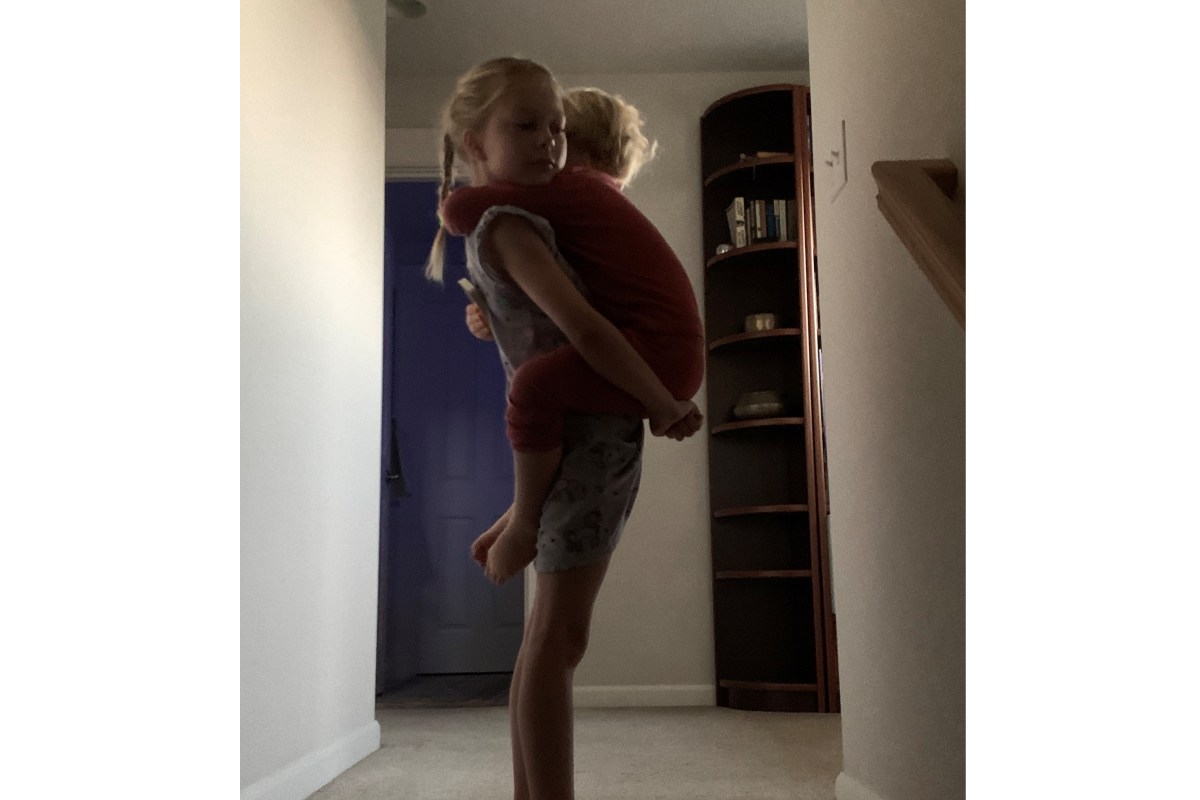
Just bearing witness to this made me feel terrible. It was as if had taken on the disappointment for my daughter’s 2nd grade hopes dying. And this happens not just with my kids but in other relationships too – I feel the heart ache of my friend going through relationships troubles. Or the exhaustion of another friend who didn’t get the job she wanted.

I suspect I’m not alone in taking on the feelings of others that I care about. As I listen to their experience, I can feel myself take on the rise and fall of their journey. Long after I’ve left them or hung up the phone, I carry the echo of their experience. It goes beyond being an empathetic listener because I’m carrying an emotion that isn’t mine to carry.

Which is a bit ridiculous because it’s a feeling of how I would react to having the same experience which is more or less meaningless. That is to say, my feelings may or may not match those of the person who is actually going through it.

So, I don’t think this makes me a better parent of friend. In fact, I suspect it diminishes my effectiveness. Thinking about the Buddhist Tonglen practice where you imagine a specific suffering in the world and you breathe it in, there is also the completion of the practice where you breathe out relief for everyone experiencing that suffering. It’s a full circle practice. Looking at it another way, the river doesn’t hold on to the water that flows through it.

This reminds me of every mountain guide I’ve climbed with. First, their stuff is well-organized so that they can be efficient and also carry a lot of gear for the group. They don’t often carry stuff for the climbers but when someone is really struggling, they will take part of their load for a time. However, they always give it back when we get to camp. They don’t keep carrying it on top of their own load.

At the school event, Miss O was upset and her first reflex was to go back to that teacher she wanted to tell her that she wasn’t in her class. Once she did that, she was able to move on and meet the teacher she’s assigned to for 2nd grade. Her new teacher is also lovely and nice.

Miss O moved on much more quickly than I did as I still feel echoes of that disappointment. I’m trying to learn from her example and shake off the feelings that I don’t need to carry for those I love.

Do you take on the feelings of loved ones? How do you shake them off?

The Blossom of a Distant Crush

There is no remedy for love but to love more.” – Henry David Thoreau

When my friend Mindy got married over 20 years ago, I remember her remarking that she felt like finding her person freed up a space in her brain for other things.

It was an interesting observation but one I hadn’t thought about in great depth until recently when out of the blue someone I had a distant crush on sent me a beautiful email. In the one gesture, distant crush blossomed into a romantic possibility.

I haven’t spent much time actively dating since I decided to have kids on my own. In these seven years, I’ve had that space in my brain, as Mindy calls it, free to focus on taking care of these kids and more or less just cruising along getting things done.

So I’m a little shocked to remember all the space that having a little romance takes up in life, of which only a small portion is actually consumed by the lovely time spent talking to him.

First, I have emotions all over the place – excitement, fear, expectancy, impatience. They cycle through my day creating waves (often of elation and joy) in what to used to be a pretty calm (mostly happy) sea.

Second, I’ve spent all sorts of time making a music playlist called “Thinking of You” and listening to it instead of the podcasts and books I used to so efficiently consume. Granted, a lot of my podcasts have been on summer break so there’s that but to match my mood, all I want to listen to is The Cure, Cold Play, Leonard Cohen and so on.

Third, I wake up in the middle of the night now with my brain racing to think about what’s next, the last conversation we had or to wonder about all sorts of things I can’t control. I think about The Hot Goddess’s latest brilliantly funny snarky pie chart about communication in midlife dating and wish I had her sense of humor about all this. Or The Goddess Attainable’s list of Zen she’s found from dating disappointments and wonder if I can find my Zen again.

All I can say is that this makes for a very rich meditation practice. Finding the space beneath all the energy and excitement where the river of life still flows and will carry me regardless of what is to come seems both harder to do these days but also more important.

I’m also discovering that it doesn’t matter how old you are, the intensity of new possibility is electrifying. I might have lost that space in my brain but I’ve opened wide a space in my heart where possibility roams free.

(Quote from Mary of the delightful Awakening Wonders blog, featured photo is mine)

Love No-Matter-What

Love is God’s religion.” – Rumi

A couple of days ago, Miss O and I had a mother/daughter day of rock climbing at the climbing gym. As we were buying our after-climbing lunch at the neighborhood grocery story, Miss O dropped the glass bottle of soda she was carrying and it shattered right near the check-out lines.

Trying to ease her embarrassment and horror, I told her that it was okay. She hissed back, “It is not okay. Have you ever dropped something like that?”

And I replied, “Only all the time.”

Which is a phrase I picked up from a recent Ten Percent Happier podcast with Father Gregory Boyle . In it he suggested the most expansive view of love and the power of love that I’ve ever heard. Days after listening to it — twice — I clearly am still trying to ingest the beautiful view of loving people no-matter-what that he presents. So it’s the topic of my post today for the Pointless Overthinking blog: Expansiveness.

Finding What Hurts

I can bear any pain as long as it has meaning.” – Haruki Murakami

Last week, 3-year-old Mr. D had a lot of objections as we were getting into the car to go to preschool. “I don’t like those boots.” And “I don’t want to watch that on my tablet.” And “This isn’t the arm I put into the seat belt.” And “It’s too sunny.”

As I responded to each of the objections, I finally got the a-ha – it wasn’t any of these things that was really wrong. It was that he didn’t want to go to school. He’d been having fun with his sister at home and didn’t want to stop.

It adds to my long list of how confusing it is to be human. First, it’s hard to pinpoint exactly what is going on with us. In Atlas of the Heart, Brené Brown cites a survey that she gave out in workshops asking people to list the emotions that they could name as they were having them. “Over the course of five years, we collected these surveys from more than seven thousand people. The average number of emotions named across the surveys was three. The emotions were happy, sad and angry.” Which is stunning that out of our nuanced ranged of emotions, we have trouble identifying many of them at the time we are having them. But I can affirm that it’s almost always on reflection after the fact that I have any emotional literacy.

Secondly, as friends, parents, partners, we try to respond to what our loved ones tell us that is wrong. And as I found with Mr. D, it’s an exercise in frustration as we solve problems that aren’t the problem. It’s like putting a band-aid on the knee that isn’t scraped – a little waste of resources that don’t stop the bleeding.

And finally, because accurately describing the wound is the key to healing, we have to keep unpacking the distractions and figure out what’s wrong. Only then can we hold ourselves and each other for what really hurts and matters. Only then can we find the meaning behind what is happening and as the quote for this post from writer Haruki Murakami suggests, it helps us to bear the pain.

So I left the boots off, turned off the tablet, got him settled in his car seat and we just talked on the way to school. About how sometimes we don’t feel like doing what we have to do and sometimes we just have to look forward to the next thing and it’ll carry us through. He wasn’t convinced but he wasn’t fussing. Then we were able to move forward into the day.

Freestanding and In Charge — Or Not

We are all apprentices in a craft where no one ever becomes a master.” – Ernest Hemingway

I often think of myself as freestanding and in charge – only to repeatedly learn I’m not. I say that even as I know my best decisions, like the ones to have my beautiful children as a single person, came from a calling that was far beyond me. I read an amazing piece on that subject this week from Mark Nepo that I am posting here in case anyone else needs to hear the same thing.

Teachers Are Everywhere

Teachers arise from somewhere within me that is beyond me, the way the dark soil that is not the root holds the root and feeds the flower.

So often we think of ourselves as freestanding and in charge, because we have the simple blessing of being able to go where we want. But we are as rooted as shrubs and trees and flowers, in an unseeable soil that is everywhere. It’s just that our roots move.

Certainly, we make our own decisions, dozens every day, but we are nourished in those decisions by the very ground we walk, by the quiet teachers we encounter everywhere. Yes, in our pride and confusion, in our self-centeredness and fear, we often miss the teachers and feel burdened and alone.

In trying to hear those quiet teachers, I am reminded of the great poet Stanley Kunitz, who as a young man struggling darkly with how to proceed with his life, heard geese cross a night sky and somehow he knew what he had to do. Or how a man I know was slowly extinguishing himself, sorely depressed, when, finally exhausted of his endless considerations, he heard small birds in snow in unexpected song. He realized he was a musician who needed to find and learn the instrument he was supposed to play.

From the logic of being freestanding and in charge, experiences of this sort seem crazy-making and untrustworthy. But the soil of life in which we grow speaks a different language than we are taught in school. In actuality, truth and love and the spirit of eternity are rarely foreseeable, and clarity of being seldom comes through words.

In my brief time on Earth, I have felt the light of ageless spirit fill me unexpectedly when I thought I would die, and as water pumps its way up a slim root making that plant leaf out toward the light, I have found myself, against all fear and will, flushed with possibility in the direction of dreams I had hardly imagined.

Whether through birds in snow, or geese honking in the dark, the brilliant wet leaf that hits your face the moment you are questioning your worth, the quiet teachers are everywhere. When we think we are in charge, their lessons dissolve as accidents or coincidence. But when brave enough to listen, the glass that breaks across the room is offering us direction that can only be heard in the roots of how we feel and think.

The Book of Awakening by Mark Nepo

The Big Questions

Be patient toward all that is unsolved in your heart and try to love the questions themselves, like locked rooms and like books that are now written in a very foreign tongue.” – Rainier Maria Rilke

I have a friend who is going through a hard break-up. Sitting with my friend as they process makes me think of all the questions I’ve wanted to know when going through hard times: When will I feel better?How will I survive this? What meaning is going to come from this? What is my purpose here?

Wanting the answer to big questions is the topic of my post for Pointless Overthinking this week: Waiting for the Big Answers.

(featured photo from Pexels)

Meaningful Interaction

Many people will walk in and out of your life, but only true friends will leave footprints in your heart.” – Eleanor Roosevelt

I was reading an article written by a single mom with kids who was bemoaning her situation in life. And there were many things I could relate to even though her kids are a lot older than mine (maybe in their 20’s). Because it’s hard to live in a house where you are loved dearly but not really cared for.

But there was a lonely note in her writing that I couldn’t place. So I looked up loneliness in Brené Brown’s Atlas of the Heart. Brené includes the definition of loneliness as defined by social neuroscientist, John Cacioppo and his colleague William Patrick as “perceived social isolation.” And Brené expands on this with “At the heart of loneliness is the absence of meaningful social interaction – an intimate relationship, friendships, family gatherings, or even community or work group connections.”

It brings to mind two times in recent years that I’ve felt lonely and had to adjust my social interactions to make them meaningful. The first was when I first became a mother. I remember one night I courageously left my daughter with a babysitter and went to a restaurant to drink wine and watch a Seahawks game with a good friend. I had fun – but the next morning got up and felt empty because what used to be fun for me longer met my needs. I longed for more meaningful interaction.

And the second was when the pandemic started. All of a sudden my meaningful interactions with other parents were eliminated or reduced to online. I had to find another way — and that eventually led me to blogging.

Thinking about Brené’s comment – it isn’t about how many friends we have or whether we are in a partnership, it’s about whether we are meeting our needs for depth. In fact, I think the loneliest place I’ve ever been is inside a committed relationship. I send a wish to the author of that article and for us all to have the focus on cultivating friendships where we are seen.

What makes you feel less lonely? What counts as meaningful interaction for you?

(featured photo from Pexels)

A Question of Love

The Eskimos had fifty-two names for snow because it was important to them: there ought to be as many for love.” – Margaret Atwood

Yesterday in the car, Miss O asked me who she should marry. Off the top of my head I said, someone who is kind, honest, funny and smart and then stopped to ask what she thought. She added, “Someone who is sweet and who likes to kiss.”

I started laughing and she explained that not all boys like to kiss which I’m sure is accurate in the 7-year-old world.

But it made me think of all the times I’ve wondered who I should love and the answer started with loving myself.

And it made me think of that WHO I should love is also an acronym for HOW I should love which I found is best with conviction, patience and kindness.

It reminded me that sometimes the answer to the question isn’t who I should love but am I brave enough to try.           

Finally, I landed on what is with age becoming clearer to me is that when I tap into the Oneness of things, I find it easier to love everyone, even the people that get my goat because when I look closely there is something about them that reminds me of me.

Miss O has about 20 years until she reaches the average age of brides in this country. I hope that in that time she learns a little about love, especially self-love, before she does.

What’s your list for what to look for in a partner? And your best advice about love?

(featured photo from Pexels)

Lying or Telling the Truth?

We are here to live out loud.” – Balzac

I remember reading a parenting book that stated that by age 4, kids lied on average about once every 2 hours and by age 6, every 90 minutes. I’ve never seen a statistic about how much grown-ups lie, it’s probably not even measurable.

But I generally believe most things people, including my children, tell me. I think what is truly dangerous aren’t lies but instead when we forget to tell our truth. It’s the subject of my latest post on Pointless Overthinking: Conditions of Truth.

(featured photo from Pexels)

Young Love

The minute I heard my first love story, I started looking for you, not knowing how blind that was. Lovers don’t finally meet somewhere. They’re in each other all along.” – Rumi

The other day Miss O came home from playing at a neighbor’s house with a mystified expression. She told me that the 9-year-old brother had been kidding his 7-year-old brother about “playing with his girlfriend.” It appears that the younger brother had confided in his brother about a crush on Miss O and now the older brother was teasing him mercilessly.

Now I understand why that delightful boy is always smiling ear to ear every time I see him. I had just assumed he was extraordinarily happy and polite.

There are so many places to go with this story it feels target rich – the complete and utter delight of having a crush, the irrepressible urge to tell others when someone sparks your heart and the vulnerability of sharing your secret.

Just witnessing the potential energy of this little scene reminded me how powerful young love is – and I don’t mean just love among the young but the first stirrings of the heart. There are so many more questions than there are answers, the anticipation is excruciating and life is so wonderfully alive! It’s the heart begging to be let off the leash and dance, the mind trying to fill in the blanks all the while you are pretending to have it under control even as you know nothing is actually normal or controllable.

So you have to tell somebody – and this leads to the next potential topic from our story. It makes me think of the time in junior high that a friend told me she’d been making out with my best friend’s boyfriend on the side and swore me to secrecy. After I sweated it out for a couple of days, loyalty won out over secrecy and I told my best friend. And it also reminds me of my friend in my adult years that would relish in telling all the dirt she knew about other people’s indiscretions. She always had a story and it made hiking up a trail a little more interesting.

Then when my husband’s infidelities came out, I found out it was my messy life that was her fodder. I was chagrined that I had listened to those other stories. And I also learned that the vulnerability of falling in love might actually pale in comparison to the vulnerability of falling out of it.

So then we get to the third act – the brotherly teasing. In his book, The Thin Book of Trust Charles Feltman defines trust as “choosing to risk making something you value vulnerable to another person’s actions.” It seems like siblings and these juicy secrets full of so much potential energy are often the proving ground for trust. And we don’t always get it right.

Our neighbors were leaving for an extended trip on the day after older brother revealed younger brother’s crush. Hopefully that gives the boys time to work it out. Meanwhile, Miss O doesn’t seem too changed by the news which makes me glad that the power of love is still pretty tame at age almost 7.