Open Up, Buttercup

Self-pity in its early stages is as snug as a feather mattress. Only when it hardens does it become uncomfortable.” – Maya Angelou

The other day on the carpool home from school, my daughter teed off when her friend said something about being called on in class. “I never get called on in class!” and “I never get to say my ideas!”

Self-pity is the emotion that I have the most trouble with. I think the idea that we should never feel or express self-pity was inculcated in me from an early age. My memory is that it was communicated in statements like “You can join us again when you are feeling more positive.” Or “Can I join the pity party?” or “Toughen up, Buttercup.”

So I think I came by my intolerance of self-pity in myself or others honestly from probably generations of family habits. But a little self-reflection shows me that the complete shutdown in my ability to listen and feel when self-pity appears is neither the person or parent I want to be.

I was mulling this over when I heard a Ten Percent Happier podcast with therapist Dr. Jacob Ham that helped clarify the underlying question. In the course of the conversation the topic of whether you have to love yourself to love another came up. Dr. Ham’s answer was it depends – “It depends if your fear is so great that it inhibits connection to yourself or another.”

While my natural inclination is not to name the feeling as fear, it gets at the heart of the question of solving things in ourselves so they don’t hinder our connection to others. I still have trouble thinking of self-pity as anything useful – but I also know my resistance tells me that it’s inhibiting the Flow of life somewhere and it’s worth a look.

In the car when I was listening to my daughter’s complaints, I could relate that I often see a skewed version of events when I’m tired or not feeling well. In my daughter’s case, I think she was both tired and hungry so I asked if we could come back to it after we filled her tank.

She said it was frustrating not to feel seen at times but after acknowledging that, we made a list of things she wants to do so that she can speak up about her ideas like raising her hand more enthusiastically. We’ll see if it works but I’m just grateful that I held on long enough to participate in the conversation.

(featured photo from Pexels)

Tent Associations

And into the forest I go, to lose my mind and find my soul.” – John Muir

When my daughter told my mom’s 83-year-old gentleman friend that we were going to camp out in the backyard this weekend, he turned to me and said, “After I got out of the army, I told myself I’d never spend another night in a tent.” It seemed like a reasonable vow for him.

My friend, Phil, who was the first American to climb the north side of Everest quips that bivouac is French for mistake. It isn’t – it’s derived from a French word that means “by guard” according to Merriam Webster but since Phil had to once bivouac high up on Everest, he’s earned the right to that joke.

My association with tents comes from the first time I spent an extended amount of time in them. It was 5-week trip through Ecuador I did in college with a group. We lugged the tents up there in our backpacks and then huddled in them to stave off the cold of the Andes. I remember one of my tentmates, Ted, retelling the entire movie of Dead Calm with no interruption since we had nothing else to do. Then we sweltered in the humidity of the Amazon jungle in tents where we squished ants and spiders and talked about our dreams of what we’d be when we were full-fledged adults. I can still replay my tentmate, Lisa, talking at length of how great an ice cube would feel sliding over her forehead. We’d take to our tents every afternoon on a beach near the Galapagos that had no shade and told stories about things we’d seen on the trip.

So for me, tents are not only a base for adventure but also a safe place to lie on your back and just listen. Listen to your tentmates, listen to the wind and the rain on the nylon, listen to your heart beat in a new place where nothing is familiar.  To me they smell like hard work, feel like closeness, look like a kaleidoscope view of the world outside them, taste like crappy food that you are just so grateful to be eating and sound like everything you can’t hear when you are too close to life as usual.

No wonder I’m excited about back yard camping with my little ones even though the ground feels a little harder than when I was young. It was hard to go to sleep with all the excitement and the steady rain on the tent and we only made it til 4:20am and the birds woke us up. And maybe they’ll need their own adventures before we’ll really know but I can’t wait to find out what they associate a tent with!

How about you – how do you feel about tents?

Fear and Confidence

Everything you’ve ever wanted is on the other side of fear.” – George Adair

The other night our iPad fell on the ground. My kids and I were getting in the car after visiting my brother and his wife. My brother folded the stroller and the iPad that my 6-year-old daughter always uses fell out of the pocket and landed on its corner. We picked it up and went on our way but as we drove, my daughter discovered that the power button had been slightly crimped down by the fall and so all the iPad would do was show the Apple icon and then go black over and over again.

This iPad is her favorite thing in the world. It represents her agency in the world to discover things that other 6-year-olds are doing. It has her books, videos and games so it is also her main source of entertainment. That iPad holds a lot of power and possibility in one sleek package.

She started wailing in the backseat that it was broken. I calmly said, “Don’t worry, I’ll take a look at it when we get home. We’ll try to fix it.” And she wailed back, “We can’t try. It won’t work.”

What?? We fix things all the time. This was the little girl that just an hour before had confidently stood up on a paddle board and was paddling it by herself on Lake Union. And then she was jumping off the paddle board over and over into the lake to swim around with not a worry in the world.

And now she was saying we couldn’t even try. That all was lost. Everything was broken and would stay broken. This wasn’t normal or rational, this was fear.

It struck me that confidence can’t show up when fear is running the show. So in my ongoing inquiry into confidence, I went digging in to get some perspective into this.

In their book The Confidence Code, authors Katty Kay and Claire Shipman distill the definition of confidence from all their sources of research and erudition into “Confidence is the stuff that turns thoughts into action.” They also describe the other positive attributes that often go hand in hand with confidence, what they label as the confidence cousins: self-esteem, optimism, self-compassion, and self-efficacy. But all of these things, confidence and the cousins that work to create belief that you can make something happen, are part of our rational/thinking brain.

Neuropsychiatrist Dan Siegel and parenting expert Tina Payne Bryson have great illustrations in their book The Whole-Brained Child that illustrate how fear is a downstairs (limbic) brain function and that when we flip our lids, we temporarily lose access to the upstairs brain that supports thinking. The downstairs brain that provides quick reaction so when we are in critical moments of fight of flight doesn’t stop to think about it.

So in our moments of fear we lose, maybe just momentarily, access to the stuff that creates confidence until we move though it. This brought to mind for me of one of the rapid fire questions Brené Brown often asks her guests on her podcast Unlocking Us: “You are called to be very brave but your fear is real and you can feel it in your throat, what is the very first thing do you do?” And the answers from her guests are things like:

  • Oprah: “Take a deep breath. Remind myself to breathe.
  • Dr. Angus Fletcher: “I think of the bravest person I know who happens to be my son who is much, much braver than me.
  • Dr. Julie Gottman: “Put my hand on my heart.

Coming back to my daughter in the car I asked her if what she was saying was because she was afraid of losing her iPad. She said she guessed it was. And owning that, we then could reason through the fact that the only sure outcome was the one if we didn’t try. If we did nothing, the iPad would stay broken. So we had nothing to lose by trying.

Sure enough, we got home, fiddled with the button and it came back to life. The button is a little tricky now but our confidence is restored. We could try – and it worked. As the quote for this post says, and it is one of my all-time favorite quotes because it has gotten me through many barriers of my own making, “Everything you’ve always wanted is on the other side of fear.

This is my second post delving into confidence. I Can was the first.

(featured photo from Pexels)

When the Clouds Roll In

One climbs, one sees. One descends, one sees no longer, but one has seen. There is an art in conducting oneself in lower regions by memory of what one has seen higher up. When one can no longer see, one can at least still know.” – Rene Daumal

Twenty-three years ago when I was practicing to get ready for a five-day expedition on Mt. Rainier, my friend Jill and I went up to the mountain to do a day climb up to Camp Muir at 10,200 feet. It’s is a non-technical climb of almost 5,000 vertical feet starting on trails and then trudging up the Muir snowfield which is snowy but not glaciated. On that June morning it was a lovely 4-5 hour hike up with views of the mountain and surrounding peaks to the south. It was early enough in the season that there were a few people on the route but it was comparatively quiet to the really busy high summer season.

When we got to Camp Muir, we sat on a rock outcropping and were eating our sandwiches when we saw the clouds coming in. They started from below and then just rolled up the mountain, thick and gray. Jill had summitted Mt. Rainier the year before, I had attempted it but not summitted so even though we didn’t have a lot of experience, we had heard warnings of how conditions on the mountain could change quickly with dire consequences.

Jill and I started hiking down and very soon were enveloped in the clouds. It was so thick, we couldn’t see the route. If you hike straight down from Camp Muir, you end up off the snowfield and in dangerous glacier territory strewn with crevasses. So Jill and I searched for the wands left by the guiding service. We couldn’t see from one wand to the next one about 150 yards away so we developed a strategy. We’d hike down about 50 yards from one wand until we could just barely see it and I’d stay there while she went down about 50 yards until she could see the next one and then I’d join her and we’d walk together to the next wand. It took us several hours to get down but eventually we reached the paths and got safely to the parking lot.

This hike makes me think of what we do when the clouds roll in. When we can’t see the horizon or any way points and everything looks white, grey or something in between. Do we look for the Divine waypoints marking the route? Do we ask our friends, therapists or other professionals to help us navigate safely through? Or do we keep walking in hope that motion will carry us down?

I think there as many answers to these questions are there are Wisdom traditions and personality types. But life has taught me that there are markers out there, just like the wands in the snowfield, if we bother to look.

The older I get the more I find it easier to stop and ask for Divine guidance. And when I have trouble discerning that, to seek out help from my friends. Whether it’s my ability to be vulnerable, imperfect or just because I know more quickly that I’ve lost perspective, I’m quicker to seek safety. When I’m having trouble finding my way, I have found that talking or writing about it helps me immensely.

The reason I remember this particular hike so well was the day after we returned the news reported that a 27-year-old doctor that had just moved from Georgia for a resident program in Seattle was missing after snowboarding on Mt. Rainier the same day we were climbing. The park rangers were out searching for him but in the days and week to follow there was no luck finding any sign of him.

Then the epilogue to the snowboarder story came for me about 3 years after that climb. The “nice guy” (from The Deep Story post) I dated told me that he had been hiking on Mt. Rainier the summer before with a friend and had gotten lost in the clouds. Knowing they were in dangerous territory, he set up camp and they waited out the night. The next morning rangers found them right on the edge of the Nisqually Glacier. And right around the corner, under a waterfall, was the body of the missing snowboarder who hadn’t been discovered for 2 years.  

While I drew parallels between my hike and life experience in this post, I don’t mean to infer any parallels or judgment on that snowboarder, a promising young man tragically lost too early.

(featured photo is of me and my parents at Camp Muir that same summer)

I Can

“Anyone who ever gave you confidence, you owe them a lot.” – Truman Capote

I was talking with my friend Scott the other day about confidence. How did he have the confidence to start his own business 25+ years ago? And does the person he’s picked to replace him have the confidence to run the business when he retires? In the course of the conversation, I told him a chain of events that sparked my interest about the subject of confidence.

About two years ago, in the spring of 2020, I had two things that I needed to replace. I’d torn the passenger side mirror of my car loose when I backed up too closely to the yard waste bin. And the torsion spring on my garage door had snapped, maybe after my 4-year-old hung from the door as it was going up. This was the very start of the pandemic so just calling someone to come fix the problems wasn’t a viable option and my inclination anyway is to at least triage things myself.

It took a little googling to figure out what I needed to do next to fix my problems but with help from the internet, I figured out what parts I needed and ordered them. Then I talked over the issues with my brother. He found YouTube videos for how to replace both things and said he’d help. But before he could come over, I did both on my own.

The way I saw it was that I could watch the videos and try. If I didn’t succeed, I could always ask for help but at least I’d learn something. And I did learn something – how to do both!

At this point in the story, Scott laughed at me because he thought I was leaving out the most obvious sign of confidence – that I’d had two kids as a single parent by choice. Right – there’s that. 😊

But what really got me thinking about this topic was that not long after I fixed my garage door and replaced my car mirror, my daughter who was then just 4 ½ years old had her pre-school graduation and the comments left for her from the other parents/teachers were things like:

I love your confidence and I appreciate how friendly you are to everyone!

I love your stories and your art and how confident you are sharing your ideas with the whole class.

I love how determined and confident you are. You are also so empathetic and such a kind and helpful friend to many.

As I was mulling over how confidence seemed to have been passed to my daughter, I heard an adult joke sarcastically about my daughter when she said she could do something, “Girl, you really need to work on your confidence.”

At that point, I knew I needed to understand confidence and if/how it’s passed from one generation to the next (because I’d say my parents were very confident people and my instinct is that I got the courage to try from my dad). More than anything what I really want to know is how to foster confidence in a child in a way that healthy, realistic and humble.

Writing for Psychology Today in an article called The Secret of Self-Esteem author and psychiatrist Neel Burton defines as being confident as to trust and have faith in the world. Merriam-Webster adds one more flavor to this with a kids definition of confident as having or showing sureness or optimism. Dr. Burton distinguishes confidence from similar concepts by explaining confidence is feeling “I can,” self-esteem is feeling “I am” and pride is the feeling of “I did.”

That resonates with me because what I often think is that I can try something and even without an expectation of victory, I have the belief it will get me to the next clue in the puzzle. I can try has a very different flavor than I will succeed.

It also matches what I learned from my dad. He taught me many of my house project skills and though we had to blunder and troubleshoot our ways through some projects there was no question that we would eventually get it done. Like the time we unknowingly bought bathroom drywall instead of regular drywall and then wondered why it was so heavy and had to figure out how to marry it with what was there. His attitude was always one of “we can.” Probably most influentially, he never told me that there was something that I couldn’t do.

When I was talking with Scott about confidence, I asked him where he thought he got his. He didn’t hesitate a moment before saying that it was from his dad. But I’ve heard other answers too – teachers, coaches, librarians – anyone influential that told us by word or by action, “You can!”

 I’m still working out many of my questions about confidence as I read through a pile of well-researched and thought out materials so I have many posts on this subject to come: what happens to confidence as we age, how to help a child build healthy confidence and what role does faith play in confidence?

Tell me how you think of confidence. Does “I can” resonate with you? Was there someone in your life that gave you confidence?

(featured photo from Pexels)

To Start

Do the difficult things when they are easy and do the great things when they are small. A journey of a thousand miles must begin with a single step.” – Lao Tzu

When my toddler learned to walk about a year and a half ago, he would slowly teeter his way to standing and then do what looked like a couple of deep knee bends to gain momentum before thrusting his foot forward. It was a great visual on preparing to get moving. I think of it often when I’m starting something.

Often when I get out the yoga mat, spread it on the floor, light the candles all around, I find myself just standing on the front of the mat, feeling the stiffness of my body straight out of bed and the reluctance to start.

Or I’ll have a tedious task at work, one that requires me to block out everything else to do it but I stall at the start finding five other things to do that don’t require the commitment.

And when I have an idea of what I want to write about sometimes before I can even put my fingers on the keyboard, I get lost because I get distracted by trying to map out where the thread will end.

I’ve come to think of that pause before beginning as a gathering. It’s the natural pause that allows my heart, mind and spirit to all show up. I used to have a great deal of impatience with this delay thinking it was a lack of willpower.

But now I recognize the beauty of it and see how often it is that I do daily tasks like the dishes without being all there. That’s okay for the things I do by rote but for things that require true presence, I’ve come to relish the practice of gathering my heart and soul.

If I’m too much in my head, I get distracted because the end isn’t clear. If I’m too much in my body, I feel the inertia that prevents me from beginning. But when the spirit comes to join the rest, it moves me into gear. Sometimes, I picture my toddler and do some deep knee bends, literal or metaphorical, as I gather and get ready to go.

This idea seemed perfect to post for a Monday. Do you ever have trouble starting? Or a ritual that helps move you into gear?

The Inner Hustler

We drink the poison our minds pour for us and wonder why we feel so sick.” – Atticus

I woke up this morning in a sheer panic at 5am worried about money. Getting up at that time isn’t unusual but the panic is. And I wasn’t worried about money now – I was worried about money in 6 months for no particularly good reason because as a self-employed person (or maybe even an employed person), the future that far out is never possible to see.

Sitting on the meditation cushion 15 minutes later, I went diving to find the source of the panic. As I peeled back the layers, I kept stumbling on the idea that I hadn’t been working hard enough.

Taking two days off to take care of Mr. D as he’s recovered from his cough had been enough to awaken my inner hustler. And this beast was telling me I wasn’t keeping up with my hustle for self-worth.

I find it so insidious that the more work I do to meditate and be aware of my internal state, the more I sometimes have to face the things that are as natural as breathing. Hustling for self-worth being one of them. As the daughter of two parents with a strong Protestant work-ethic, I like to say that I come by my productivity panic honestly.

Sure, I have to be responsible for my little family and that means constantly juggling trade-offs and boundaries as they relate to the work I do. But managing practicalities is a completely different reality from appeasing my inner hustler – you know the one that tells me that I have to DO something to be WORTH something.

Looking for some perspective on this panic, I found this passage from The Gifts of Imperfection by researcher, professor and author Brené Brown. “We convince ourselves that if we stay busy enough and keep moving, reality won’t be able to keep up. So we stay in front of the truth about how tired and scared and confused and overwhelmed we sometimes feel. Of course, the irony is that the thing that’s wearing us down is trying to stay out in front of feeling worn down.”

The remedy that Brené prescribes for letting go productivity as self-worth is cultivating play and rest. She quotes psychiatrist, clinical researcher and author Dr. Stuart Brown, “Play helps us deal with difficulties, provides a sense of expansiveness, promotes mastery of our craft, and is an essential part of the creative process.”

Play, as in activities that have no purpose, isn’t a part of my life that I have been focusing on even though I have two very willing playmates. I count this morning’s panic as my wake-up call to incorporate more of it.

(featured photo from Pexels)

The Right Thing To Do

We must be willing to let go of the life we planned so as to have the life that is waiting for us.” – Joseph Campbell

After I dropped my daughter and her friend at school yesterday, I kept driving towards my toddler’s daycare while an inner debate raged over whether I should take him to school. He had a cough that he’s 85% recovered from and never had a fever. I tested him and it wasn’t Covid. He was mostly fine but cranky enough that he’d likely not have an easy day. I could drop him off and still be within the guidelines of the school.

But I kept hearing my dad in my head saying, “If it’s the right thing to do, often it’s the hard thing to do.”

Not taking my son to daycare would definitely be the hard thing to do. It was a Monday morning and I had a day packed with work and things to get done. After spending a weekend primarily focused on my children, I was more than ready to switch gears to productivity.

Pondering why the right thing to do is often the hard thing to do, I think it’s because it requires a sacrifice. We give up our plans in order to help someone else. We give up our pride in order to say we are sorry. Or we are giving up the expected path in order to find a deeper answer.

But on the other hand, we gain a freedom of spaciousness within ourselves. It’s a little like telling the truth all the time and then you don’t have to remember all the lies you told. It’s also like forgiveness – where you free up that energy that you no longer have to hang on to. It’s got a payoff in inner unity and less worry.

When I turned the car for home instead of his daycare, I felt the reward immediately because I was listening to my inner voice. In this case it was the voice of my dad but it was also the voice of the wisdom within.

Listening to that voice is never easy because it always makes me wonder if I’m crazy to give up my plans to follow it. But I’ve found when I do, it always puts me into the Heart of life where I can be surprised by the joy. In this case, the joy of an uncomplicated day with my son.

What about you – is the right thing to do is often the hard thing to do?

(featured photo from Pexels)

Dear Mom

Life doesn’t come with a manual. It comes with a mother.” – unknown

It seems like when I see a headline on the news relating to something that happened to a mom, it starts with something like, “Mom of two is ____” (fill in the blank with missing, found guilty, bitten by a dog and so on). She also might be a real estate agent, banker, engineer or some other profession but it seems in my non-scientific survey, that they always lead with her parental status.

Which I take to be evidence of the importance of mother figures. This post is a both a celebration of moms and also a chance for me, as a somewhat new-ish mom, to learn what is the essential stuff of motherhood.

If you feel comfortable, please tell me in the comments what was the most important lesson your mom or a mother figure taught you and/or if you are a mom, what is the primary thing you want your kids to get or learn from you. I’ll compile a list and publish it.

Here’s my start for the list:

My mom taught me to speak and write. Her precision with language is extraordinary so just by listening to her and having her guidance, I learned a great deal about speaking English properly. It’s only in later years that I’ve realized that my mom only speaks what she believes to be true, which is another dimension of her gift to not only be precise in how she says something but also in what she says.  

As for being a mom: I observe my kids eat better, communicate more clearly and follow the rules more closely when they are with people other than me. I sometimes, just for an instant, wish they would want to step it up and impress me. Then I remember what an honor it is to hold their fragile conception of love like a baby chick in my hand. When they are grown and have learned to behave and handle themselves well, I hope I’ve created a space in each of them that knows you don’t have to perform to be loved.

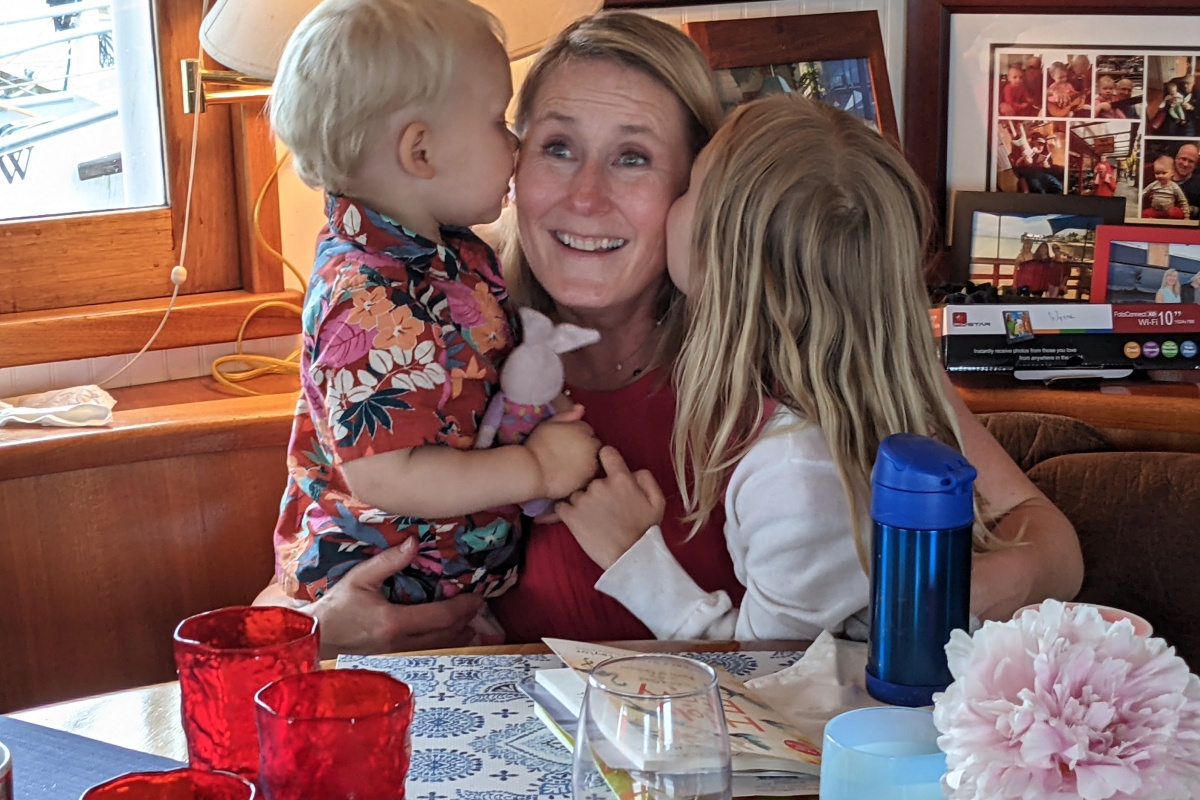
(featured photo is of my mom, my son and me)

(quote comes from a post on Philosophy through Photographs blog)

Working Out My Change Muscle

Everybody wants to be enlightened but nobody wants to change.” – Andrew Cohen

Last Monday when my mom was over, my 6-year-old daughter asked her if she wanted to get the stem out of a strawberry. Thinking that Miss O meant for her to do it, my mom grabbed a paring knife and reached for the strawberry. Then Miss O explained that she was going to show her how to do it.

Grabbing a straw, she pushed it up from the bottom of the strawberry until it popped out of the top, taking the stem with it. A pretty neat hack she learned from a You Tube video.

This makes me think of the quote from Andrew Cohen at the top of this post, “Everybody wants to be enlightened but nobody wants to change.” For me, I take that to mean at this phase of life that change is more about attitude than substance. That is to say, an openness to change is more important than what exactly it is that I will change.

I can name a half a dozen reasons why I wouldn’t stem a strawberry with a straw without even trying it. But that leaves me in a position of only trying change when I deem it to be important. How can I believe I’ll have the spiritual wherewithal to recognize and accept the one change I may need for enlightenment if I’m out of practice of changing at all?

So this week for Miss O’s school lunches, I’ve been popping the stem out with a straw all week. A change I’m not committing to stick to because I usually have knives more readily available than straws. But I consider it a workout for my flexibility.

What does change look like for you in your stage of life? Have you ever tried to stem a strawberry with a straw?