The Lottery of Life

Some people are born on third base and go through life thinking they hit a triple.” – Barry Switzer

My friend, Eric (from the recent On The Bus podcast), and I recently made a lottery ticket pact. Neither of us usually buys lottery tickets. But we saw a condo for sale at the place we like to go to on Whidbey Island. We can’t afford it, so we decided to buy a PowerBall ticket and if we won, we’d buy it.

I know, a silly idea all around. But the funny thing was that once we’d bought the ticket, I was beset by the idea that I didn’t want to win the lottery because I wanted to earn what I have in life.

Following this stream of consciousness made me realize how many “lotteries” I’ve already won in life.

Being raised by an incredibly smart mom who told me I could be whatever I wanted as long as I was willing to put in the effort.

Having a loving dad that did the work to follow the example of Jesus to love and accept everyone.

Living at a time when women can get credit, buy houses, and use IVF to have children.

Benefitting from mentors who were willing to help me discern what is important, how to navigate adversity, and retain integrity.

Having technical skills at a time when personal computers, the Internet, and mobile technology emerged.

Being blessed with kids that were healthy when they were born and being able to afford good health care for me and my children to help keep us well.

Living in the Pacific Northwest where there are mountains to climb, beaches to comb, and summer weather so nice that most people just want to stay near home. At least for these five months.

Having incredible friends who have walked alongside me for ups, downs, and adventures.

And the list goes on and on. It makes me realize how much my independence and sense of earning is a tenuous construct. It reminds me to balance my dreams with not just what I want and need, but what I can give in thanks.

Or, to put it briefly in a phrase I learned from Dr. Gerald Stein: Tikkun Olam – repair the world.

The Art and Science of Making Friends

There’s not a word yet for old friends who’ve have just met.” – Jim Henson

This was originally published on 3/15/2023. Heads up – you may have already read this.


This past Saturday night I was over having dinner at my friends’ Rachel and Karl’s house. As our kids happily played together, we talked about technology, philosophy, and their recent vacation to Mexico and I marveled at how much I enjoy their friendship. It started because their daughter and mine were in a preschool co-op class and we often worked in the classroom on the same days.

When I had kids at age 46 and again at 50, I essentially started a new phase of life that was out of sync with my friends. None of my friends from before I had kids have kids as young as mine. So I needed to expand my circle of friends if I wanted to have friends that were experiencing the same things as I was.

I found establishing friendships with people that have young children to be hard. First off, everyone has just expanded their family and is all hands-on-deck with supporting new life. Secondly, having young children doesn’t mean we have anything else in common. And thirdly, research shows that we typically have the most friends at age 25 when we are establishing our identity and from there, our friend networks get smaller, often with a focus on fewer but more in-depth friends.

A recent study revealed that only 50% of people report establishing a new friend in the last year.

[I’m going to insert a big aside here. I think this might be a much different number in the blogging community where we are “introduced” to new people regularly and form some of what I think are great blogging friendships, or as my friend Betsy calls them, Blog Buddies. The research I mention here was focused on the broader population.]

Listening to a Ten Percent Happier podcast with psychologist and professor at the University of Maryland, Dr. Marisa G. Franco who has recently written a book called Platonic, made me think about the parenting friendships I’ve established in the seven years since I’ve had kids. It’s taken some time but I’d say that I’ve established a handful of close ones.

Here are some of the things I’ve found helpful in creating new friendships interspersed with some of the wisdom from Dr. Franco.

Openness

You have to be vulnerable. This is a hard one for me because my biggest fear is to be seen as a needy person who can’t do it herself. So I’ve worked hard to open up to people who have earned my trust.

Attachment Style

Dr. Franco has found we have attachment styles that affect our ability to make friendships. There is a lot of room for interpretation in our relationships (e.g. is that person just busy or ghosting me?) and our past relationships can factor in on how we do that interpretation.

  • Securely attached people tend to not to take things as personally and to think people like them.
  • Anxiously attached people tend to cling or lose themselves because they assume they’ll be rejected.
  • Avoidantly attached people don’t want to give others the chance to reject them or use their vulnerability against them.

Dr. Franco says being aware of our styles can be really helpful so that we understand the filter we are using when interpreting new friendships.

This brings to mind a recent situation with a parenting friend. I had made overtures to do things again and again. She always said, “yes” but never made the effort herself. I tend to be the securely attached style but I started to wonder if I was the only one who valued the relationship when she offered up the comment, “Thanks for thinking of this. I have social anxiety and often forget to reach out.” Ah – awareness matters.

Continuity

What often falls off my radar is my existing friends. I confess to being not very good at planning things with my pre-parenting friends. Life feels busy and that falls into “me” time that is hard to set aside. So I’m always incredibly grateful when they reach out and suggest get togethers. I do my best to tell them I appreciate it!

On the morning after that lovely dinner with my parenting friends, Rachel and Karl, my best friend from when we were seven-years-old, Katie, came over to hang out with me and my kids. Friends, from all phases of life – what a blessing and well worth the effort.

(featured photo from Pexels)

The Power of Friends

Friendship helps our souls grow.” Michel de Montaigne

I worked for a small, local computer consulting firm right after I graduated from college in the early 90’s. Nestled in the suburb right next to Microsoft, it was growing fast – doubling every year. Most of the new employees were my age and it was a fun working environment in which it was easy to make new friends.

So when I recently heard a Ten Percent Happier podcast with psychologist and professor at the University of Maryland, Dr. Marisa G. Franco who has recently written a book called Platonic quote the statistic that we typically have the most friends at age 25 when we are establishing our identity, it matched with my experience.

Dr. Franco had a lot of interesting stats about friendships these days like four times as many people report having no friends as compared to the early 90’s and 2012, the year of the introduction of the smart phone, correlates with a rise in loneliness. One of the interesting things she added about smart phones and social media is that when we use them to connect with people (aka comment and message) and not just lurk, they can be useful tools in supporting friendships.

She also talked about how friends help us grow. Alone, we have an instinct to be on the lookout for danger that can be calmed when we cultivate good connections:

“Healthy and quality connections and it can ground us and center us more, our souls grow because it gives us the space to figure out who we are because we’re not in that active state of threat anymore. Friendship, good quality friendship, good quality connection it regulates us, it helps us feel less activated all the time, less reactive all the time.”

Dr. Marisa G. Franco

I feel so blessed to be part of this blogging community where it has felt easy to create quality connections with other delightful, thoughtful, and interesting people. Establishing friendships with other parents in this phase of life of having young kids has felt much harder by contrast. Dr. Franco’s research on how attachment theory applies to friendships and making new friends is the topic of my Wise & Shine post for today: The Art and Science of Making New Friends

(featured photo from Pexels)

The Four Habits of Happiness

It all comes to this: the simplest way to be happy is to do good.” – Helen Keller

I was listening to a 10 Percent Happier podcast that featured Arthur Brooks. A professor and social scientist, Arthur Brooks has recently published a book called From Strength to Strength: Finding Success Happiness and Deep Purpose in the Second Half of Life. He named a list from research of the 4 most important habits of happiest people:

  • Faith
  • Family
  • Friends
  • Work that serves others

But it made me wonder if everyone can fulfill that formula? First of all, faith means so many different things to different people. But perhaps it’s the trust in one of my favorite Steve Jobs quotes (which as Dr. Stein pointed out seems to build off Kierkegaard’s famous quote about living life forwards):

You can’t connect the dots looking forward; you can only connect them looking backwards. So you have to trust that the dots will somehow connect in your future. You have to trust in something – your gut, destiny, life, karma, whatever. This approach has never let me down, and it has made all the difference in my life.

Steve Jobs

But going down Brooks’ list, what about people who don’t have a lot of agency in their work? I recently heard an example of a hospital janitor. Instead of feeling like he didn’t have purpose in his work as he cleaned up vomit in the oncology ward, he’d framed it as an opportunity to make people feel a little bit better on what might be a low point in their lives.

And this made me think of my life. One of my least favorite activities about parenting is cleaning up spills. On a weekday when we are at work/school/daycare, it’s not so bad, but on any given weekend day, I clean up (or help my kids cleanup up) 6-10 spills a day. It feels like a waste of time to me, like I could be spending more time laughing and playing with my kids if we didn’t have spills.

But of course, despite my best precautions – kids, especially at age 3-years-old and age 7-years-old have accidents. They splash water out of the sink, they tip over the reservoir of paper they were using for a project, paint brushes fly out of little hands, and so on.

Reframing it, I see that I am not cleaning up spills. I’m teaching my kids how to react when things don’t go right. I’m helping them learn to pick up the pieces and continue when we have lost our mojo. And most importantly, I’m building up their belief that they can do it, even when it isn’t fun.

This big picture sentiment when it comes to caretaking is echoed by research professor Dr. Alison Gopnik “Taking care of children, like taking care of elders is frustrating, is tedious, and it’s difficult in all sorts of ways but it is also deep and profound and an important part of what makes us human.

In this way, maybe it is not only work that serves others but also quite possibly a habit of happiness.

What do you think about the four habits of happiness? Is there anything you do regularly that you’ve reframed as work to serve others?

(featured photo from Pexels)

The Window

Friendship is unnecessary, like philosophy, like art…It has no survival value; rather it is one of those things that give value to survival.” – C.S. Lewis

The moving truck has come and gone and with one last sleepover, it’s official that my daughter’s first best friend and our neighbor has moved away. We ticked through the 90 days since the announcement, some went quickly, others with a happy unawareness and then finally the days when it hung over our choice of activities like a dark cloud. And then the time arrived.

This is the first friendship that I’ve seen through my kid’s eyes. It started when my daughter was 3-years-old, I’d put her on my shoulders so she could see across the fence to talk to the little girl next door. If they were really lucky, Miss O would be up on my shoulders and Miss Z who was then 4-years-old would be up on her daddy’s shoulders and they could talk face to face.

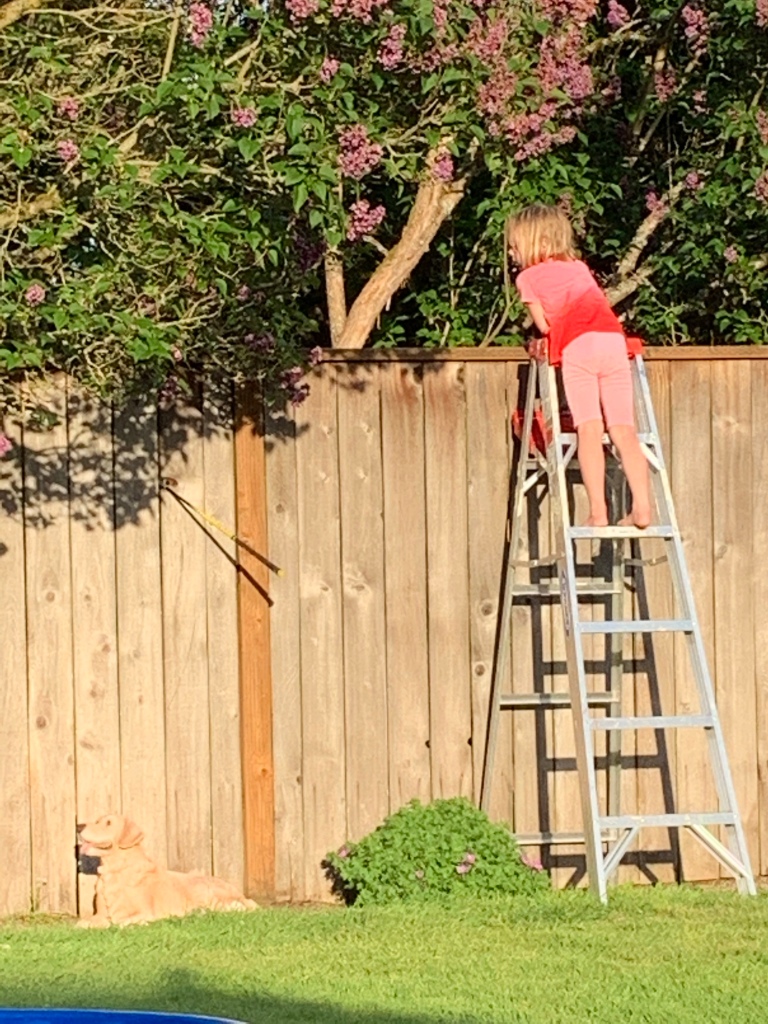
As Miss O got bigger and I got closer to my due date with her brother, I searched for a new solution as the shoulder carry got uncomfortable. Putting my 6 foot ladder next to the fence, Miss O would climb up to the highest step we agreed upon, Miss Z would climb her tree and they’d talk.

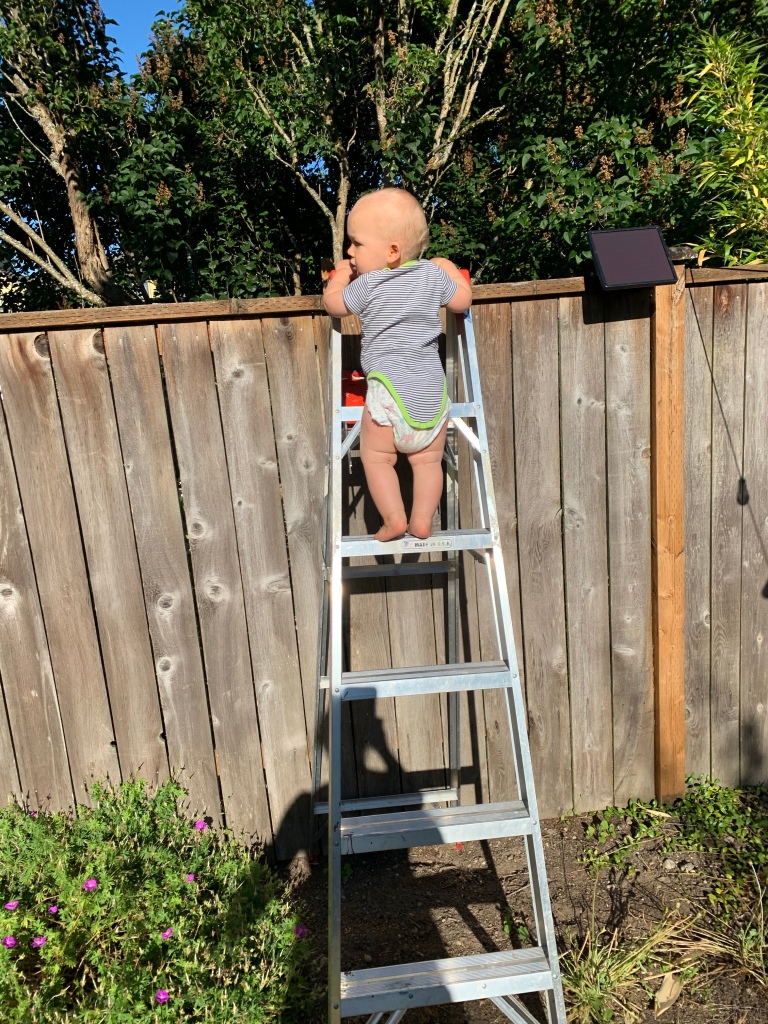
The ladder stayed next to the fence even as they became more and more comfortable with play dates and visiting each other’s yards. Then one day I found my 1-year-old son who’d just learned to walk atop the ladder looking as comfortable as can be.

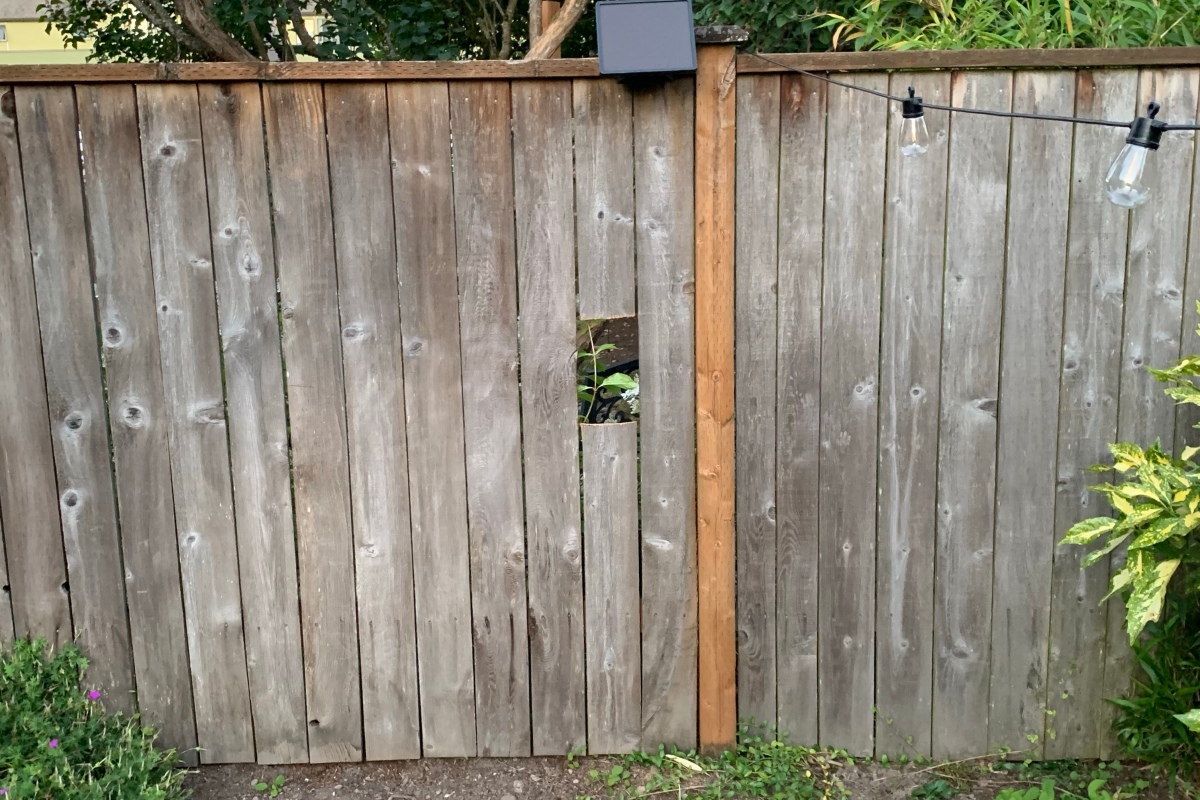
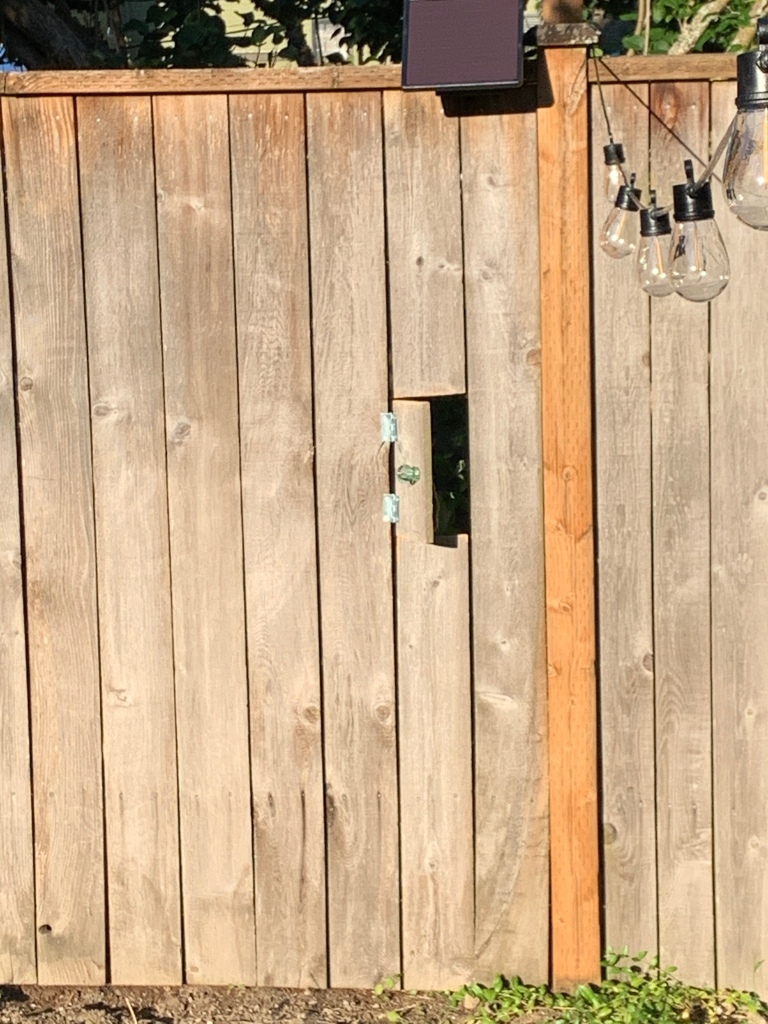
Of course I snapped a picture of it as I ran across the yard to get him down. That night after I got the kids in bed, with agreement from Miss Z’s family, I got out my dad’s Sawzall and cut a hole in the fence. After I attached two little hinges and a doorknob for each side, it become Miss O’s portal into the yard next door.

At the beginning of the pandemic, each girl would put a table on her side of the fence and they’d “eat together” talking through the window. They’ve passed markers, stuffies and shared deserts through the window in the fence. They’ve argued and then put apology notes through the portal. When we’ve accidentally stomped a rocket all the way into their yard, sometimes it comes back through the window in the fence.

This window has given me an insight about friendship. About the little windows in which we are visible to each other. The doorknobs we pull tight when the vulnerability is too much. The transparency with which we are willing to regard our own and other’s lives.

Now the window is closed. Sure, they’ll stay friends and figure out how to talk but this open-window era has ended. If fences make good neighbors, then little windows in them make good friends.