An Honest Mistake

Make your ego porous. Will is of little importance, complaining is nothing, fame is nothing. Openness, patience, receptivity, solitude is everything.” – Rainier Maria Rilke

I wrote a post for today to celebrate one year of doing a post every day. Then I looked back at my posts to confirm whether it was May 19th or May 18th when I started the practice, I found that I skipped a post on June 11th. Damn! If I hadn’t looked, I could have posted my victory lap and it would have been an honest mistake but once I knew, then I couldn’t celebrate because it became a dishonest mistake.

Not that I think anyone who reads the blog would have noticed. In fact, there could be some followers who wished I skipped more than one day, if you know what I mean… 😉

But somehow it matters to me because I think that if I’m going to go to the effort to write about my life, I might as well be as honest as I can be. I’m sure I have blind spots that keep me from seeing who I am in totality but at the very least I can not believe the BS my brain produces when I see it. Because when I do buy into the fiction, it just wraps one more layer between me and my experience of life that keeps me from feeling the beautiful, joyful, and yes, sometimes gritty reality.

I dated a guy when I was in my early 30’s who was always telling me what a nice guy he was. He’d usually say that as an addendum to a story he’d be relating from work or his first marriage that involved a kerfuffle of some sort. And because he got into a lot of disagreements that related to him needing to be in control or not listening very well, he had to tell me quite often what a nice guy he was. I think he really thought of himself that way but (and this probably goes without saying) I think that he was many things good and bad but objectively speaking, he wasn’t that nice of a guy.

Reflecting on the relevance of this to life, I went looking through Brené Brown’s book Atlas of the Heart to find the section on Places We Go To Self-Assess. There are three definitions offered there:

Pride: Pride is a feeling of pleasure or celebration related to our accomplishments or efforts.”

Hubris: Hubris is an inflated sense of one’s own innate abilities that is tied more to the need for dominance than to actual accomplishments.”

Humility: Humility is openness to new learning combined with a balanced and accurate assessment of our contributions, including our strengths, imperfections, and opportunities for growth.”

I loved that Brené Brown includes that word humility derives from the Latin word meaning groundedness. So I’m practicing humility to try to accurately assess my blogging contribution and opportunities for growth until I actually reach the 365 days of posting. And then I’ll celebrate the milestone with pride, not hubris, I hope!

Anyone else meet a “nice” guy that wasn’t? Or discovered an honest mistake recently?

(featured photo from Pexels)

Feeling Things All the Way Through

What is not expressed is depressed.” – Mark Nepo

The other day our honorary grandfather said to my two-year-old son who was fussing over a circumstance in his life, “Boys don’t cry.” While it was said totally genially and as a way to humor a child out of a mood, there was no doubt that he believed that mantra.

Which brought to mind the quote included at the top of this post by author Mark Nepo, “What is not expressed is depressed.” The longer that I live, the more that I have come to understand that emotions wreak havoc if not allowed to be felt all the way through. It brought to mind a comment I heard from emotions researcher Barbara Frederickson that all emotions have utility – sadness and depression when experienced in the typical course of life often tell us to stop doing what we are doing.

It’s when we refuse letting them tell us things that we shut down our own ability to listen to our inner source of knowledge. I spent years doing that when I was married because numbing my emotions was easier than taking the steps to acknowledge that under the surface of my positivity that I was miserable.

I haven’t gotten much better at vocalizing my less enthusiastic emotions since then but I have gotten better at recognizing them. The other day I was really resistant to working on a particular client project and internally thought, “Wow, I can’t stand this project.” And that strong note which often doesn’t arise in me made me realize that the way this particular project is structured doesn’t work for me. Observing that, I could acknowledge I won’t do it this way again.

Watching my son with his honorary grandfather reminded me of a passage I read in Listening to Your Life by Frederick Buechner. In it he points out the similarities between old age and childhood – the body does not support everything you want to do so you learn to play, you aren’t at an age where you have to prove yourself and:

Very young children and very old children also seem to be in touch with something that the rest of the pack has lost track of. There is something bright and still about them at their best, like the sun before breakfast. Both the old and the young get scared sometimes about what lies ahead of them, and with good reason, but you can’t help feeling that whatever inner goldenness they’re in touch with will see them through in the end.

Listening to Your Life by Frederick Buechner

The great thing about toddlers is that there seems to be very little artifice to the emotions they share. In the course of learning to regulate them, they express what strikes them at the moment. Boys do cry as do girls, and then they move on. It’s like watching master class on authentic expression and I can’t help but be impressed and learn a little bit more every day.

The Armor We Put On

Don’t ask what the world needs. Ask what makes you come alive, and go do it. Because what the world needs is people who have come alive.” – Howard Thurman

I watched my whole family don armor yesterday and I sit here writing this now stunned and a little sad.

It started with drama about drama camp. As I was preparing my 6-year-old daughter to go to the three day camp this week, there was a registration problem and I told her she might not be able to go. Then her friend was going with couldn’t come the first day. By the time we worked through the registration snafu and she was able to join the other kids, it had been 90 minutes of uncertainty.

I could feel the tension growing in my daughter’s body as she held my hand. Then she whispered to herself, “Be brave,” squared her shoulders and walked in the door. I should have been proud. I was proud. But it blew me away to watch.

It was similar with my two-year-old. He didn’t want to go to daycare after a week when his favorite teacher was on vacation. He was communicating this to me all the way up until I parked and then he completely shut it down as he walked in. It made me think of what one his teachers said to me after he’d recently been stung by a bee on the cheek, “I wondered if this would be the first time I would see him cry and even then, he didn’t.”  

My son is a pretty affable kid but that hit me hard. It made me a little sad not only for him but for all men who are told to be strong, brave and fearless at the expense of shutting down their emotions.

And then me. When this morning’s problem with the drama camp registration came up, I started feeling the fear of having to rearrange all of my work for these three days if my daughter couldn’t go. It created a tension of fear, mixed with disappointment, anger and self-pity since I’d juggled a day off last week when my son was sick.

But when I went to talk to the camp people, I put on my usual bubbly demeanor. Things generally work out pretty well for me because I lead with friendliness. As I’ve said before, my general disposition is a lot like a golden retriever – enthusiastic, friendly and goofy. And for the most part, my inside matches that disposition too but I’ve learned to wear it whether I’m feeling it or not.

I’ve thought a lot about authenticity and vulnerability in the last 10 years since I started to meditate. More than anything, it has changed my inner experience so that I truly know that with the help of God, I can handle whatever is thrown my way. These years of work has built my faith so that the faith tips the scales over the fear. It has made my inner experience match my outward affect.

Watching my kids don their armor at such young ages, it created an ache inside me for all of us. Not just my family but this whole world full of people whose insides don’t match their outsides. We’ve been living with it for so long, we don’t even realize it until we can no longer feel the caress of a hand on our cheek. Then we have to do the work to unpack it or continue to suffer the experience of not feeling fully alive.

I don’t have any solution with which to help my kids except to make it clear we take off the armor at home and practice stoking up the flames of the passion, the rawness and beauty of our whole beings. Then I pray that as Howard Thurman’s quote above says, that helps what the world needs too.

(featured photo from Pexels)

I Like It!

“It is not easy to find happiness in ourselves, and it is not possible to find it elsewhere.” – Agnes Repplier

When I first started actively blogging, I was pleasantly surprised by the email that WordPress sends out. “Person X liked your post. They thought A Randon Post Title was pretty awesome.” But then those “likes” get pretty addictive, don’t they? So I recently I started thinking about “likes.”

If you hit “like” on this post, is it because you like me and generally think I’m a good person or is it because what I’ve written means something to you? And if you don’t hit “like” is it because what I’ve written doesn’t resonate or because we don’t have a relationship?

I know it isn’t such a cut-and-dried thing but if I break it down that way, I think about feedback and what I give away. After all, “likes” are free for me to give, so why not like everything? If I do, do those likes count for much anymore?

I read a beautiful metaphor that Mark Nepo included in The Book of Awakening. He was talking about someone who was interviewing for a job and she said she wanted to jump and down and yell “pick me.” In this way he said we are all like puppies at the pound, dying for someone to pick us and take us home.

But when I perform for “likes,” it can cost me my authenticity. Not always – sometimes it pushes me to do a better job writing and communicating. But I have also found myself at times changing my voice based on who I think is reading. The former is great, the latter is destructive.

I want you to like me. But as I discover again and again, whether it’s blogging, parenting or being a friend – more than important than that is whether I like me. From there, I’m okay with how many likes I get or don’t get as long as I’m telling my truth.

(photo by Pexels)

Five Pieces of Writing that Inspired Me: #2 Self-Compassion

Wisdom is oft-times nearer when we stoop than when we soar.” – William Wordsworth

I’m a master at slicing and dicing things so that I have to be perfect even as I cut everyone else slack. Most recently it’s that as a single parent, I better have things totally dialed otherwise people will think I expect help. Before that it was because I was the only female in a group of mountain climbers, I couldn’t forget anything or be the last to have my pack on to leave camp or the other climbers wouldn’t want to have a woman in their group again. And before that it was because I was the only blonde in an electrical engineering class, I better get a good grade or be a disgrace to all blondes.

Reading the work of Brené Brown has shown me that I’m better off at using my energy to practice self compassion than to keep believing that I’m the one person that can’t make mistakes.

We don’t claim shame. You can’t believe how many times I’ve heard that! I know shame is a daunting word. The problem is that when we don’t claim shame, it claims us. And one of the ways it sneaks into our lives is through perfectionism.

As a recovering perfectionist and an aspiring good-enoughist, I’ve found it extremely helpful to bust some of the myths about perfectionism so that we can develop a definition that accurately captures what it is and what it does to our lives.

  • Perfectionism is not the same thing as striving to be your best. Perfectionism is not about healthy achievement and growth. Perfectionism is the belief that if we live perfect look perfect, and act perfect, we can minimize or avoid the pain of blame, judgment and shame. It’s a shief. Perfectionism is a twenty-ton shield that we lug around thinking it will protect us when, in fact, it’s the thing that’s really preventing us from taking flight.
  • Perfectionism is not self-improvement. Perfectionism is, at its core about trying to earn approval and acceptance. Most perfectionists were raised being praised for achievement and performance (grades, manners, rule-following, people-pleasing, appearance, sports). Somewhere along the way we adopt this dangerous and debilitating belief system: I am what I accomplish and how well I accomplish it. Please. Perform. Perfect. Healthy striving is self-focused – How can I improve? Perfectionism is other-focused – What will they think?

Understanding the difference between healthy striving and perfectionism is critical to laying down the shield and picking up your life. Research shows that perfectionism hampers success. In fact, it’s often the path to depression, anxiety, addiction, and life-paralysis. Life-paralysis refers to all of the opportunities we miss because we’re too afraid to put anything out in the world that could be imperfect. It’s also all of the dreams that we don’t follow because of our deep fear of failing, making mistakes and disappointing others. It’s terrifying to risk when you’re a perfectionist; your self-worth is on the line.

The Gifts of Imperfection by Brene Brown

Becoming Real

I am still in the process of growing up, but I will make no progress if I lose any of myself along the way.” – Madeleine L’Engle

My nanny sees the same massage therapist, Deirdre, as I do and as does my sister-in-law who used to nanny for me. The other day Deirdre told my nanny that she can feel the side that each of us carries my baby on. Because of course he isn’t a baby any more, he’ll be two this month and he’s 30+ pound bundle of love. So we contort our bodies to accommodate his weight and motion, cook one-handed and endlessly stoop to pick things up off the floor twisting to use one arm while balancing his heft with the other. Even when I’m pushing the baby in the stroller, I sometimes find myself on situations where I carry my daughter on my shoulders and hold a door open with my foot to get the stroller through. Then we schedule an appointment with Deirdre to help us put our bodies back together.

I’m happy to contort myself for my children. That feels like part of the process of extending myself to help them grow. But it makes me think the ways that I’ve contorted myself in relationships. Because carving my work and enjoyment time out of the space after I’ve made sure everyone else is taken care of and living in a house where projects don’t get finished and supplies are spread all over sounds like what comes with the parenting territory but also describes what I’ve previously done for some the men in my life.

With kids, this is tolerable because I know they’ll change. And even if they don’t learn how to pick up after themselves, one day they will not live with me, or so I hope. But when I think back the relationships I’ve had, I think I’ve often contorted myself because I’ve been unwilling to say, “I can’t live like this.” And if I dig really deep, I have to admit that don’t say that because I believe that love requires women to not ask for what they need and to instead just be grateful for what they have.

But I am starting to reshape that belief. Because when I play a role, I don’t feel seen as me. Then I require time away so I can take the role off and need people like Deirdre to restore me. I’m coming to see I only have endurance for life that is authentic and that is changing how I show up. I’ve come to see being real as part of having faith that others will truly love me if I do the hard work to let them.

What I’m learning is that there are a hundred little ways to practice saying what I need so that I can change alongside my kids. “Clothes” is sometimes all I have to utter to remind my daughter to pick up the outfit she just took off and threw on the ground instead of doing it myself. “Not now” buys me a rest from exertion when my body is just too tired. And “I’d like” is a great preface to naming what I want to do for fun. The repetition is necessary for both me and for them. I’ve been able to see how I can be optimistic, warm and loving AND real. I’m finding that I have a lot of opportunities to practice being grateful for what I have — and also asking for what I need.

God Bless You

Happiness is when what you think, what you say, and what you do are in harmony.” – Mahatma Gandhi

I don’t know what is in the air but it’s making me sneeze. But yesterday I had to drive my toddler to the very first birthday party he’s ever been invited to on a farm an hour from our house, I didn’t take any allergy medicine just in case it would make me sleepy. We had a great time at the party but whatever it is got worse so by the time we got home, I was sneezing non-stop. Achoo, achoo, achoo. My kids think it’s funny and maybe it was fine for the first 100 but by the 101st, I was tired of it. Finally, I took an allergy pill.

I tend not to tell my kids when I’m not feeling well. I guess I think they can’t do anything about it, it’s not their problem… <snort> until it is because I’ve got a fraction of my patience and am swimming in the shallow end of my grace pool. But last night, I did tell them as I went to lay on the couch for a minute, the Benadryl made me drowsy.

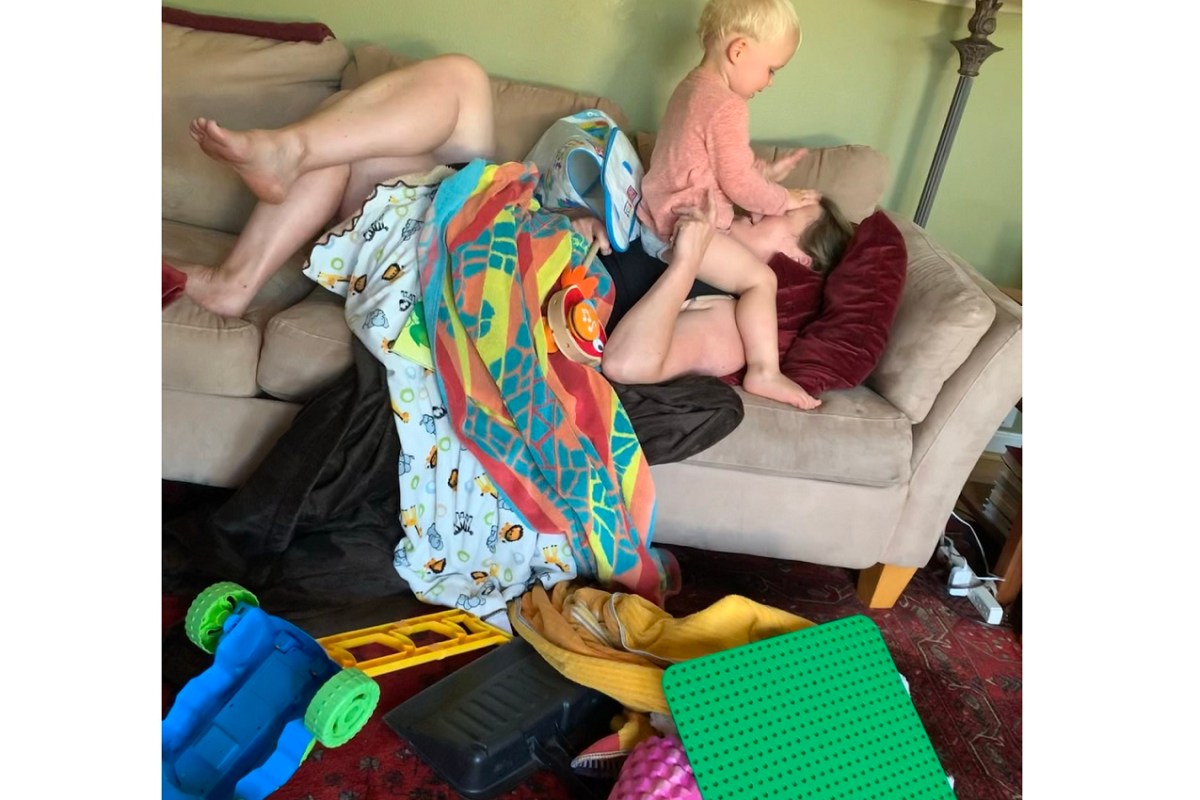
Their reaction was fascinating. They tried to help. My 5-year-old daughter took off my shoes and covered me with a blanket. My toddler son followed his sister’s cue and piled on whatever he could find on the floor, which these days is a lot of stuff, and then sat on me. Not particularly helpful but very amusing. And he tried to say, “God Bless You” which came out sounding a little like a sneeze itself.

Yet another little lesson for me not to keep my inner world and my outer world so separate. Somehow in the communicating of how I’m really doing, life continues but just a little more authentically, humorously and with a little less effort. Not to mention it’s hard to keep anything to yourself when you are violently sneezing… achoo!😊

True Grit

“Please remember that it is what you are that heals, not what you know.” – Carl Jung

The other day a friend of mine sent me a video. For a moment I wondered why she sent a video of the console as she exercised on a stationary bike and then she panned left and down, it showed that as she rode, her 3-year-old was calmly standing next to her holding her hand. Wow, I was so impressed — that she actually got on the bike and stayed on the bike in those conditions. It takes true grit for any parent to take care of their own needs with children around!

Taking care of myself to be the thing that I’m destined to get habitually wrong in parenting. First with one kid and now with two and I suspect with every change in routine and schedule, I keep relearning that I have to take care of me in order to be any use to them. My obstetrician used to joke that babies were parasites. They take exactly what they need from their host. She said it humorously but wasn’t joking. I’ve thought of it many times since having kids because sometimes I wonder what is left of me to be present. And it’s such a paradox because often when my kids need me most, I’m at my most depleted. As this quote from renowned psychiatrist Carl Jung says ”it is what you are that heals” that describes exactly what my kids are coming to me for, that surety, safety and knowledge of warmth that helps them soak away their hurts and fears.

If only I could be patient, funny and creative during the day then I can be thoughtful, deep and well-cared for at night. But when I try, the only thing that happens is that I end up exhausted for both. The answer is that I have to show up not only with my love but also with my needs, dreams and fears. It’s a threshold of entry that I must cross to be real with family, friends and colleagues.

My frequent excuse for not bringing all of me is that as a full-sized human, I don’t need as much so I lurk around living my life before they get up and after they go to bed. But every time I plan for us to do something that I want to do like go hiking, I’m rewarded that we all end up happier. Knowing that I want family to be a place where we are exercising and nurturing our most authentic, hopeful selves, I have to accept that includes me. It takes grit and courage but I know my kids will hold my hand, just as I hold theirs.