The Outer View

To see what is in front of one’s nose needs a constant struggle.” – George Orwell

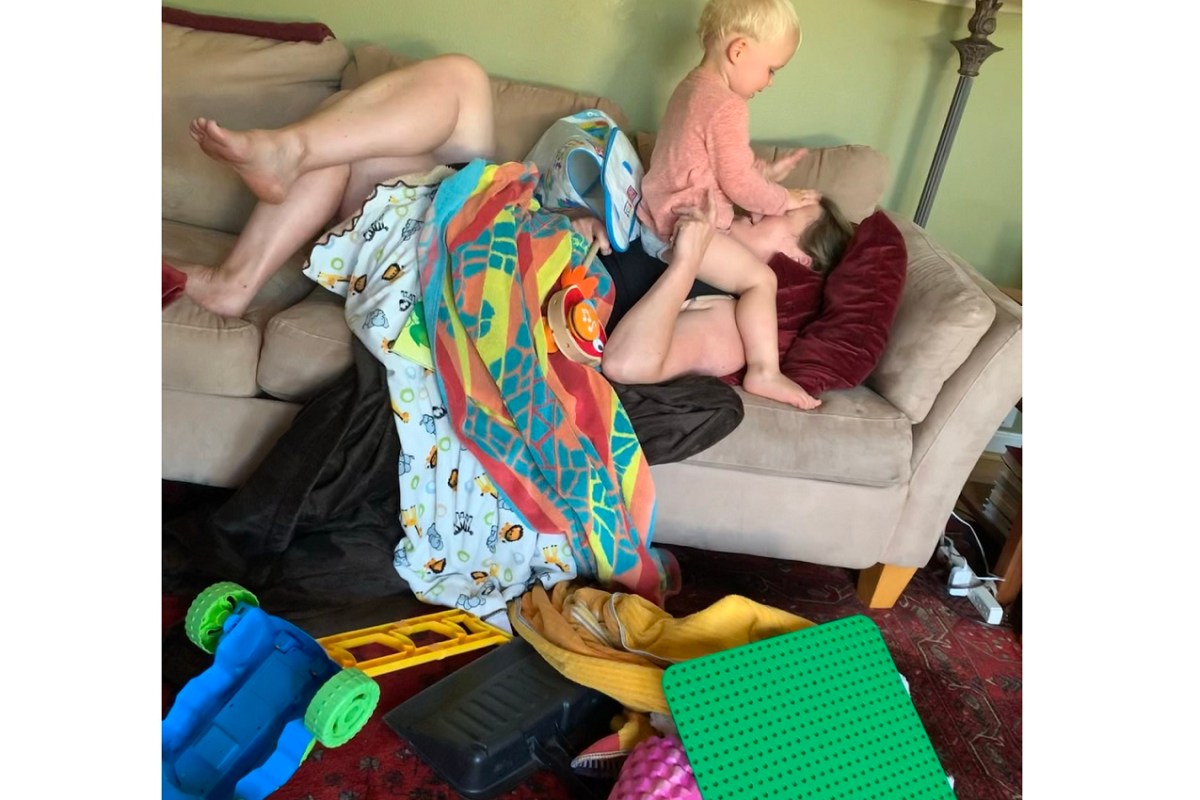
I sent this picture to my mom. She wrote back that it looked like something that could be on the cover of the Saturday Evening Post. I laughed because I snapped it to capture one sweet moment that was somewhat unusual in the typical the after-dinner chaos.

Life always looks easier from the outside, doesn’t it?

I think of a picture I took of a friend at a beach on a school field trip (back a few years ago when we could do those). She was sitting on a log with her two children nestled in her arms and I texted the picture to her adding that she looked like the quintessential mom. Her reality was probably that she was struggling to keep her children warm on a cold June day and to feed them without dropping anything into the sand.

Which is right? The inner view or the outer view?

The more I meditate, the more that I’ve come to believe that the outer view holds great promise. When meditation helps me drop the dialogue in my head that is always taking me out of the moment by planning for the next thing I need to do or recovering from the last thing that went wrong, I can see the outer view. Like in the case of the picture, I was still recalibrating after getting my kids to stop vying for a turn on the piano and also calculating how long til we started our bedtime routines.

It seems like there is a healthy and an unhealthy way to think of the outer view of our lives. The unhealthy way is to work hard to make everything appear in a certain way and then use other people’s perceptions to check to see if we are meeting up.

The healthy way is to get a glimpse every once in a while of what a trusted person sees in order to be reminded of what is so delightful about this moment.

So here’s a moment of my picture perfect life. There are other moments that aren’t as sweet but I bet when I look back on this time, this is how I’ll remember it.

Twenty-Five Words or Less

Every great dream begins with a dreamer. Always remember, you have within you the strength, the patience, and the passion to reach for the stars to change the world.” – Harriet Tubman

I was intrigued by a question in one of my meditation books, Listening to Your Life by Frederick Buechner. “If you had only one last message to leave to the handful of people who are most important to you, what would it be in twenty-five words or less?”

I came up with two versions.

Life is a never-ending raffle. Curiosity buys you tickets. Love enables you to turn them in. And, most importantly — you have to be present to win.

OR

Thank you. You have shown up, laughed with me, made me think, kept me company when it was dark. But that’s not why I love you. I love you because you are amazing.

What would you say?

Why Wine?

Longer-term consistency trumps short-term intensity.” – Bruce Lee

I can still remember being at an 8th grade party when a boy from school, Corey, came up to me and told me he had a crush on me. He had been drinking and was acting all goofy. Because none of the rest of us were drinking (or ever had), it was my friend that took me aside to explain that alcohol made people reveal their true feelings.

Which is something that I hadn’t updated until I recently heard a Super Soul Sunday with Oprah and Malcom Gladwell. In the podcast, there were discussing his book Talking to Strangers and revealed “Many of those who study alcohol no longer consider it an agent of disinhibition. Instead they think of it as an agent of myopia.”

According to this Psychology Today article, myopia in the context of alcohol means short-sightedness. It means we lose perspective, our ability to place our actions in the context of anything other than the current moment and consider the long-term consequences.

Which explains my recent response when a friend came over to dinner and asked if I wanted a glass of red wine. I said, “No, it makes me a crappy parent.” It makes me feel tired. This is surprising because I love red wine and used to drink copious amounts of it. But now, it not only means I will not sleep well but it also creates an impatience in me that feels uncomfortable.

Putting this feeling together with the research, I think I rely a great deal on perspective to be an understanding and supportive parent. I need the long view to energize me. When I see my kids’ actions in the context of learning the overall lessons in life, I feel an expansiveness to give them room to grow. When I’m feeling myopic, I am feel hemmed in by the mess and chaos of now.

Corey and I never talked about his crush once he sobered up. While I felt that giddy attention for the night he said it, the light of day squashed it. It’s a little like how I feel about wine now – I like the idea of it far more than I like the actual experience of it. It seems that perspective, in love and in parenting, is a very good thing.

(featured photo from Pexels)

Wordle as a Metaphor for Life?

You can’t win a game 7 without losing three games first. Keep going.” – Shea Serrano

As I having trouble solving Wordle the other day, I realized that I have been unusually focused on the word I used to start the puzzle. I’ve asked my friends that also play it what word they use. I’ve tried a few different ones myself, often using S-T-E-R-N since it represents some of the letters used most frequently used in English.

[For anyone who hasn’t tried to play this game that was recently bought by the NY Times, Wordle is a game where you have six tries to guess a common five letter word. You are not given any information to start with but when you enter a guess, you are told if you have any right letters and they are green if correct in the right spot and yellow if they are used on the word but in the wrong spot. Letters can be repeated. There is one word a day and everyone gets the same word so rest assured, this post doesn’t reveal today’s wordle.]

But as I typed in my word and got the result that the answer had none of those letters, I realized that knowing what isn’t in the word is equally as important.

The absence of a positive result is also informative.

It makes me think of a story about Thomas Edison. As he was trying to invent the light bulb, he tried more than a hundred different types of materials to use for the filament. Someone asked if he got discouraged and he said that he didn’t because each failure told him one more thing that didn’t work.

So Wordle is just the latest reminder that life is best met by continuing attempts to try. Every failure is just another opportunity to see what doesn’t fit. When I feel great resistance to something I’m doing in work or parenting, it presents an opportunity to think about whether I should push harder or try another tactic.

Some of life’s lessons are the hardest because we learn what not to do. But they are also some of the most valuable lessons, especially when we are able to distill the information and heal the trauma.

I did finally get the Wordle on the sixth try – phew! Because there weren’t very many letters left to combine into a common word (letters in dark gray on the keyboard indicate they have been tried and are not used in the word). It reminded me yet again, failure is an excellent source of information. Here it is in case you want to guess.

Wired to Learn

“Sharp people learn from their mistakes. But the real sharp ones learn from the mistakes of others.” – Brandon Mull

I got a new client this week. She was introduced to me by a mutual contact that told her I could help. She is clearly very bright and has done a lot of research but given the huge amount of documentation on the technology choices she has to make, she just needed someone to weigh in on what would work best because she doesn’t have time to try out every option herself.

After only a 30 minute phone call in which we talked through her options, she was ready to go with what I recommended. Of course, the technology we were talking about is my specialty and has been for 20 years but what struck me was how openly she was able to learn.

According to Nicholas Christakis, a sociologist from Yale, this is the hallmark of the human species. Christakis’ work in the field of sociology is about the long view of human history. He’s deeply optimistic about our ability to cooperate, teach others and love because we are one of the only species that does that outside of the family structure. In his book, Blueprint, Christakis lays out the case that “natural selection has given us a suite of beneficial social features including our capacity for love, friendship, cooperation and learning.”

Of course one of the places this is easiest to see has been with my kids over the last few years as they’ve learned to talk. When my son was one and just starting to talk he called water, “Mamu.” He and my brother’s wife, who was nannying for me, use to have a funny verbal game they’d play. He’d said, “mamu”, she’d say “water” and it would go on for a minute until they both broke out in laughter. And then eventually he accepted that it was water, just like he’s learned all the other hundreds of words he can say, because he trusts the caretakers in his life.

Which reminds me of my ex-husband. He had good reasons to believe his parents weren’t reliable sources of information. His dad used to say to me, “I knew my boy was smart when I came in to beat him with a belt and he asked for me to beat him with the wooden spoon instead.” And it was in his senior year of high school when he was living with his dad and step-mom and they moved in the middle of a night to a different state to avoid a tax debt without telling him (or bringing him) so he had to find a place to live on his own.

I think they were one of the reasons that he couldn’t learn from other people (or maybe the primary reason he couldn’t). And that was behind my reluctance to have kids with him was because I couldn’t bear the thought of having him experiment on children as the only way to learn the best way to parent.

So I understand that we all have different levels of openness to learning and that it might vary within a person by topic. But it gives me great hope when I witness the human ability to trust and learn like I did with my client this week. Because it resonates with what I’ve gleaned from Nicholas Christakis’ work – that we have come this far because we are wired to cooperate and learn. Coupled with Arthur Brook’s concept of crystallized intelligence that I wrote about last week, the idea that as we age we develop intelligence more suited to synthesize, tell stories and teach, it seems we have the right ingredients to pass on goodness to the next generation and beyond.

(featured photo is of my dad teaching a class)

The Environment

I cannot do all the good that the world needs, but the world needs all the good that I can do.” – Jana Stanfield

At the end of every day my house is a mess. There is litter (toys on the floor), dangerous spills (popsicle residue on the floor), waste of precious resources (water, electricity and paper), some areas have been taken over by debris (the dining room table) and I think the couch could be a Super Fund clean up site (crumbs, toothpaste and other unidentifiable debris). There is an invasive species in with the dishes (toys in the sink) and measurable climate change (I keep the house is four degrees warmer than I used to at night). Having kids is really messing with my environment.

The environmentalist Wendell Berry is credited with the profound idea that we have not inherited the earth from our parents; we have borrowed it from our children. But he must have been talking about the concept of children and not actual children who seem to naturally tend toward not worrying about limited resources.

Given the numerous stories and approaches that I’ve heard from parents, I’d guess raising an environmentalist is hard, even when the practice is limited to only their room or a play room. My friend told me her daughter once excitedly said to a guest to their house, “Come see my ruin!” A miscommunication so apt that they are still laughing about it 30 years later.

Another family tried teaching by logical consequences so that any toys left on the floor were likely to be trod upon and that must be an effective method because the girls, now in their college years, can still enumerate the toy fatalities (toy-talities?).  Eventually these kids grew up to be good stewards of their environments but not without someone helping them see the big picture and how they can make a difference.

A quote from the Dalai Lama, “Human use, population, and technology have reached that certain stage where Mother Earth no longer accepts our presence with silence,” has spurred me to action because up to this point I’ve been often opting for silence — mostly cleaning it myself rather than teaching them how.

My son goes on garbage walks with his school – the kids identify garbage and the teachers pick it up and put it in bags. My daughter loves to be organized. So I have some raw capabilities to work with and just might be able to make some good stewards of the environment out of them yet!

The Feelings Expert

The more we sweat in peace, the less we bleed in war.” – Vijaya Lakshmi Pandit

The other day my daughter, Miss O, came home from school upset because she had a little kerfuffle with a fellow 1st grader at school. He kicked down the wall of wood chips she and her friends were building and when she went to talk to him about it, he started talking before she could get the words out. This is the conversation she reported to me.

Miss O: “You can’t take the words out of my mouth.”

Boy: “Yes, I can.”

Miss O: “Er…I’m going to talk to my mom about this. She’s an expert on feelings. I’ll tell you what she says tomorrow.”

I’m amused by the title she’s given me. I remember reading Brain Rules for Baby by University of Washington professor John Medina when she was a baby. It said that to help our kids manage their big emotions, we had to model naming our emotions, even the less desirable ones. I clearly thought “no thank you” to that but I guess I must have made some inroads countering my own resistance and stoic modeling from my childhood.

But more than that, I find my daughter’s story to be so relatable. Communication is hard isn’t it? Especially in those tight moments when you are disappointed or angry and the words, if they come, get muddled.

Last week I was listening to a 10 Percent Happier episode titled How Not to Ruin Your Relationships with Drs John and Julie Gottman and they were talking about situations where we are overwhelmed by emotion. In that case, we are flooded and there’s no point in continuing to talk. They recommended walking away, doing something completely different until we can return to the conversation.

Which is what Miss O did. We talked through not calling any names or labeling the other person and instead just stating what she felt and needed like being able to finish her sentence. When I asked her if she’d said any of that to the boy the next day she said, “Nah, it wasn’t that big of deal.”

It reminded me – learning to talk is one thing and learning to communicate is a whole other thing. One that takes a lifetime to work on. But I’m inspired by the quote at the top of this post from Vijaya Lakshmi Pandit, “The more we sweat in peace, the less we bleed in war.”

(featured photo from Pexels)

Efficiency

“It’s not the heavy load that breaks you, it’s the way you carry it.” – Lena Horne

I needed to go downstairs to empty out the recycling bin. While I was down there, I thought I’d bring up some sodas from the store room. Then I remembered that my friend Eric was coming for dinner and I grabbed cans of the seltzer water he likes too. Before I even got to the door of the storage room, I dropped one of the cans. I picked it up, dropped it again and this time when I picked it up, it had been punctured. Nevertheless, I still continued to carry it upstairs, balancing 6 cans and a recycle bin dripping seltzer water the whole way.

<Sigh> The things I do for efficiency. 😊

This seems to be a lesson that I have to learn again and again. I think it’s a tangible reminder when I’m carrying too much.

When I slow down and do things well, I feel the simple joy of completing each task well. When I overload myself, all I feel is the sensation of juggling balance.

And then I drop one thing and instead of noticing it as a cue to empty my hands, I focus on just the thing I dropped.

Finally when I’ve persisted in bumbling my way through, I see the ridiculousness of it all and start to laugh. Humor makes sopping up seltzer water more bearable as I shake my head in wonder at my stubbornness.

I know it’s a human affliction to believe that we can contort ourselves in all sorts of shapes in order to juggle it all. And then we are reminded to put the load down, ask for help, or not do it all at once. If we listen, we are rewarded with the pleasure of doing one thing well. If we don’t, we get to laugh at our humanity while we clean up the mess.

(featured photo from Pexels)

Synthesis

“Whatever you are, be a good one.” – Abraham Lincoln

My best friend since second grade, Katie, was telling her college aged daughter that I was one of the smartest people she knows. I laughed knowing all the stupid stuff I’ve done over all the years that Katie is very well aware. But getting my bachelor’s degree in Electrical Engineering was one of those things that made people think of me as smart and so I just smiled.

But it also struck me that it’s been a long time since someone called me smart. And then I heard a 10 Percent Happier Podcast yesterday that explained why that might be. The podcast featured Arthur Brooks, a professor at Harvard who has just written a book From Strength to Strength: Finding Success, Happiness and Deep Purpose in the Second Half of Life. In it, he discusses two types of intelligence: fluid intelligence and crystallized intelligence.

Fluid intelligence is raw smarts, solving problems and doing it quickly, thinking very quickly. It is the brain power of young brains and it starts to decline in our mid-30’s to 50. Young tech entrepreneurs tend to rely on a lot of fluid intelligence.

Crystallized intelligence is what emerges as fluid intelligence declines. It is the ability to synthesize so that we become better story-tellers, teachers and are able to put ideas together and explain them to others. Historians are great examples of people that are using their crystallized intelligence to its fullest potential.

Which brings me back to thinking about my friend Katie. She graduated with honors as the 11th in our high school class and I graduated 12th. The reason I go to Katie for advice isn’t because she’s smart – it’s because she’s wise, kind and understanding. Most often, she is using her crystallized intelligence to relate the stories of her life to mine.

It also struck me that with those descriptions, all of us over 50 bloggers are in our sweet spot. Telling stories and synthesizing life, we are making the most of our crystallized intelligence as it starts to come to the fore. And if I’ve done a decent job telling this story, you all should be feeling great that you are right where you need to be!

(featured photo from Pexels)

Self-care

Sleep is the best meditation.” – Buddha

I had a moment this week when I felt unappreciated. In my exhaustion from the endless loads of laundry, the sudden need for spot cleaning and the excessive attentiveness that comes with potty training, I was running at 100% and no one seemed to notice. The way I remember it, my 6-year-old daughter asked me to get her something right after I sat down and my internal dialogue whined, “Can’t she see how hard I’ve been working?”

And then I had the inclination to be elusive, enigmatic and mysterious so that those around me would seek me out. Funny because I have never embodied mystery in my 52 years but somehow it seems viable as a strategy when I’m feeling tender. As if somehow retreating will make me feel more seen.

It’s a silly idea but thankfully I finally have come to have some sympathy for myself at this age. That I can recognize that as I sign that I need some self-care instead of calling it stupid or just powering through it is progress in my friendship with myself.

But the inclination to hide when I am exhausted and feeling unseen reminds me of something I heard in a podcast with Dr. Laurie Santos. She teaches the “Psychology of the Good Life” course at Yale which she described as:

“Evidence based strategies students can use to feel better. The problem is that it’s hard because our minds lie to us – like negative emotion, run away [from it]. Our minds lie to us about the kinds of things we are going to enjoy. When I’ve had an exhausting day, I just want to plop down and watch Netflix and never get off the couch. My mind doesn’t say, ‘Hey why don’t you go for a hard workout or why don’t you call a friend you haven’t talked to in a long time?’ The point is that we have intuitions about the kinds of things we need to do to promote our mental health and the kinds of things we need to do to live a happy life but often times those intuitions are wrong. They [the intuitions] are like – change your circumstances, get a lot of money, succeed, succeed, succeed at all costs. In practice those intuitions are leading us astray. We are putting in the work to become happier. But we are doing it wrong.”

And what are some of the right things that Dr. Santos has found that she has to remind the students in the course? To eat well and sleep.

And eating well and sleeping is what I’ve found cures my inner whine at least 98% of the time. I’m grateful that I can be friends with my mind. Even though I’ve learned not to listen to what it suggests, it often is telling me to take care of something and I appreciate that.