“Take chances, make mistakes. That’s how you grow. Pain nourishes your courage. You have to fail in order to practice being brave.” – Mary Tyler Moore
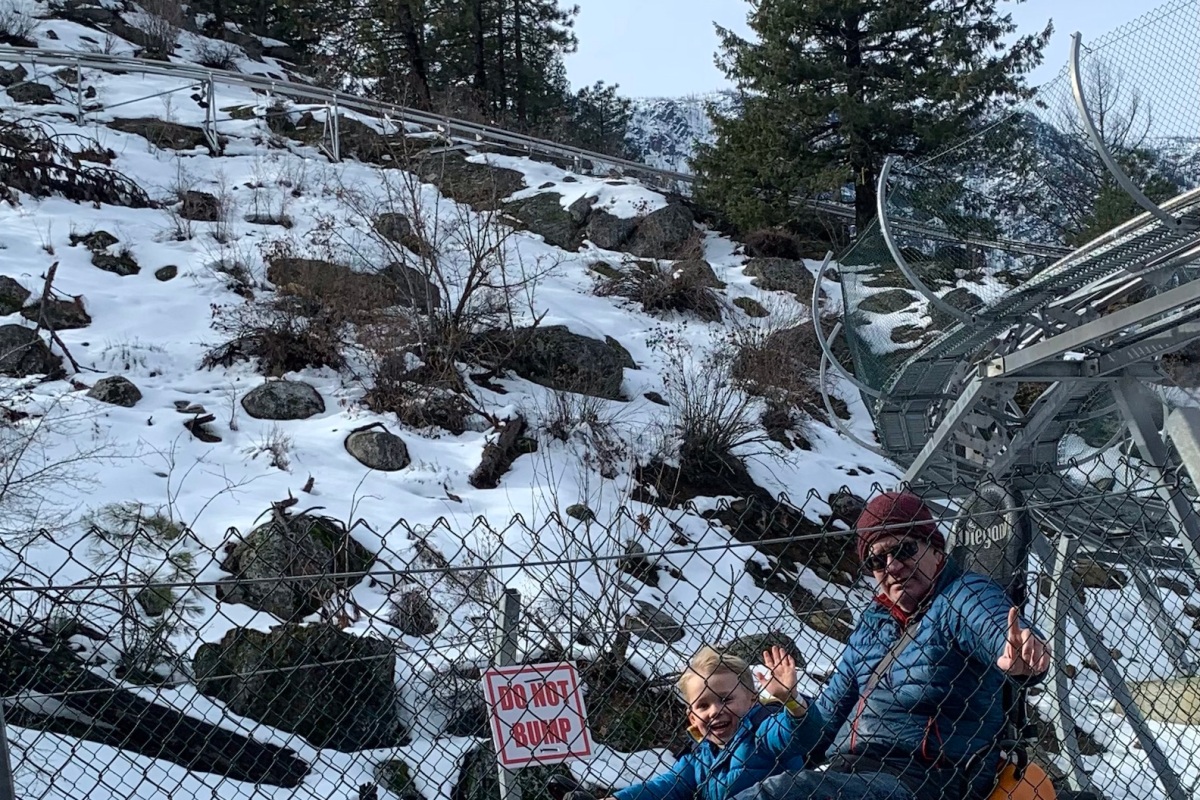
Last weekend when we were in Leavenworth, WA, we went to an adventure park to ride a roller coaster. Or maybe I should say a roller-coaster-ish kind of ride because the cars were individual and the driver could apply the brakes as much as they wanted. Another clarification: by “we” I meant my kids rode with my dear friend, Doug, because I’m an endurance person, not a speed person.
Now that I have all those caveats in place, on with the story.
Eight-year-old Miss O had no hesitation and climbed right in to ride with Doug. Talking with four-year-old Mr. D about it, he was clearly torn. He didn’t want to do it. And then he did. He flip flopped a couple of times. Since I was pretty sure he’d like it, I was trying to figure out how to nudge him in the direction of trying it.
But even though Miss O didn’t hesitate on this challenge, she and I had just been having a conversation about failing when it came to learning to ride her hoverboard. She asserted that life was easier for me because I never failed. I told her I fail all the time which is why is doesn’t faze me much any more. In fact, I rarely think of it as failing but just as a step towards the next thing I need to do.
On the drive to Leavenworth, I’d been listening to the Ten Percent Happier podcast, The Science of Failing Well where Dan Harris was talking with Amy Edmonson, a professor of leadership and management at the Harvard Business School. She had three points that stuck with me about taking risks:
- Make the risk as small as possible: This point reminded me of gambling – make a bet but don’t put all your chips in.
- Have a hypothesis: Know what you are trying to test or prove
- Learn from the attempt: Use the experience and hypothesis to extract information for the next thing you might try.
I think a lot about what creates confidence. What my parents did to create kids who are willing to try hard things because for all the differences between my siblings and me, we are all game to take on new challenges. So I’ve tried to figure out how I can do the same for my kids. While there’s much that remains a mystery to me, what I’ve identified is that my willingness to try and fail might be the single most defining characteristic in the arc of my life.
So, I told Mr. D he didn’t have to do it. But if he did, he only had to try one ride, Doug could go as slow as he wanted, and that I thought he’d like riding in a car on a track. When it came to his turn, Mr. D was a little nervous but resolutely game. Until I greeted him at the exit ramp, that is. He rolled back in with a huge grin on his face!
He had so much fun that he learned he wanted to do it again. And the second time he went up with his hands in the air.
Life is a roller coaster and I’m glad that I continue to ride. The metaphorical kind at least.
(featured photo is mine)
(quote is from Real Life of MSW blog: Being Brave)


A champion in life is raising two more. Congrats, Mom!
LikeLiked by 3 people
I appreciate that vote of confidence, Dr. Stein!
LikeLiked by 1 person
The most revealing sentence in this post is Miss O thinking that her mother never fails. That’s something we don’t often/ever stop to consider, that when our kids are very young (it doesn’t last!), they see their parents as the experts on life. Little do they know!
LikeLiked by 5 people
That’s so true, Jane. I suspect it has to do with what she expects to see as failure too. She doesn’t see me give up or have a fit so perhaps it doesn’t seem like I fail. But she sees me not setting up the tv on the first try or having to get a different tool to fix something and then I take a moment and try again. It’s different than the kind of melt down that kids often display.
LikeLiked by 1 person
Yep, I prefer’s life’s metaphorical roller coasters to the real ones too.
LikeLiked by 3 people
Haha, I’ve with you, VJ!
LikeLiked by 2 people
Yes, VJ!
LikeLiked by 1 person
As Jane mentioned, it’s so interesting how we see our parents as flawless when we’re young. I’m glad the kids had a good time, and I bet Mr. D learned a lessons about trying new things in the process. 😊
LikeLiked by 2 people
You’re right, Erin. That is a nice honeymoon phase at least! 🙂
LikeLiked by 1 person
Trying new things with encouragement and love all around. Nothing better than that! (And hey – that’s quite an MTM quote to lead off your post. Love that – new to me!) 🥰
LikeLiked by 1 person
Encouragement and love – always good! Funny thing about the MTM quote. I thought I might have gotten it from you and had to check my source. Happy Monday!
LikeLiked by 1 person
You, too! 🥰❤️🥰
LikeLiked by 1 person
❤ ❤ ❤
LikeLike
Anyone who is successful has failed at their attempts, including Steve Jobs, for example. I’m glad your son tried the adventure and enjoyed it! You reminded me of a John C. Maxwell book called “Failing Forward.”
LikeLiked by 2 people
That’s such a good point, Elizabeth! And when we’re looking at the outcome of a story, sometimes we forget all those failures!
LikeLiked by 1 person
I think that it’s important that our kids see their parents as real, see them fail, see them be fearful, see them show emotions– all within reason surely. If an adult always seems to succeed or doesn’t admit (like you do to O) that life is hard, that you fail then are we really preparing them for reality, and maybe more important why don’t we show those things? Or why can’t we show those things…
LikeLiked by 2 people
All such good points, Deb. It reminds me of a question that O asked me when she was about 3 – “why don’t grown-ups cry?” And I was kinda surprised and not sure how to answer. Because my loop for failing and being frustrated happens pretty quickly – I’ll stop, take a deep breath or walk away, and then return (whether it’s work or trying to fix the frig). I suppose I need to narrate more of this out loud.
LikeLiked by 1 person
It is hard to remember that’s it’s ok to fail. Thanks for the reminder.
LikeLiked by 2 people
Great point, L.K. — and that we can fail well, too! Thanks for commenting!
LikeLike
I’m not a roller coaster person – I have the inner ear disturbance thing that creates nausea… my daughter and grandkids however do not, so they go on the rides while I babysit the bags! I know my strength and weaknesses. On a different note, if the risk is minimal, and it’s not something that will affect my physically, my daughter and I have a phrase: “What have we got to lose?” and because we gave things a try, we succeeded.
LikeLiked by 1 person
I love your “What have we got to lose?” phrase, Tamara. So inspiring – and indeed, what do we? ❤ ❤ ❤
LikeLiked by 1 person
Lol, it seems to work! We overcome our fears and discover something new!
LikeLiked by 1 person
“I’m an endurance person, not a speed person.” Hmmm, how do I want to fall, traveling fast down a crazy roller coaster or from falling down a huge mountain that I had to walk up. Oh, you crazies are scaring me and I’m just sitting here at my desk. Ha, ha. Anyway, Go Mr. D. You can do it.
LikeLiked by 2 people
You crack me up, Brian. I assume if I fall down the mountain that I walked up slowly, I will at least have some chance of going slowly…. 🙂
LikeLiked by 1 person
It’s so interesting that you return to your own upbringing to understand how you learned to be courageous even when you risk failing. I think you nailed it. Our kids learn from what we actually do as opposed to what we say! Keep emulating resilience, courage, and empathy. I’ve always thought those were vitally important to a successful life. Hugs, C
LikeLiked by 1 person
I love what you are encouraging here, Cheryl – resilience, courage, and empathy. So good, my friend!!
LikeLiked by 1 person
“In fact, I rarely think of it as failing but just as a step towards the next thing I need to do.” Isn’t that the best way to look at things, Wynne? When asked what I would change if I could have a “do over” of my life, I usually say nothing. Because every experience, every failure, brought me to where I am today.
LikeLiked by 1 person
Oh, you say it so well, Michelle. Exactly – it’s we got to here! Thank you!
LikeLiked by 1 person
I love that Mr. D gave it a try and loved it! I still remember when my very nervous son rode his first rollercoaster: a very small one that was at the foot of the Needle in Seattle (it’s gone now). By the time he’d gone around once, he was thrilled – and ended up riding it a few more times. Yes, one of the most important lessons we learn is how to fall down six times and get up seven.
LikeLiked by 1 person
I remember those rides at Seattle Center. I’m so glad he took the ride. Yes, Susan – fall down 6 and get up 7. So good!
LikeLiked by 1 person
Great bits of advice there, Wynne! My youngest was always the kid who would flip-flop when it came to scary rides. Tears were often involved. I was always so excited for them (and relieved) when they would finally just “go for it”!
LikeLiked by 1 person
I love how you describe the moment when they just go for it! So good, Rhonda!
LikeLiked by 1 person
The metaphoric nature of your roller coaster riding is amusing to me. 😏
You’re raising some securely attached kids. This will be a benefit to them throughout their entire lives!
LikeLiked by 1 person
Wow – I couldn’t ask for a better compliment. Thank you, David!
LikeLiked by 1 person
Way to go, Mr D! And way to go to you, Wynne, for nurturing that confidence in him by applying those principles from the podcast. I too find taking risks incrementally make such a difference. I see it in the way you raise your kids, even having them cut food in the kitchen too. They are going to be great when they’re older in this rollercoaster of life.
LikeLiked by 1 person
Thank you, Ab! I’m laughing about cutting food in the kitchen. Sometimes that makes other adults nervous but my kids are great at it. You should have seen them when they were out front with saws (at their request) the other day. That drew some comments. 🙂 Geez, it wasn’t power saws….
LikeLiked by 1 person
“Risky play” is something to nurture and encourage in kids and it’s good to see you do that!
LikeLiked by 1 person
Yes!
LikeLike
Great post, Wynne. The part about taking risks, especially learning from the attempt, is spot on. Some people fear attempting new things based on past experiences. In reality, the best approach is to continue moving forward, utilizing what we’ve learned to change our current situation. The picture is awesome, and it seems that he enjoyed the ride.
LikeLiked by 1 person
Oh, I love what you’ve highlighted here, Edward. Continuing to move forward, utilizing what we’ve learned. Yes! Thank you!
LikeLiked by 1 person
Wow Wynne this is so good – “While there’s much that remains a mystery to me, what I’ve identified is that my willingness to try and fail might be the single most defining characteristic in the arc of my life.”!!!
LikeLiked by 1 person
Thank you, Mary! You know how to pick out the really important bits! I appreciate you! 🙂 ❤
LikeLike
Wynne,
You have some of the best stories! Love this and I learned something along the way, too! 😀 Mona
LikeLiked by 1 person
What a lovely comment. Thank you, Mona!
LikeLike
Love that Mr D took a chance and enjoyed it! 💞
I’m reminded of the saying “practice makes perfect”. I think I’ve perfected the art of failing, so I can grow and improve!
LikeLiked by 1 person
Love this perspective! Maybe that’s the only thing possible (and desirable) to perfect??
LikeLiked by 1 person
I’m a fan of Dan Harris’s podcast and that particular episode was great.
Yes, your post is a great reminder about the art of failure. We’re also never too old to fail.
LikeLiked by 1 person
Love knowing you are another 10 Percent Happier fan, Brad. And never too old to fail – that’s such a good point. Thanks for reading and commenting!
LikeLiked by 1 person
I wonder if a very small risk can even be classified as a risk. Maybe they should be broken into categories, like hurricanes, tornadoes, and earthquakes are. Walking down the street with a shoelace untied? 1 on the Risk-ter Scale. Running with scissors? That’s a 3. Climbing Mt. Everest naked while balancing a plate of spaghetti on your head? Definite 27.
LikeLiked by 1 person
Ooooh, I love the risk-ter scale, Mark!! And your example of Mt. Everest? Is it a 27 because it takes [spaghetti and meat] balls?? 😉
LikeLiked by 1 person
I can’t sneak anything pasta you!
LikeLiked by 1 person
[snort] 🙂
LikeLike
So true. The best payoffs for me have been when I took the biggest [calculated] risks following my own muse, in the sense of how to live my life authentically. Of course one person’s idea of a risk may be another person’s idea of no big deal.
LikeLiked by 1 person
Live life authentically and take the right risks. A great formula! Happy Valentine’s day!
LikeLiked by 1 person
I like your thought about failing as a step towards the next thing you need to do. Thank you for being always a source of inspiration!
LikeLiked by 1 person
What a lovely comment. Thank you, Cristiana!
LikeLiked by 1 person