Loving the Bad Cat

“It never hurts to see the good in someone. They often act better because of it.” Nelson Mandela

I used to have this cat, Simon. He was a Siamese mix that I inherited from a neighbor when she went to study in Hawaii for two years. She moved back from Hawaii but never returned for the cat. I suspect it was because he was a bad boy. He’d break into other people’s houses, he’d fight with other cats, he’d get locked in places like neighbor’s garages that he should have never been in the first place. A classic Simon story was that I had a neighbor, Steve, who hated Simon because he was always getting into his stuff. Steve lived in a duplex and when someone new moved into the other apartment, he was showing them around the basement with the washer/dryer the two units shared. As he was saying to them, “The most important thing is that you can never leave this door open because there is a cat that likes to come in here.” The new people asked what he looked like and as Steve replied they interrupted, “Like that cat right there?” And right behind Steve’s shoulder was Simon sitting up on a shelf smugly looking at them all.

Simon was so smart with such a big attitude that he was very amusing. He’d walk with me and my dog for 12 blocks, always looking around like he was the secret service agent keeping us safe. He was a snuggler too. Whenever he bothered to come home, he’d climb right into my lap and collapse there. But when push came to shove around his bad behavior, I’d always distance myself from him, “Oh yeah, that’s a cat that I inherited.” Like I did at the very top of this story. His bad behavior was disrespectful and rude, two things that I don’t see myself as so I think I just couldn’t own up to him.

I’m thinking of this because my five-year-old daughter this morning told me that she got in trouble yesterday when she and her friend were at the park with her friend’s caregiver. They went to an area that they were told not to go in order to climb trees. I assume that this was a pretty mild incident given that I heard about it from my child a day later and not the caregiver or the other parents. But it was notice that I’m crossing the threshold of parenting where my child can make choices outside of my control and supervision. And it raises the question about how to manage the myriad of feelings that come with it, specifically the judgment that comes with it – my judgment of my child and my fear of judgment by others.

There are two examples that come to mind about parental reactions to bad behavior. The first is a notable case from when I was growing up about a prominent family in the town. The dad was the editor of the newspaper, the son, who was then in his 30’s, got arrested for serial rape and the mom tried to bribe the judge and have the prosecutor killed.

The second story is on the other end of the parental spectrum and is a video that I saw a dad had posted online of his daughter running to school. He had posted it to shame his daughter for lying about what had happened to her bike.

Between those two examples is probably where most parents operate, I hope. I am finding that I am at my best when I let go of my judgment and instead choose discernment. When I am judging my child’s behavior, I feel the constriction of my viewpoint into not only what have they done but also who that means they are. Even when I don’t say half of what I’m thinking because I’ve declared that there will be no name calling in my house because the research that shows shame does not work, my thoughts jump to judgment. But when I am able to move through that into discernment, I can feel myself open back into curiosity. Both about how to best teach the values that I think will be most helpful and also about what conclusions/lessons my child has already learned before I even say anything. Crossing between judgment and discernment requires at least one deep breath.

So I asked my daughter why she thought that area of the park was out of bounds and what she might do differently the next time she’s invited. She had pretty good answers and we talked through the gray areas. It was better than anything I could have lectured on my own.

Postscript: After many different types of behavioral intervention for Simon and one time when he died and had to be resuscitated on the operating table as he was getting another cat’s tooth extracted from his back after fighting, the vet finally prescribed some kitty Prozac for him. He stopped fighting and breaking into other’s houses and he lived to 19 years of age. He lived with me for 14 of those years so I guess he was my cat after all.

Always in My Boat

“Smooth seas do not make skillful sailors.” – anonymous

This morning I was trying to put shoes on my toddler. I got one on before he starting running around the kitchen island. It started a game where we were chasing each other and hugging when we collided. My five-year-old daughter got in the mix and I stopped running just to watch them run, collide and hug. A moment of pure fun and joy.  

In my twenties I dated a man who had rowed crew for the University of Washington. His stories of teamwork and precision were beautiful. If I close my eyes, I can still see the images painted in my head. On a calm, still morning at the break of dawn, 8 rowers carrying a shell down to the water with the coxswain giving directions, they flip the boat and lower it in to Lake Washington. Once they are all in with the coxswain nestled in the front, they take up their oars and in perfect rhythm set off across the smooth surface as the morning mist swirls around them. The cox calls directions and timing. Stroke, feather, stroke.

I’ve been picturing my family as a rowing team. Each of my kids is a rower and I am the cox, at least for this phase in life. We get up every morning and do our best to row across the expanse of the day. Each of us has a part and some days we are in sync and glide smoothly.

And then on some days, one or both of my little rowers or I have a fit which I liken to catching a crab. That’s rower lingo for when the blade goes into the water at the wrong time for the momentum of the boat and results in the oar driving hard into the rower, perhaps even knocking them out. It’s a hard moment for everyone in the boat and we have to take stock as to whether we keep rowing until they can get back into the rhythm or stop to help them center themselves again. Because we are a team and no team gets good without practicing together.

We also have to take into consideration the conditions outside. Right now as we transition back to in-person activities, it feels like the lake is choppy and it’s hard to hold the boat steady. It’s also when we have to set our expectations that we won’t be going as far or as fast until conditions improve.

I like this analogy because it helps me see the long view of life and my family. For now they are in my boat but someday they’ll have their own boats and I’ll be a rower for them. And then of course, I’ll be gone and then they’ll have to close their eyes to see me pulling for them as I do with my dad and the feeling that he’s always in my boat.

Because what is the boat? I think of it as anything that keeps us above water. For me it is Faith and it makes it so much easier to stay afloat in the reassurance there is a Higher Power so much bigger than me. I step into the boat trusting that a master craftsman has constructed it to be sound and for the best rowing experience in both still and choppy water.

This morning as we ran around the island, my daughter caught my son and hugged him long enough for me to get that second shoe on. We took that instant to stop, hug each other and laugh. I felt the prayer in my heart, “Thank you for this beautiful and easy moment that gives us momentum to glide through all the others.”

Finding My Stride

“Song is not a luxury, but a necessary way of being in the world.” – Mark Nepo

This first mountain guide that I ever climbed with recited poetry. Not while we climbed but during breaks and when we were all gathered in the evening around the camp stove drinking hot drinks. I was not quite 30-years-old and eager to learn everything I could about climbing so the poetry stuck. And the rhythm of it while I climbed was so helpful when roped to others. Go too fast and the rope bunches up and makes it harder to avoid stepping on it. Go too slow and you tug on the person in front of you, throwing them off balance. High up on the mountain where the oxygen is thinner, the breath harder to catch, having a rhythm stuck in your head to move to works. The guide favored Robert Service poetry and I can still recite it, maybe even use it to find my internal rhythm in moments:

There’s a race of men who don’t fit in,

A race that can’t stand still.

So they break the hearts of kith and kin,

A roam the world at will.

I’ve been thinking about stride a lot lately because I’m having trouble finding mine. Three weeks into getting my toddler into the rhythm of preschool, there was a teacher in-service day and school was cancelled. Now my 5-year-old is going to go to in-person Kindergarten for the first time starting in April but they are cancelling all remote classes for 3 days to prepare. And changing the start time for everyone, even the kids that are staying remote. And once they’ve been back to school for one week, then we are taking a week off for Spring Break. I totally get that starting back up a big school district is a huge task and acknowledge that they need to take the time. I’m just trying to figure out how to get my work done amidst the turbulence. This moment of re-entry, obstacles and challenges feels like the upper reaches of a mountain. My little family is like a roped-up team. It’s hard work and I feel like I can’t find my stride and it’s hard to breathe.

I’ve had plenty of moments in the mountains when I couldn’t find my stride either. And like with what I’m feeling right now, one of the biggest reasons is low-level worry and complaints like I’m tired, it’s windy, what are the tough conditions we’ll face ahead? But my time on mountains has taught me that I can take one step at a time until I find my stride. If I can replace the worry and complaints with a song, a mantra or a poem, I start loosening up and flowing again.

So I’m channeling my inner mountain guide as I meditate in the morning of these weeks knowing that if I can find my rhythm, I make it easier for all those on my rope team. Because we are all tied together and we’ll get to where we are going and face our obstacles as a team. I’d rather do that singing than worrying, dancing through one step at a time.

The Conditions of Creativity

“Fill the paper with the breathings of your heart.” – William Wordsworth

The other night we had some friends over. In the raucous atmosphere of an audience after so many months without one, my kids were showing off. My toddler was falling off a bouncy horse over and over and when I went to video him on the fifth time through, I asked, “Did you do that on purpose?” and he turned to me and winked.

It has taken me five days to write about that one funny and wondrous moment of connection with a not-yet verbal human. For me, I need to write in the morning, when I am still fresh from sleep. I can’t write when taking care of my kids, I can’t write in the middle of the day when I’m in work mode, I can’t write at the end of the day when I’m completely worn out. I once heard an interview with the author Ursula Le Guin and she said something about writing whenever she could. Except when her kids were young because she said, “of course you can’t write when your kids are young.” My reaction at the time was, “Why not?”

But now I’m starting to understand three things about being in the thick of life. First, that the moments that I see into the depths of life are precious. Just because we love them doesn’t mean our loved ones can’t muddy our waters. Second, that I can’t be a participant and an observer at the same time. Like the danger of being behind a camera on vacation, seeing everything through a viewfinder with one eye closed instead of seeing the full experience, I can’t digest the meaning of whatever is happening at the moment without creating a barrier to whole-hearted participation. I have to process it later. And third, that the conditions of creativity must be right to write. Even though my kids are so much of the inspiration of living without reservation, the attention they require engages my head in a way that blocks the quiet presence of the heart behind my words.

So I’ve waited until I was clear before writing this to you. That I can do so feels like a miracle, having a free moment, finding some words and depth about how they come, and even to have a medium that allows me to connect with others. It feels a lot like that wink from my son, a small sign that we might truly be communicating. Hopefully the sacred flow of creativity stays open long enough for me to ring true for you.

The Root of Courage

“Courage is being afraid but going on anyhow.” – Dan Rather

My mom was joking with me the other day that I’m paying for preschool for my toddler twice. “First you pay a monthly fee for him to attend three days a week,” she laughed “and then you pay again by having to hold him for three days straight after that.” And as it goes with humor, there is a lot of truth in that. As my toddler goes through this third week of being at daycare, I’m exhausted from making breakfast, lunch and dinner with only one arm but hopeful that he is getting a little more comfortable with this new routine. And as soon as we get into this rhythm, it’s going to change again when my 5-year-old gets to go to in-person Kindergarten for the first time.

This pandemic has been hard for me as I try to be everything to everyone – breadwinner, childcare, friend, teacher, janitor, all without much personal space to recharge. But this re-entry is definitely hardest on my kids. Even though there have been times when they were bored at home, all this time has mostly just been basking in their happy space without having to grow their boundaries. It has been all the sweetness of togetherness and not the growth that comes with otherness.

I come from a long line of encouragers but as we face these situations I think most often of my dad. At my dad’s funeral service, he was eulogized so perfectly as a “battery on feet, just looking for someone to jump start.” When working a project or a problem with my dad, I always felt that everything was possible. The word encourage has it’s origins from French – in courage. And to break that down further, courage as in rooted in the heart. So we encourage others by instilling courage, helping them to live from the boldness of their heart. I love this breakdown of the words because it reminds me that courage isn’t going forward without feeling but just the opposite, it is completely rooted in feeling. And to encourage, we help others lean in to all those feelings and do it anyway.

So I’m happy to hold my son for three days after his days at preschool. I give him some of my heart so that he can go forward living fully from his.

Affirming Ourselves

“You can search throughout the entire universe for someone who is more deserving of your love and affection than you are yourself, and that person is not to be found anywhere. You yourself, as much as anybody in the entire universe, deserve your love and affection.” – Buddha

I bundle my son into the car and off to preschool and when I return and sit down to work, I find that he’s removed the mouse from my laptop – the small pencil-eraser style mouse that sits between my G and H keys that is my favorite way to navigate. I look all over the floor for it, I search my office for my replacements but I’ve hidden them too well so that my kids won’t get them and now I can’t find them. Young kids are such a hindrance to getting things done. I was going to say “can be” but pretty much at this age, it’s not that they can but they are.

There is the big picture view that I am working in order to support my precious children so perhaps I should just take a deep breath, picture them and all aggravation goes away. And that is true, but it is also true that I really like to get things done. For my own sense of self and esteem.

I read a story in Mark Nepo’s Book of Awakening about Dr. Elkhanan Elkes about how she survived the Holocaust. She always kept two things with her: a small crust of bread and a broken piece of comb. The bread was for when she met someone who needed it more than she did and the comb was to comb her hair twice daily as it affirmed her person.

Applying her wisdom to parenting — the crust of bread is easy. I don’t know of any parent of small children that doesn’t keep a little snack just in case with them. In pre-Covid times, we even shared these with other people’s kids that needed it. But the daily affirmation of myself and my humanity is a harder. Dr. Elkes story tells me it is something we all need for survival and it’s a daily practice. I am a person and not just a role that I perform at home and work. For me that affirmation comes from a meaningful communication with another adult at least once a day — writing a card to a friend, writing or commenting on a post, or checking-in with someone who’s going through something big.

So I borrow the pencil-eraser mouse from another computer, write this post and find that my son really helped with my affirmation after all – he gave me something to write about. That’s one thing done for the day!!   

Sliding Glass Door Moments

“Beauty is Truth, Truth Beauty –
that is all you know on earth,
and all you need to know.” – John Keats

I was reading yesterday about how the English poet John Keats wrote “Ode to a Grecian Urn” while he was dying from tuberculosis at age 24. As tragic as that is for him, my mind immediately thought of his mother and how she must have felt. Clearly my becoming a mother has altered the angle from which I think about life. I’ve heard of decisions like mine to become a mother described as sliding glass moments – moments where you can see life on the other side and choose whether to open the door and cross the threshold.

I’m fascinated by our sliding glass moments because they define the major plot lines of our lives. They are the story we tell others when we first meet. I was stuck in traffic at 29-years-old and just had broken up with my boyfriend when I saw Mt. Rainier majestically sitting in front of me and decided to climb mountains. I was 39-years-old and my business partner invited me out to lunch to tell me of my husband’s infidelities and my life as I then knew it changed forever. I was 45-years-old and decided that I wanted to have kids and was willing to do it alone rather than rush a relationship that might not be right for all of us.

But as showy as those moments are, I think it’s equally telling how we live each day between them. Before my business partner told me about my husband’s infidelities I was drinking at least a bottle of wine each day trying to numb the fact that I was in a relationship I wasn’t supposed to be in. After he told me, I found meditation and the inner peace that comes with leaning towards life instead of away from it. Before I had babies I would cry hearing any story about the miracle of birth. After I had my kids, I practice my gratitude by writing at least one thing down every day for my gratitude box. If sliding glass moments are the plot lines, I think our daily habits must be the language and tone of how our stories are written.

I looked up the story of John Keats and found his dad died when he was 8-years-old and his mom died when he was 14-years-old. I imagine that his genius was in part defined by those moments and the words he wrote the way he lived each day processing them. Altogether they formed the life that brought the words to us – “Beauty is Truth, Truth Beauty” – and in reading those we find the echo of both in our own lives: the truth of the big moments and the beauty of our days.

The Crux Move

“One climbs, one sees. One descends, one sees no longer, but one has seen. There is an art in conducting oneself in lower regions by memory of what one has seen higher up. When one can no longer see, one can at least still know.” – Rene Daumal

I can picture the hardest move from one of my favorite routes in the rock climbing gym. It’s after you have climbed halfway up the 50 foot wall and then the wall juts out over your head so that to get past it, you have to lean backwards, reach your hand up where you can’t see and throw your leg out awkwardly to the side to counter-balance. It’s the crux move. The one that takes such balance, confidence and hope to overcome but leads to a gently inclined section that is a breeze to climb to the top.

Even though it’s been five years since I have regularly climbed on that route at the gym, whenever I get to a tough place in life I think of that crux move. It’s how I relate to the hard spots in life like the one I’m facing one now. My brother’s wife, Lindsey, who has nannied for me for five years is quitting to take her dream job. She has been here for me and my kids 2-3 days/week and in the coronavirus era, 4 days week to take care of everything. She has been the closest thing I have to a co-parent.

I am genuinely happy for Lindsey as my friend and sister-in-law and the time feels right for a change. But I’m also facing uncertainty as I wait for the school district to finalize their plan for in-person school. I’m hanging in this space in between what has been and what will be all the while trying to hold the ship steady and work.

The hallmark of these crux moves is the feeling of being off-balance and in fear. Life is pushing a shift, a shift that makes us live more out in the open because we aren’t treading our well-worn path. That exposure creates a tenderness against which fear is so much more palpable. For me, I fear that Lindsey will be relieved to be away from us and if so, does it mean she doesn’t love us and this work of raising kids isn’t worthwhile? And if I imagine Lindsey’s end, she is probably afraid that we don’t need her and aren’t grateful for all the time she gave us.

This fear leaves me feeling so vulnerable. I want to stack up all the irritations and hurts I can find, even though they are relatively few in order to block feeling this way.  But that’s when I come back to the muscle memory of the crux move. Learning to climb them taught me they go better if I’m not tense. The more I cling to whatever hand holds I have, the faster my arms burn out. But if I breathe deeply and relax into it, I preserve my strength for where I’m going. Even when I can’t see the next hand hold yet, I can feel my way into the timing so that I have momentum to help move me up and over. There is great joy in moving through a crux move because it requires the body, mind and spirit to all come together. Applying it this way, I get a glimpse of how no experience in life is wasted because our “play” helps create pathways through “life.”

I read recently that good-bye came about as a short way of saying “God be with you.” Saying it that way reminds me that we are all on a journey and the best way to help others along is to wish them well. So I wish Lindsey, God be with you, and I trust that the next move I make will carry me and my family through our crux move to the next part of our journey.

Who Are You Listening To?

“It is the ability to choose which makes us human.” – Madeleine L’Engle

When the pandemic hit last year I had just started watching Season 3 of Bosch on Amazon Prime. One night I turned it on and the story line involving one of my all-time favorite detectives as he navigated departmental politics, the drama of his own life and homicide cases he works left me feeling wrung out instead of entertained. So the next time I was looking for evening entertainment, I had to find something else.

Instead I’ve been listening to podcasts as I clean, exercise and prepare for the next day. On Being with Krista Tippett, Soul Sundays with Oprah, Unlocking Us with Brené Brown, The Michelle Obama podcast and Revisionist History with Malcom Gladwell have given me the sound bites and food for thought for a year. What a difference it has made! Author Simon Sinek on Brené Brown’s Dare to Lead podcast made a comment that put words to this for me – sometimes we work alone but that does not have to be lonely if we have sense of faith and community. Listening to deep and inspired conversations with curious and insightful interviewers has kept me company and inspired in this year of being apart.

Krista Tippett’s podcast with Nicholas Christakis, professor of sociology at Yale, was so uplifting to hear his message about how our species is wired for good – to love, to cooperate, to teach each other stuff.

I loved hearing one of the rare interviews with psychiatrist Dr. M Scott Peck did with Oprah. She asked how he got so much done and he replied that he got so much done because he spends two hours a day doing nothing. He used to called it his thinking time but then people felt free to interrupt him so he renamed it his praying time and then no one dared.

When Brené Brown interviewed psychologist and author, Harriet Lerner, it was a master class in apologies. I so related to the point she made that adults often use a child’s apology as a launching point for a lecture instead of “thank you for saying that, I appreciate it.” Her point was that neither children nor adults feel much like apologizing when that is likely to happen.

Michelle Obama interviewed her mom, Marian Robinson and they laughed about how Marian used to foster independence in her children by letting them get themselves up and ready for school, “it’s up to you” she would quip, “I already got my education.”

One of the Brené Brown podcasts was with neuroscientist David Eagleman whose research at Stanford shows that our brain is constantly changing and making new connections. He made the point that even in the hour of listening to the podcast, our brains would be changed by it. And I believe it was in the same interview that he said who we are is shaped by the five people that we spent the most time with. It is that point that sticks with me as I consider how to spend my precious free time. Who am I listening to and is it what I want to be shaping me?

Glimpses of Sunshine

The other day at my 5-year-old daughter’s check-up, the doctor asked her how online school was going and she answered, “It’s stressful.” And it is stressful – for her teacher who can’t see the kids when she is sharing her screen, for my daughter who often doesn’t feel seen, for her younger brother who wants to do what his sister is doing and for me adding the jobs of teaching assistant and janitor to parent and breadwinner. On one level we are fine and on another level, we are deeply tired as most everyone is during this pandemic.

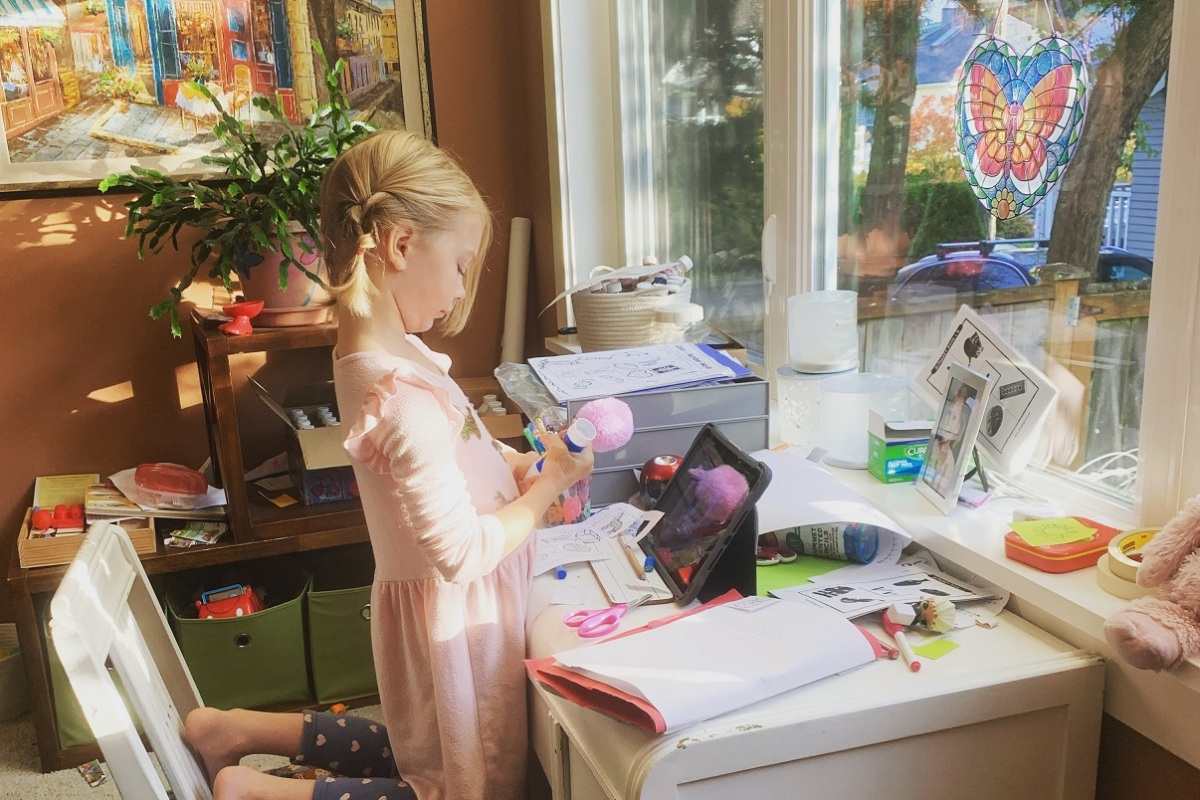
But every once in a while, something breaks through my grief of how things ought to be to show me the beauty of how things are like the sunshine in this picture. I know that I will be grateful for this extra time with my kindergartener and the extra glimpse I’m getting into how she learns. I also know that generally speaking, I’m a Pollyana but I greatly need these miraculous glimpses to fuel my sunshine!

There are moments when I’m buried too deep in my to-do list to let the light in. Finding time to clean my windows when I don’t have two spare moments to rub together is not easy. But when I take fifteen minutes before the kids wake up in the morning to meditate, do yoga, read something inspirational or write anything that is authentic, it changes my day. The step back from my to-do list restores my heart space that holds the why I am running around doing all these jobs. It widens my aperture to include the big picture so I am more open to see the sunshine streaming in. And when I’m operating from my calm, all my tasks, whether they be work, kids or home go a little better. This Zen saying makes me laugh but probably even more so because there is truth to it, “You should sit in meditation 20 minutes a day. Unless you’re too busy, then you should sit for an hour.”

Yes, this time of remote learning and social distancing is stressful. It puts a spotlight on our human struggle to see and be seen. All of which goes better when we whatever we need to do to clean our windows and let the sunshine in.