Open and Even

Be a fountain, not a drain.” – Rex Hurdler

My 6-year-old daughter recently came home from an extended play date and I had no idea who she was. I mean she looked like my daughter but one minute she was super confident and magnanimously sharing the candy sitting on the table with her little brother. But the next minute she was lying on the floor yelling that she couldn’t get ready for bed by herself, even though she’s been doing it for at least two years.

My take away from this episode is that the line between our big space where anything and everything seems possible and our small space where problems loom large is really thin. And the line seems to teeter on proper care and feeding.

If something feels off — as if one of us is in one of those tight parking spaces where we can’t open the doors, we are cursing those parked next to us and it feels like we have to use a can opener just to get out, I’ve learned to check the basics. Is anyone tired, cold, hungry or wet? And yes, I’m talking about my kids but I’m also talking about myself. Have I meditated, exercised and eaten well? If I have, then 90% of the time I’m operating from my big space.

Ten years ago when I started meditating, I had no idea that sitting in silence for ten to twenty minutes a day could change the experience for all the other minutes in a day. But for me it’s like a daily washing of the windows so that I let more light in and my perspective is brighter. It is a parking space I feel so lucky to have gotten, looks out to the most beautiful vista and I want to whoop with delight.

I assume with my daughter that she was exhausted by having the navigate the ground of relationship in an unstructured play with someone her own age. Grown-ups are pretty easy for her because for the most part in play, they generally will give her whatever they want because no one wants to be the jerk who won’t share a doll with a 6-year-old. But it’s a completely different ball game with other kids. And negotiation is exhausting.

It’s precisely because navigating relationships can be exhausting that I come back again and again to self-care. Because I want to be operating from my big space in case I meet someone temporarily parked in their small space.

(featured photo from Pexels)

Photo of the week: Nov 20

My mom captured this picture of Mt. Rainier this week when she was flying home from a trip. With 26 glaciers, Mt. Rainier is the most heavily glaciated mountain in the lower 48 states of the United States. But even so the hot weather this past summer melted the mountain so bare that it is such a relief to see her covered in white again.

This is the mountain that made me want to climb mountains. I’ve stood on top twice and spent countless hours hiking around and admiring her majesty and mystery. Even with this long history, every time I catch a glance of Mt. Rainer out the window or while standing on her flanks, I feel a rush of awe, inspiration and peace. She speaks to me of beauty, timelessness and the Divine and I listen.

Thanks for the picture, Mom!

The Courage Not to Quit

It always seems impossible until its done.” – Nelson Mandela

When my daughter, her friend and I were biking back from school the other day she absolutely refused to walk her bike up a steep hill even though her friend and I were walking our bikes. She would run out of steam, stop and then start trying to ride again in the middle of the hill. I repeatedly coached her “walk your bike.”

Finally she explained she wanted to be a story. “What does that mean?” She replied, “I want to be a story we talk about at the dinner table.”

I assume this hearkens back to the time she bought an ice cream for her brother from the ice cream truck, all by herself, with her own money and without me telling, choose to get one for him too. I blogged about it in The Great Turnaround post. I was proud of her, she was proud of herself and I told many people the story when they came over for tea or dinner.

So I had to explain that for every epic journey, there is always a time that you want to quit. I’ve never climbed a mountain where there wasn’t a place where I totally wanted to quit. Just mentioning this brings back the time on the Mexican volcano, Mt. Ixtacchuatl right after we left high camp at about 14,000 feet.

It was dark, the middle of the night and we were walking on scree – that loose gravel that shifts every time you set your weight on it so that every step was a scramble and rebalancing effort too. We were on the way to the 17,600 foot summit so we had a long way to go and the only thing I could think was that I’d have to contend with this on the way back too. I totally wanted to quit.

And so I told her that’s where the stories come from – because you want to quit and yet you don’t. Whatever you do to get past that section where it’s hard and bleak doesn’t have to be pretty. The epic stories all have a middle section. Otherwise they aren’t very entertaining..

My daughter looked at me as if she wasn’t convinced. And since she’s 6-years-old and has had very little personal struggle in her life, I suspect that she doesn’t yet have a hook to hang that on.

So the next time she had to ride home from school, her friend’s dad ran behind them and pushed them up the hill as they stayed on their bikes and rode. She returned home to me triumphantly and said, “I have my story now!”

Picture of the Week

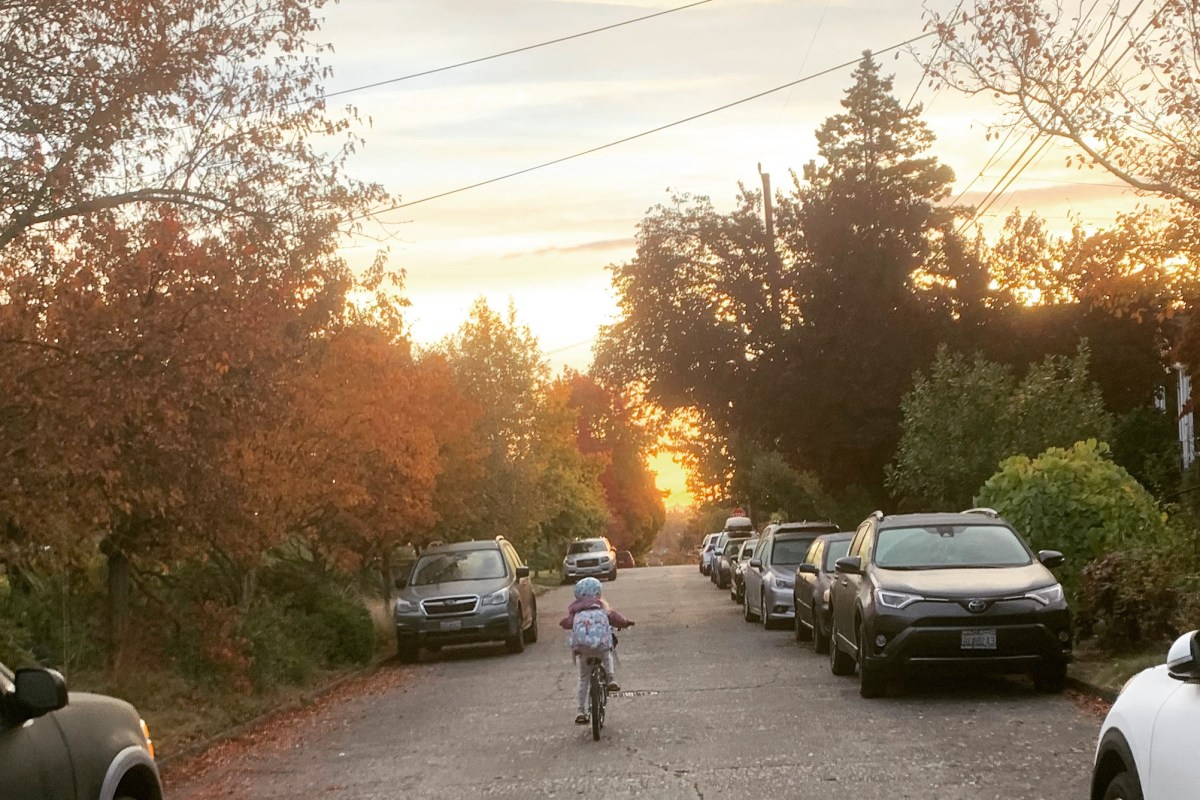
My 6-year-old daughter and her friends wanted to ride bikes to school. It felt hard to do – it was cold, difficult to get everyone ready early and took a lot of coordination with the other parents. As this was our second time doing this, my daughter felt confident enough to lead for some of the ride with me and her little brother on my bike behind her and her two friends following us. We turned a corner and all the difficulty stripped away when I took this picture. The promise of the day meeting the potential of youth.

I was so proud of them. But more importantly, they were proud of themselves.

Riding to school on a crisp October morning

Cut the BS

Life is the sum of all your choices.” – Camus

The first time I did preschool with my daughter she had just turned 2 years old and it was a co-op preschool. Parents worked in the classroom one day per week and dropped off our child the other day of the week. The teacher said to us, “Never leave without saying good-bye to your child. It doesn’t work to sneak out.”

I think that might have been the best parenting advice that I may have ever received. I took it to mean to not undermine my child’s trust in me by being sneaky. Just because you can fool a small child doesn’t mean you should. I didn’t know any better at the time but witnessing parents do the “sneak-away” approach at other moments, I’ve seen the resulting effect when it’s happened. The child seems both dismayed that they can’t find the parent as well as beyond consolable because they want the parent for comfort.

I want to claim that I knew sneakiness doesn’t work in life before I was a parent but that would also be BS. I was not attuned to the feeling of tension that signals a choice of not facing or facing the emotions of someone who will be unhappy by what I chose to do. I have ducked out of many parties with a white lie about why I couldn’t come instead of telling the host the truth that I didn’t feel like coming. I shudder to think about the time I canceled going to see U2 with a friend and his son because I had a colossally bad day at work.

But what I’ve learned from parenting isn’t about lying per se – because I don’t tell my kids the truth about many things like Santa and the Easter Bunny and whether or not I’ve ever had sex. It’s more specific to not telling the truth in order to avoid emotions. Like saying we are out of cookies instead of being the bad guy who says “no” because they’ve had too much sugar.

Instead of amplifying feelings by adding the horror of being tricked, this advice has taught me to lean into the discomfort of the initial disappointment. It also honors the emotional intelligence of anyone that I might mislead who can often sense they are being tricked, even at a very young age, even if they don’t know exactly how.

I’m leaving. I will miss you and can’t wait to scoop you up when I return. There is nothing like the sweetness of reunion and it is not possible until we recognize the truth of being apart.

(photo by Pexels)

Effective Redirection

It never hurts to see the good in someone. They often act better because of it.” – Nelson Mandela

The other day I quietly came into my still dark room and to put my toothbrush away before waking my daughter for school. She had migrated into my bed in the middle of the night as she often does so I brushed my teeth in a different bathroom so as not to wake her prematurely.

After setting my toothbrush down, I went to kiss her on the cheek. As soon as I did, she barked out “You are ignoring me and you’re late!” And I was taken aback that the quiet had turned to this and started to retort, “Now wait a minute, you are in my room and I’m just trying to get to my bathroom…”

It made me think of a dog-training article I read the other day. One of the tips was that when telling a dog not to do something, it’s too vague for the dog because in essence we are saying “don’t chew my shoe” but then then dog has to both process that and also think of what it should be doing. The article, and I can’t think of where I read it or why I read since I don’t presently have a dog, suggested instead to tell the dog what to do. That in essence solves both problems – getting the dog to stop chewing the shoe and redirecting it to a new behavior – in one command.

This seems to be the work of relationships as well. I don’t think it’s just me that often responds that I don’t like what someone has said or done without ever saying what I’d prefer to happen. In fact, I often just hope the other person can intuit that! Because thinking and naming what I want comes from a different place than a retort, an intentional place that takes some work to access. It’s a subtle shift from defense to bridge-making.

When my sister-in-law nannied for me she was great at saying to my kids, “A better way to say that is…” and it worked great at helping them know how to express their feelings but in a way that is more likely to be heard. My sister-in-law both was telling my kids what not to do and redirecting the behavior but in one efficient suggestion.

My 6-year-old daughter is so verbally adept so it’s really easy to forget that communication is still incredibly new to her. It may not be obvious how to express irritation and ask for what she needs. And more than that, it requires her to practice accessing her intentional space as well.

Even though I’m an old dog (or middle-aged one), I’m trainable too. So I stopped my retort and started again. “Hey darling girl, a better way to say it might be, ‘Morning, Mom. I’m frustrated you are taking so long because I’m dying to have your attention.’ ”

(photo by Pexels)

The Most Influential Person in the Room

You can’t depend on your eyes when your imagination is out of focus.” – Mark Twain

When we drive to school, my son often says “go this way” as I back out and points to the direction opposite the way we need to go. The other day we had a couple of extra minutes so I humored him and went the way he wanted down our block – then I turned, turned and turned and we were back on our way. That little change to give him some control made him so much happier.

This little exercise reminded me of all the choices we make and as we do, how they help us narrate our own story. I also brought to mind the quote from humorist Kevin Kling “we need to rewrite our story sometimes just so we can get some sleep” that I talked about in the post I wrote for Aspiring Blog about the power of telling our own stories. I’m reblogging it here because I think there is so much goodness in remembering the power of our own stories:

I was listening to an On Being podcast where Krista Tippett was interviewing American humorist and storyteller Kevin Kling. He was born with a disabled arm and then in mid-life was in a motorcycle accident that paralyzed his other arm.

He was talking about the PTSD that came with his accident. With it came anger and inability to sleep and when it resurfaced with a vengeance years after the accident he was talking to his therapist about it.

She said that he needed to retell the story with a different ending – tell the story as if he didn’t hit the car and he reached his destination. He did that and it worked! He was able to sleep again. His takeaway was: “We need to rewrite our story sometimes just so we can get some sleep.”

That line caught me by the throat and hasn’t let go. Because it means that our bodies believe our own storytelling. It means that while I think a storyteller is someone like Kevin Kling, it is actually my own storytelling that matters most.

It means that the most influential person in my life isn’t my boss, my loved ones, a beloved actor or author, or even Oprah Winfrey – it’s me.

So I’ve pondered the stories I tell myself. The two most cataclysmic things that have happened in the past ten years of my life are when someone told me of the infidelities of my husband I’d been married to for eight years and the marriage fell apart.

Then once I was divorced, I choose to have kids on my own as a single parent. Someone said to me when my firstborn was about 6 months old, “I wish that he [my ex-husband] hadn’t wasted so much of your time.” And I replied something like, “It’s okay, that marriage and its downfall got me to meditation and where I needed to be.”

I rewrote the story of heartbreak and loss as the impetus to put me on my current path with these two beautiful children I love dearly. I believe that the Divine has used all of the past to get me where I needed to be which I genuinely believe to be true. But it is also a story that helps me be very happy where I am instead of mourning what I’ve lost.

In talking about the story he’s rewritten so that he can sleep, Kevin Kling said that of course he wakes up every morning and has to contend with the fact that his arms don’t work as a result of the fact that the accident did really happen.

Stories can’t change the circumstances of our lives, but they do change how we relate to those circumstances. Knowing this I’m carefully checking my current inventory of stories to make sure I’m telling myself the right ones!

Renewal

We are like someone in a very dark night over whom lightening flashes again and again.” – Maimonides

By the end of last week, I was feeling burnt out. My daughter stayed home from school for a couple of days, I was trying to start a new project with a new client and that’s scenario that causes me the most stress — when I try to parent and work at the same time. I end up feeling like a failure at both. Then I got the news that my favorite teacher from my son’s class is leaving, it added disappointment and worry to my heap. By Friday night, I was feeling disoriented – as if I was driving a dark road without the lights on.

So I took some advice about renewal that I’d recently heard a couple of places – maybe a podcast and the blogosphere and intentionally watched a movie after the kids went to bed instead of flipping through channels or surfing social media. It took me two nights to watch A Dog’s Purpose but I cried, I cheered and at the end, definitely felt better.

In two hours, it reminded me of perspective and faith. It all works out in the end. There is a beautiful design to this life. Once time and the Universe connect the threads, you can see how they all come together for good. I have come to know this in my bones and my Budheo-Christian beliefs (my made up combo name) have given my many examples.

And I’ve watched it work with my mom, especially after the death of her husband of 53 years. When my dad died suddenly in a bike accident, my mom has relied again on again on the verse from Romans 8:28. “And we know that in all things God works for the good of those who love him, who have been called according to his purpose.” She is an extraordinarily strong, independent, smart woman – but I’ve seen how she goes back and reconnects to that belief to renew her charge to be useful, kind and good.

I get disoriented and disconnected from time to time, I think we all do. What I’ve learned is that it’s a reminder to reconnect to my faith and beliefs and the faster I do it, the less I blunder about without the lights on. Whether it is just sitting still and meditating, watching a movie or hiking to the top of something, when I find the way to renewal, I’m always heartened by the experience. It strengthens my faith that I can find my way back to the Source. Once again, it all comes together, I see how the dots connect or relax into knowing that one day I will.

(photo from Pexels)

Checking for Help

If you were waiting for a sign, this is it.” – unknown

Last week I was stressed because my biggest client was 35 days late in paying their invoice for July. I’ve been self-employed for 20 years so it’s not the first time I’ve had a situation like this. I’ve learned on my side, I need to make sure it isn’t an indication of a problem with my relationship with the client and work. If everything is okay and it’s just a payment issue on their side, I’m pretty good at weathering the storm and not worrying about it too much.

So I was fine for the first 2 weeks the payment was late.

But by the 3rd week it was late, I’d started to check the mailbox a few times a day and when on one of those days, an envelope came from my health insurance provider, I ignored it and set it unopened on my desk.

When the 4th week started, I was spending a lot of meditation time both trying to acknowledge and dissipate the stress and praying to the Universe to end the wait.

By the 5th week, I was in a low-grade panic – I’d managed to pay all my commitments but I was down to $14 in my checking account.

Finally the payment came. It was only AFTER it came that I opened the envelope from the health insurance company and found that they’d sent me an unexpected rebate. I’d had a check sitting on my desk for TWO weeks while I sweated out the payment from my client.

It reminds me of the story about a man who gets caught in a flood and is stuck inside his house. He prays for God to save him and while he’s praying, the phone rings. It’s the fire department asking if he needs to be rescued. He answers, “No, I’m sure God is coming to save me.” A little while later after the flood waters have risen even more so he’s hanging out his 2nd story window, some neighbors come by in a boat and ask if he needs help. He replies, “No, I’m sure God is coming to save me.” Finally the flood water is so high that he’s up on his roof and a helicopter comes by and offers to evacuate him. He yells, “No, I’m sure God is coming to save me.”

After he drowns and goes to Heaven, he asks God, “Why didn’t you save me?” And God replies, “I called you, I sent a boat for you and flew in a helicopter to get you but you wouldn’t come.”

The whole experience makes me wonder if life is simply a process of removing our self-imposed blinders. Note to self: when asking for help, be open to any package it might come in, not just the one I expect.

(Photo from Pexels)

Comparative Suffering

Comparison is the thief of joy.” – Theodore Roosevelt

I’m old for a parent of a 2-year-old and a 6-year old. I had my son when I was 50 years old. Most of my long-time friends have kids in college which is great when I need babysitters. So part of my parenting journey has been to make new friends with people that have young children and have met many delightful ones.

But the other parents don’t complain to me. That isn’t to say that they don’t like me or include me, it’s just that generally they refrain from sharing their parenting woes. Every once in a while I’ll get a hint of why they don’t when a mom friend will say to me, “My husband was out of town for this week and wow, it’s so hard to get two kids to bed!” And they will often then add, “But I shouldn’t complain about that because you have to do it all the time.”

While I reassure them that it is totally fine to say that to me, I completely understand. More than that, I don’t feel bad that I do it by myself because I chose to. In fact, I often think about what would have happened if I’d had children when I was married and shake my head in relief that it’s only two kids that I have to get ready in the morning and not three if I was still married to my ex. 😊

But I finally have a term for why parents don’t complain to me because of a great Brené Brown Unlocking Us podcast episode with Esther Perel that I heard this week. Comparative suffering. When we start to complain about something and then cut ourselves off because others have it so much worse. I was recently talking with my friend Mindy about my dad’s death when I was 45-years-old and then stopped because her mom died when Mindy was only 23-years-old. I felt insensitive because I’d been able to have him in my life so much longer.

But I heard a heart-changing quote from Brené Brown on that podcast: “I had very little empathy for other people because I wasn’t open to my own pain.” When we stop to acknowledge that something hurts, sucks, is difficult — without comparing it to anyone else’s journey — we land ourselves back in reality. And from there, we can reach other people.

I frequently use “Comparison is the thief of joy” with my 6-year-old when she resorts to comparison with her friends. But now that I heard that wisdom I’m thinking of expanding it to “comparison is the thief of relationship.” We don’t have to compare any of our experience – good or bad. And when we do, we just have to acknowledge our own experience and theirs, and then continue to be real because that’s the glue of friendships, old and new.

(photo from Pexels)