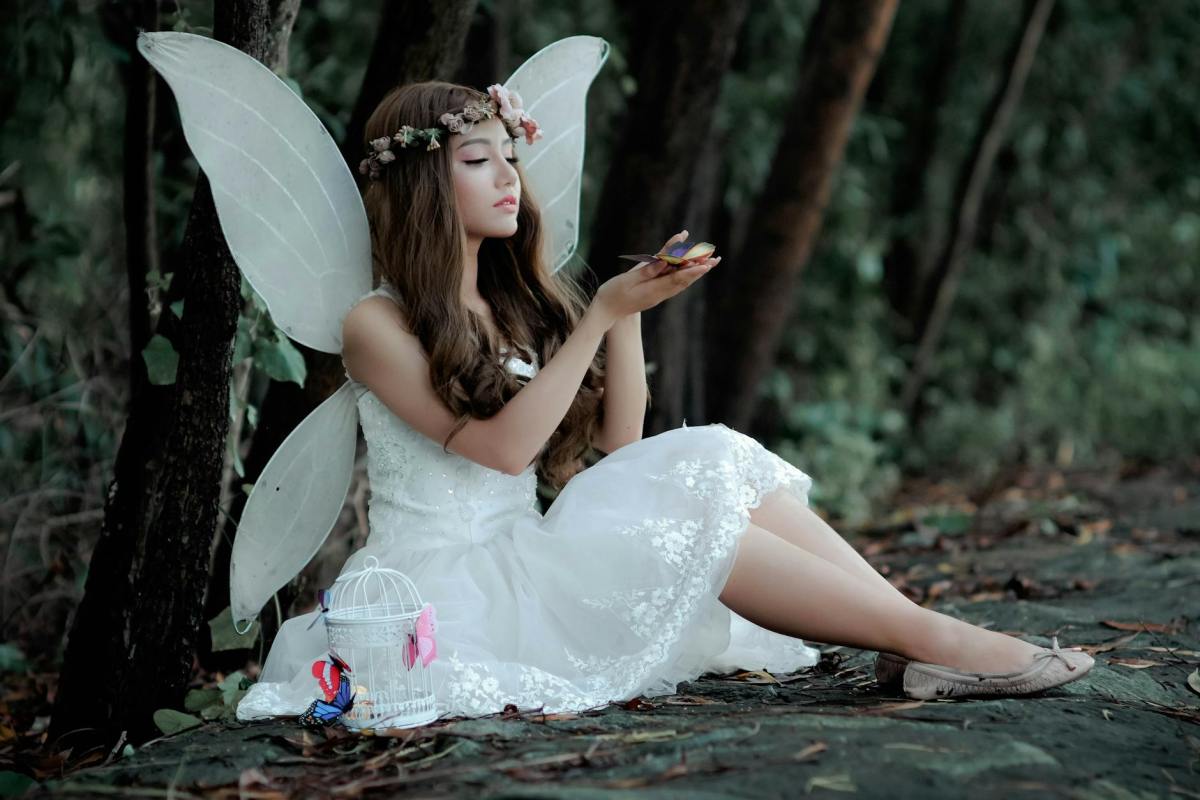
“If we could see the world through the eyes of a child, we would see the magic in everything.” – Nancy Wait
I had to have the conversation with my eight-year-old daughter the other day. You know the one I mean? About Santa?
We were driving in the car and I broached the subject as “Do you want to talk about what your friend said the other day about Santa?”
Two days before I’d overheard her friend tell her that Santa wasn’t real. Then the friend took on the tooth fairy too when my daughter had asked, “Do you know your tooth fairy’s name?”
Her friend, a master of short, declarative sentences, replied with a snort, “Yeah, Mom and Dad.”
All of this led to my tentative query in the car. Quite honestly, I was feeling pretty shaky about it. It felt like blurting out something that we can never “unknow” even if we wish to. So, I’d come up with a spin that I got from a dubious parenting manual (and by that, I mean the Internet). I was going to talk about how we can all be part of the magic of the holiday season.
I find it difficult bordering on tortuous to write about and talk about magic. I think of some of my favorite South American authors like Gabriel Garcia Marquez and Juan Luis Borges, and their easy touch with things that can’t be explained.
Then I wonder if some American pragmatism blocks my flow when it comes to breaking away from the observable. Or perhaps it’s my engineering brain. But either way when I start trying to put words to experiences that can’t be rationally explained, I get very wordy. It’s like I need to insist that I really am anchored to reality and a lot of words are my lifeline.
So, when my daughter said she did want to talk about Santa, I started to roll out a lengthy explanation.
“Well, you know that everyone has different beliefs and whether or not you believe in Santa, there’s a magic around Christmas time that comes from the spirit of generosity.”
She nodded and said, “Yes, no one really knows what Santa looks like, so we all see it differently.”
I pressed on, not realizing that she was still pretty attached to the Santa thing.
Before I could launch into more, she interjected, “Why don’t people want to believe in magic?”
Hmm, in my preparation for the talk, I hadn’t prepared a good answer to that one, so I asked about if she’d heard what her friend said about the tooth fairy.
“Yes,” she said, “he said his Mom and Dad were the tooth fairy.” As I started to respond, my daughter continued, explaining something the tooth fairy had just done…”but my mom wouldn’t give [my brother] a two-dollar bill for nothing.”
I stopped. I was magically saved from having a conversation that I wasn’t ready for anyway.
2024 Note: Miss O is now 9-years-old but still believes…
(featured photo from Pexels)


Magic is a beautiful thing. It’s all around us in all those things that we don’t understand. The shape of a flower’s petal is like magic. How can we explain the precision by which it grows. Mathematics may explain some things. Think Fibonacci’s Sequence. We theorize and deduce through observation. Yet we don’t fully know. We just feel it. That’s beautiful magic. If we can’t explain something, we call it magic. I think you fortified Miss O’s belief in magic. And she believes. So good!
LikeLiked by 4 people
I love how you call it out in all things we don’t understand. So good! This comment is beautiful magic – I feel it! Thanks, Alegria!
LikeLiked by 2 people
I love the magic in the world and love to write and talk about it. I always talked about the fairies and made fairy houses with my classes and grandchildren. one little guy who I had for two years in my class, told me each year, ‘ms. Kennedy, fairies aren’t real, they aren’t science.’ I told him that it’s okay for each of us to believe what we want, and the second year, he said. ‘ms. Kennedy, I have to tell you, fairies still aren’t real, and they’re still not science.’ I gave my same answer and we both decided to let people believe what they want to believe.
LikeLiked by 2 people
That’s a great story about your little student. Funny he should say that so young. But agree to disagree is a good solution. Because I’m with you – it’s fun!
LikeLiked by 1 person
Excellent, Wynne. After outliving a dozen-plus presidents, I’m still prone to shout, “Don’t confuse me with facts!” Beliefs serve as my foundation for a world of wonder.
LikeLiked by 2 people
Oh, that’s so good, Grant!! A world of wonder — I love it!
LikeLiked by 1 person
This is what I love the most about children and childhood. The pure innocent belief in magic and see the world and life through wonder. It’s such a shame that life wears this out of us and you want to hold onto the magic as long as possible.
I remember this post and I’m so heartened to see Miss O still believes, as does T. It’s a quality of resilience, I think. 🙏
LikeLiked by 2 people
“It’s such a shame that life wears this out of us” – yes, yes, yes!! Love hearing that T believes too! A quality of resilience – I like it!
LikeLiked by 1 person
I am left with the same troubled thoughts I had when my oldest daughter asked me the same question. Perhaps more troubled because beliefs based on “fake news” leaves our democracy hanging by a thread.
I am not here to judge, and I have treated wonderful people whose faith both gave them solace and enhanced their kindness and the love of their neighbor, all based on beliefs seen as questionable by others who see no evidence of an all-loving God. But is it really acceptable for people to believe thoughts that corrode their treatment of their fellow women and men?
LikeLiked by 2 people
I think how people act is something we can hold them accountable for. Whether it’s fueled by feelings, beliefs or group think becomes a separate matter, doesn’t it?
LikeLike
First, when my oldest daughter asked the Santa Claus question, I answered it directly because I thought other children would likely, and shortly, make a fool of her if she didn’t know the truth. She broke into tears and this still bothers me. Perhaps her own fantasy could have saved me and her in this with a momentary distraction, or perhaps she would eventually indict me for not telling her what I knew to be true.
As I say, Wynne, I don’t have the right answer if there is a right answer. I am for the joy of children and would agree that the joy is in no small part due to their innocence, but also question what we do to children when, as in some places of worship and some homes, they are told that something terrible will happen to them if they don’t follow the program. Hell. James Joyce, in “The Portrait of the Artist as a Young man” describes what he experienced, or his protagonist, in his early days, while in church. The kids were terrified into believing.
In saying this, I’m not doubting that some places of worship and some religions some of the time have found a way to foster wonderful and kind people. But what of those that now tell their youth and the adult parishoners that God has chosen one candidate and that there will be hell to pay if they don’t “faithfully” rally behind him.
If we tell children that “magic” exists beyond a certain point, say, as opposed to or in addition to beauty, or if we encourage them to believe in things that, in or out of a place of worship, require faith (an analogue of the belief in the Tooth Fairy or Santa) are we creating an opening forbelieving in fake news as time passes? Do their neural pathways, more or less, freeze up early on?
As I said in my previous comment, I have no certain answer to this and try not to judge others on a number of points related to the issue we are discussing. I would add, that it is clear that actions often follow from beliefs, and as we both know, we see rationality and science being criticized among people who “believe” that they are right to do so.
In some situations, inaction also plays a part in the behavioral excesses we witness. History tells this story. JFK and Adlai Stevenson II both quoted a phrase that went something like, “The worst places in hell are reserved for those who, in times or moral crisis, choose to remain neutral.” Inaction is the functional equivalent of siding with those who go over the line behaviorally.
I am left with the troubled thoughts I mentioned earlier. Thanks for indulging me, Wynne.
LikeLiked by 1 person
Troubling thoughts indeed, Dr. Stein. Thanks for sharing.
LikeLiked by 1 person
We could all take a page from Miss O’s book when it comes to believing in goodness.
LikeLiked by 2 people
Right! We all need to believe in goodness – at least a little bit!
LikeLiked by 1 person
LMBO Wynne! 🤣🎅🏼😂 Your kids are too comical. BUT, the Tooth Fairy left $2.00? 🦷💲🧚🏼♀️ I guess that’s a cost of living raise huh??? A quarter under my pillow, when I was little, was like $100! Looks like Miss O had this! 😜
LikeLiked by 2 people
Oh Honey, there’s a tooth fairy tracker on Dental Dental. In my area, the average is $5.84. 😁😁😁
LikeLiked by 1 person
WHAT??? 😲 For a tooth? 🦷 I am so behind the times girlfriend! 😝
LikeLike
Darned kids always come up with arguments that we haven’t thought of. Ha ha. At least it worked that way with my kids. Yes, yes, here’s to magical thinking. There’s magic all around us. Some would just rather not look.
LikeLiked by 2 people
Good point about some would rather not look. Here’s to magical thinking. ❤️❤️❤️
LikeLiked by 1 person
Beautiful … we all need to take time to appreciate the magic in our lives. I hope Miss O never stops believing
LikeLiked by 1 person
Thank you, Brenda! You’re right – we all need to take time to appreciate the magic in our lives. Great to see you! ❤
LikeLiked by 1 person
I loved how you phrased this as I seem to struggle from a similar issue: “when I start trying to put words to experiences that can’t be rationally explained, I get very wordy. It’s like I need to insist that I really am anchored to reality and a lot of words are my lifeline.” I do believe in magic and miracles and immense goodness we can’t describe with our limited thoughts. Yet I love to stroll through words trying to come as close as I can to bringing magic to concrete form.
LikeLiked by 2 people
Oh, oh, oh, I love your sentence, ” Yet I love to stroll through words trying to come as close as I can to bringing magic to concrete form.” Yes! Beautiful, Rose!
LikeLiked by 1 person
We should all believe in magic. Christmas is never quite the same after kids stop believing. I think my girls made it to 12 before they stopped believing.
LikeLiked by 2 people
“We should all believe in magic.” Yes! Love that your girls kept Santa alive for a lot of years! 🙂 ❤
LikeLiked by 1 person
I love, love, love Miss O’s questions. Keeping the magic alive — a life goal, I’d say! 🥰
LikeLiked by 2 people
A life goal for sure!! Thanks, my dear friend! ❤ ❤ ❤
LikeLiked by 1 person
oh i always found these hard convos to have and I loved how you dealt with the magic of it all. This made me laugh, Wynne “So, I’d come up with a spin that I got from a dubious parenting manual (and by that, I mean the Internet).’
I love to perserve these times as long as we can! 💗
LikeLiked by 2 people
Now you have me giggling too. What did parents do before the Internet? 🙂 Thanks for the great comment!
LikeLike
I love Miss O’s question and the fact that she still believes. We need to nurture that goodness and innocence for as long as we can.
LikeLiked by 2 people
Goodness and innocent — exactly right, Edward! Yes!
LikeLiked by 1 person
That’s an eye-opening question from Miss O! Indeed, why don’t people want to believe in magic? I don’t have a solid answer. Because I still believe in magic. Also, I enjoyed your mention of Jorge Luis Borges, as I admire his works. A writer who dives into mazes, endless libraries, and mysteries. 🌝
LikeLiked by 2 people
I love how you do magic, Dave! You are a master about writing about it (I say as I think of heads in jars). Brilliant!
LikeLiked by 1 person
You’re very kind, Wynne! I appreciate that, along with the nod to that creepy part of my book 🌝
LikeLike
The Santa conversation is so hard. As we age our imaginations deem, sadly!
LikeLiked by 2 people
Sadly for sure! You are so right, Belladonna!
LikeLiked by 1 person
I love that she still believes! Because once they stop, there’s a certain innocence that is lost forever.
LikeLiked by 2 people
Well said, Mark. Trying to keep that innocence alive!
LikeLiked by 1 person
What a great story, Wynne, and I’m glad the magic is still alive! This line resonated: “It felt like blurting out something that we can never “unknow” even if we wish to.” I remember dreading this conversation decades ago. 🥰
LikeLiked by 2 people
Oh yes – the unknowing! Thanks for the great comment, Lauren!
LikeLiked by 2 people
It’s quite weird. I don’t believe in it. But I have wishes so much something pretty like this exists. Magic is the solution of disappointment, like Cendrillon told us. And then, I want to believe. Magic is a power and so on. I would love to practice it etc. But, impossible. That’s quite saying I abandoned the idea years ago. I didn’t meant to let it there, at whatever years old.
LikeLike