The Way of Unifying Energy

But where was I to start? The world is so vast, I shall start with the country I know best, my own. But my country is so very large. I had better start with my town. But my town too, is large. I had best start with my street. No: my home. No: my family. Never mind, I shall start with myself.” – Elie Wiesel

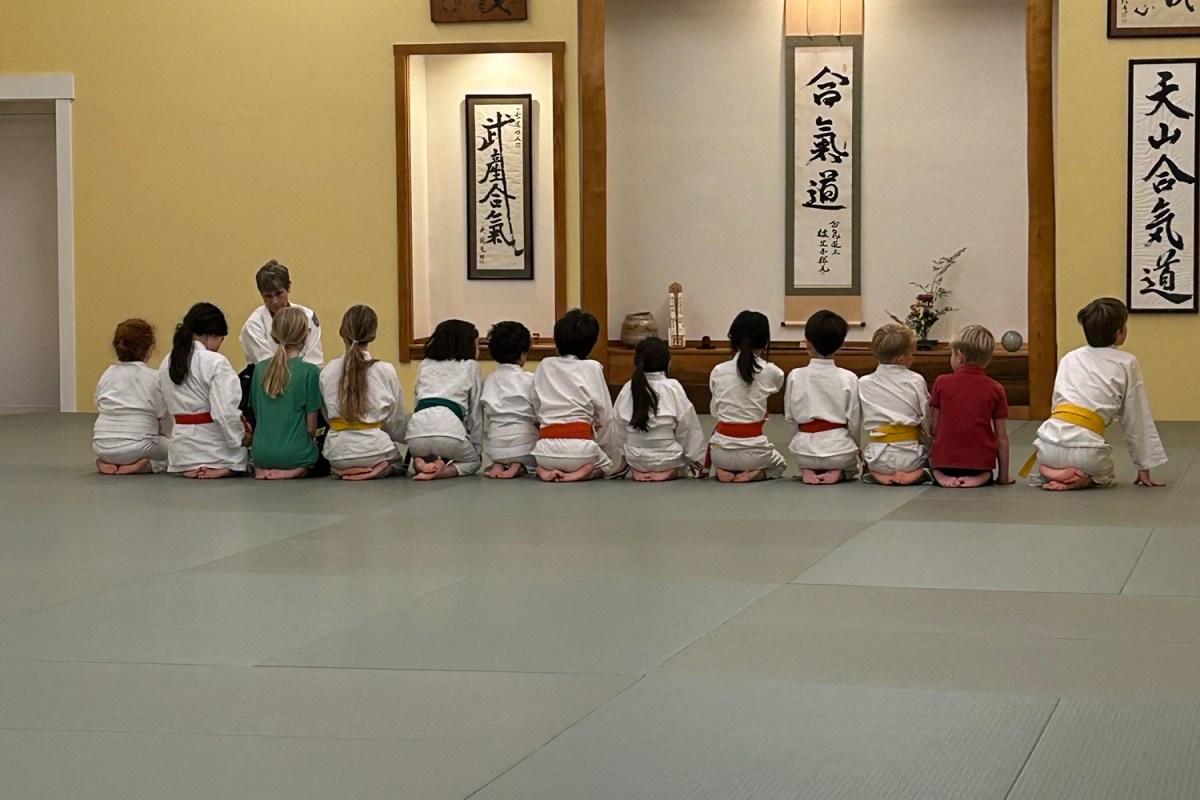
Our Aikido dojo recently had open house day. We recruited my brother, sister-in-law, and a dear young friend and all headed off to give it a try.

Let me tell you. It’s a lot easier to watch kids get up and down from the mat 30 times (or more) in an hour than to do it. Yeah, that’s not news to anyone reading this.

But I was captivated by the philosophy behind this martial art. It’s a way of redirecting energy. Or, as Wikipedia puts it, defending oneself while protecting the attacker from injury.

Aikido, the way of unifying energy, is a way of helping attackers calm down according to our Sensei. Watching my kids practice, I can see how the moves are intended to help the energy move past. It isn’t meeting a blow with a blow but instead stepping out of the way and using the attacker’s energy to pin them.

It seems like there are so many practical ways to employ this. It’s like not resisting our emotions, but instead leaning in to see what we can learn. It’s not telling others that they shouldn’t upset, but instead actively listening to understand the experience. It’s not fighting fire-with-fire but instead poking a hole in the roof so that the dangerous smoke can dissipate.

I imagine all the ways practicing Aikido, the way of unifying energy, the way of defending oneself while protecting the attacker from injury, could make a difference in this world. Our national politics come to mind. But I’m only a white belt so I’ll start by practicing on myself. That’s a head up to my inner critic.

(featured photo is one of mine of our dojo)

The Learning Curve

It always seems impossible until it’s done.” – Nelson Mandela

We worked hard on potty training this weekend. I found it to be a fascinating window into the nature of learning. And that’s not just me putting a positive spin on it.

Day 1: Chaos. The first morning was hit and miss (or more miss than hit). By naptime we were both exhausted. My son because of the huge change that comes learning how to use his body and me because infinite patience takes a lot of energy! So the first lesson came after we’d both napped. Rest helped consolidate the learning so that he was a better student and I was a better coach.

Then after an afternoon and evening of more efforts and celebrations, my son was never happier to have the feel of a nighttime diaper, jammies and to snuggle up and read books. And it underscored for me the need to have comforting rituals to soothe ourselves when in the midst of big change.

Day 2 was characterized by a lot of resistance and efforts to control everything else around. It reminded me of a Brené Brown podcast I heard years ago that whenever she has led or attended a three-day conference, day 2 was always marked by the doldrums. Brené likened it to the middle part of the hero’s journey as described by Joseph Campbell. The hero does everything in their power to pursue all options except for the one that they are called to that leaves them feeling vulnerable.

Day 3: We needed expert help. Which is uncomfortable for me not have it dialed but the amazing teachers at my son’s daycare have said repeatedly that they are more than willing and able to help with this journey. For which I am so thankful. I left him on Monday with a “Good luck” and “God bless you” and I couldn’t have meant both more!

This learning curve at times has felt impossible, exhausting, vulnerable, and not worth it. Somehow it reminds me of learning to snowboard – and also mastering a new technology, figuring out to give my dog allergy shots, starting to blog, and learning how to do mosaic tiling.

Each new venture has roughly followed the same pattern of chaos, resistance and then leaning in and asking for assistance if needed. And it’s not just me. I have a dear friend who didn’t learn how to swim until she was 60 years old. And my 82-year-old mom has been figuring out how to do piano performances online for her retirement community.

Watching my son, I am reminded how hard learning something new is – until it isn’t. And while grown-ups might not be taking on changes as transformative as potty training, we still need to give ourselves the rest and rituals to support our learning, grace to survive the resistance and the courage to lean in to expert help when we need it.

Because as Nelson Mandela says, “It always seems impossible until it’s done.”

(featured photo from Pexels)

In Feeling

The problem with this world is that we draw our family circle too small.” – Mother Teresa

Here’s the way sickness travels in my family. One kid gets sick, the other one gets it and then finally I get sick. Fortunately, I don’t always get sick but if I do, I’ll be last to get it. And when I do, I learn how brave my kids have been.

This time it was my daughter who got a stomach bug first last weekend. She spit up a few times and then said, “Wow, I’ve never thrown up 4 times in a day before. When are we going to go hiking?” I replied that I thought she might want to rest given that she didn’t feel well. She exclaimed she felt fine so we went.

Then my son got it mid-week. It was very clear because I opened his door to get him out of his crib in the morning, and instantly got hit with the smell. “I sneezed it out!” he exclaimed, not all that upset. He stayed home from school but he too said he felt “good” and was pretty peppy playing around all day.

I thought I’d avoided getting it too until this weekend when my body, probably exhausted from all the cleaning, just gave up and succumbed. I wondered how the heck my kids were so delightful when their bodies were fighting this bug. It always looks easier when someone else is doing it, doesn’t it? As usually happens with getting sick, it comes with a huge heap of humility and admiration too.

This made me think of the words sympathy and empathy. Sympathy from the Greek of sun (with) + pathos (feeling). Oxford languages defines sympathy understanding between people, common feeling.  

Empathy, a word I hear so often these days in conjunction with raising emotionally intelligent kids, is from the Greek of em (in) + pathos (feeling). It is defined by Oxford languages as the ability to understand the feelings of another.

In my little family we have so many opportunities to have sympathy for each other because we share so much context at this stage – the people we know, the many hours we spend all together, the illnesses we pass along. It may be the easiest time for us to all stand in common feeling. And if we get that right, at least some of the time, it helps us become more empathetic toward others because we have the family experience of feeling understood.

The other thing I was reminded of as the illness ran its course is how much energy I spend resisting being sick. I didn’t want to throw up and I managed not to. But in hindsight, it may have made it last longer overall. Sometimes we just have to let the bad out so that the healing can begin, a lesson I keep having to repeat.

It’s funny as I type this thinking of my gratitude towards this stomach bug. It created a shared family experience, reminded me that resistance to uncomfortable things is often a harder route to go and most of all, makes me so thankful that we all feel well again. If only there was a virus that could unite our bigger human family….

(featured image photo from Pexels)