Figuring Out Feelings

These pains you feel are messengers. Listen to them.” – Rumi

There’s nothing like watching a kid trying to figure out what they’re feeling to remind me how hard it is to name what’s wrong.

We traveled this weekend to San Francisco for a family party. Tons of fun! Also lots of people to coordinate with. I’m sure I don’t need to tell you how traveling can decrease the easy access to food, increase how far we need to walk, and obliterate the routine. All in the name of doing fantastic things, of course, but a little disorienting nonetheless.

At one point on Friday afternoon, we walked to the Lucas Films office building to see the Star Wars memorabilia on display. They had the R2D2 in the lobby as well as the original Darth Vader costume. And tucked in glass shelving, they had Han Solo’s light saber and some other guns from the movie.

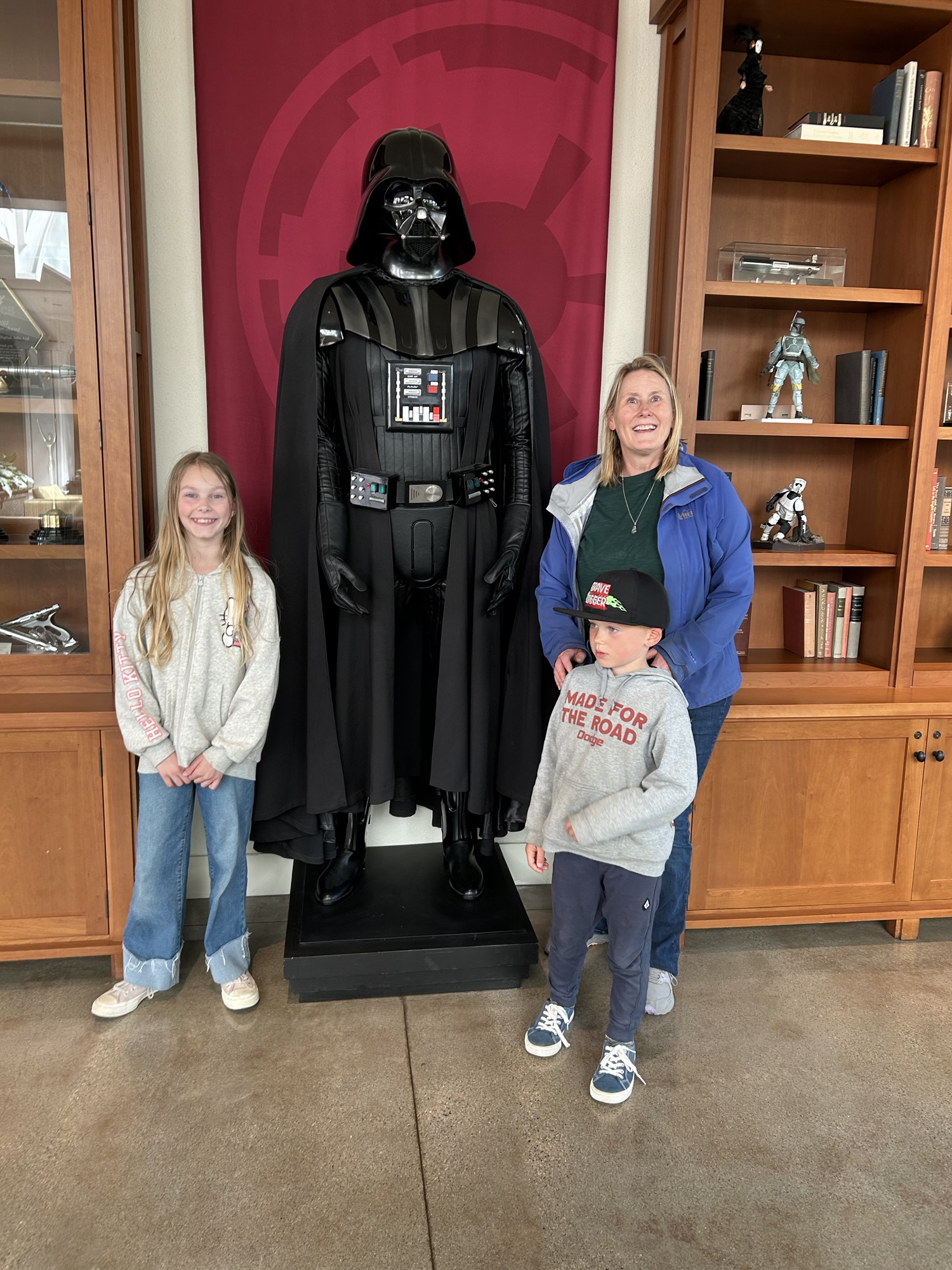
Yeah, you don’t even need to be a huge Star Wars buff to think that was cool!

We walked out of there and my son was upset. He wasn’t crying or saying anything but he parked himself on a wall a half dozen steps from the door and wouldn’t move. When I finally got him to talk, he said, “It’s not fair that they get to have those guns when I want one.”

Hmm… I didn’t think that was the root of it. Granted I’m not a five-year-old boy, but the guns didn’t seem amazing enough to spark a protest.

After some minutes of silent protest with his sister and me at his side and our family patiently waiting about 50 feet away, he finally could be persuaded to walk around the corner to a Starbucks. At least that was a little slice of familiar territory.

Even so, it probably was another ten minutes before he ate and drank enough to come back to himself. He still wanted a Star Wars original light saber but he could move on.

It made me wonder how many times I’ve hit the wall, mistaken the source of my depletion, and tried to climb the wrong tree to get over it. More times than there are Star Wars movies, for sure!

Being human is hard. Borrowing social psychologist Jonathan Haidt’s metaphor for the body (elephant) and the mind (rider) — the elephant stops moving and the rider, thinking it’s in charge, finds the best story why, but not necessarily the most accurate. And then we can find ourselves wanting to shoot our way into the Lucas Films lobby to steal priceless memorabilia when all we really need is a snack.

May the Force (of stopping long enough to get to the bottom of our angst) be with you.

(featured photo is mine)

You can find me on LinkedIn: https://www.linkedin.com/in/wynneleon/ and Instagram @wynneleon

I host the How to Share podcast, a podcast about how to share anything – to the appropriate audience, with the right permissions, at the most opportune time.

I also co-host the Sharing the Heart of the Matter podcast, an author, creator and storytelling podcast with the amazing Vicki Atkinson.
Useful at Any Age

A lifetime is so precious, and so brief, and can be used so beautifully.” – Pema Chödrön

A while back, Miss O asked me if teenagers wanted to be little kids. When I said I didn’t believe so, she explained the question – if she, at age seven, wants to be a teenager, and her aunt in her 50’s wants to be younger, then what age do teenagers want to be?

I recently learned from Jennifer Senior, a staff writer at The Atlantic, that it is fairly common, especially in people over 40-years-old, to think of themselves as an age different than their years. This concept has the name “subjective age.” In her piece, The Puzzling Gap Between How Old You Are and How Old You Think You Are, she explains that, “Adults over 40 perceive themselves to be, on average, about 20 percent younger than their actual age.” People under 25 tend to think of themselves as older.

The article is delightfully filled with data, anecdotes, and links to research, as one would expect from The Atlantic and Jennifer Senior. A few things stood out to me:

David C. Rubin, a psychology and neuroscience professor at Duke, has found “the adults have an outsize number of memories from the ages of about 15 to 25. They call this phenomenon ‘the reminiscence bump.’ (This is generally used to explain why we’re so responsive to the music of our adolescence)”

Also, the gap of perceived age is greater in Western cultures than in Asia or Africa, or places where elders are more respected.

And one of Jennifer Senior’s conclusions about this mental trick really stuck with me, “If you mentally view yourself as younger—if you believe you have a few pivots left—you still see yourself as useful; if you believe that aging itself is valuable, an added good, then you also see yourself as useful.

The three ways of seeing our subjective age: wanting to be older like Miss O does, seeing ourselves as younger than our actual years, or liking the age we’re at because we’re seen as respected and valuable, share the common ground of wanting to have agency and feel generative. It reminds me of my dad whose motto of service to others was “I just want to be useful.

May we all feel useful, at whatever age we believe ourselves to be.

For a related post, about the perspective gained when I met someone that reminded me of who I was 15 years ago, check out my Heart of the Matter post: Better Off Without

(featured photo from Pexels)

The Way I See It

Be sure to taste your words before you spit them out.” – unknown

I’m fascinated by the different ways our brains work. Most recently, I’ve had the chance to watch my kids as they approach the world with their “lantern awareness.” That’s a phrase from Dr. Alison Gopnik, the cognitive psychologist from UC Berkley, who talks about young brains being rewarded for what teaches them the most so they see the world as if they are holding a lantern high and they see everything in their vicinity. Whereas our adult brains have spotlight awareness, which most of the time is like tunnel vision towards our objectives.

In addition to that, it’s things like my friend, Doug, who can remember every route we’ve ever climbed in like a 360 degree view. “Remember that tree when we turn to head up the ridge?” he ‘ll ask. And I shake my head no.

Or my brother who has such great spacial awareness that to work with him to assemble the 300 bars of a jungle gym into a dome is a marvel.

When I was young, I used to memorize license plates which earned me the nickname Rain Man (do you remember that movie?). Fortunately my brain has given that up and now it hangs memories onto my favorite words. So when I hear the word luminous, it reminds me of Julia Preston because of her ability to bring light.

These word associations are the topic of my Wise & Shine post: My Love Affair with Words.

(featured photo from Pexels)

Wind Beneath My Wings

There are two types of tired. One that requires rest and one that requires peace.” – unknown

On this past Friday morning it was clear that Mr. D had caught a bug. But his 3-year-old brain hadn’t quite registered that he wasn’t feeling well yet and had big plans to go outside without a coat on to collect rocks and leaves to paint.

Fortunately I had just listened to a great Ten Percent Happier podcast that featured Lisa Feldman Barrett, a professor of psychology at Northeastern University with appointments to Massachusetts General Hospital and Harvard Medical School. She was explaining that the primary function of our brain, evolutionarily speaking, is allostasis, “to predict and anticipate the needs of the body and attempt to meet those needs before they arise.” So the brain is trying to determine the salt, glucose and oxygen needs of the body and predictively distribute those resources as appropriate.

Dr. Barrett used the metaphor of body budgeting to expand on this concept. There are activities that expensive: learning new things, experiencing persistent uncertainty, exercising, and stress. And there are some things that are savings deposits: drinking water, sleeping, eating healthy foods. If I understand this metaphor correctly, the brain is trying to balance the budget and needs the deposits to outweigh the spending.

She also added that it’s not only our body that spends the budget but other people influence the system. Others can be a tax that deplete the account or they can be a sale –  they can make things cost less for those around them.

Isn’t that a great idea? And I imagine if you are like me, people spring to mind that tax you as do the ones that make life easier. Now I’m hearing Wind Beneath My Wings by Bette Middler. 

That whole image has me inspired not to be a tax, but instead a sale – to make expensive things, biologically speaking, cost less for others. We can support them as they learn, go along when they exercise and pour a glass of water when they need it most. And while we’re at it – we can do it for ourselves, as well.

Which brings me back to Mr. D wanting to go outside. I got him bundled him and we compromised that he’d ride in the stroller. We hadn’t been out for more than 15 minutes when he started really feeling tired and crummy. For the rest of the afternoon, he alternated napping and snuggling on my lap so I had plenty of time to contemplate how children know and accept letting other people help balance their systems.

Yet another thing I’m learning from my kids.

(featured photo from Pexels)

Simple and Direct

The problem of distinguishing what we are and what we are not responsible for in this life is one of the greatest problems of human existence.” – Dr. Scott Peck

We were at a community swimming pool the other day when we walked by a grown-up forcefully saying to a boy who looked about 12 years-old, “Stop talking. All I hear from you is blaming others, saying how they made you do what you do instead of taking responsibility. Stop talking.”

It was easy to have great sympathy for both of them. The grown-up who also had 3 other children younger than the boy with her and the boy who looked stunned to have a grown-up yelling in his face.

Thinking about it, it reminds me of the quote for this post, a great line from psychiatrist and author, Dr. Scott Peck, “The problem of distinguishing what we are and what we are not responsible for in this life is one of the greatest problems of human existence.

We all personalize or project. When we personalize, we think that everything happens has to do with us. If the boy at the swimming pool personalized, perhaps he thought that the grown-up’s mood was his fault. And when we project, we take our feelings and color everything around us.  In the swimming pool scenario, the grown-up could have been tired and frustrated after the effort to get four children dried off and changed after swimming so she projected that frustration onto the boy.

Dr. Peck wrote that we all exist on a continuum between neurotic and character disordered. When we are neurotic, as I tend to be, we take too much responsibility for things and when we are character disordered, we take too little. We see it all through our lens and then it’s a struggle to find a way to just own our part.

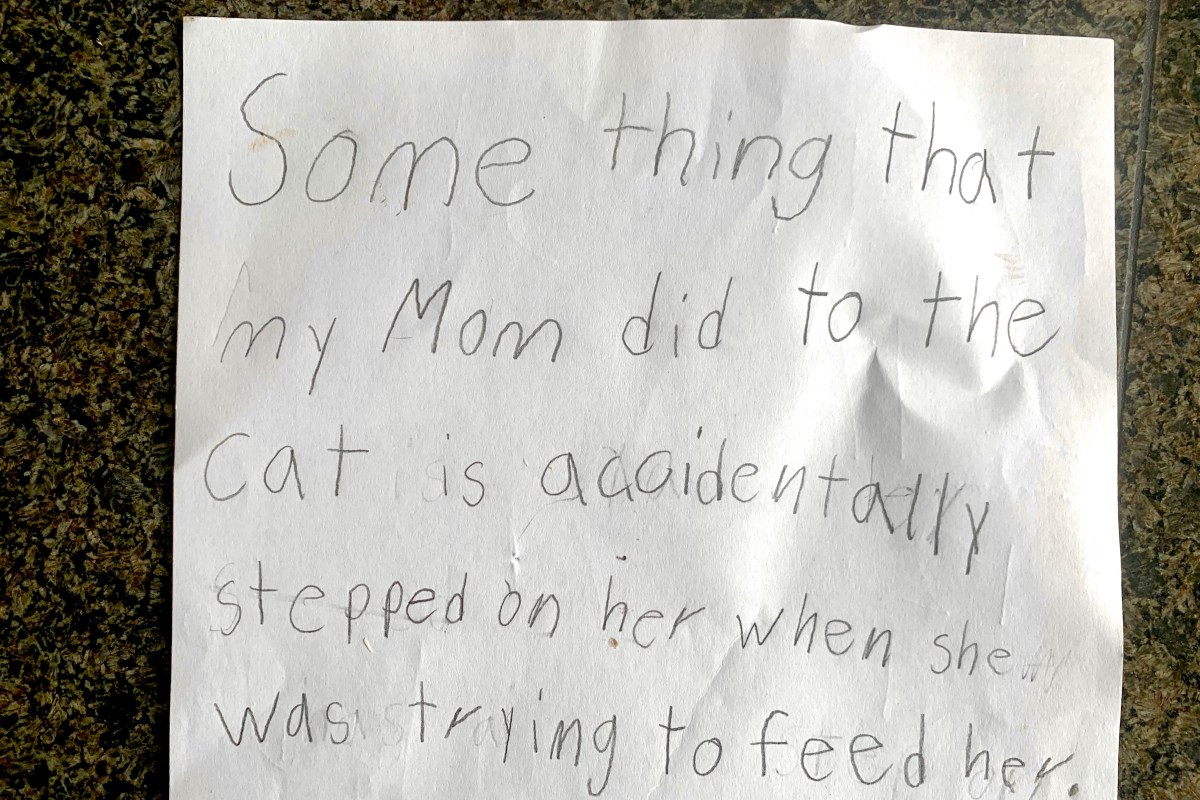
It’s a hard thing to teach to my kids since I’m still working it out myself. But I’ve been practicing just being direct – not embellishing either why it happened or owning too much or the scenario. When I step on the cat’s paw when she is winding her way around my ankles as I feed her, I try to model just saying “I’m sorry I stepped on your paw” instead of “I’m so sorry, it’s all my fault” or “you made me do it, you shouldn’t have been underfoot.”

At the swimming pool, I walked by the intense scene and then went out the double doors just past them. I’ll never know if the boy was able to say, “I’m sorry I did that” and the woman to say, “I’m sorry I took my frustration out on you” but I hope so.

The Peak-End Rule

All’s well that ends well.” – William Shakespeare

On our way home from the airport after 9.5 hours of traveling, my kids broke into a scrum. Mr. D was saying, “This is not our car. This is not a Toyota!” and Miss O had discovered on the trip that giggling softly when he talks is a truly effective way to make Mr. D mad. After doing so well on all the different legs of our journey including all the waiting when our plane was delayed, we were at risk for falling apart.

It made me think of the research of Daniel Kahneman, psychologist, behavioral economist and author of Thinking, Fast and Slow who found the way that we remember both painful and pleasureful experiences as defined by the peak moment and the end moment. So, if we are getting a painful medical procedure, we’ll generally not remember how it felt all the way through, just how it felt at the end and at its most intense. Research bears this out for positive experiences as well.

Applying this to life, it made me think of my relationship with my ex-husband. Over 8 years of marriage, we laughed a lot. In fact, that was probably what we did best. But I have a hard time remembering that because I most often think of the moment my business partner told me of my exes infidelities and I not only had to deal with that in my personal life but also walk into work the next business day and face all the people I worked with who knew. And I think of the end of the marriage, when no amount of talking could overcome the defenses we’d built.

Now, a dozen years later with the remove of time and healing, I strain to think of the fun times and I honestly can’t. I come back to the peak moment and the end moment.

Conversely when I think of every mountain I’ve ever climbed, even though I know it was a lot of hard work, what I picture is the summit and having beers with friends at the end. The peak-end rule as applied to fun stuff is capable of filtering out a lot of discomfort.

Not wanting the same rule of memory to apply to our very enjoyable recent vacation, I sat in the car trying to think of how to turn around these last moments when we were all tired and past our limits. But the kids did it for me when they started singing The Lion Sleeps Tonight from the Lion King and we bopped along to wim-o-weh. I needn’t have worried – it felt so good to be home, we all ended on a good note!