The Art of Packing

“Great things happen when men and mountains meet.” – William Blake

My daughter was looking in my drawer of kitchen accessories and asked about an open-ended tube I had in there. I explained it was a tube for mountain climbing so that you could fill it with something like hummus or peanut butter and then crimp the end to seal it up. They way you don’t have to carry more than you need. She asked, “Why not take the whole container of hummus?” And that sparked the muscle memory I have of loading a backpack for a 2 or 3 day climb and paring it down to just the essentials.

It seems to for every trip I’ve made an equipment list, packed more than necessary with me for the travel to the mountain and then at the base, sorted through to pack only what I need to feed me, keep me safe and warm and also my share of group gear for the team. It’s an art that I learned from experienced mountain guides and it very much affects how well the climb is going to go. Pack too much and you will wear yourself out on the lower reaches of the mountain getting to the first camp. And if you pack too little you will likely be uncomfortable or even worse, unsafe, on the upper part of the mountain when you need that extra layer or extra battery for your headlamp. If you forget to put in the group gear, you might just be the goat that didn’t bring the tent poles and jeopardized the trip for everyone. Many things can go wrong when packing. On one trip climbing some volcanoes in Mexico, a guy on the trip couldn’t find his Payday bar at a rest break. Then we stopped again at 16,000 feet on the side of the mountain waiting for the lead team to try to get some ice screws attached so we could cross an exposed part of the route and he found it in his boot.

Since I haven’t climbed any mountains since I got had kids, it’s been a least six years since I’ve done the packing but I still hold on to it as such a great metaphor for the journey through life. At some point, it helps if we empty out all that we are carrying in our pack and make sure we are ONLY carrying what feeds us and keeps us safe. If we carry too much baggage, like memories of all the times we’ve failed, it hampers our ability to go far.  And if we carry too little, like not figuring out our patterns of picking unhealthy partners or friends, we expose ourselves to the same dangers again. If we don’t carry our share of the group gear, like concern for the health of the community and planet we live in/on, the whole enterprise could fail. And if we can’t find what we need, sometimes it helps to sit down, take off the pack and find out what is making our metaphorical boot so uncomfortable before we continue on.

I get a chill when I think of how edifying it is each time I try to explain something to my kids. Which is good because my daughter’s next question was, “Why do people climb mountains anyway?”
Healing the Divide

“In the middle of every difficulty lies opportunity.” – Albert Einstein

There’s a divide that runs right down the middle of my family of origin – I call it tree people and forest people as inspired by the phrase “Can’t see the forest for the trees.” The tree people are so good at details that they are the ones you want to invite if you need help painting a room or weeding a patch of garden. The forest people are generally better at navigating the ups and downs of life and are the ones you want to invite when you need advice or help troubleshooting a systemic problem. Even with different perspectives, we managed okay until a tree person sued a forest person. Now it’s hard to see that we all stem from the same ground.

So I’ve thought a lot about the root cause (pun intended) about the pain in my family. And when I read the following passage about belonging in Brene Brown’s book Braving the Wilderness, it resonated as the real reason that my family is divided.  

Even in the context of suffering – poverty, violence, human rights violations – not belong in our families is still one of the most dangerous hurts. That’s because it has the power to break our heart, our spirit, and our sense of self-worth. It broke all three for me. And when those things break, there are only three outcomes, something I’ve borne witness to in my life and in my work:

1. You live in constant pain and seek relief by numbing it and/or inflicting it on others;

2. You deny your pain, and your denial ensures that you pass it on to those around you and down to your children; or

3. You find the courage to own the pain and develop a level of empathy and compassion for yourself and others that allows you to spot hurt in the world in a unique way.

Brene Brown

My dad was a Presbyterian pastor and so the church defined our lives growing up. Amidst all the wonderful things that came with the church community – friendship, values, service and faith, came an unfortunate side effect of an expectation of conformity to an image of a good Christian kid. As the youngest kid, I think the inferred expectation of having to be a living example was much lower or it just didn’t phase me but I imagine that it was harder for my siblings. As such the feeling of not belonging because they didn’t fit the precise mold began early.

I think about this a lot with my kids. As a side effect of being at home together in this year of pandemic, although sometimes feeling cramped, we have enjoyed the luxury of more time building the base of belonging. Now with schools opening up and more activities available, I am both relieved to see my kids start to branch out and concerned with keeping that feeling of deep connection going. I saw some great advice posted by Tina Payne Bryson, co-author of The Yes Brain: How to Cultivate Courage, Curiosity and Resilience in Your Child: “If you are a parent of a baby or toddler, then I have two big tips for you: 1) Delight in your child. It doesn’t have to be all the time, but find time every day to truly delight in them. 2) Take care of yourself. You matter, too.” It’s great advice because when I delight in my kids, I’m present and celebrating who they are and it not only works for my toddler by also my 5-year-old.

I don’t yet know whether my kids are forest people or tree people. Seeing my family’s experience has taught me that I’m willing to work hard to ensure that my kids know that whichever they are, that we inhabit the same ground, stem from the same Earth and are fed from the same soil. We might not see things from the same perspective but I’m betting that if we know we belong together, we will be willing to share our experience, our lives and our delight. Here’s my hope – if I start with my kids then the goodness of healing will ripple out maybe to my family of origin and then beyond.

The Gift of Perspective

“If you light a lamp for somebody, it will also brighten your path.” – Buddha

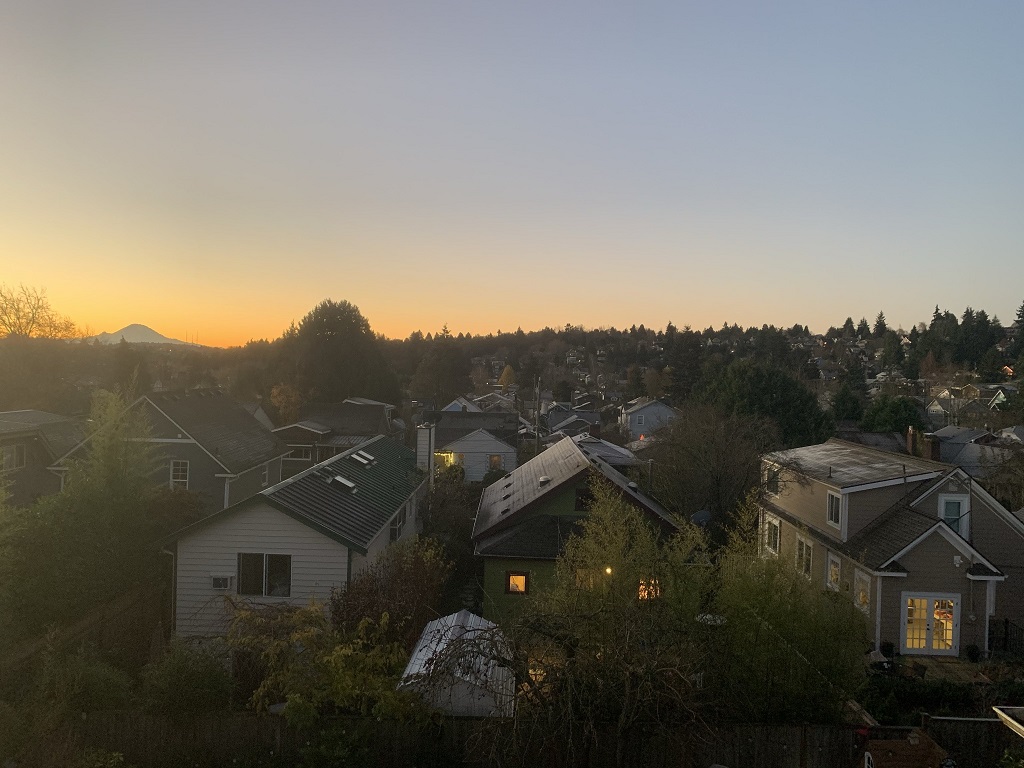
I thought I had a great way to teach perspective to my kids. I asked my daughter how many houses she could see when she looked out the ground floor window of our house, it was about three. Then I took her up to the floor above and ask her how many she could see and it was about seven. Finally we went out onto the little deck on our rooftop and I asked her how many she could see and it was more than she had numbers for. “Olivia” I said “this is the perspective that you get when you are older, you know that everything fits into a larger picture and you are able to see more of it.” Brilliant, right? The problem was she was only three. 🙂

I find myself pondering the little crumbs of wisdom other parents have given me since I became a parent until they finally click. Someone said when my oldest was a baby in a bucket car seat, “At this age, parenting is physical but after that it becomes psychological.” And when my daughter got to the age of choices, power struggles and motivation to do chores, that line made sense. Another said when my son was born, “The great thing about having two kids is while you love them both, you like at least one of them at any given time.” And when I realized that the Universe is kind enough to make it so only one of their phases really pushes my growth at a time, I got that one. Most recently someone said to me, “It gets easier. It gets less busy.” And I can’t wait to discover when that becomes true.

It strikes me that this is the gift we give to other when we share our experience. We mark the path of how they can go forward like rock cairns on a hiking trail. They are tokens of kindness and wisdom for others to follow so that they know they are going the right way and they are not alone.