A Meditation on Evenings or Evening Meditation

Wear your ego like a loose fitting garment.” – Buddha

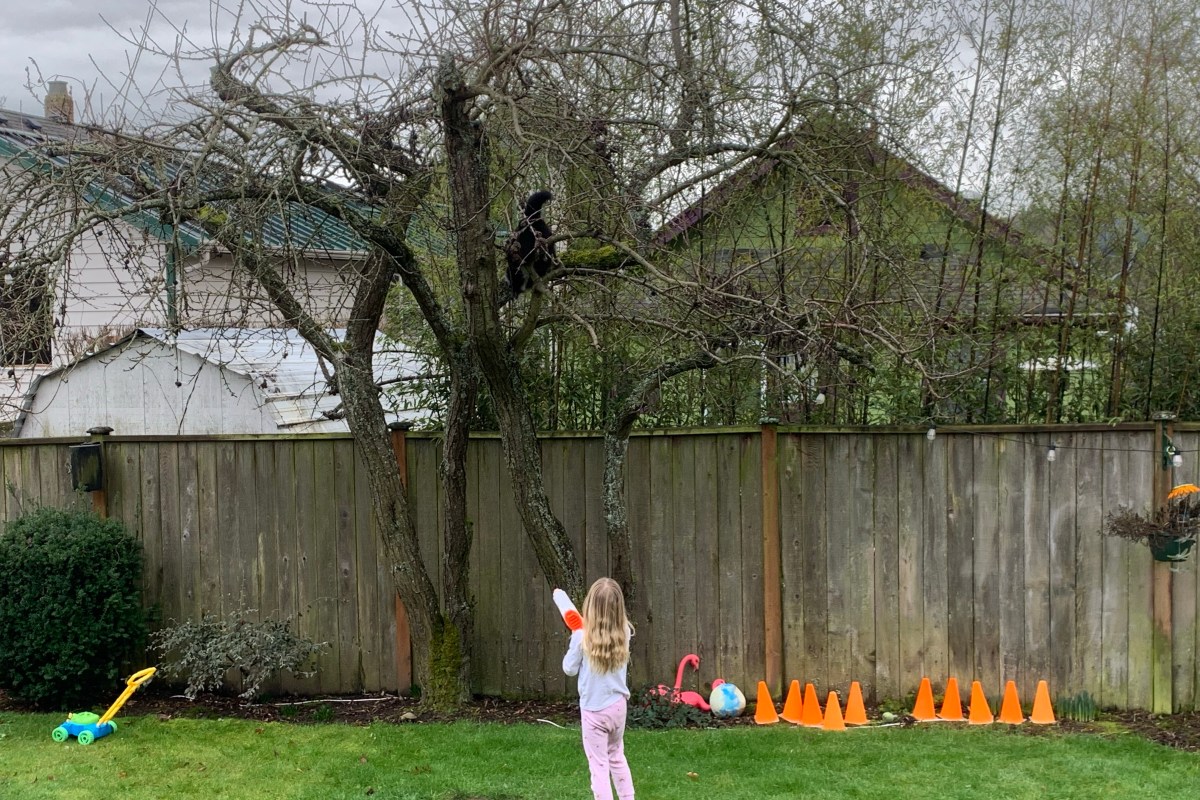
We all have Covid (mild, thankfully) and are on day 99 (feels like) of quarantine. The one household member that doesn’t have Covid, the cat, is on a diet because a recent trip to the vet for her check-up revealed that she’d gained a lot of weight under all that fluffy fur. On top of that, she has to put up with us all home and as you can see in featured photo, my daughter trying to shoot her with a water gun. So, I think it’s fair to say that we’re all a little grumpy.

In the midst of this, I’ve noticed something interesting. We do pretty well until right around 6pm. Then it turns into a scrum unless I can find a way to redirect the energy.

What I find fascinating is that corresponds with about the same time of day that the voice in my head turns self-critical. The other night I was getting ready for bed and thinking about a proposal that I needed to do the next day when my inner narrator popped up with “There’s no value you can add for them that they can’t already do themselves.”

What?? The voice was talking about what I have done for 20 years that I do day in and day out and I know based on my track record of doing it for happy clients that keep me employed that I do it very well.

This reminds me of the preface to Dan Harris’ book 10 Percent Happier in which he said the working title for his book was “The Voice in My Head is an Asshole.” My voice doesn’t usually stoop to that level until after about 6pm. And then it is always a JERK!

I am a congenital optimist. For example, when I gain weight, it usually makes me think, “Well, at least I don’t have one of those hard-to-detect cases on cancer where the primary symptom is unexpected weight loss.” There is nothing I have knowingly done to foster this optimism but life has largely worked out for me – or maybe it hasn’t and I just think it has because I’m an optimist?

That’s the problem with the voices in our heads, right? They are completely subjective, often influenced by food and sleep and given how much they change in a day, totally unreliable. But I like my optimistic voice, just not the self-critical voice that kicks in for the evenings.

This is where meditation has saved me by creating an awareness that these voices are not me. That if I sit with ideas, actions and my path for a little while, a way that rises above the fickle swings presents itself. As the quote from Buddha above suggests, wearing the ego like a loose fitting garment helps remove it more easily. Just a moment’s space between thought and speaking or action can allow peace to prevail.

This gives me an idea for the rest of our quarantine. Maybe tonight I’ll try to get the kids to sit and meditate with me after dinner and we’ll have a completely peaceful and cooperative transition to bed. As you can probably tell, I’m writing this in the morning when my optimist voice is strong…. 🙂

The Next Right Thing to Do

Fear is the cheapest room in the house. I’d like to see you in better living conditions.” – Hafiz

I received the dreaded close contact notification last night. My 2-year-old son was exposed at daycare last week to someone who later tested positive for Covid-19.  

In the middle of the night I heard a single cough from him and though he’d been healthy all weekend, my mind was off and racing. I was tracing vectors of sickness with my family, trying to redesign the house to make it so I could both isolate and entertain my daughter, notifying all the people in my head. What I meant was making a list of people to notify but when I typed it “notifying all the people in my head” it also rang true – I had a whole committee up there.

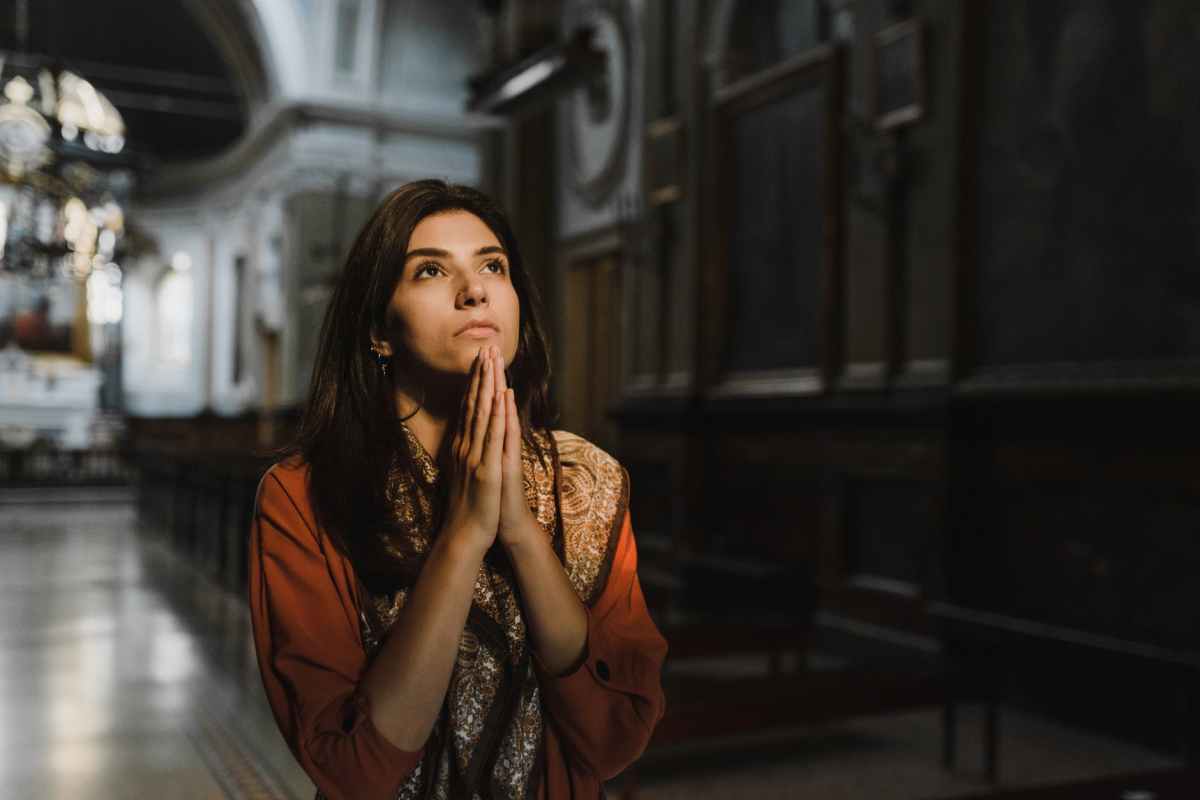
This went on for a couple of hours as I lay awake at 3am trying to control everything I didn’t know, keep people safe from everything that hasn’t happened and mentally grocery shop for anything we could need. And then finally, I landed on the only thing I needed to pray for – the next right thing to do and I went back to sleep.

Because the next right thing to do is clear – cancel everything for today and keep praying for the next right thing to do.  The simplest and maybe only way through is one step at a time.

(featured photo from Pexels)

Embracing the Obstacle

The strength of a tree lies in its ability to bend.” – Zen Proverb

The other day my two-year-old found a Q-tip and he picked it up and started to swab the inside of his nostril. I know that kids frequently put things up their noses. After all, I wrote about the funny time my daughter put popcorn up her nose and I had to lay her on the floor, plug her other nostril and blow into her mouth. And then my toddler thought it looked like so much fun, he lined up next to her for his turn. 😊

But back to the nose swab, I’m sure it isn’t just a kid putting things up his nose – it’s all about COVID. As I was telling him not to do that, it reminded me of all that is driving me crazy. And also of the wisdom of embracing the obstacles in front our of ourselves that are our teachers.

I think the last two weeks might have been the most uncomfortable weeks of this pandemic for me. With the surging numbers that are off the charts, the constancy of COVID on the news, and with everything open so we are trying to live more or less as if its business as usual, it has brought so many decisions to my door. Trying to make friends with my experience, I am attempting to lean in to listen to all the things my discomfort is teaching me.

Uncertainty. Right now, when I am incredibly uncertain if I can schedule meetings and work because school or daycare could be cancelled, I accept that certainty has always been a mirage.  Uncertainty makes me feel disoriented but I’m coming to realize that the cure is not grabbing for more certainty but instead bending my knees as if I’m learning to surf.

Responsibility. My awareness of my responsibility to fellow humans has never been so heightened. In this era of contagion, it’s so obvious that we can spread love and light as well as disease. Smiling, laughing and joy are so infectious, especially when we are in the throes of a major surge. And learning the integrity of keeping my kids home from school, testing them, cancelling things myself when needed has been a huge takeaway for me.

Flexibility. This coming weekend we had two big things planned – a kids birthday party and a sleepover at Nana. Both had to be changed because of COVID and then all the other plans we had for the holiday weekend rearranged around them.  And it worked because everyone else is flexible too. I’m learning to accept that if they have to shift again, that too will also be fine.

 I look at what I’ve written and it’s a lot of “trying” and “accepting” and “learning.” It’s all so uncomfortable – kinda like putting a swab up your nose. Which, unlike my toddler and regardless of this attempt to embrace the obstacle, I will never do for fun!

Are Buddhists Bad Texters?

Joy is not in things; it is in us.” – Richard Wagner

I have a couple of friends that identify as serious Buddhists. Neither is the Dalai Lama but I’d stereotype them as people that have made mindfulness a way of life which is a level (or more) up from my I’m committed to sitting down and meditating every morning level.

They are both terrible texters. That is to say I will text them and they will respond without my prompting them for a response. But probably not for days. And no, it isn’t something specific to this friend group because neither knows the other.

Not responding for days seems to me like a violation of the texting technology. It’s made so that you don’t have to pick up the phone at any specific moment but that conversational-ish communication is available to you when you are ready. Right?

My other explanation about their behavior was that they could be unfamiliar or uncomfortable with the technology. Nope, not true – they both will initiate text threads.

But I was listening to the Ten Percent Happier podcast the other day with Matthew Hepburn, a Buddhist Teacher and it prompted another thought.

Matthew Hepburn’s summary about mindfulness was a practice so that we can use our attention intentionally. That is to say that if life is made up of what we pay attention to, mindfulness helps make the sum total of what we pay attention to better and under our control.

When we meditate or sit quietly in any practice and notice where our mind goes – and I’ll speak for myself personally here – it’s most often to my to-do list or where my loved ones are. My attention when I call it back is somewhere between the laundry and my next meal. Nothing wrong with that except that I don’t imagine that is where I’d like the sum total of my life to be. I’d rather it be in the love and friendships I had with others and my usefulness on this planet Earth.

I don’t have a big enough sample to know if Buddhists are bad texters. But my theory reminds me that I can’t pay attention to everything. And that means putting down my phone, turning off the sound on my laptop so I can’t hear the <ding> of a new email. Or better yet, going for a walk outside with a friend.

The idea that we can intentionally set our attention is so appealing to me. It rings true that I can determine the life I want to live just by aiming my focus. Even if that means I won’t be a very good texter.

Underneath the Urgency

Either you run the day or the day runs you.” – Jim Rohn

I woke up this morning at 5:30am – a little later than usual. In the dark of a morning in January, I rolled out of bed thinking that I didn’t have enough time to do yoga in addition to meditate, write and read before I need to get my kids up.

I frequently feel like I don’t have enough time. I feel it on weekdays when I know I have a hard deadline to wrap things up with work so that I can go pick up my kids. I feel it on weekends when I’m immersed in kid chaos and can’t get personal to-do items done.

The more that I think about it, the more urgent it feels. Gripped by that feeling, I flail and get less done. It’s like a secret of physics that noticing the speed of time makes time go faster.

I think it’s fair to say that I’ve never enjoyed a moment in which I was gripped by scarcity. And the majority of the mistakes I make are done when I rush.

And sometimes I can sense that it’s not a feeling of not have time (lower-case t) as in just that day but Time (upper-case T) as in before I die. Recently a 63-year-old friend died of complications of cancer treatment and I have another friend who is experiencing some progressive cognitive diminishments in her mid 60’s.

When I think about these friends, not only do I feel grief for them and their families but also a little frantic. Because having kids as an older parent means I will be 68-years-old when my youngest graduates from high school. I want to be fully present for my kids all they celebrate all their growing-up milestones. And beyond.

When feeling that urgency, the only thing I’ve found to do is to slow down. It’s a sense of reaching underneath the urgency to grab the fabric of life that’s just under the surface. Gripped by that ache of not enough time, I force myself again and again to return to this moment.

This moment, the one right here where I’m quietly sitting and writing these words is full of abundance. It’s a rich moment of quiet and calm. It’s a celebration that I haven’t yet run out of time because I woke up this morning.

Sure, I have to make choices about what I can get done today and prioritize. But making those choices when in the throes of scarcity usually means I make the short-sighted one. When I’m plugged in to the power of now, I can choose more wisely. And the other secret is that most of the time, the wisest choice is opting not to clean. 🙂

Pushing Our Limits

Only those who risk going too far can possibly find out how far one can go.” – T.S. Eliot

I just took care of my kids for 11 days without a break. Turns out that was two days too long. It was fine -we had lots of fun activities with our family and friends, new Christmas toys to play with and even two nights away at a cabin on the water. But without taking some intentional time to myself to take an hour’s walk alone or just sit on a bench and listen to sounds around me that wasn’t my kids’ voices, I hit my limit of tolerating chaos, my patience was thin and I didn’t have any of my usual zest for the experience.

Being pushed to the limit makes me think of the judgment calls mountain guides have to make on a climb. The ones that I’ve climbed with are very good at assessing an individual’s physical and mental state and making that call whether to push through or turn back.

On a five-day expedition climb of Mt. Rainier that I once did, there was a team member who when we did the group introduction said that he’d come from St. Louis, hadn’t worked out in preparation and was there for the most painful experience of his life. Then he disappeared for a few minutes while we were all packing up and returned with a chili dog. Just the thought of a chili dog in my gut as I cinched down the waist belt on my pack made me a little queasy.

When we left the lodge at 5,400 feet altitude for a five-hour climb to our camp for the night, the climber from St. Louis fell behind right away. A guide stayed with him and started the process of understanding his limits as I’ve seen practiced in the mountains several times.

Guides start by asking how you are doing to gauge a sense of your mental state and attitude. In between the lines of answers like “I just got a stitch in my side”, “I didn’t sleep well last night” or “I just can’t seem to get it together” are clues about how the climber is feeling about the journey.

Then they slow the pace down for the climber or take an extra break to see if that will help restore the equilibrium. I’ve often wondered why they don’t just turn people around right away if it seems to be a problem. But sometimes just a few minutes of rest can change the attitude from “I can’t” to “I can.”

And then, if someone is still struggling, the guide will walk the climber to the base. I’m know this is a safety thing to not leave people wandering around a mountain trying to get back but it’s always struck me as a beautiful act of kindness to walk someone home when they are done.

The climber from St. Louis hit his limit pretty early on that first day of climbing and turned back about three hours in. I never saw him again so I don’t know whether it was the chili dog or approaching the trip as the most painful experience ever that did him in.

As we face this new week, new month and new year, I think about the guides’ formula for understanding our limits: talking through how we feel, slowing down and take a rest and if necessary, having someone walk us safely back to the base when we have reached our limit so that we can climb again another day. It gives me inspiration for not only knowing when I’ve had enough but guiding others through theirs.

Sometimes we have to carry on in spite of our limits – like I had to my kids because the unusual Seattle snow hampered the breaks that I had planned. It worked out fine but I learned once again to respect the balance of life, pushing my limits and also finding a way back to home base when I’ve reached them.

Other People’s Writing: Dec 31st

I had a different piece of writing picked for today but then I got a piece of news yesterday that sent me to Pema Chödrön’s writing in When Things Fall Apart. Pema Chödrön is a Buddhist nun that writes so intimately about groundlessness, that moment when we can’t find anything solid to stand on to pretend we have it all together. Oh, how I love my life when I’m not experiencing groundlessness – but wow, how much I’ve learned when I have.

And here’s what sent me to this place. First, before Christmas my son caught the bug going around daycare so he had to be out sick a couple of days. Next I got sick. Then we were all well and the scheduled holidays with no school and daycare happened. Fine – I’ve now missed about 6 days of work in December but some of those were expected and I’m rolling with it.

Then it snows in Seattle. And Seattle is ridiculous when it snows so 2 more days of daycare for my son this last week were canceled. Then, and this was the latest, Seattle Public Schools just announced they are canceling school for my 1st grader on Monday, January 3rd so they can hand out COVID tests. <scream>

How the heck am I supposed to be responsible, professional and earn a living when the ground beneath my feet is always shifting? The fact that I know I’ve typed that question in practical terms in order to gain the most sympathy tells me that I’ve at least gained some consciousness about my situation. Groundlessness is like a patch of ice on a mountain – the trick is not to dig in and try to plant your feet but instead walk lightly across letting your momentum work for you.

For me, this COVID era has been one big patch of ice. I’ve always figured out a way through before and I know that I will again. Re-reading Pema’s words reminds me that in moments like these that I get to learn so much as I do so.

Basically, disappointment, embarrassment, and all these places where we just cannot feel good are a sort of death. We’ve just lost our ground completely; we are unable to hold it together and feel that we’re on top of things. Rather than realizing that it takes death for there to be birth, we just fight against the fear of death.

Reaching our limit is not some kind of punishment. It’s actually a sign of health that, when we meet the place where we are about to die, we feel fear and trembling. A further sign of health is that we don’t become undone by fear and trembling, but we take it as a message that it’s time to stop struggling and look directly at what’s threatening us. Things like disappointment and anxiety are messengers telling us that we’re about to go into unknown territory.

…How do we work with our minds when we meet our match? Rather than indulge or reject our experience, we can somehow let the energy of the emotion, the quality of what we’re feeling, pierce us to the heart. This is easier said than done, but it’s a noble way to live. It’s definitely the path of compassion – the path of cultivating human bravery and kindheartedness.

In the teachings of Buddhism, we hear about egolessness. It sounds difficult to grasp: what are they talking about, anyway? When the teachings are about neurosis, however, we feel right at home. That’s something we really understand. But egolessness? When we reach our limit, if we aspire to know that place fully – which is to say that we aspire to neither indulge nor repress – a hardness in us will dissolve. We will be softened by the sheer force of whatever energy arises – the energy of anger, the energy of disappointment, the energy of fear. When it’s not solidified in one direction or another, that very energy pierces us to the heart, and it opens us. This is the discovery of egolessness. It’s when all of our schemes fall apart. Reaching our limit is like finding a doorway to sanity and the unconditional goodness of humanity, rather than meeting an obstacle or punishment.

…If we’re willing to give up hope that insecurity and pain can be exterminated, then we can have the courage to relax with the groundlessness of our situation. This is the first step on the path.

When Things Fall Apart by Pema Chödrön

(featured photo from Pexels)

Other People’s Writing: Dec 30th

Henri Nouwen was a Dutch Catholic priest and prolific author. In the forward to his book, The Inner Voice of Love he describes a period of mental and spiritual anguish catalyzed by the sudden interruption of a friendship. To heal from this agony, he took a six month retreat during which he wrote down spiritual imperatives that were his notes on working through his pain and healing.

He never intended for these notes to anything other than private. But eight years after he’d worked through his anguish, a friend convinced him they could be helpful to others. The last note of the book, it includes a quote that knocked me over with its power: “Your future depends on how you decide to remember your past.” Here’s the passage:

As you conclude this period of spiritual renewal, you are faced once again with a choice. You can choose to remember this time as a failed attempt to be completely reborn, or you can also choose to remember it as the precious time when God began new things in you that need to be brought to completion. Your future depends on how you decide to remember your past. Choose for the truth of what you know. Do not let your still anxious emotions distract you. As you keep choosing God, your emotions will gradually give up their rebellion and be converted to the truth in you.

You are facing a real spiritual battle. But do not be afraid. You are not alone. Those who have guided you during this period are not leaving you. Their prayers and support will be with you wherever you go. Keep them close to your heart so that they can guide you as you make your choices.

Remember, you are held safe. You are loved. You are protected. You are in communion with God and with those whom God has sent you. What is of God will last. It belongs to the eternal life. Choose it, and it will be yours.

The Inner Voice of Love by Henri Nouwen

(featured photo from Pexels)

Other People’s Writing: Dec 29th

I don’t know where I got this book, The Faith of a Writer by Joyce Carol Oates nor can I even say that I’ve read her work extensively. But this author of 58 novels who was first published at age 26 and taught at Princeton for 36 years certainly has so many great stories to tell about writing with sections on inspiration, self-criticism, memory and more. But it’s the description of her process that caught my attention and charmed me.

The Writer’s Studio

It’s a room much longer than it is wide, extending from the courtyard of our partly glass-walled house in suburban/rural Hopewell Township, New Jersey (approximately three miles from Princeton) into an area of pine trees, holly bushes, and Korean dogwood through which deer, singly, or does-with-fawns, or small herds, are always drifting. Like the rest of the house my study has a good deal of glass: my immediate study area, where my desk is located, is brightly lighted during the day by seven windows and a skylight.

All the desks of my life have faced windows and except for an overwrought two-year period in the late 1980’s when I worked on a word processor, I have always spent most of my time staring out the window, noting what is there, daydreaming, or brooding. Most of the so-called imaginative life is encompassed by these three activities that blend so seamlessly together, not unlike reading the dictionary, as I often do as well, entire mornings can slip by, in a blissful daze of preoccupation. It’s bizarre to me that people think that I am “prolific” and that I must use every spare minute of my time when in fact, as my intimates have always known, I spent most of my time looking out the window. (I recommend it.)

The Faith of a Writer by Joyce Carol Oates

And as a bonus selection – here’s a small part of her reflection on inspiration.

Inspiration

Yes, it exists. Somehow.

To be inspired: we know what it means, even how it sometimes feels, but what is it, exactly? Filled suddenly and often helplessly with renewed life and energy, a sense of excitement that can barely be contained; but why somethings – a word, a glance, a scene glimpsed from a window, a random memory, a fragrance, a conversational anecdote, a fragment of music, or of a dream – have the power to stimulate us to intense creativity while most others do not, we are unable to say. We all know what it was like to have been inspired, in the past; yet we can’t have faith that we will be inspired in the future. Most writers apply themselves doggedly to their work, hoping that inspiration will return. It can be like striking a damp match again, again, again: hoping a small flame with leap out, before the match breaks.

The Faith of a Writer by Joyce Carol Oates

(featured photo from Pexels)

Other People’s Writing: Dec 28

It is Mark Nepo’s Book of Awakening that I turn to again and again when I need to think more deeply about life. Which is to say, I read it daily. 🙂 After spending half his life as a poet and an educator, it was his journey through cancer that uncovered his journey to write about the life of Spirit and celebrate life fully as it is now.

I discovered Mark Nepo when Oprah choose this book for her list of Ultimate Favorite Things. He has a way of finding the Divine inside and all around us that guides me to a place of comfort and joy, regardless of the circumstances of life.

Friendship

Nothing among human things has such power to keep our gaze fixed even more intensely upon God than friendship.” – Simone Weil

I have been blessed to have deep friends in my time on Earth. They have been an oasis when my life has turned a desert. They have been a cool river to plunge in when my heart has been on fire. when I was ill, one toweled my head when I couldn’t stand without bleeding. Another bowed at my door saying “I will be whatever you need as long as you need it.”

Still others have ensured my freedom and they missed me while I searched for bits of truth that only led me back to them. I have slept in the high lonely wind waiting for God’s word. And while it’s true — no one can live for you — singing from the peak isn’t quite the same as whispering in the center of a circle that has carried you ashore.

Honest friends are doorways to our souls, and loving friends are the grasses that soften the world. It is no mistake that the German root of the word friendship means “place of high safety.” This safety opens us to God. As Cicero said, “A friend is a second self.” And as Sant Martin said, “My friends are the beings through whom God loves me.”

There can be no greater or simpler ambition than to be a friend.

The Book of Awakening by Mark Nepo

It would be an incomplete post about friendship if I didn’t end it sending gratitude to all the blogging friends I’ve met this year. My life is richer for meeting and learning from you all. Thank you!

(featured photo from Pexels)